 The Magazine of The Sierra Club
92 Ways of Looking at a Tree
Up close and aboreal with photographer James Balog
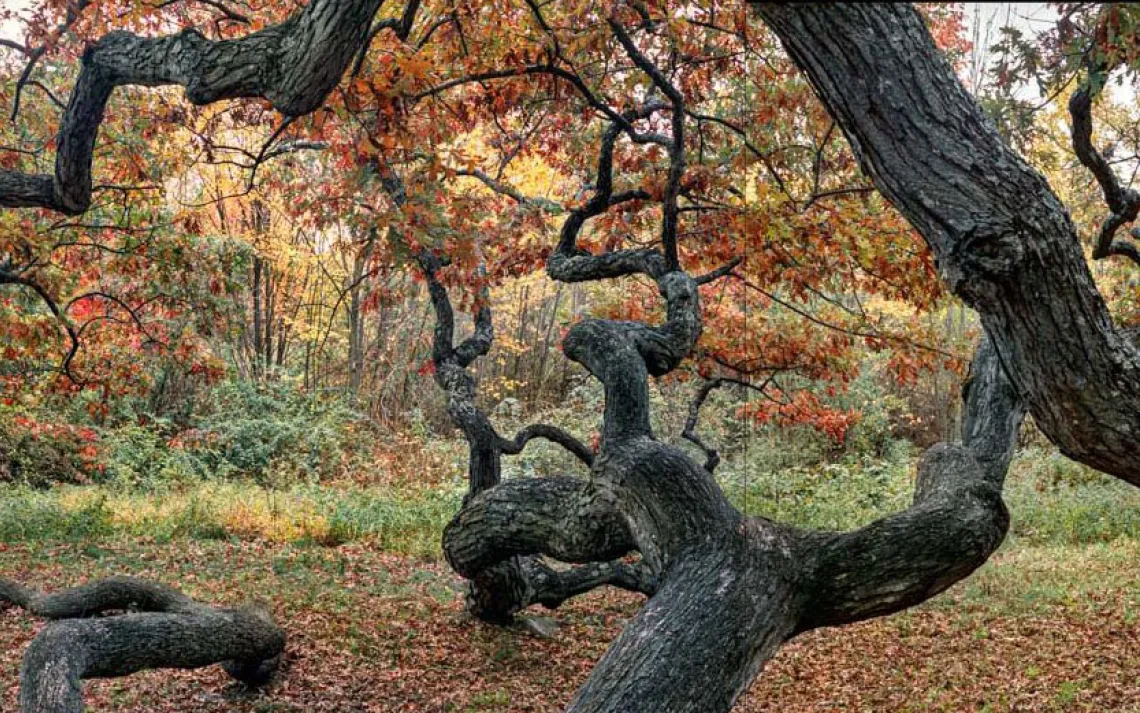
When James Balog walks through a grove of redwoods or a stand of aspen, he's not seeing the forest—he's looking at the trees. Often at one specific tree. While working on his recent book, Tree: A New Vision of the American Forest, the photographer scoured woods, fields, and suburban backyards for the country's biggest, tallest, and oldest specimens. He even spent several winters earning the trust of a handful of biologists before they deemed him "worthy" of learning the location (kept secret to protect the tree and its habitat) of the tallest living thing in the world: the 370-foot redwood Stratosphere Giant.
Other subjects were more accessible, like the cottonwood (at right) outside the Colorado home where Balog recently lived. While many trees in the book are national "champions"—the largest of each native and naturalized species in the United States—or notable for their advanced age or distinct appearance, this one simply charmed him. "It's a middling-size cottonwood at best, but it's really special to me," Balog says. "I looked at that tree every day, and it was always a marvel."
Balog discovered he wasn't alone: People would regularly approach him at photography exhibits to talk about the important trees in their lives. "This wasn't just environmentalists," the artist says. "I find that quite reassuring. Though we are living in a very technologized society, not all of our connections to nature are lost."
The author of six books, Balog is best known for his 1990 work Survivors: A New Vision of Endangered Wildlife, in which he bucked the documentary conventions of wildlife photography with his stark, stylized portraits of single animals in a studio setting. The 92 images in Tree likewise bring out individual personalities. "It's hard to relate to generalized places," he says. "I believe that people can expand from their connection to one tree to something more universal."
For Balog, that realization came not out in the woods but in front of a computer screen. To capture the biggest redwoods and sequoias, he took hundreds of photographs while rappelling a neighboring tree, then spent weeks digitally weaving the shots into large composites. As these images emerged, Balog says, he started to think about the even bigger picture: all the trees, species, and habitats that have disappeared from the continent since it was settled and industrialized. "I felt like I was taking a little step to put the lost forests of America back together again."