 The Magazine of The Sierra Club
Proposed Forest Service Reorganization Is an Attack on the Venerable Agency
The Trump administration claims to be streamlining operations while asking Congress to terminate an important program
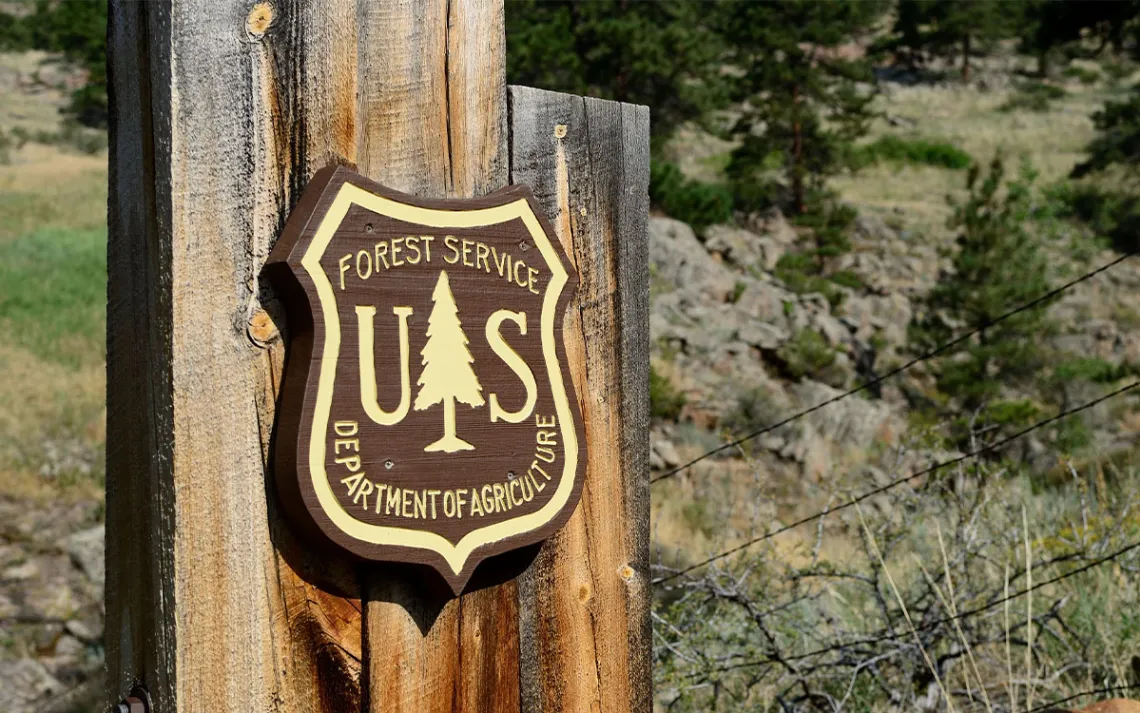
Photo by RiverNorthPhotography/Getty Images
On March 31, the US Department of Agriculture announced a “sweeping restructuring” of the US Forest Service that would amount to the largest forced purge of a federal land-management agency in the country’s history.
The reorganization plan included moving the Forest Service headquarters from Washington, DC, to Salt Lake City. If completed, the agency would lose all nine regional offices; close 57 research facilities across 31 states and consolidate that work into a single location in Fort Collins, Colorado; and replace it all (offices, scientists, institutional knowledge, and professional independence) with 15 “state directors.”
“Moving the Forest Service closer to the forests we manage is an essential action that will improve our core mission of managing our forests while saving taxpayer dollars,” said USDA Secretary Brooke L. Rollins. He focused on the need to support timber growers, boost timber production, and provide affordable timber, while adding almost as an afterthought, “and it means preserving and protecting the beautiful landscapes we are blessed with across this great country.”
Nothing could be farther from the truth, public lands advocates contend. The proposed relocation, they argue, is cover for neutralizing the Forest Service and rendering it obsolete. The administration is following the same playbook from Trump’s first term, when officials tried to relocate BLM headquarters.
“That touched one agency’s headquarters,” says Jim Pattiz, cofounder of More Than Just Parks. “This one dismantles the headquarters, collapses the regional structure, and wipes out the scientific backbone of the largest forestry organization on Earth.”
There are more than 193 million acres of land in the National Forest System, which include 154 national forests and 20 national grasslands. The Forest Service’s integrated design of districts and field laboratories was set up for staff to do their work and then transfer their learnings to the same regions. Employees have a long-term understanding of wildfire behavior, forest disease, watershed health, carbon storage, old-growth ecology, and climate adaptation. What may seem initially like a commonsense approach to streamline operations doesn’t address the danger of the loss of employees with decades of institutional knowledge and field experience.
On August 6, 16 US Senate Democratic members, led by Hawaiian Senator Mazie K. Hirono, requested that Forest Service chief Tom Schultz provide Congress with a full breakdown of the criteria and factors considered in evaluating facilities for possible closure. On September 3, the Forest Service revised the reorganization plan and announced that it had completed a national review of regional offices and research and development facilities, determining that instead of the initial list of 57 facilities to be closed, 23 sites with “little to no staffing” would be closed.
The claim is that only about 200 affected staff are expected to transition to other facilities, but there’s no official reporting on the numbers of employees who will be sidelined through attrition.
“One of the ‘solutions’ is to close the field offices and expect those scientists to work out of their home,” says Rachel Riemann, a retired research forester for the Forest Service. “Of the 23 facilities on the list, eight are Forest Inventory and Analysis (FIA) field crew offices, and nobody seems to know yet where FIA crews in each location are going to move their equipment and vehicles to continue their work. FIA’s work is nationally mandated by Congress.”
The administration has informed Congress in its fiscal year 2027 budget request that it wants to “terminate the Forest and Rangeland Research program.” This cannot happen without action by Congress, even if it’s on the wish list of the administration, and once legislators appropriate funds, the executive branch is legally obligated to spend them.
“A government that works well and smoothly is quiet,” says Riemann. “It just works. But the downside is that nobody on the outside knows what’s happening.”
Geographically oriented research is important because large regional landscapes don’t have replicates. Climate, temperature, geology, soil, precipitation, and solar radiation patterns are unique from geography to geography. Research labs and their scientists have decades of long-term science that can’t be restarted once it’s gone.
“Research laboratories work with land managers in the field to not only find out what are the timely research questions, but to research those questions and then work to get answers back to the field,” says Paul Hessburg, a senior research ecologist and professor at the University of Washington who was a research scientist for the USDA Forest Service Research Branch for 42 years. “When key laboratories are on the cutting block, it’s a direct assault on place-based research.”
“These research programs and facilities amount to Forest Service employees working hand in hand with university scientists to determine how we can best manage our forests,” says Pattiz. “When these facilities close, the university programs either cough up more money to do it, which is unlikely, or the research altogether stops. The experiments die. The datasets end. The impacts are far reaching.”
If agencies are made to be ineffective, it becomes much easier for them to be eliminated and the management of public lands to be transferred to individual states or sold outright to private companies. In recent years, Utah, Wyoming, and Idaho have all introduced or supported efforts to gain control over federally managed land.
“The research and management environment is an ecosystem, and it’s been carefully curated over time,” says Hessburg. “Small changes can disrupt that ecosystem just like one wildfire can disrupt the future trajectory of a forest. Research labs and foresters have adapted to be able to do their jobs better and to intersect knowledge creation with knowledge application. Severing vital connections that were hard won over decades, over administrations, over chiefs, can be damaging if they are not well thought out.”
Forest Service research stations are emblematic of the importance of independent science. The network of research and development, National Forest System staff, and state-private-tribal forestry connects the work of different agencies to share expertise and increase efficiency, effectiveness, and reach. The relocation, if successful, could pose a direct attack on the holistic nature of that network.
It’s a system worth protecting from the administration’s plan, public land advocates say.
“I had five chances to be a university professor, and I chose this public service because I think the experiment in participatory democracy that public land management and research affords is a huge idea,” says Hessburg.