 The Magazine of The Sierra Club
Above it All
High-flying Photographer Yann Arthus-Bertrand puts the Planet in Perspective
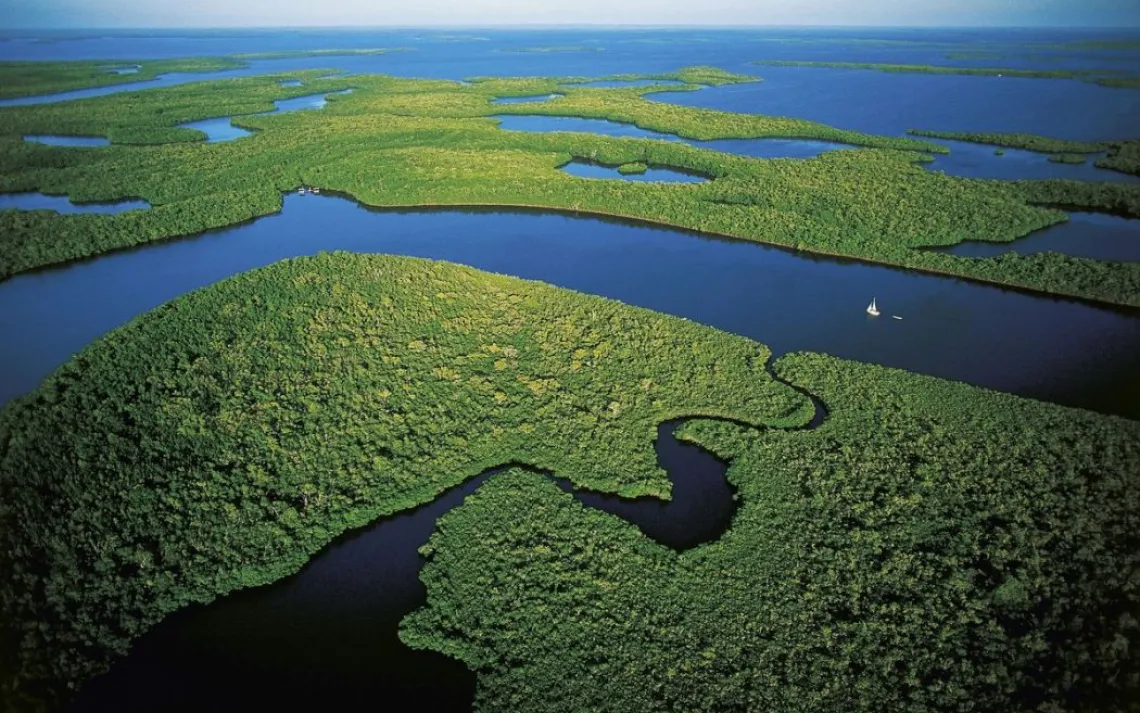
Florida: Mangroves in Everglades National Park
Deep in the south of Florida, freshwater from Lake Okeechobee mingles with the saltwater of the Gulf of Mexico to form the mangrove swamps and estuaries of Everglades National Park. Although the park covers more than 2,300 square miles, it is a fragment of the ancient wetlands that, before drainage work began in 1880, were five times larger and covered one-fifth of the state. Home to 40 species of mammals, over 350 of birds, over 50 of reptiles, and many hundreds of fish, the park is recognized as a UNESCO World Heritage Site and a "wetland of international importance." But the Everglades are still threatened by agricultural pollutants and hydraulic engineering projects, as well as Florida's growing population.
Things look different from a few thousand feet above the ground. Coral reefs, cultivated fields, and sea-swept dunes array themselves into intricate designs with colors that rival the most energetic abstract paintings. Planes in an airfield and birds in flight exhibit geometric precision, while clusters of skyscrapers and rock outcroppings seem to grow chaotically before our eyes. From the vantage point of a helicopter, French photographer Yann Arthus-Bertrand has spent 15 years capturing thousands of such scenes in more than 75 countries.
He's shared hundreds of them with the world in his Earth From Above books and traveling exhibits, which combine environmental activism and art to create his "photographic portrait of our planet." By presenting natural and human-made landscapes without distinction, Arthus-Bertrand's photos show how small we are in the grand scheme of things — and what a big impact we can have.
Seen through Arthus-Bertrand's ecumenical eye, the sinuous line of a suburban street evokes the soothing rhythm of a river. The buildings we construct, the art we create, the communities we form find echoes in unexpected places. In their cold grandeur or their glorious color, their closeness or their isolation, Arthus-Bertrand reveals how we strive, consciously or not, to emulate the natural world. "The earth is art," he says. "The photographer is only a witness."
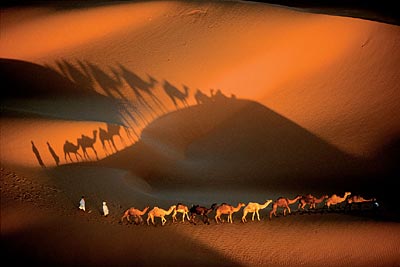
Mauritania: Caravan of dromedaries near Nouakchott
In winter, the dromedary can go without water for several months, as long as it has good grazing land. In summer conditions, however, this domesticated member of the camel family can survive for only a few days without drinking. Reserves of fat in its single hump provide energy, while its ability to withstand major increases in body temperature without sweating allows the animal to conserve moisture. These adaptations have made the dromedary indispensable throughout the Sahara region.
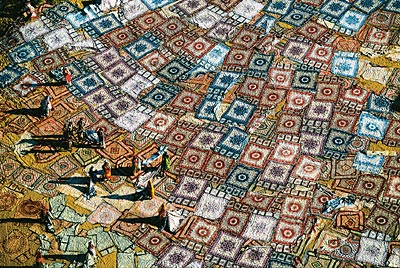
Rajasthan, India: Cotton fabrics drying in the sun in Jaipur
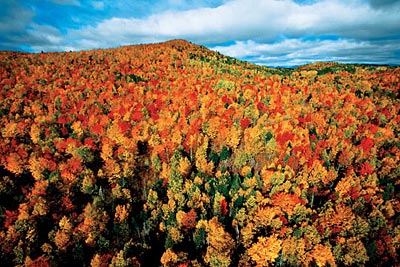
Quebec: Fall forest in the Charlevoix region
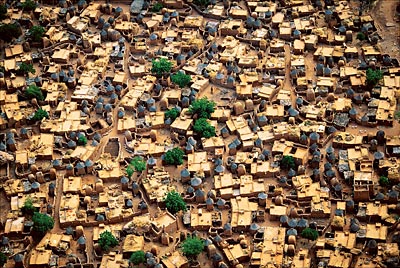
Mali: Dogon village near Bandiagara
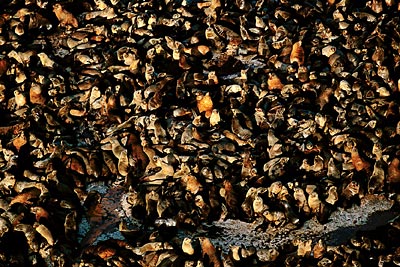
Cape Province, South Africa: seals near Duiker Island
Highly gregarious by nature, South African fur seals spend most of their time in the water hunting fish, squid, and crustaceans, but gather by the hundreds to breed on land. Although the entire 1.5-million population of these mammals (also known as Cape fur seals) is found only along the coast between Cape Cross, Namibia, and Algoa Bay, South Africa, their relatives inhabit most of the world's seas. The different pinniped speciesÑincluding eared seals like the South African fur seal, walrus, and true seals — number 50 million in all.
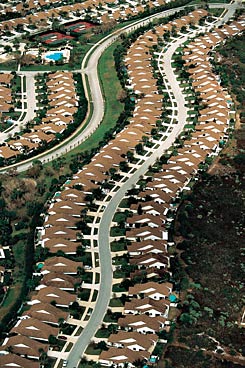
Florida: Houses near Miami
The mushrooming residential suburbs of Miami are being built on former wetlands, where drainage schemes have been in operation since the beginning of the 20th century. Largely wild 100 years ago, Florida is now the fourth most populous state in the country, with 14 million people. Miami-Dade County is the most densely inhabited part of the state, with over 2 million residents.
About the Earth From Above Project
Since 1990, photographer Yann Arthus-Bertrand has flown over dozens of countries, capturing aerial images that, as he puts it, "invite each of us to reflect on Earth's evolution and the future of its inhabitants." A devoted environmentalist, he asked us to include the preceding captions and the following message with his work:
"Now more than ever, we are consuming and exploiting natural resources in ways that are not sustainable in the long run. Total production of goods and services has increased sevenfold since 1950, but living standards in much of the world have not kept pace. Currently 20 percent of the earth's population has no access to safe drinking water, 25 percent have no electricity, and 40 percent have no sanitary infrastructure.
"While inhabitants of industrialized countries consume and produce in excess — and generate massive pollution — four-fifths of the world's people live in developing countries and, for the most part, in poverty. To provide for their needs, they, too, make heavy demands upon Earth's natural resources.
"At this critical stage, we need to create and implement alternative methods of development. The mandate set out in 1987 by the United Nations' World Commission on Environment and Development still holds true today: We must 'meet the needs of the present without compromising the ability of future generations to meet their own needs.' For the future of our children, we can and must act individually to bring about the necessary changes on a daily basis."
For more on the photographer and his work, see yannarthusbertrand.org.