 The Magazine of The Sierra Club
Lifetimes With Fire
A writer learns about living in the woods
by Gary Snyder
IN 1969, I PACKED MY BOOKS AND ROBES, and with my young family I sailed back to California from ten years in Japan. When I first moved to a piece of Sierra forest the next summer, I wouldn't let even a tractor drive over it. Except on a couple of ancient logging tracks that evolved into an access road, I wouldn't take a truck into the woods.
We built a house that summer. We felled trees for posts and beams using an old Royal Chinook two-person falling saw and then barked the logs with large drawknives. They were not skidded or trucked to the building site but carried by crews of strong young men and women using rope slings and little oak-pole yokes. The three-month job--the workers were mostly just out of college, and only a few had architecture and building skills--was done entirely with hand tools. Our ridge had no grid power available, and we had no generator. The rocky road ran across a barren mile of ancient, rounded riverbed stone laid open by hydraulic mining in the 1870s. The building site was beyond the diggings and back in the forest, three miles from a paved road and the mailbox. The nearest town was 25 miles away across a 1,200-foot-deep river canyon.
Over the years since, we have gone from kerosene lamps to solar panels with a backup generator. I take my four-wheel pickup into the forest for firewood, and our homestead is now a hybrid of 19th- and 21st-century technologies. There's a wood-burning kitchen range and two large wood-burning heating stoves (more on those later), but we also use laptop computers, have a fax and a copying machine, and buck the big downed oak rounds with a large Husqvarna and a small Stihl chainsaw.
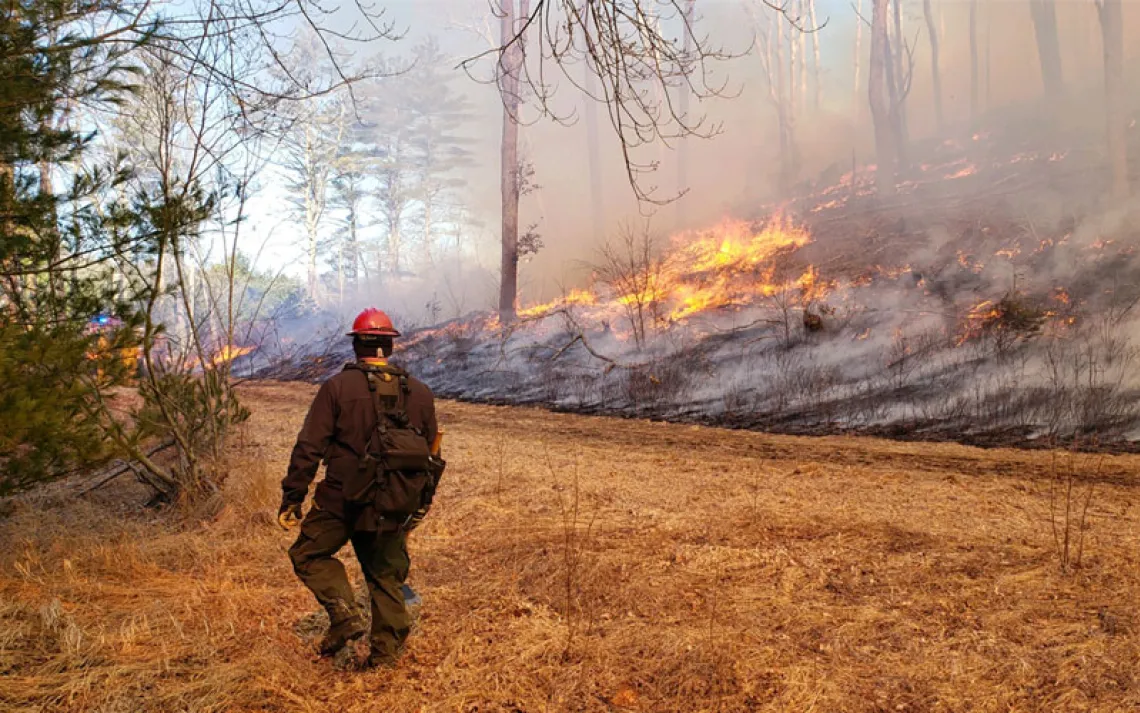
Every summer season, I do a bit more work clearing the underbrush (ceanothus and manzanita), and every winter I burn the brush piles. A few years back, I stood watch on mostly Bureau of Land Management forest, with the planned burn zone overlapping onto an adjacent private parcel. The fire torched a few big trees and burned a lot of underbrush down to ash. It was scary, but the fire chief assured us everything was OK. Bulldozer operators were ready to come if needed, and so were the California Department of Forestry and Fire Protection pilots at the county airport with their spotter and tanker planes. The burn went well all day. There were some complaints about the smoke--and that's one problem with prescribed burns: The air quality goes down, and newcomers don't like it. But the bigger problem is, eight years later, the site is getting brushy again. It needs a follow-up burn.
In 1952 and '53, I worked on fire lookouts in the Skagit District of the Mt. Baker Forest, in the northern Washington Cascades. Crater Mountain and then Sourdough. Those were the first jobs I held that I felt had some virtue. Finally, guarding against forest fires, I had found "right occupation." I congratulated myself, as I stood up there above the clouds memorizing various peaks and watersheds, for having a job that didn't contribute to the cold war and the wasteful modern economy. The joke's on me 50 years later, knowing how much of the fire-suppression ideology was wrongheaded and how it has contributed to our current problems.
I fought on a few fire lines back in the '50s too--as I was working alternately in logging camps and on lookouts or trail crews. I'd be carrying the little backpack pump full of water, with its trombone-slide pump, and always toting a duff hoe called a "McLeod." Nowadays I have a yellow Nomex jacket and a forest-firefighter helmet. I found them both at the Salvation Army. (Maybe a young firefighter just ran away.) I am reminded that my roots are in the Pacific Northwest when California forestry people seem to never have heard of Filson tin pants and I'm the only one wearing White's boots from Spokane.
Fire in the very high mountains is most commonly caused by lightning. A lively storm passes over and lasts all night, and hundreds of strikes are visible. Flashes light up the whole sky with their forks and prongs. Every once in a while, a strike goes to the ground, and even from a distance one sees a little spot fire blossom (usually soon to be quenched by the rains that come with storms). A dry lightning storm is what's dangerous: You might have hundreds of spot fires at the same time. A few are still going at dawn, and you take a reading on them with the Osborne Fire Finder. You radio in the bearing and describe the drainage. Fifty years ago, the crews hiked in with the help of a pack string. There were only a few smoke jumpers then.
In 1954, I was working on a logging crew at the Warm Springs Indian Reservation in Oregon. A lightplane crashed in the nearby hills and started a fire. They drafted a bunch of us, and we hiked in along with some U.S. Forest Service boys; half of our logging crew were local Wasco and Warm Springs Indians. The fire had spread to about two acres, but it was slow and the sky was overcast and finally drizzly, so it wasn't hard to put it out. The pilot had been killed. Fifty years later, I have three of the same type of backpack pumps, all in good condition, under the eaves near the toolshed door. They are filled with water and kept covered with cloth to protect them from the sun. A McLeod hangs on a bracket, and next to that in a woodshed there's a whole section full of hoes, shovels, and a few extra fire rakes. The classic wildfire-fighter's tool, a Pulaski, hangs in the shop. In the open porch space of the house is a line of wood pegs holding work clothes, but one is reserved for firefighting clothes: ragged, old Wild Ass logger jeans on a hanger, with a fire coat and yellow helmet, and a full canteen. Wild Ass is a brand name from a logger supply company. It has a fetching label. The company also makes light blue boxer underwear, which for a while became de rigueur among some West Coast girls studying at Brown University. In one coat pocket are the firefighting goggles, and in the big pocket is a pair of work gloves.
Several hundred families live in the pine-oak zone on this Sierra ridge. Higher up is national forest and heavy winter snow; lower down, the blue oak, grass, and gray-pine country, which once was hot and droughty ranch land but now is either an Air Force base or becoming an air-conditioned new development. At our elevation, most of the community seems to feel that our dedicated volunteer fire department should be prepared to step out the door anytime to help hold the fire line until the crew trucks come.
My family and I have taken care of several little fires ourselves. One time a tree only a few hundred feet from the house took a lightning strike, and the lower trunk and forest floor around were quietly burning. I saw the flickering light against the window. At 3 a.m., we went out and doused it with our backpack pumps and went back to bed. We checked it again at dawn and doubled the width of the strip of land we cleared by hand.
When there's suspicious smoke, a spotter plane takes off and cruises over, and if it's not just somebody's transgressive brush pile, tanker bombers might go out right away. If necessary, the bulldozer trailer hauler will start moving in that direction. California Department of Forestry stations are staffed with crews all summer. They have admirable fire trucks and, unless there are big fires elsewhere in California, they'll be there pronto. Still, in a place that's 25 miles or more from a fire station, you're the one to hold a fire in check and maybe even put it out.
I had an education that combined labor in the woods and on the farm, Forest Service seasonal work, and a college major in Native North American ethnology with a good dose of art, philosophy, and world history. My readings on Native California cultures, and then doing backcountry trail-crew work for Yosemite National Park, helped me realize that fire was not an enemy but should be a partner. The huge Sierra Nevada, from the timberline high country down to the oak and grass foothills, is all one big fire-adapted ecosystem, and a century of fire suppression--mostly the government's idea--has somewhat messed things up. I wrote the following poem in 1971:
Control Burn
What the Indians
here
used to do, was,
to burn out the brush every year.
in the woods, up the gorges,
keeping the oak and the pine stands
tall and clear
with grasses
and kitkitdizze under them,
never enough fuel there
that a fire could crown.
Now, manzanita,
(a fine bush in its right)
crowds up under the new trees
mixed up with logging slash
and a fire can wipe out all.
Fire is an old story.
I would like,
with a sense of helpful order,
with respect for laws
of nature,
to help my land
with a burn, a hot clean
burn.
(manzanita seeds will only open
after a fire passes over
or once passed through a bear)
And then
it would be more
like,
when it belonged to the Indians
Before.
--from Turtle Island, 1974
From July to September 2002, the Biscuit fire in southwest Oregon swept over half a million acres, largely in the drainage of the lower Rogue River. It got national coverage. Next came the always-contentious plans for "salvage logging." The media fell into line with the Forest Service's spin, and much of the public has been sweet-talked into thinking that cutting merchantable trees contributes to forest health.
Arguments about logging and recovery after a fire have been divisive, and Washington, D.C., brass has put pressure on Forest Service line officers to cut more timber. Salvage logging means going in quickly and trying to save the damaged trees for their timber value. But in the process, there's a mysterious way that many green trees seem to be slipped in too.
Media stories on wildfires are usually off the mark. They rarely tell us whether the fire is in brush, grass, or forest, and if in forest, what type. TV reporters might say, "Ten thousand acres were destroyed," when the truth is that fire intensity is highly variable, and islands of green, patches of barely scorched trees, and totally scorched stands create what foresters might well call a healthy mosaic. A good percentage of the Biscuit fire was probably a good thing.
As for the intensely burned areas, the outstanding forest ecologist Jerry Franklin says we shouldn't use a fire as a cover for further logging. A forestry professor at the University of Washington who once worked for the Forest Service, Franklin objected in 2004 to the agency's Biscuit fire-recovery plan. "Salvage logging of large snags and down boles does not contribute to recovery of late-successional forest habitat," he wrote in comments on its draft environmental impact statement. "In fact, the only activity more antithetical to the recovery process would be removal of surviving green trees from burned sites. Large snags and logs of decay-resistant species, such as Douglas fir and cedars, are critical as early- and late-successional wildlife habitat as well as for sustaining key ecological processes associated with nutrient, hydrologic, and energy cycles. Effectively none of the large snags and logs of decay-resistant species can be judged as being in excess of those needed for natural recovery to late-successional forest conditions."
Forest recovery takes time, not chainsaws. "Fifty years for natural reestablishment of forest cover is not a particularly long period," Franklin wrote. "Many 19th- and 20th-century burns are still not fully reforested.
"In fact," Franklin continued, "naturally disturbed habitat that is undergoing slow natural reforestation--without salvage or planting--is the rarest of the forest habitat conditions in the Pacific Northwest. Yet such large, slowly reforesting disturbed areas are important hot spots of regional biodiversity."
This is bold and visionary science and contains the hope that both the Forest Service and the industry might learn to slow down and go more at the magisterial pace of the life of a forest. The bottom line for all talk of forest sustainability is an undiminished quality of soil and maintenance of the entire diverse array of wildlife species in full interaction. In earlier times, no matter the bug kills, fires, or blowdowns, the ecosystems slowly and peacefully adapted and recovered. After all, until recently the entire Human Project too was a lot more leisurely and measured.
Here in the Sierra, we live with the threat of fire six months of the year--miles of forest stretching in every direction from our clearing. Over the past 35 years, we've taken out the biggest manzanitas for several hundred yards and thinned out a bit of the pine, oak, and madrone canopy. But any fire with enough wind behind it to crown could still overwhelm our little place--four outbuildings, a small barn converted to a seriously useful library and gear room, and a 1,700-square-foot handmade house--and hundreds of square miles beyond.
I can see, and most of my neighbors can see, that our hand-clearing work is too slow and that prescribed burns are also too slow and chancy. The wildfires are getting hotter and the roads and houses closer. Not long ago, the California Department of Forestry designed a large firebreak. It was a big step to let an excavator with the "brontosaurus" thrasher head go down our ridge through the oak and pine woods, crunching all the old-growth manzanita (leaving the pine and the oak) and spitting out wood shards everywhere, leaving big tracks in the duff. This firebreak would help slow down a wildfire--not just for my place but for all the forests to the north of me, on both private and public land.
Looking back on it and recalling travels in the Chobe Forest of Botswana in the early '90s, I can see it's not unlike the way the mopane groves look after a herd of elephants has browsed through, breaking limbs and thrashing the trees to get the leaves. Mother Nature allows for a bit of rough sex it seems.
Our balance here with this mostly wild ecosystem is the same that we would hope for throughout the whole North American West. We'd like to see the forests be a mix of trees of all ages, with the understory cleared out or burned enough to be able to take the flames when they do come, and big and diverse enough to quickly recover from all but the very worst fires. This is doable--but it sickens one to see whatever clueless administration is passing through use fear of fire to warp public policy in favor of more exploitation, more industry, and more restrictive laws. It is an exact parallel of the use of "terrorism" to warp American values and circumvent our Constitution to justify aggressive foreign policy and promote again the sick fantasy of a global American empire.
Fire can be a tool and a friend. I've always cooked with wood, outdoors and in. For several decades, we had an open fire pit in the center of our home. The kitchen range was made in St. Louis in 1910 with curvy, floral art nouveau motifs. There's an outside kitchen area with a stone fire circle. We also have a sauna with a wood-burning stove from the Nippa company in Michigan--the last we heard, the only company still making such stoves in North America. My sons and daughters learned kindling-splitting, fire-laying, and feeding the wood as part of daily life.
Now that the fire pit is gone, the main heating stove is an Irish Waterford with a round stone watchtower as its symbol, cast into a side panel. The other's a Danish Lange. Along one side it has a cast bas-relief of a stag with a crucifix between its antlers. For the kitchen range, you get the fire going with some dry pine splits, then slip in dry oak to stabilize it and bring up the heat. If needed, you can flash the heat up higher with more pine, then slow it down with a chunk of green oak. Those are cooking tips I learned orally from elders.
We use a short-handled hatchet, a graceful slender-handled Hudson Bay ax, a full-length poleax, and a double-bitted ax for specific tasks. For green-wood bucking, there's a Swede saw, a two-person saw, and the small Stihl and the big Husqvarna chainsaws. For limbing up high, there are two pole-mounted pruning saws. For splitting, we use the double jack with a ten-pound head and a set of wedges. Also a 12-pound maul. One needs at least five wedges for going at it: two for working a round from the top and at least two more for opening it on the sides when it gets sticky. I've used hydraulic splitters too, and they are fast, but there's a lot of setup time. Every year we put five or six cords of oak and pine into the woodsheds, all of it from downed and dead trees and no sign of it ever running short. New trees grow, old trees drop, spring after spring.
THE FIREBREAK IS IN. Sixteen acres of forest and brushland were thinned and brushed, in a long, skinny swath, with some watershed-improvement and firefighting funds helping pay the bill.
But there will always be handwork too. Year after year in the Sierra summer, we wield ax and saw, taking off limbs and knocking down manzanita, ceanothus, and too-dense pine, fir, or cedar saplings. We drag the limbs and little trees and pile them in an opening. When it gets to be fall, we scythe or duff-hoe back the weeds around them and clear a fire line down to mineral earth to be ready for winter burning. (Bailey's in Laytonville sells wide rolls of tough brown paper to put over your brush piles, and this will keep them dry through the first sprinkles of fall rain so that they'll light more easily. Since it's paper, you won't be burning quickly shredding black plastic.)
You have to look for proper burning weather, just as with prescribed burns. Not too dry, not too windy, not too wet, not too hot. The very best is when you've had dry weather and can see the rain clouds definitely coming. It has been a good day when the big pile burns to the ground and is still hot enough to keep burning up limb ends from around the edges when you throw them back. Then comes the rain, but still it all burns to ash. No further spreading or underground simmering can take place.
One late-November day, standing by a 12-foot-high burning brush pile, well dressed for it, gloves and goggles, face hot, sprinkles of rain starting to play on my helmet, old boots I could risk to singe a bit on the embers. A thermos of coffee on a stump. Clouds darkening from the west, a breeze, a Pacific storm is headed this way. Let the flames finish their work--a few more limb ends and stubs around the edge to clean up, a few more dumb thoughts and failed ideas to discard--I think: This has gone on for many lives!
How many times
have I thrown you
back on the fire
Gary Snyder is a writer, forest landowner, mountaineer, Buddhist, and bioregionalist living in the northern Sierra Nevada. A version of this article appears in his latest book, Back on the Fire: Essays (Shoemaker & Hoard, 2007). A collection of his poems, Turtle Island, won the Pulitzer Prize for poetry in 1975.