 The Magazine of The Sierra Club
Message in a Bottle
Plastic, plastic everywhere—including the deep blue sea
Part 1: The Captain
Captain Charles Moore drives along a concrete channel in Long Beach, California, keeping an eye out for floating trash and chatting up a reporter--yet another one--who wants to know how the Great Pacific Garbage Patch came to be. Moore scans the green water. "Here," he says, pulling his Toyota Prius onto the shoulder and silencing the reggae on the stereo. Moore, 62, squirms like a teenager through a gap in the chain-link fence and leads the way down the channel bank to where a five-foot-thick crescent of trash has come to rest.
Many years ago the captain's father rowed around nearby Colorado Lagoon in a dory, picking up flotsam. One man could handle it all back then. Moore still lives in the bayside house his dad left him, and does garbage surveys from a boat docked across the street. But instead of a dory he uses a million-dollar, 25-ton catamaran, the Alguita, and instead of a lagoon he trolls the vast emptiness of the northern Pacific Ocean, where more than a decade ago he discovered a patch of plastic garbage hundreds of miles across, bobbing on the surface for anyone to see.
Today Moore is the most determined member of a small fraternity of biologists, bureaucrats, and activists coming to grips with what happens when humanity's "miracle" material, plastic, floats down the drain and merges with the oceans that cover 70 percent of the planet. A nonprofit that Moore founded, the Algalita Marine Research Foundation, studies these throwaway flotillas. In 2005 its researchers sampled the effluent of the Los Angeles and San Gabriel Rivers over three days following a big storm and estimated that 60 tons--some 2.3 billion individual pieces of trash--were pouring into the sea.
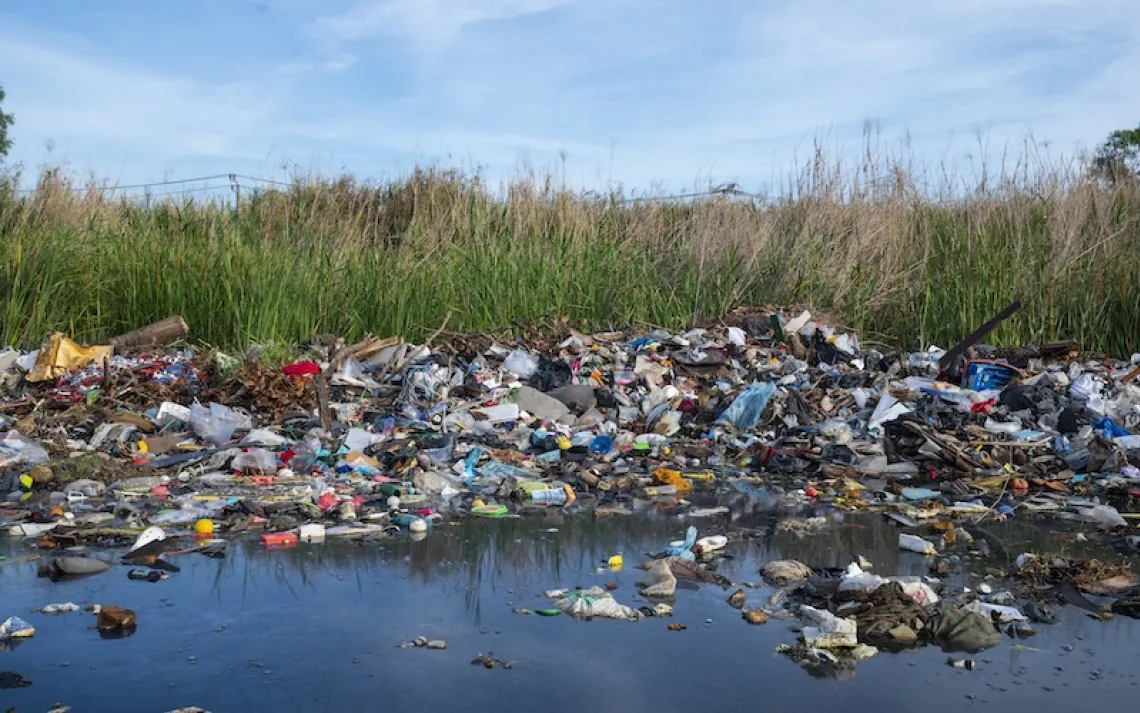
Arms folded across his Hawaiian shirt, Moore stares at the familiar flotsam: bubble wrap, soda bottles, a tennis ball, a Starbucks cup, a stuffed bunny, a GTX motor oil bottle, an empty jug of Tide, and innumerable bits of Styrofoam, from packing pellets to take-out trays. Crouching over the mud, he picks up a translucent pebble, then another. He pokes his fingers into the silt and soon displays a palmful of black and opal pearls, mud still clinging. These are "nurdles," he explains, the raw feedstock of plastic. In this form, before factories have melted them into Xerox machines and Frisbees, they make up 10 percent of the plastic found in the ocean.
Most of America's nurdles hatch in manufacturing plants in Texas and Louisiana, where workers pump from the earth the natural gas and petroleum from which the pellets are made. Wholesalers sell 50 million tons of them a year. The factory fixes a nurdle's DNA by brewing it into a particular type of plastic and then adding chemicals that make the final product hard or soft, elastic or rigid, colorful or colorless, ultraviolet- or shatter-resistant.
The polymer pearls, now more specialized than a worker ant, board trains and trucks and move from coast to coast to be melted and made into things so essential they're easy to forget, like the package that contains your tofu. The tofu heads to the supermarket in a crate of polypropylene, the same material that makes up the weave of the truck driver's long johns. The ride isn't too bouncy, thanks to the elastic polystyrene in the truck's tires. The driver parks and gets out of the padded seat--made from nurdles blown into expanded polyurethane--and hand-carts the crate to a walk-in cooler with polyurethane-insulated walls. Later, a customer grabs a plastic shopping cart and enters the store, heads past the polyvinyl chloride wall siding and window frames, and rolls to the refrigerator case.
There is the container of tofu. Illumination comes from overhead lights whose wires are sheathed in polyethylene. The package, too, is a batch of polyethylene nurdles, this time injection-molded into a form that's just the right size to hold a few tofu cubes. On top is stretched a clingy, transparent film known as PET, made from nurdles transformed into sheets. A similar material makes up the grocery bag that carries the tofu home and, finally, the garbage bag in which the waste is thrown away. Every year 12.5 million tons of plastic in the United States go unaccounted for, not to the dump or the recycler. Some portion of that missing plastic flows downhill and out to the ocean.
"This is what I call the lubricant of globalization," Moore says, pointing to his plastic pearls. "This was the packaging that allowed you to make your goods in Timbuktu and get them to L.A. This was the miracle stuff. This was better than sliced bread. It kept things so fresh and nice."
"But," he adds, "there's a downside."
Moore found that downside by accident on a pleasure cruise in 1997. As a child, he had played with Bunsen burners and managed controlled explosions under the tutelage of his father, a chemist at a power plant, who also taught the young Moore how to sail. Moore went on to a career repairing damaged cabinets, but imagined a second act as an ocean adventurer, researcher, and scientist--Indiana Jones in flip-flops. When he retired, he used the family fortune, passed down by his oilman grandfather, to create his foundation, have the Alguita built in Australia, and start patrolling the seas.
So it was that one sunny August day Moore and a few friends set out from Honolulu toward Long Beach. Most sailors cross the Pacific by catching the westerly winds and following the North Pacific Current in a lazy clockwise arc. Supplied with an extra bladder of diesel and a strong curiosity, Moore instead plotted a line straight through the North Pacific Gyre, a giant watery desert without any wind.
The Alguita motored across the gyre for a week. When Moore wasn't at the helm, he made tapioca and grilled steaks from a 100-pound bigeye tuna. Cloudless sky and still water stretched to the horizon in every direction.
"Going to the top of the mast to fix something, I would see a bottle cap, a shard of plastic floating by," he recalls. "I started betting myself that I could go on deck and not see something, and each time I was wrong."
Unbeknownst to Moore, five years earlier a Seattle oceanographer named Curtis Ebbesmeyer had become aware of and attached a name to this garbage patch. A container ship had lost a consignment of several thousand plastic bathtub duckies during a violent Pacific storm. An avid beachcomber, Ebbesmeyer had a worldwide network of fellow flotsam-lovers. He also had access to the latest computerized models of oceanic currents. So he put his friends on rubber-duck alert, and sure enough, the reports people sent from around the globe matched the computer's prediction: More often than not, the toys bobbed in a slow, clockwise eddy into that whirlpool Moore would later traverse.
"Things dropped off near Japan ended up in the doldrums and just kept collecting there," Ebbesmeyer says. "I called it a garbage patch, and the name seemed to catch on."
After returning from Honolulu, Moore, too, found himself drawn duckie-like into the gyre. Now, after eight voyages, countless experiments, and endless interviews, he probably has as good an understanding as anyone of the Garbage Patch. What it isn't, he says, is a solid mass like an ice floe. Rather, it is an inconceivably diffuse soup, a little here, a little there, doing not one but two roundabouts: in the eastern Pacific and in the western Pacific. Together these gyres form the shape of a dog bone. Moore describes the Garbage Patch as two to three times the size of Texas, but in fact it might be far larger--as much as 5 million square miles, or one and a half times the size of the United States. Sailors encounter it within 500 miles of the California coast and 200 miles off Japan.
These days the Algalita Marine Research Foundation, with its staff of nine and budget of $900,000--provided by Moore and a handful of donors--is dedicated to understanding and publicizing what happens when plastic and ocean collide. The foundation publishes its results in science journals and wages publicity campaigns.
Some researchers question whether a group with an agenda can make independent evaluations. Moore doesn't worry about such matters. "I could be like my neighbor over there, who spends his time on the deck sunning himself and inviting ladies over for cocktails. But I've seen the degradation firsthand of our natural environment, and that's a motivator," he says. "It lights a fire under you, makes you want to do something."
Part 2: The Scientist
Even as Moore was discovering the Garbage Patch, other scientists were launching inquiries into plastic's effect on the ocean. One, a tall, spare Englishman named Richard Thompson, can't forget a beach cleanup he led during his grad school days at the University of Liverpool. In September 1993 he and five other volunteers combed Poyllvaaish, a rocky shoreline on the Isle of Man, expecting to pick up a truckload or two of debris. After sending off 30 truckloads of mattresses, fishing nets, televisions, plastic bags, bottles, and shipping pallets, Thompson had to plead with the local constabulary to haul away the pile that remained. "The quantities just staggered me, really," he says.
Now 45, Thompson teaches marine ecology at the University of Plymouth in southwest England. He has become one of the world's foremost experts on ocean-borne plastics, with a particular fascination for the geriatric end of the polymer "life" cycle--the point at which nurdles and their kin decompose into smaller and potentially more dangerous forms. His sixth-floor office window looks out on the port where Charles Darwin set sail on H.M.S. Beagle. In a temperature-controlled lab across the hall, researchers feed bits of polymer to mussels. Here, too, is the Fourier transform infrared spectrometer that tells Thompson what sort of plastic he's found on the tide line.
In an upcoming edition of the Philosophical Transactions of the Royal Society, the oldest scientific journal in the English-speaking world, Thompson spells out to the scientific community how deeply plastic has woven itself into nature's web. He solicited reports from biologists, chemists, and toxicologists who span the globe but are few enough to fit on the deck of a trawler. He learned that on Diego Garcia, an atoll in the Indian Ocean, hermit crabs live in bottle caps instead of shells. The kittiwake of northern Denmark raises its young in a cliff nest assembled mostly from drinking straws, plastic twine, and ear swabs. In a 600-foot-deep trench off the coast of Marseilles, France, troves of Evian bottles lie perfectly preserved, absent the light or oxygen to break them apart. The fur seals of Macquarie Island, far off New Zealand's southern tip, poop bits of yellow and blue.
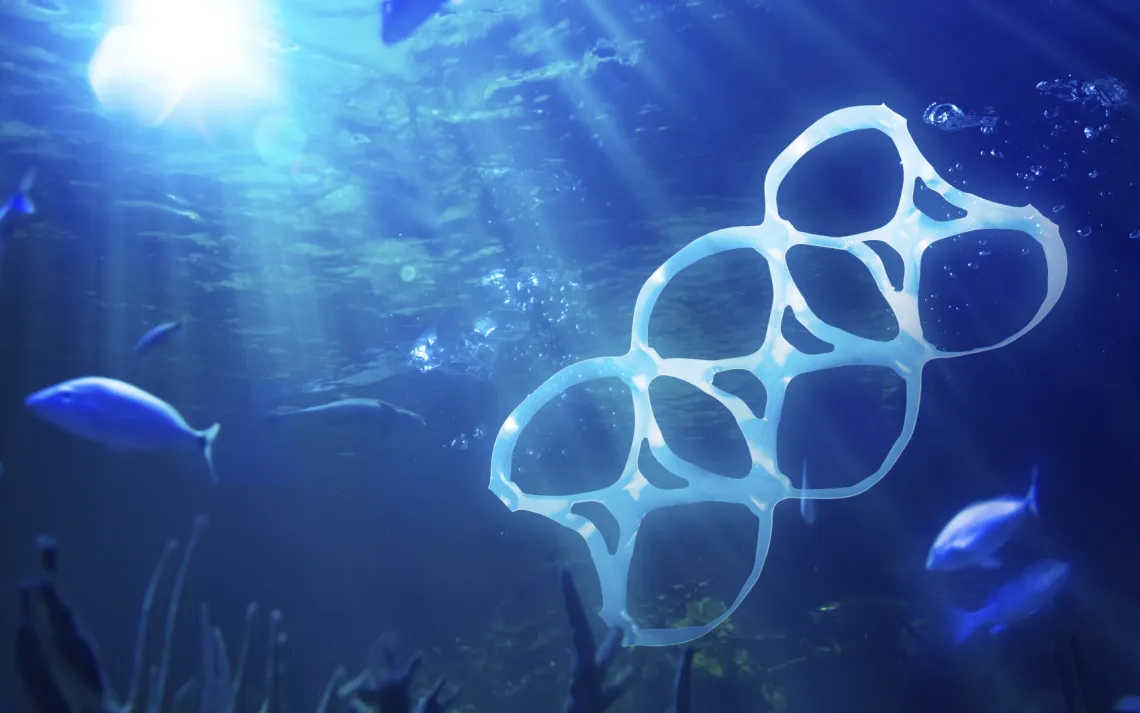
Thompson discovered studies from the late 1960s documenting albatross eating plastic and reports over the ensuing decades of turtles chewing on shopping bags and seabirds strangled by six-pack rings. Photos of these hapless animals first awakened the public to the menace. Plastic objects kill an estimated 100,000 marine mammals and one million birds every year, including the albatross: mistaking trash for fish, it starves with a stomach full of cigarette lighters and disposable forks.
Thompson also cites a lesser-known but confounding problem that accompanies drifting plastic. Like a sailboat that hasn't been scraped, flotsam amasses an underwater ecosystem. It grows a green and gray beard of seaweed, barnacles, and mussels, with a few fish trailing along. Species have always migrated by floating on pieces of pumice or driftwood, but nothing on the scale introduced by basketballs and yogurt containers.
The modern era's explosion of floating matter--46,000 pieces of plastic per square mile of ocean, according to the U.N. Environment Program--is an invitation for marine life to invade foreign shores.
"It's making a very big impression on life on the planet," says David Barnes, an ecologist who has found barnacles barging into new habitats from the equator to the Arctic. "The world shoreline has obviously been dramatically changed just in my parents' generation."
Even as he led the scouring of Liverpool's beaches, Thompson found himself less interested in the gross chunks than in the little bits underfoot--constellations of colorful dots hardly larger than grains of sand. Later, when he got his first teaching job and squad of graduate students, he took them to the beach. "In between the pieces of rock, we were finding bright pieces of blue or red, pieces that were long or fibrous," he recalls.
With the help of the spectrometer, Thompson determined that they were specks of polypropylene, polyethylene, and polyester as small as 20 microns across, narrower in breadth than a human hair. These tiny, broken shards had once been lasagna trays or construction tarps. He called them microplastics.
The sun's ultraviolet rays make plastic brittle, and the grinding action of waves breaks it to pieces, but polymers don't vanish. They just get smaller and smaller. Since the 1930s, researchers had sampled populations of krill ten feet underwater by attaching trawls to merchant marine vessels that plied the same routes through the North Atlantic each year. Many samples had been preserved, and by studying them, Thompson concluded that between the 1960s and the 1990s, the density of microplastics had increased threefold.
Meanwhile, across the globe in the Pacific, Moore pulled similar trawls through the Garbage Patch behind the Alguita. In some areas the ratio of plastic to plankton was six to one. On an expedition last year, the Alguita's crew harvested hundreds of lantern fish, two-inch midgets that make up 90 percent of the biomass in the middle depths of the ocean. They are a staple of the tuna, swordfish, and mahimahi caught near Hawaii. Ninety percent of the tiny fry had eaten plastic--one had 84 fragments in its belly. The dissections revealed nurdles and Thompson's colorful microplastics as well as minuscule uniform bits that are a new item on the ocean's dinner plate: abrasives. More and more, plastic powder is used to scrub grime from airplane fuselages and exfoliate skin in the shower. The powders are so small that they run unimpeded from the drain to the sea.
"In parts of the ocean, a fish is more likely to consume plastic than actual food," Moore observes. Then he asks the natural question: "If these plastics are in fish, and birds and other fish are eating those fish, how far is plastic moving up the food chain?"
Thompson has an initial answer. Last year he fed microplastics to mussels and found that the microplastics jumped unaltered to the circulatory system, where they stayed for four weeks before being flushed. How else a polymer diet affects the mussel, or other sea creatures, or higher predators, is still unknown. But a provocative suggestion comes from our friends the nurdles.
Across the Pacific in Tokyo Bay, a toxicologist named Hideshige Takada took an interest in nurdles because they told him something about pollution. In ocean water, Takada noticed, nurdles and other plastics suck up toxins like sponges. They hold concentrations up to a million times greater than the surrounding water. The round pellets washed up on Tokyo's shores carrying loads of polychlorinated biphenyls (PCBs) and the insecticide DDT, even though both had been banned worldwide more than three decades earlier.
Takada realized he could use nurdles as an indicator to track the imprint of toxic chemicals on the ocean. He put out an appeal for beachcombers around the world to mail him nurdles they'd found. He got thousands, from Italy, Mozambique, Vietnam, and 14 other lands. Takada found the highest concentrations of both poisons off the coast of the United States, where the compounds were made in greatest quantity.
At the same time, Takada fed PCB-laced plastic to streaked shearwaters, a common seabird of the eastern Pacific. PCBs and DDT nestle in the fat stores of fish and mammals and accumulate in greater concentration the higher one goes in the food chain. PCBs mess with the reproduction of marine mammals, spur skin lesions and liver damage in humans, and may cause cancer, while DDT causes nerve damage and may tweak a mammal's sex hormones. Sure enough, Takada found that the plastic-gobbling shearwaters had three times more PCBs in their preen glands than shearwaters that ate just fish.
It is still unknown whether some plastics are more toxic than others, or whether a line can be drawn from tiny crumbs of plastic drifting in the Pacific to the tuna on the supermarket shelf. The U.S. government isn't alarmed, at least not yet. Holly Bamford, who heads the National Oceanic and Atmospheric Administration's marine debris program, says more studies are needed to determine whether plastic is a toxin in the food chain.
Thompson, meanwhile, anticipates years of research before science gets a clear view of what plastic is doing to the oceans, and to us. Every so often, he pulls on his Wellington boots and bright yellow oilskin coat to survey the beach at Thurlestone, on England's southern coast, and see what sort of castoffs are stranded in the wrack line. Whether it's Coke bottles entombed on the seabed or the tiny shards he finds in the sand, he knows it's all still with us, all the plastic we've ever produced.
Part 3: The Lawyer
Bohan, 46, is the executive policy officer for the California Ocean Protection Council, a task force created by Governor Arnold Schwarzenegger (R) to repair the state's abused coastline. Litter tops the agenda. California's multitudes (at 36 million, it's the most populous state in the country) and economy (fifth largest in the world) generate a Sierra Nevada of waste, some of which blows on the wind or flows via rivers and storm drains to the 840-mile shoreline. There, it floats about children's ankles and erodes the coast's $25 billion tourist economy.
Yet Bohan, an attorney with spectacles and boyish brown hair, remains optimistic. "Getting our junk out of the ocean isn't even all that hard," he says. "It is well within our ability to fix. We know where it comes from. The solutions shouldn't be that difficult."
Not that California hasn't tried. The state has run don't-pollute education campaigns for decades, and beach towns have mounted huge cleanups. Los Angeles County collects more than 4,000 tons of trash annually on its beaches. Today, the council is trying a new tack, assigning a representative from every agency with coastal jurisdiction--toxics, solid waste, water, parks, transportation, environmental protection, everybody--to the same panel, along with members of the state senate and assembly. The council, endowed with $90 million in bond money to insulate it from events like the current state budget crisis, meets four times a year.
In the summer of 2006, the staffs of these agencies met to vet a list of 63 ideas for tidying the shore. At Bohan's urging, they made a key decision: Spare the litterbug, mostly. Don't even clean up after him. Instead, identify the most offending types of litter and cut them off at the source.
"We could keep cleaning up all we want, but it's not going to matter unless we get to the sources of the debris," says Eben Schwartz, head of the Ocean Protection Council's steering committee. "It's not just a consumer issue; it's a producer issue. And Drew got that right away. He has been moving us in a direction so that everyone involved in this issue has a stake in resolving it."
The first target emerged in 2007 when council members received baseball caps declaring them the "Nurdle Posse." Those tiny spheroids that have caused Captain Moore so much consternation were the easiest fix. Nurdles are so small that the state had never bothered to regulate them. Lawmakers closed that loophole later that year, but enforcement hasn't started yet because of the state's money woes.
Previously, the Los Angeles Regional Water Quality Control Board had been putting the screws to the Slurpee lids and sandwich wrappers that foul the waterways of the L.A. Basin. In 2001, the board informed the communities on the banks of the Los Angeles River and Ballona Creek--49 municipalities in all--that trash in the water would no longer be tolerated.
By September 2009, those communities along 60 miles of river must reduce their runoff by half or face fines of up to $10,000 a day. Cities are scrambling to meet the goal with vacuum trucks and new and better grates. "We intend to enforce the law where necessary," says Tracy Egoscue, the board's executive officer. Up north, the San Francisco Bay Area is developing a similar scheme.
Other Garbage Patch ingredients face extermination if the Ocean Protection Council can prod politicians and consumers to act. Take plastic bags, for example: Rather than the outright ban recently enacted in countries from China to Tanzania, the council recommends a statewide 25-cent fee for paper and plastic grocery sacks. This would nudge shoppers toward reusable totes, like the blue Trader Joe's bag that Bohan keeps in his trunk.
The council also argues for a ban on polystyrene containers, the stuff of Chinese takeout and gas station coffee. They keep food hot, but they float like rafts and break up readily into serving-size bits for fish and birds.
Another quarry are the drink caps, straws, and other errata of convenience that litter the beaches. Every McDonald's lid and Odwalla bottle seal could draw a fee, or manufacturers could be required to integrate the castoffs into the container, like California did with pull-tab aluminum cans in the 1970s. All the fees that the council's proposals generate would go toward education and enforcement.
The political tide seems to be with the health of the ocean as demands for "extended producer responsibility" intensify globally. In the 1990s, Germany inaugurated the Green Dot system, putting manufacturers on the hook for recovering throwaways. Plastic waste dropped by 14 percent, plastic recycling shot up to 75 percent (compared with 5.5 percent in the United States), and industry redesigned products for a lighter environmental impact, an approach that has spread through much of Europe.
California's Green Chemistry laws, signed by Schwarzenegger last year, followed Europe toward another sea change. They empowered the state to document the chemicals in all products and to ban or phase out any that might cause harm, such as those that spur cancer or alter hormones. One day such laws might protect not just humans but also marine life.
"We fully embrace innovation in doing more with less," says Steve Russell, managing director of the plastics division of the American Chemistry Council, which predictably prefers public education and incentives to government mandates.
For his part, Moore is glad that humanity is beginning to recognize that the ocean won't provide for us if we treat it like a trash bin. But he doubts that government intervention will do much good if it's not accompanied by a widespread change of heart. "Everything has to be valued, and we have to have a zero-waste philosophy as opposed to a throwaway philosophy," he says, sliding the handful of nurdles into his pocket for later recycling. "It's going to be radical."
Then he turns and hikes back up the bank toward his Prius, which, like most energy-efficient cars, is composed largely of strong, lightweight plastic.
Miraculous meeting in a sea of junk
On their three-month journey from Long Beach to Honolulu aboard the recycled Junk, Marcus Eriksen and Joel Paschal found plastic in the stomachs of fish caught in the mid-Pacific. "Plastic is forever," Eriksen blogged, "and it's everywhere."
On June 1, 2008, two men on a strange raft called Junk set sail from Long Beach, California, on a 2,600-mile voyage to Honolulu, Hawaii. The pontoons of their aptly named craft were made of 15,000 plastic bottles and discarded fishing nets; the deck, of old sailboat masts; and the cabin, from the fuselage of a Cessna.
Marcus Eriksen and Joel Paschal had hoped their voyage on Junk would raise awareness about the vast expanse of plastic debris in the Pacific Ocean. "We were two crazy guys with a crazy idea," Paschal says, laughing. The eco-mariners met at the Algalita Marine Research Foundation while researching the plastic pollution swirling around in the North Pacific Gyre. "It's like a toilet bowl that never flushes," Eriksen wrote on the duo's blog, junkraft.com.
Before launching his expedition, Eriksen spoke with British adventurer Roz Savage, who was planning her own voyage to raise awareness about plastic marine debris in conjunction with the Blue Frontier Campaign. Having already rowed across the Atlantic several years before, she hoped to become the first woman to row across the Pacific. Savage and Eriksen talked about coordinating their efforts, but she left San Francisco before they could connect again.
More than two months into their respective journeys, the boats came within 100 miles of each other. Paschal's mother had been reading Savage's blog and heard that her water desalinator was broken. She called her son via satellite phone, and Junk was able to make radio contact with Savage and locate her on radar.
Savage had plenty of food and no water, and the other boat had lots of water but very little food. "Fortunately, when I met up with the guys on the Junk in mid-ocean, we were able to do a trade," Savage says. After a fine dinner of freshly speared mahimahi, she says, "we cut through all the small talk and got down to discussing the environment and how we could collaborate."
After three hours, Savage rowed into the sunset. Two weeks later, the three activists reunited in Honolulu to highlight the environmental dangers and health risks of plastic marine debris. Standing with Eriksen and Paschal in front of their vessels, Savage summed it up: "If we have sick oceans, we're going to end up with a sick planet and sick people." --Stuart Coleman