Mulch Is Dirtier Than You Think
Contaminated mulch is undermining California’s climate and sustainability goals
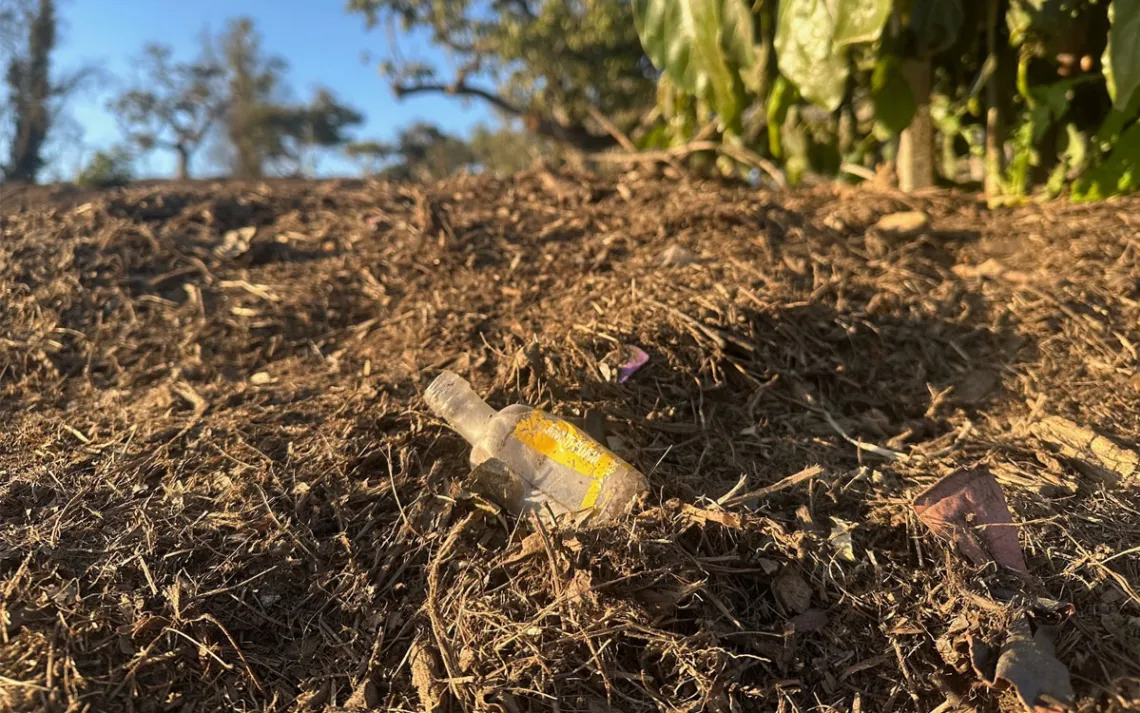
Plastic debris—including children’s toys, bags, and food wrappers—ends up in commercial mulch applied to farmland slated for organic agriculture. | Photo by Kristen Weiss
Opinion
The opinions expressed here are solely those of the writer and do not necessarily reflect the official position of the Sierra Club.
Mulch, a seemingly natural material, is hiding a lethal secret. Lurking within the wood chips, bark, and leaves is a toxic substance that pollutes the land and poses harmful impacts to human health—millions of tons of plastic. That’s a big deal for farmers, who deposit heaps of mulch on their fields to capture carbon, increase productivity, and help scorched earth rebound.
According to recent research, agricultural soils now contain roughly 23 times more microplastics than our oceans. In the US, a big culprit is mixed municipal solid waste. This waste, which is turned into mulch and compost, is widely promoted as a climate-friendly way to reduce landfill use, cut greenhouse gas emissions, and return nutrients to depleted soils. But when this material is sourced from mixed household waste, plastics routinely slip through the system, degrading mulch quality and introducing forever contaminants into farmland.
Farmers have reported receiving mulch filled with remnants of plastic bags, bottle caps, tarps, food wrappers, dog toys, and even complete dolls’ heads. On one California farm that received state funding to apply mulch to a fire-ravaged field, plastic studded the organic material like confetti, and thousands of lighter fragments scattered far beyond the application site, blown into surrounding hillsides and waterways.
Researchers warn that without stricter rules and cleaner feedstocks, the very practice meant to support sustainable agriculture risks becoming another pathway for pollution.
“Plastics are disrupting the microbiome of the soil,” said Susanne Brander, an associate professor in the College of Agricultural Sciences at Oregon State University. “When organisms like earthworms consume microplastics, it impacts their growth and ability to reproduce. They also become a vector for those plastics to be introduced to other organisms in the ecosystem.”
Microplastics have been found in nearly every human tissue and organ tested (including placentas). Medical studies have shown that plastics may cause inflammation, damage cells, and trigger autoimmune diseases, hormonal disruption, and other serious health issues. While the full consequences remain uncertain, one thing is clear: Once plastic enters the soil, it creates a long-lived environmental and human health dilemma.
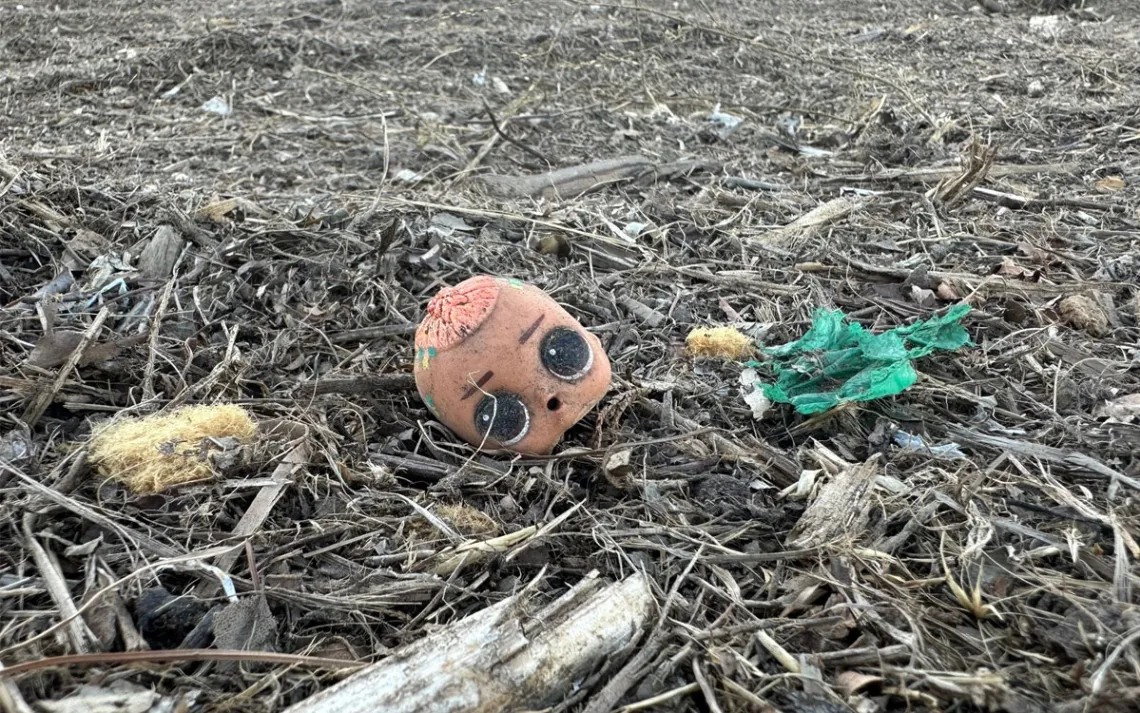
Plastic pollution litters a mulched field. | Photo by Kristen Weiss
The soil-climate connection
In California, the agricultural industry—which includes nearly 70,000 farms and ranches and generates more than $100 billion annually—plays an outsize role in the climate equation. Not only does it produce greenhouse gases through fuel use, fertilizers, and livestock, but it also manages millions of acres of working lands with the potential to store vast amounts of carbon in soil.
A program called the Healthy Soils Program represents one of California's efforts to harness that potential: incentivizing farmers to use compost and mulch to divert organic waste from landfills, which are the state’s third-largest source of methane. Because methane traps more than 80 times as much heat as carbon dioxide in the short term, diverting food scraps and green waste into compost and mulch is seen as a fast and effective climate solution. But when contaminated material is returned to farmland, plastic pollution is simply shifted from landfills into soils, raising uncomfortable questions about whether a climate solution can still be considered “healthy” when it introduces persistent pollutants into the land itself.
“The challenge is that farmers and landowners who receive state support are responsible for sourcing their own mulch and compost,” explained Bre Sliker, the climate-smart agriculture program manager at the Community Environmental Council, a nonprofit located in Santa Barbara. “They must obtain material from a certified facility, but the quality of mulch or compost varies among certified providers.”
Sliker and her team offer support and technical assistance to regional growers interested in adopting sustainable agriculture practices. She said it has been rewarding to build relationships with local farmers and ranchers and to help them gain access to new funds and scientific knowledge. Mulch and compost contamination, however, have at times become a sore spot.
The extent of California's plastic problem is, in part, a nightmare of its own making. State regulations allow for small amounts of physical contamination in compost and mulch. At the maximum allowable level, a single ton of material can contain as much as 10 pounds of plastic, meaning that covering a large field with mulch can legally introduce thousands of pounds of plastic into the soil—material that has no natural pathway back out of the ecosystem. What’s more, the rules are silent on plastics smaller than four millimeters, including microplastics that can persist in soil for decades.
Sliker said that she hears regularly from farmers in her region who are frustrated at the amount of contaminants they find in the organic material they receive from certified distributors. “It really puts a bad taste in people's mouths,” Sliker said. Growers who receive contaminated mulch must either request that the provider send workers to remove visible contaminants or hire their own workers to do so.
Cristina Czochanski, a technician with the Ventura County Resource Conservation District, said that growers in her county have also complained about plastic contamination in mulch from local facilities. "We've seen firsthand plastic contamination in large mulch applications sourced from green waste facilities,” said Czochanski. “Tree-trimming companies that directly donate their trimmings to farms typically have much less contamination. However, it can be difficult for farmers with high acreage to obtain a sufficient amount of tree trimmings to cover their fields with two to four inches of mulch.”
Bill Camarillo is the founder of Agromin, one of California’s largest organic waste recycling companies in the state. Operating across more than 200 jurisdictions, including Ventura and Santa Barbara Counties, Agromin converts roughly 1.2 million tons of organic waste to soil amendments every year. As one of the state’s largest organic waste processors, Agromin sits at the chokepoint between California’s waste diversion goals and the material that ultimately ends up on farmland.
“Our base material for compost is the green waste that's residentially collected at the curbs of homeowners,” said Camarillo. “We get all kinds of things we don't want—especially plastic bags are not our friend. We get bottles and cans and metal pieces and things that really don't belong in there. So then when it gets to our facilities, we have labor on the ground that actually picks through the yard waste to get all the trash out of it.”
Getting plastic out of green waste
The more contaminated the organic material, the more workers are needed to remove contaminants. According to some studies, mulch and compost sourced from individual homeowner green bins (as opposed to, say, commercial agriculture sites) are more likely to contain discarded plastics and other difficult-to-remove inorganic trash.
Under California law, residents and businesses are required to separate organic waste (food scraps, yard trimmings, compostable paper) from regular garbage and place it in green waste bins or equivalent organic carts. But enforcement is rare and depends less on whether contamination exists than on where it appears—and which agency, if any, has authority to act. County level environmental health divisions typically require composting facilities to submit periodic self-analyses of physical contaminants in their products, but unless these analyses show something concerning, no additional oversight occurs unless the division receives a formal complaint that warrants investigation.
Addressing the problem will require action at multiple levels, say researchers and policy experts. Among their recommendations are stricter contamination standards for mulch and compost, better sorting technology at processing facilities, more consistent monitoring and enforcement, and stronger incentives for farmers to source cleaner feedstocks. Public education and upstream waste reduction—keeping plastics out of residential green bins—are equally important to prevent contamination before it reaches farms. And of course, shifting from single-use plastics is a critical step toward reducing plastic pollution in the long term.
So far, a number of states and jurisdictions recognize the problem and are taking steps to reduce municipal solid waste contamination. For example, Washington State has passed a series of laws to strengthen municipal waste standards and reduce green bin contamination. Washington’s Department of Ecology is in the midst of improving the state’s solid waste handling standards and addressing oversights in monitoring and enforcement.
“The biggest challenge is that there are so many players involved in the green waste system,” said Sliker. “If we are able to streamline the process, we could significantly reduce contamination.”