 The Magazine of The Sierra Club
That Shrinking Feeling
Before-and-after images are just as compelling when it comes to climate change as they are for fashion makeovers
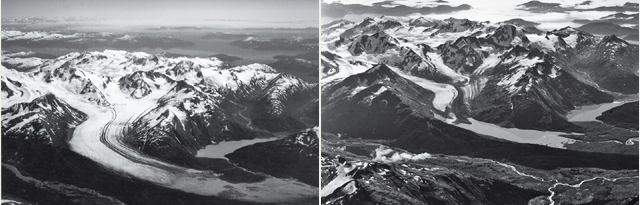
Alaska's 20-Mile Glacier in 1938, left, and in 2007, right.
Before-and-after images are just as compelling when it comes to climate change as they are for fashion makeovers. When photojournalist David Arnold stumbled on high-quality pictures of Swiss and Alaskan glaciers taken by mountain-eer Bradford Washburn in the 1930s, he wanted to see whether the sites had changed since Washburn's time. The eye-opening photos are showcased in Double Exposure: Photographing Climate Change, which has been touring museums since 2008, with upcoming shows in Oklahoma City and Norwich, Vermont.
What motivated Washburn?
Washburn was director of the Museum of Science in Boston. In the late 1930s he began taking extraordinary aerial photographs with a 55-pound army surveillance Fairchild camera. It shot 7-by-9-inch negatives. Ansel Adams took the same type of photographs. Why did Washburn bounce around with fuel kegs at 15,000 feet and lean out of the plane chained to the fuselage? He was a perfectionist. He was a scientist and an artist. And he was a mountaineer. In the 1930s, when it was still so dramatic to climb new peaks, he wanted high-quality photo-graphs so he could pick out his routes.
What motivated you to retrace his shots?
I was a Boston Globe reporter for many years and wrote stories that Brad would feed me. In 2005, toward the end of his life, I purchased a photograph of his that I had always loved, an iconic shot of six climbers crossing a ridge on the Doldenhorn in the Alps. I thought, "I wonder what that looks like now? If global warming is real, has it changed?" It took me three seasons to get it. I kept getting weathered out. Even at 11,000 feet there were dynamic changes in the ice. That surprised glaciologists. They didn't expect to see that kind of change at 11,000 feet.
Was it difficult to find Washburn's sites?
He kept thorough flight logs, so I knew the name of the feature, the altitude he shot it at, and the time of day and date. In some cases the changes are so dramatic that it's hard to tell you're looking at the same feature.
What did it feel like to take your first comparison shot?
When the pilot and I came up on the Hugh Miller Glacier in Glacier Bay National Park, there was no glacier. We looked at each other; it was a "Holy s---!" moment. You realize that this is a very different world from the one Washburn saw.
How is this exhibit unique?
My benchmarks are artistic photographs that invite people into the detail. The show walks a line between fine art, science, and advocacy.
What makes a simple pairing of photos so dramatic?
You can't argue with your eyes. You can talk yourself into things when you're trying to make a point. But when you do it with photographs, you don't need to say anything.
What is the exhibit's lesson?
That we underreact to slow change. These photos point out that, in geologic time, these changes aren't slow at all. In fact, the pace of these changes is drastic and recent.
Alaska's Guyot Glacier, which Brad shot in 1938, has retreated 14 miles. It has fractured into two glaciers. Enough ice has melted from the Guyot to provide for all of New York City's water needs for 97 years.
How do you hope people will react to such stark evidence?
The challenge is to try to create a show that doesn't only depict a dismal melting world but also highlights some of the actions we can take. In this exhibit I dared introduce a photo of people standing in line in Boston to get butter during rationing in World War II. They're all smiling. They're all willing to make that sacrifice. The threat was tangible, whereas the threat of global warming is still a generation away.
What's your environmental vice?
I inherited a classic 29-foot motorboat. At cruising speed, it consumes seven and a half gallons an hour. That's outrageous, though as far as motorboats go, it's fairly modest.