
How Can Builders Cut Their Carbon Emissions?
Some think "massive timber" is the answer
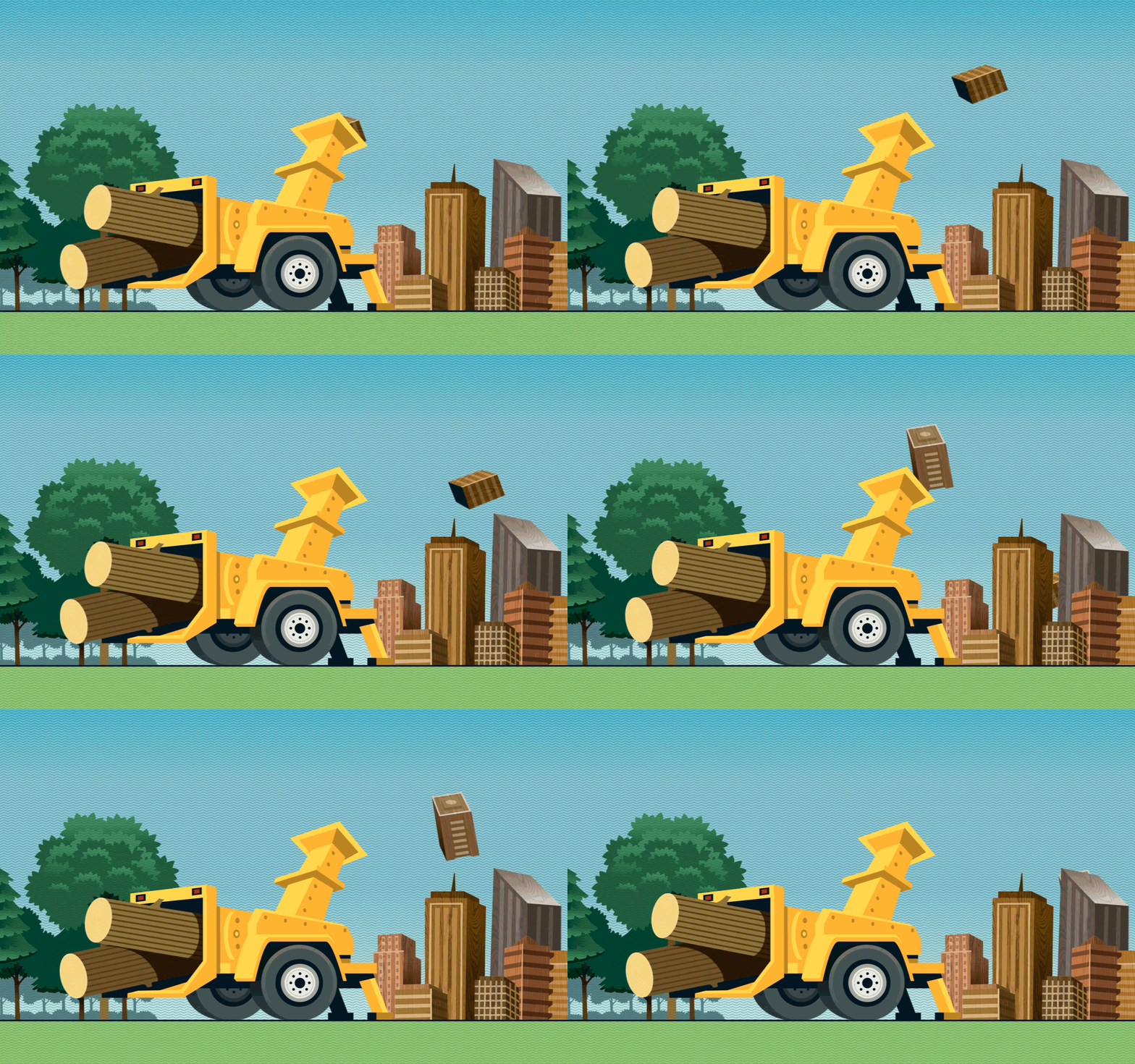
The carbon dioxide emissions from manufacturing steel are so massive that they surpass the European Union’s entire output. This ubiquitous building material, along with carbon-intensive cement (the base material in concrete), frames nearly every skyscraper, industrial facility, and transportation hub, making construction responsible for one-sixth of the world’s CO2 emissions. To meet global emission-reduction targets, we need to decarbonize the construction industry, and some climate-savvy developers and corporations think a retro material is the solution: wood.
How it works
“Massive timber” (or “mass timber,” for short) is a product engineered from natural wood that can be stronger than steel and cheaper to manufacture and use. In large buildings, wood is often relegated to decorative elements, but now this modified version makes it possible to build wood-framed structures higher, bigger, and safer than before. Proponents say that turning to this new wood and away from fossil-fuel-intensive concrete and steel could reduce construction’s emissions by as much as a quarter.
Mass timber combines individual pieces of lumber to form a stronger, more durable whole, such as a post, beam, wall, or even an entire ceiling. There are several techniques: Cross-laminated timber is created by using a hydraulic press to bind together cross-hatched layers of lumber. Laminated veneer lumber is made from near-paper-thin slabs stacked together. For dowel-laminated timber, pegs are used to hold the layers of lumber together. And nail-laminated timber relies on nails to affix the slabs. Each of these manufacturing pathways ends with a coating of fire-resistant glue to fortify the hold.
What could go wrong?
Manufacturing mass timber still emits CO2 during the logging process, from transportation and discarded material—only about a third of a tree becomes lumber—and the World Resources Institute has found that mass timber evangelists frequently omit this fact. Supporters also seem to cherry-pick data about deforestation, which skews the emissions balance sheet. Living trees lock up carbon for centuries before they die, while industry experts expect most mass timber structures to last just 60 to 100 years, meaning mass timber emits stored carbon into the atmosphere much sooner than if the source trees had been left in the ground.
Because it can take trees decades to reach their peak carbon sink capacity, harvesting for mass timber at a sustainable, regenerative rate while keeping pace with the construction industry seems unlikely. Even without an uptick in logging, the world is on track to raze a forest the size of the contiguous United States by 2050. If the production of mass timber ratchets up, that would add pressure to an already stressed ecosystem. Tree plantations, with fast-growing trees bound for industry, might reduce some of that stress, but plantations displace native ecosystems, and sometimes people.
The upshot
While the promise of mass timber seems tantalizing, it’s impossible to create it at the level needed to make a discernible dent in carbon emissions without negative side effects. Wood is a great complement to today’s ubiquitous building materials—it’s pretty, brings people closer to nature, and has a lower carbon footprint than concrete and steel. But to truly decarbonize construction, the industry is better off continuing to scale up low-emission concrete and steel production.