This Ecologist Is Rewriting the Story of California Landscapes
Redwood trees hold secrets in "fairy rings"
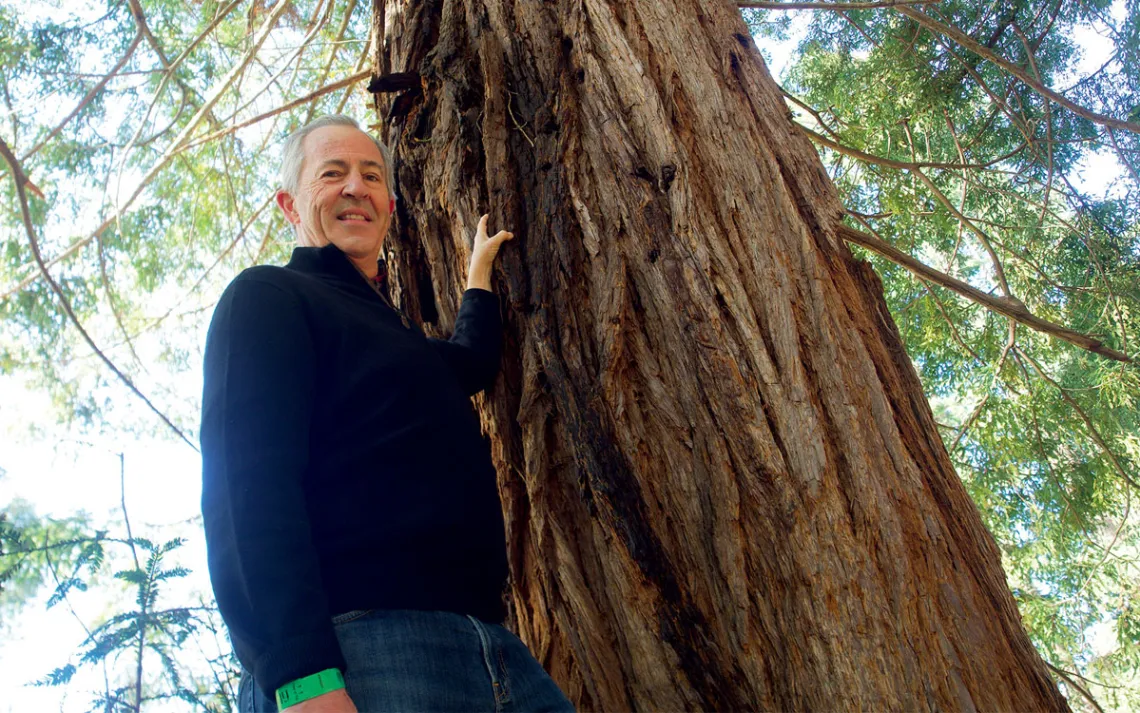
Rick Lanman spends much of his time thinking about the past, imagining the natural splendor of the San Francisco Bay Area before its urban transformation. So it’s fitting that on a warm afternoon, we meet at the Filoli Historic House and Garden, a 1917 Georgian revival–style manor surrounded by nature trails at the base of the redwood-covered Santa Cruz Mountains. In the parking lot, three women in elegant gowns and jaunty hats, holding parasols, make it feel as if we have walked into an episode of Bridgerton.
We are not here to gawk at the mansion’s manicured gardens and lush interiors, however. Our objective lies a quarter mile beyond the manor’s back gate, where 650 acres of native madrone, oak, laurel, and redwood forests remain much as they have been for generations.
Tall and lanky, Lanman wears faded blue jeans, a flannel shirt, and worn hiking boots. For 40 years, he worked as a doctor, a health-care executive, and a cancer researcher, authoring more than 130 peer-reviewed scientific articles on immunology and cancer genetics, many challenging the conventional wisdom of practitioners. “In medicine, you learn to look for what seems unusual or off,” he says. “If something seems off, there’s likely a problem to be solved.”
Since retiring from medicine, Lanman has turned his diagnostic eye to the natural world. Over the past 15 years, he has published numerous papers on the historical ecology of California. His findings have often upended long-held views about the state’s natural history.
One myth Lanman has dispelled—perpetuated by the famed early 20th-century naturalist Joseph Grinnell—is that beavers were never native to the Sierra Nevada and central California’s Coast Ranges. He knew something was wrong with that assessment after a trip to the Smithsonian archives, where he found a beaver skull that had been collected in 1855 in Saratoga Creek, near San Jose—clear evidence that these animals were present before white settlers arrived.
“People think the Bay Area never harbored redwoods the size of those found in the northern part of the state. Not true.”
“A lot of what we think we know about the Bay Area’s natural history is based on received knowledge,” he says. “And a lot of that knowledge is simply wrong.”
One of the questions that preoccupies him is how extensive the Bay Area’s redwood forest was before European settlement. To find out, he plotted the extent of former redwood forests using maps showing gold rush–era sawmills between Santa Cruz and San Francisco. Since redwoods were too large to be hauled (and there are no rivers big enough to float them), they had to be cut near where they fell. Thus, the locations of sawmills serve as a proxy for where redwoods once thrived.
Like any good doctor, Lanman is not merely looking to diagnose ailments. His ecological inquiries are carried out with an aim for a cure. Lanman and his research partners created a machine learning model that incorporates satellite imagery and climate data to pinpoint places in the Bay Area where redwood trees could be restored. They identified a 100-square-mile area in the Santa Cruz Mountains that overlaps significantly with the area’s protected lands.
On this day, Lanman’s focus is trained on a group of redwood trees growing in a circular arrangement at Filoli. These “fairy rings” are a unique feature of coast redwoods. When a large tree falls, saplings along the perimeter kick into rapid-growth mode. The space between those trees provides an outline of the tree that once stood there. Fairy rings are not uncommon in logged redwood forests, but the Filoli ring is special: Lanman suspects it is the largest ever recorded.
But to confirm that hunch, we must first measure it.
We traverse a forested stretch along the dry bed of Fault Creek, and fragrant laurels and red-barked madrones give way to a clearing with towering redwoods. The temperature is in the mid-70s, but upon entering the shade of the trees, each easily over 100 feet tall, the air cools noticeably.
Lanman retrieves tools from his worn leather backpack—hammer, stakes, measuring tape, bright-orange twine—and we begin measuring the circumference of each hulking tree. After we record the widths—the largest tree is nearly 18 feet around—we string twine around the fairy ring’s perimeter, creating a crude square. Lanman measures the distance from the corners to each tree as well as between the individual trees, thereby sketching out a coordinate map of the ring.
A few days later, Lanman’s data confirms his hunch that the Filoli fairy ring is the largest ever recorded—36.5 feet in diameter. That beats the previous record holders, including the so-called Fieldbrook Stump, a tree in Northern California that measured over 32 feet. It’s astonishing that this massive specimen could be hiding less than half a mile from a parking lot, in a tourist destination that sees hundreds of thousands of visitors each year. The Filoli ring, Lanman says, is yet another example of the blind spots and hard-to-dispel myths that define our thinking about the natural world. “People think the Bay Area never harbored redwoods the size of those found in the northern part of the state,” he says. “Not true. Some of the largest redwoods were right here. Right here.”
Lanman’s vision of the past carries into the present. “If we could just restore redwoods in this area, we could mitigate 2 to 3 percent of California’s total carbon emissions,” he says. If redwoods were replanted in the state’s coastal counties, they could capture as much as 20 percent of its emissions.
“These trees,” Lanman says, “are a gift.”