 The Magazine of The Sierra Club
New Plan Lays Out Path to Boost NYC’s Tree Canopy
Tree equity is increasingly important to decreasing heat and closing the nature gap in the nation’s largest city
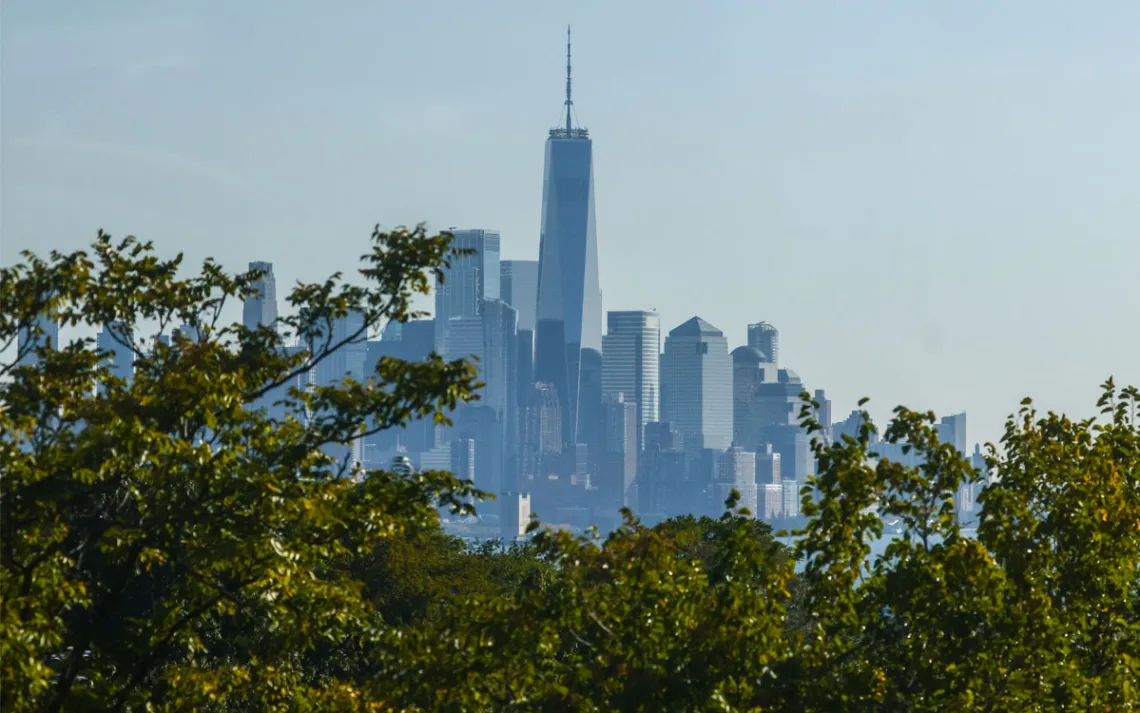
Photo by Beata Zawrzel/NurPhoto via AP
On an unseasonably hot day last July, thermometer-wielding New Yorkers walked between Brooklyn’s verdant McGolrick Park and a treeless industrial district nearby. The surface temperature of the unshaded sidewalk clocked in at a stifling 101°F. Just a five-minute walk away, under the cover of the park’s mature London plane trees, temps were a pleasant 75°.
The event, organized by the North Brooklyn Parks Alliance, demonstrated that trees are essential cooling infrastructure in a city where more than 500 people now die prematurely each year as a result of summer’s choking heat. Beyond meaningfully decreasing temperatures, research shows that urban canopy helps reduce flood risks, improve air quality, and create wildlife habitat.
Last month, the NYC Mayor's Office of Climate & Environmental Justice, a coalition of city agencies, and local organizations released the Urban Forest Plan. The framework lays out a plan to achieve 30 percent canopy cover across NYC by 2040, a roughly 5 percent increase from today’s levels. The city’s first centralized plan for increasing leafiness seeks to both protect existing trees and plant new ones in areas that need them most. On properties under city control, leaders are hoping to close the green gap by prioritizing new tree plantings on NYC Housing Authority public housing campuses and economically disadvantaged communities, which now make up 44 percent of the city.
Meanwhile, across the concrete jungle, trees are not currently distributed equally. Around 26 percent of land in the city’s wealthier areas sits shaded in canopy. That number is closer to 19 percent in low-income minority neighborhoods and as sparse as 6 percent in certain pockets of the city.
These inequities are deep-rooted. In the 1930s, parts of the city with a higher percentage of Black and Latino residents were deemed unsuitable for mortgages or loans. The racist lending practices, known as redlining, set off a cascade of disinvestment that can still be seen and felt today. Across the Bronx, Brooklyn, Queens, and Staten Island, neighborhoods that lack green space and canopy cover tend to match up with these redlined maps.
Victoria Sanders, climate and health programs manager at NYC Environmental Justice Alliance and a member of the plan’s advisory committee, notes that greening historically redlined communities tends to come with a higher price tag, since these areas are more industrialized and less equipped for green infrastructure. “We could reach 30 percent tree canopy without making it equitable, and it would be much simpler and probably a lot cheaper,” Sanders said. “But we need to be willing to put that extra investment to close the historical gap that still exists today.”
She says successful implementation will require working with community members to learn about their visions for their specific neighborhoods, as opposed to making blanket recommendations. Proponents of tree equity also say that thinking of tree canopy as just one element of a broader investment in environmental-justice communities could also help prevent issues like green gentrification, which happens when new green spaces increase the cost of living in an area, pricing lower-income residents out.
If they’re able to successfully pull off planting efforts in parts of the city that have previously been ignored, city officials could create a path for a type of “greenlining”—a novel concept introduced by Danielle Stokes, an associate professor at the University of Richmond School of Law, that reimagines redlined maps as tools for prioritizing areas for social and environmental justice.
The plan also includes dozens of strategies for protecting the 7 million trees that already exist in the city’s urban forest—a diverse ecosystem of bushy oaks, vibrant redbuds, stately maples, and the animals, microbes, and fungi that inhabit them. “Ninety percent of our canopy comes from preserving the trees that we already have,” said Paul Onyx Lozito, the deputy executive director for the NYC Mayor's Office of Climate & Environmental Justice.
Increasing flooding and drought due to climate change, cramped conditions, and invasive pests are just some of the challenges urban foliage faces. The new plan seeks to recruit more dendrophiles around the city to help water, prune, and care for the trees around them. Expanding climate education within NYC public schools, exploring an urban forestry track in CUNY community colleges, and increasing community boards’ engagement in urban forestry efforts are a few strategies the plan puts forth to involve more of the city’s 8.5 million people in a culture of canopy stewardship.
Aurelia Casey, the youth program senior manager at Gowanus Canal Conservancy and a member of the plan’s advisory committee, hopes these strategies can open up new career paths to young people throughout the city too. “I think what's going to be very key right now is showing these youths that they have a solid future in the climate industry,” she said.
Private property with one- and two-unit homes is the only category of city land that has lost canopy in recent years. To reverse this trend, the plan calls for city agencies to educate private property owners on the benefits of trees, such as reduced AC costs in the summer, improved air quality, and stormwater protection. “We've got a ton of data to show that the greatest opportunities to increase canopy are on private land,” said Jessica Einhorn, director of forestry programs at NYC Parks Department.
The Mayor's Office and the Parks Department are now working with community partners to set the plan’s recommendations into motion, though it’s unclear where their funding will come from. Despite managing 14 percent of NYC’s acreage, the Parks Department—which is responsible for planting new trees on public property and caring for them during their first one to two years in the ground—currently receives less than 1 percent of the city’s budget. “Forested natural areas receive an annual average of only 0.7 percent of the NYC Parks expense budget and 0.84 percent of staff resources to manage,” stated a 2024 report from the Natural Areas Conservancy.
Staffing shortages in the Parks Department have led to backlogs of pruning, inspections, plantings, and routine care in recent years, notes the city’s comptroller, Mark Levine. In a new report on funding the Urban Forest Plan, Levine’s office calls for increasing NYC Parks funding to 1 percent and exploring other avenues for financing the proposed initiatives, such as new concessions and cafes in public parks.
Ultimately, success will also require the buy-in of New Yorkers willing to lend time and care to their neighborhood canopy. “The urban forest is not only the trees,” Lozito said. “But the ecosystem that supports the trees—which includes people.”