 The Magazine of The Sierra Club
Mycorrhizal Fungi Can Restore Ecosystems. Here’s How.
This library of spores specializes in growing and distributing the essential organisms
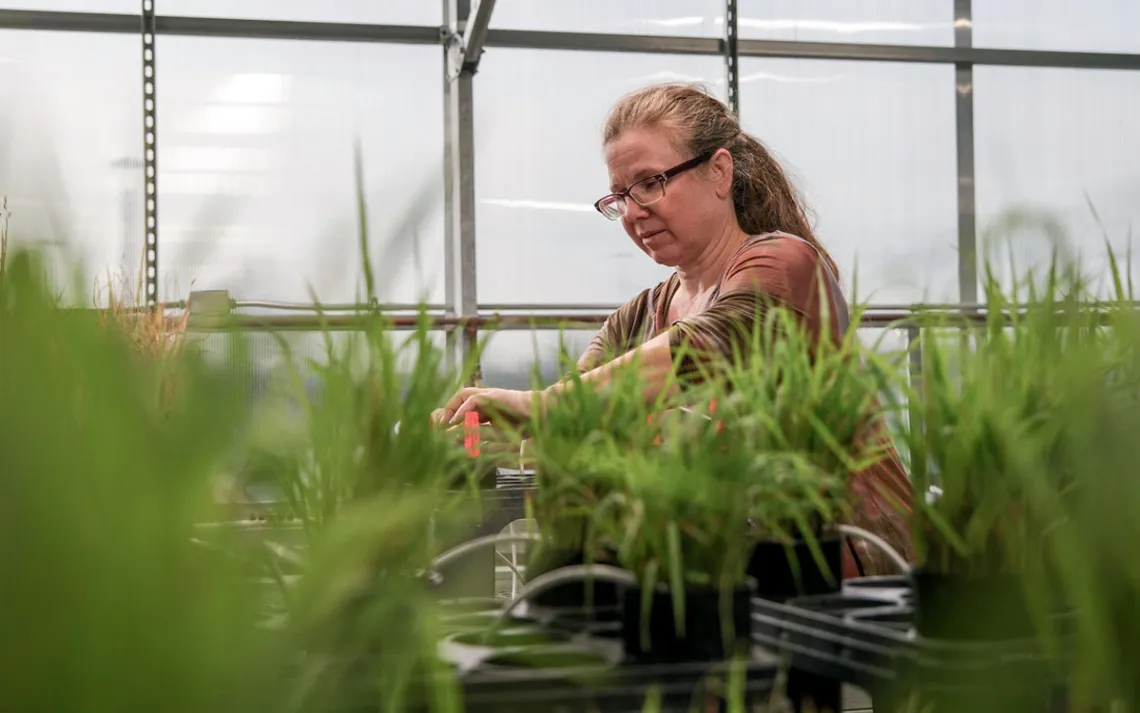
Terra Lubin works in the INVAM greenhouse in Lawrence, Kansas. | Photos by Arin Yoon
Nestled amid Kansas's rolling hills and cornfields, Lawrence is a compact college town that’s home to an unassuming but important greenhouse. Inside, the air is kept at a balmy 70-some degrees year-round and most of the pots contain weedy-looking grasses. Next door, a cold storage room preserves soil in more than 2,000 plastic bags stacked from floor to ceiling.
You’d need a microscope to understand the true treasure of this collection. Scattered in all this dirt are spores galore in various shapes, sizes, and colors and with different surface ornamentation. Some look like delicate glass beads, others like tiny acorns—their individuality helps scientists tell species apart. All the spores—fatty reproductive cells—have the understated potential to restore out-of-balance ecosystems.
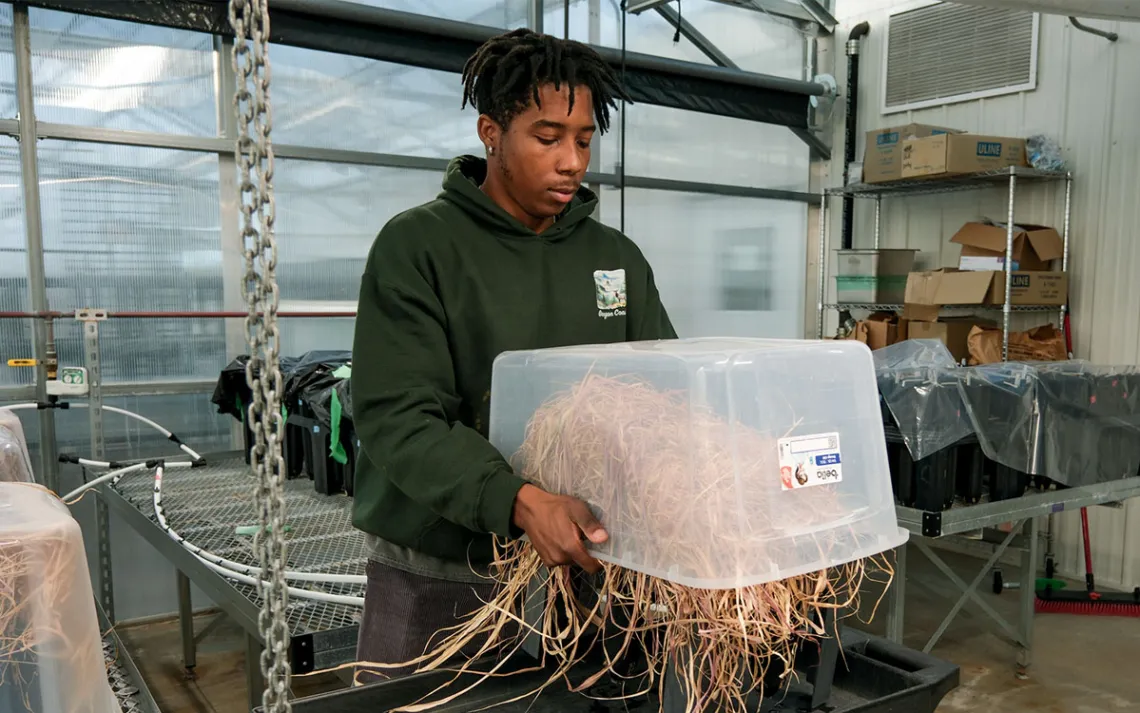
Yalone Woodruff prepares dried Sudan grass and soil for spore harvesting.
The spores are part of a living library of arbuscular mycorrhizal fungi, tiny organisms that live in symbiosis with the roots of plants. The University of Kansas institution that cares for them has a mouthful of a name that’s right on the nose: The International Collection of (Vesicular) Arbuscular Mycorrhizal Fungi, or INVAM. Its mission is to maintain 900 isolates from 63 species of this type of fungi to share with the scientific community. Most of these lie dormant in cold storage as spores until scientists want to grow them out to distribute among plant hosts.
In nature, arbuscular mycorrhizal fungi are long-standing evolutionary partners to plants, making them indispensable members of a functioning ecosystem. They are entirely dependent on their hosts for survival, and in exchange, they offer the plants protection against environmental adversity, boosting their resistance to pathogens and tolerance to drought. The plants also feed the fungi; in return, the fungi help plants scour for nutrients and water in the soil. An estimated 80 to 90 percent of all terrestrial plants have this mutually beneficial living arrangement with arbuscular mycorrhizal fungi.
Jim Bever and Peggy Schultz, INVAM’s co-directors and lead curators, are deeply invested in restoring the tallgrass prairie that once blanketed midwestern North America, sprawling as far south as Texas and north into Canada. As much as 96 percent of these grasslands have been lost, converted into the Corn Belt’s agricultural fields. The overprocessing of these fields gradually wiped out the fungi. Simply planting native grasses in former croplands has failed to reestablish the original biodiversity.
In early field trials, Bever’s team showed that restoration plots inoculated with native mycorrhizal fungi had three times the plant community diversity of untreated fields. Now the researchers work with conservationists to reintroduce native plants plus their fungal helpers to return swaths of farmland back to their natural biomes. “The results are very clear and very consistent,” said Bever. “Reintroducing native mycorrhizal fungi improves the establishment of these high-conservation-value prairie plants.”
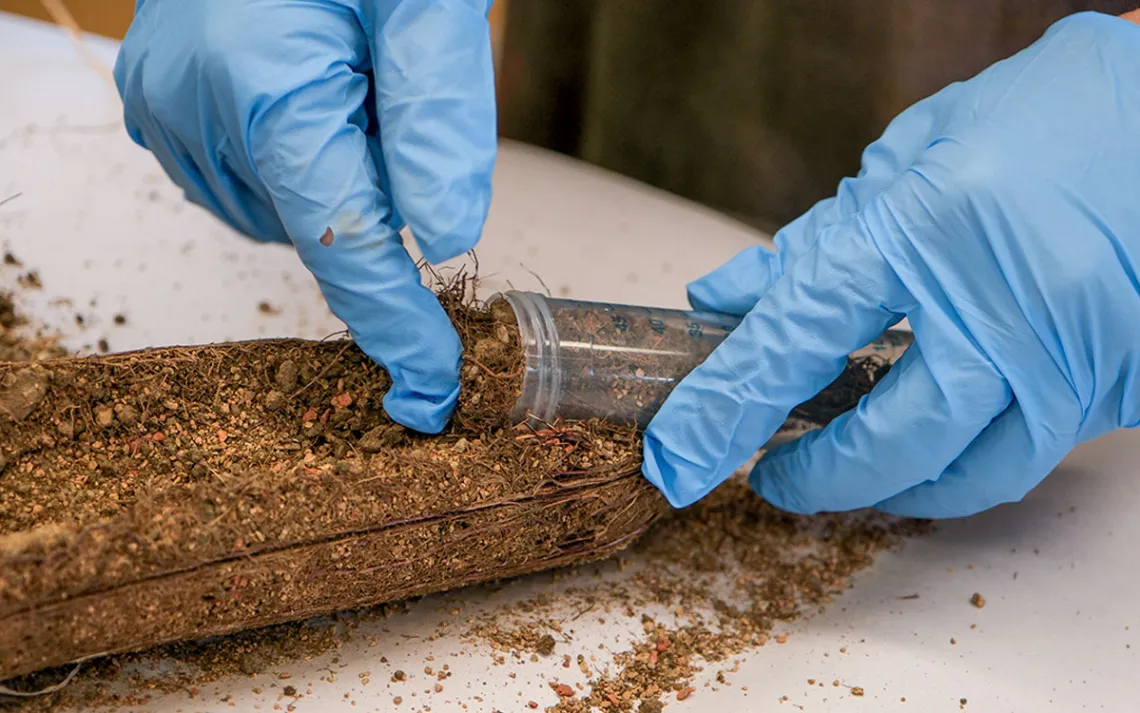
Lubin gathers dried, spore-enriched soil to add to the INVAM collection.
Since INVAM’s inception over four decades ago, there have been major advances in information about mycorrhizae and how to curate them. The institution now houses specimens from nearly every continent, making it a resource for the scientists who continue to move the field forward. Many of the specimens from the United States were personally collected by the INVAM staff over years.
Some stand out to their human caretakers, such as the spores of Entrophospora infrequens, with their fuzzy surface resembling a shag carpet. Then there’s Racocetra gregaria, whose bronze-colored spores look like they’re covered in powdered sugar. Some of the largest spores belong to Gigaspora gigantea, lemon-yellow gumballs so big they’re visible to the naked eye.
A highly textured surface is part of a fungi spore’s defense mechanism against other hungry microbes, along with its thick shell. In fact, when you smash a large spore, you can hear it pop—it sounds like a person smacking their lips in the distance.
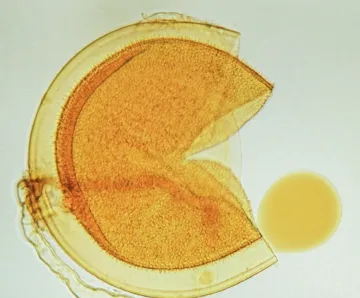
“It’s crazy you can hear a single cell breaking,” said Liz Koziol, an associate curator at INVAM. When a spore splits open, it spills its fatty guts; the tableau resembles Pac-Man chasing a power pellet under the microscope. She said that triggering this “lipid vomit” is as satisfying as popping bubble wrap.

Tubes of spore-enriched soil are stored in a fridge.
Maintaining a spore bank is no easy task. Compared with seeds, spores have a much shorter shelf life—only a few years. To ensure INVAM’s spores are perpetually viable, scientists grow all of them out every year, then harvest a fresh batch from the new fungal generation. Considering the size of the collection, this means that INVAM’s staff is always, always planting.
To harvest new spores, INVAM’s researchers mix spore-enriched soil with seeds of Sudan grass, which plays host. After 16 weeks, they dry out the mixture in the pot. The stress of dehydration triggers the fungi to sporulate. Enriched with fresh spores, the pot’s soil becomes the next culture to enter INVAM’s collection. The entire procedure for one species takes about five months. Practitioners shuffle dirt from container to container and follow a complex process for extracting spores, including running a centrifuge at 3,000 revolutions per minute.
“There are a lot of moving parts,” said Terra Lubin, an associate curator at INVAM. Her clothes are peppered with bleach stains from the constant cleaning she does to prevent fungal cross-contamination between containers—including sterilizing the exterior of grass seeds before planting.
INVAM’s repository of mycorrhizal fungi is the biggest in the world, yet it contains only a small fraction of the mycorrhizal species in nature. “It’s both inadequate and the best,” Bever said. He’d love to expand INVAM’s collection, but he and his team recognize that they might not have the hands or the funds to keep up with the strict schedules of propagating all their new spores regularly. Maintaining the existing collection already requires an army of staff scientists, graduate students, and undergraduate interns, not to mention continuous funding. The team is currently seeking support from various federal agencies plus private foundations to keep INVAM going.
Bever is painfully aware of his team’s burden. “If you stop investing in [INVAM], it’s gone,” he said. He’s hopeful that others will continue appreciating the value of such a demanding, exquisite collection, even long after he and Schultz retire. “If INVAM still exists in 20 years, I will call it a success,” he said.
The Underground Network
Dig a little deeper into the world of mycorrhizal fungi.
Invisible but Everywhere
In the wild, they can form huge networks that span an entire forest and facilitate nutrient exchanges between trees. However, species are usually picky about which plants they strike up partnerships with.
Global Do-Gooders
Synthetic fertilizers and pesticides are expensive at industrial scales, especially compared with the free benefits of mycorrhizal fungi. Researchers are using these fungi in restoration projects worldwide, from revegetating old mines to reviving native biodiversity in places like Hawai‘i, where invasive species threaten endangered flowers.
Not Always a Hero
Mycorrhizal fungi can be invasive too. On the Galápagos Islands, foreign-brought specimens are partly to blame for turbocharging the spread of invasive plants.
Bottom-Shelf Bust
You can buy commercial mycorrhizal mixes in garden stores, but research has shown that they don’t necessarily boost plant health. You’re better off using conventional fertilizers in your yard, rather than these unregulated mixes with generic and poor-quality spores.