When Indigenous Knowledge and Climate Science Meet, Good Things Happen
Tribal leaders and climate coordinators are working together to protect lands and waterways
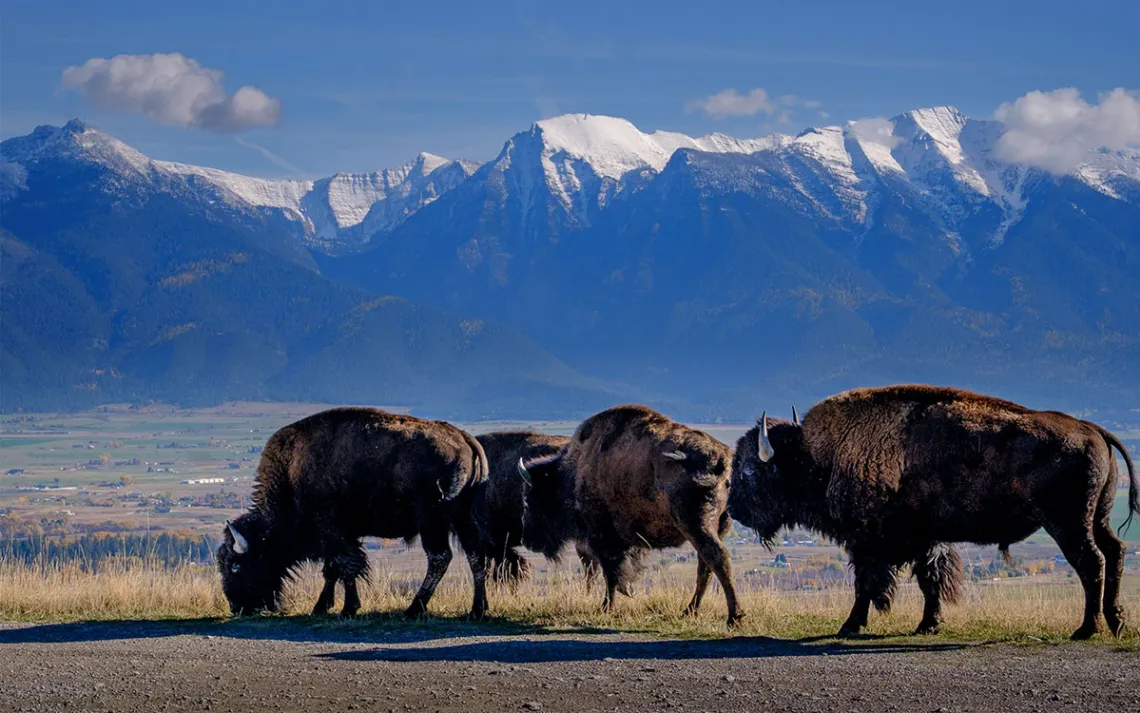
Photo by Matthew Hamon
Standing outside the visitor center for the CSKT Bison Range, on the Flathead Indian Reservation, Mike Durglo Jr. suddenly went silent. The gregarious climate coordinator for the Confederated Salish and Kootenai Tribes gazed eastward, toward the Mission Mountains, their peaks covered in snow beneath a clear blue Montana sky.
“I remember going out there to visit my grandparents; my dad would speak fluent Salish,” said Durglo, whose Indigenous name translates to Standing Grizzly Bear. “After the Allotment Act, well, that’s where their allotment was.”
The General Allotment Act was passed in 1887 to force the assimilation of Native Americans by breaking up tribal lands into individual parcels. Large tracts were opened for settlement, and tribal members often became a minority presence on the land their ancestors had stewarded. For the Confederated Salish and Kootenai Tribes, this upheaval led to the sale of their bison herds and the loss of their primary source of protein, warmth, and cultural strength.
In 2022, some of that damage was repaired when the federal government fully transferred management of the 18,800-acre bison range to the tribes. Descendants of those original bison roam free on this culturally invaluable nature reserve, where they’re celebrated and protected alongside thousands of deer, elk, and bighorn sheep.
Today, tribal leaders and climate coordinators are working together to implement strategies for protecting lands from environmental challenges and a changing climate. They are using Indigenous expertise as their guide. Known as traditional ecological knowledge (TEK), this form of ecosystem management—passed down through generations of observation, experience, and interaction with a changing environment—offers a holistic approach to land stewardship and climate action, marrying ancestral knowledge with modern climatology.
Within the paradigm of TEK, the natural world is not treated as an object to be managed from a distance but as a living relative deserving of care. This tenet guides decisions about harvest levels, land use, and restoration, ensuring that ecological systems aren’t depleted beyond their ability to regenerate.
According to Whisper Camel-Means, a wildlife biologist for the Confederated Salish and Kootenai Tribes, the principle of reciprocity is foundational to how they treat their lands. Along with bison, “we’ve restored populations of trumpeter swans, the northern leopard frog, and the peregrine falcon,” she said. “We’re very active in managing grizzlies, bald eagles, and bull trout because we believe we have a responsibility to care for all the plant and animal communities and all the lakes and rivers on our reservation.”
Shortly after assuming management of the CSKT Bison Range, the tribes installed a solar-powered mesonet station that records and publicly shares meteorological and hydrological data, helping guide conservation goals and climate adaptation planning. These data inform how and when the tribes thin the range’s ponderosa pine forests to encourage prairie recovery and boost biodiversity. The tribes have developed new techniques to identify the most resilient whitebark pine trees—a keystone species that shades snowpack and slows melt on surrounding mountaintops—so that their seeds can be collected for reforestation.
From 2012 to 2013, Durglo consulted with eight elders to devise the tribes’ climate action plan. The elders—many speaking in Salish, Kootenai, or Sanka—shared wisdom rooted squarely in the principles of TEK. His father spoke about high-elevation medicinal and food plants and how those might change in a warming world.
“The face of the earth might burn up,” another elder told Durglo. “But we’ll still be here.”
The tribes sent Durglo across the country to collaborate with other Indigenous nations on designing their own locally and culturally relevant action plans, which go beyond carbon and species-restoration metrics to honor communities as well as spiritual relationships with ancestors.
Durglo also developed climate change plans with the Institute for Tribal Environmental Professionals. The institute gained recognition in 2021 after unveiling the first version of its Status of Tribes and Climate Change Report, featuring 90 authors and artists. The 248-page second volume, released in 2025, is as packed with technical data as it is rich in spirituality and history. It includes case studies on how tribes are reintroducing cultural burns, or “good fire,” and how those practices are improving biodiversity and resilience.
Nikki Cooley of the Diné Nation, the institute’s director, said the report grew out of a conversation among colleagues about how the Intergovernmental Panel on Climate Change and other major climate assessors often gloss over Indigenous efforts. “We’ve always been doing this work; we’re just documenting it now,” she said. “To see it actually reflected in a larger space, across government agencies and institutions—well, it’s about time.”
Durglo was called to Washington, DC, in 2023 to help the Department of the Interior develop a handbook for staff that aligns with TEK. The handbook puts Indigenous methods on par with Western scientific approaches, integrating traditional wisdom into federal decision-making processes. In one section, tribal observations of wolves in Southeast Alaska are woven in with scientific data on wolf populations and habitat.
Durglo frequently illustrates the importance of combining traditional ecological knowledge with contemporary science by invoking the image of a canoe and a colonial ship. “We’re here together on this waterway, traveling down this same river of life,” Durglo said. “It’s not for you to assimilate me or me to Indigenize you. But when we come to the rapids, we’ve got to help each other out.”