Marching Mangroves Threaten This Delicate Florida Ecosystem
South Florida residents worry about the inland and northward advancement of the trees
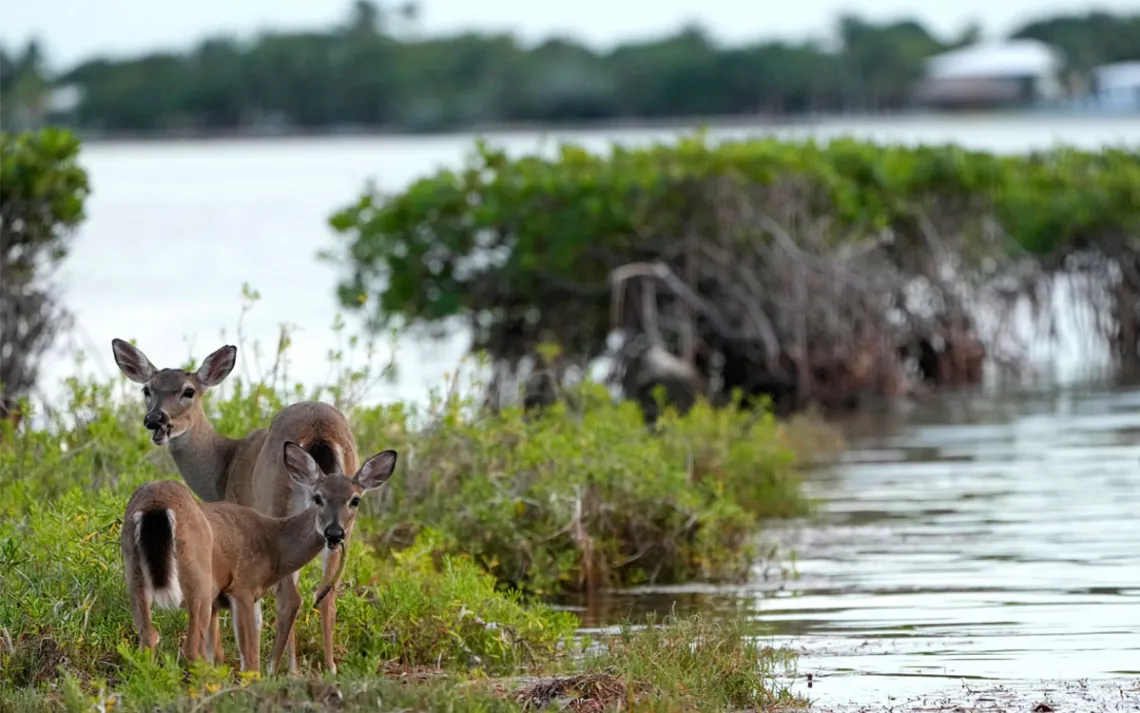
Key deer walk among mangroves in Big Pine Key, Florida. | Photo courtesy of AP Photo/Lynne Sladky
Jimmy Wheeler cut the speed of his fishing skiff, slowing to a chug as he steered into a mangrove forest. Trunks stretched upward, roots twisted and tangled below. Wheeler focused on a serpentine strip of navigable water. “Watch your head,” he warned, unable to clear a low-growing branch spanning the narrow channel. This isn’t the landscape Wheeler, 41, remembers from his boyhood.
“If you can imagine it, this was all grass,” he said, looking around. He and his friends used to run jon boats side by side through this very spot, once part of the vast aquatic grasslands in and around Everglades City, a little outpost on the western edge of the Everglades. But the mangroves have moved inland, multiplied, and made the area unrecognizable to residents like Wheeler.
Mangroves are tropical trees that flourish in estuaries, where freshwater and saltwater meet. They’re known as “walking trees” for their unusual root systems, which look like spindly legs. Indeed, they’re on the move, here and in other coastal regions globally, advancing inland and northward at rates that surprise observers. Near Everglades City, they’ve “walked” as far as 12 miles inland, jumped a highway, and are advancing through swaths of the “River of Grass,” as the Everglades are known.
In other contexts, such vigor is celebrated. Mangroves sequester carbon, provide habitat for fish, birds, and small mammals and blunt shorelines from storms. In fact, mangroves spared Florida $1.5 billion in surge-related damage from Hurricane Irma in 2017, according to a study by The Nature Conservancy. As such, media attention, policy decisions, and public conversation are generally focused on mangrove protection and restoration.
Wheeler and fellow residents don’t question the value of mangroves—when they stay in their traditional, shoreline locations. But what happens when they don't? Residents are questioning the rapid expansion of these ecosystem-shaping plants. The heart of their concern, though, is deeper than that: The land that defines this community is becoming unrecognizable. Everglades City is on the front lines of vast ecological change—but it is far from the only place that will have to contend with such things.
“There’s a balance, and we’re way off balance,” said Mike Merritt, 63, a fishing guide who’s been navigating these waters since he was a teen.
Mangroves and marshes
Ecologist Mike Barry has spent the last three decades studying the vast conservation lands of southwestern Florida and chronicling ecosystem change. In one 2013 report, Barry and fellow researchers studied 70 years of vegetation changes across 98,000 acres of an estuarine reserve. Mangrove forest composed 5 percent of the terrestrial portion of the reserve in 1940; by 2010, it spanned 19 percent. Today, it is more than 80 percent.
Marshes, meanwhile, vanished. In one 100-acre sample taken near Everglades City, marshes shrank from almost 86 acres in 1940 to 7.4 acres by 2020. “The tides are coming up,” Barry said, “and the marshes have drowned even faster than the mangroves can come in.”
Although mangroves and marshes share commonalities, such as protecting shorelines, sequestering carbon, and providing habitat, there are, of course, differences. Some bird and fish species, for example, depend on one or the other. Mangroves are superior when it comes to building soil, a key defense against sea level rise. Marshes are nature’s water purification system, absorbing contaminants picked up on land. Both are important to maintain nature’s balance, scientists say.
“We’ve been preaching about this for a long time,” said John (Jack) Meeder, a professor emeritus at Florida International University. He studied mangrove migration on the eastern side of the Everglades, near Miami. Using historic imagery, Meeder and his colleagues discerned that by the early 1950s, mangroves were migrating from the shoreline fringe they occupied in the 1930s at a rate of 31 meters per year, about a third of a football field.

Jimmy Wheeler shows an area near Everglades City still dominated by grasslands. He worries that mangroves will migrate here too. | Photo by Jennifer Reed
Broken hydrology
It was not sea level rise that nudged South Florida’s mangroves on their inland ventures—at least not at first.
“For mangroves, the Achilles heel is altered hydrology,” said biologist Kathy Worley, director of science at the Conservancy of Southwest Florida, based in Naples, Florida, about 40 miles north of Everglades City. Her career has focused on restoring hydrology around urban mangroves that had perished because roadways cut the flow of water. The severed pathways starved the trees of oxygen.
In the Everglades, altered hydrology had a very different effect. Beginning in the 1800s, Florida’s fledgling developers drained and ditched these vast wetlands, which once spanned the lower third of the state. In doing so, they altered the natural movement of rainwater, which once flowed from central Florida to its southern tip. Among many other benefits, this steady freshwater presence acted like a barrier against saltwater intrusion.
Roads bisecting the peninsula also blocked the water’s southward journey. Wheeler shakes his head at the irony of it—his own great-grandfather was among the men who carved the Tamiami Trail (US 41) through the Everglades in the 1920s. Back then, the environmental ramifications weren’t understood, and the road was celebrated as an engineering feat.
In freshwater’s absence, saltwater pushed onshore. Mangroves followed. In December 2000, Congress passed the Comprehensive Everglades Restoration Plan to restore the hydrology in a diminished River of Grass. Migrating mangroves weren’t the driving force behind it—the chief concerns were dehydrating wetlands, hypersaline coastal waters, inadequate drinking water, and the loss of plants, wildlife, and marine ecosystems. But the mangroves were an early warning sign of a wounded landscape.
“The main thing we need to do now is stop further encroachment,” said Merritt, the commercial fishing guide. His daily hauls are a fraction of what they used to be. Merritt knows no single factor is to blame, but he wonders how much the loss of marshes and grass flats has impacted fish populations. “As locals, we’re trying to understand what’s happening,” he said. “It’s been a slow death.”
Replumbing the Everglades may help. North of Everglades City, for example, engineers have plugged three massive drainage canals and installed pump stations to spread rainwater across the landscape, mimicking how nature once distributed it.
“The very best thing we can do as land managers is restore the hydrology and keep the ecosystem as healthy as possible,” said Barry, the ecologist. The drainage canals not only starved the land of water, but they also invited mangroves upstream, Wheeler added. But both men are skeptical that the restoration projects will halt mangroves’ spread—Wheeler thinks the efforts haven’t gone far enough and Barry believes there are new forces at work: higher tides and rising seas.
“The biggest thing that surprised us is we thought mangroves were killing marshes,” Barry said. Now he regards a jump in tides—especially low tides—about 15 years ago as the primary culprit. Barry uses an undeveloped island northwest of Everglades City as a barometer. Even without hydrological tampering or storm surge, mangroves are cropping up mid-island, driven in by the tides.
Forces that once kept mangrove populations in check are now rare. The county that includes Everglades City hasn’t had a freeze in 25 years. Prescribed fire is a common practice in Florida, but it’s hard to ignite a blade of grass—fire’s fuel—that isn’t there.
That’s why Scott Jones is seeing tropical mangroves in temperate Georgia.
Jones, a coastal ecologist and assistant professor of biology at the University of North Florida, was part of a research team that last year found what’s believed to be the northernmost population of mangroves, in southern Georgia. Storms do carry propagules, mangrove seedlings, miles from their parent trees. Those that take root, however, usually succumb to freezes and competition from freshwater species. But Georgia is getting warmer and saltier, and Jones and his colleagues have found at least a thousand in their survey area.
“A little bit of sea level rise on a flat landscape goes a long way,” Jones said.
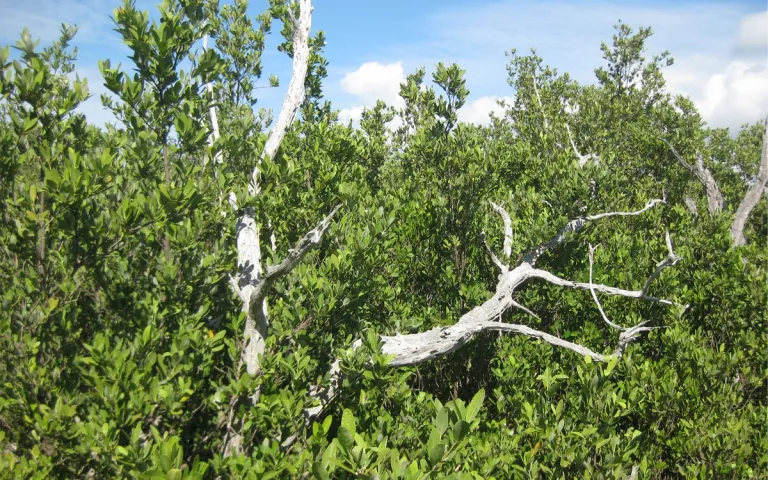
This buttonwood snag was once the border of an upland forest and is now surrounded by mangroves that have migrated inland. | Photo by Mike Barry
What to do about the mangroves?
Wheeler thinks policymakers should reconsider Florida’s mangrove protection law, which makes it illegal to remove or trim the trees without a permit. The law makes sense in areas where mangroves were lost and the coastline left exposed to storms and erosion, Wheeler said. But here? “It’s a strangulation of the Everglades,” he said.
Reducing protections, though, may be a hard sell. Between 1996 and 2022, the world lost about 2,000 square miles of mangroves, an area roughly the size of Delaware, according to the Global Mangrove Alliance. Mounting public awareness of their benefits, including the storage of 21 billion tons of carbon and protection of some 15 million coastal residents, has slowed their losses, though forces like sea level rise and storms pose significant threats.
Along the Florida-Georgia line, where the mangrove spread is less pronounced than it is in South Florida, scientists and policymakers are considering whether they can strike a balance between mangrove expansion and marsh preservation. At the Merritt Island National Wildlife Refuge, for instance, researchers are proactively removing some mangroves while restoring marshes. Even with this type of hands-on approach, they may not be able to hold the line forever. Some scientists project a vast inland shift of all habitat types, as plants respond to a landscape reshaped by water. “The peninsula of Florida is shrinking,” Barry said.
Everglades City–area residents might not describe themselves as such, but in a way, they are lucky: Along Florida’s coastal cities, development prevents plants from moving at all. They’re simply swallowed by the sea.
“Species have to be able to migrate across the landscape,” said Brian Bovard, an ecologist and associate dean at Florida Gulf Coast University’s Water School, in Fort Myers. He’s concerned about plants that can’t adapt as readily as mangroves.
Regardless of their stance on managing migrating mangroves, those watching the ecosystem changes agree: There should have been more public conversation—and much, much sooner. Residents like Wheeler and Merritt—men who make their living on these waters—want to share their concerns with scientists. The researchers themselves don’t always feel heard, either. Despite the billions Florida has spent on Everglades restoration, its elected leadership has been infamously restrictive on climate-related discussions.
“If we were able to talk about this more and think about it more … we would have been much further ahead with this,” Barry said. “We’ve been pretending it’s not going to happen.”