Farmworkers Brave Deadly Heat, Pollution, and ICE Raids
Here's how communities take care of their own in California's Coachella Valley
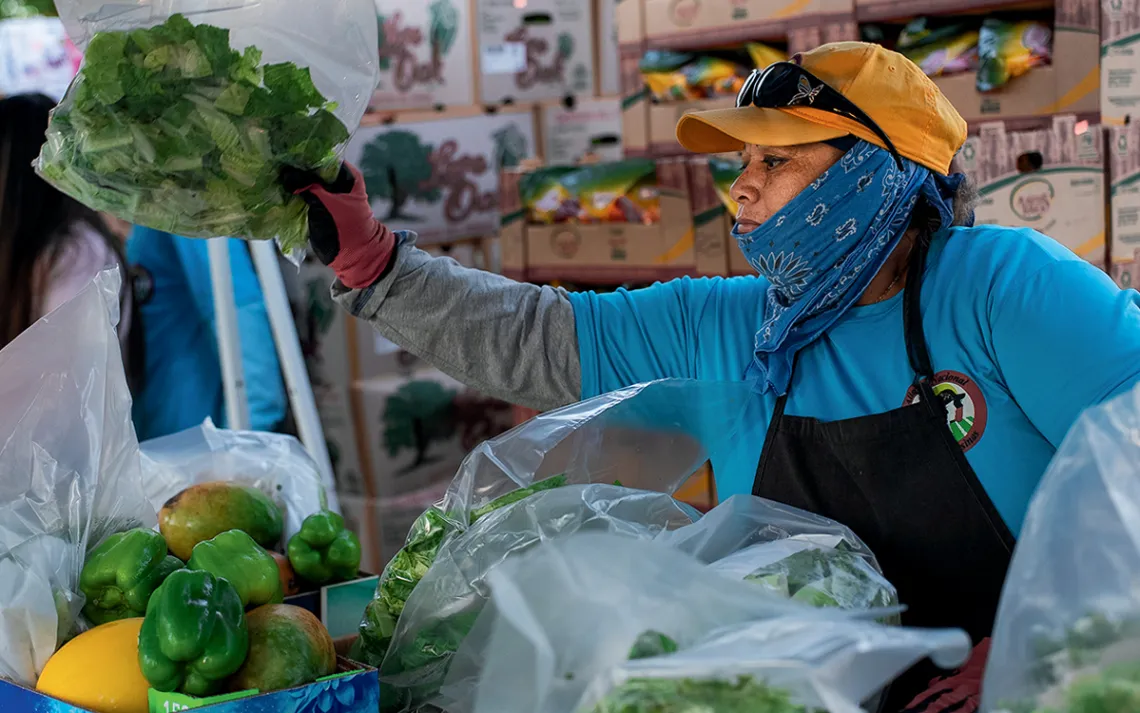
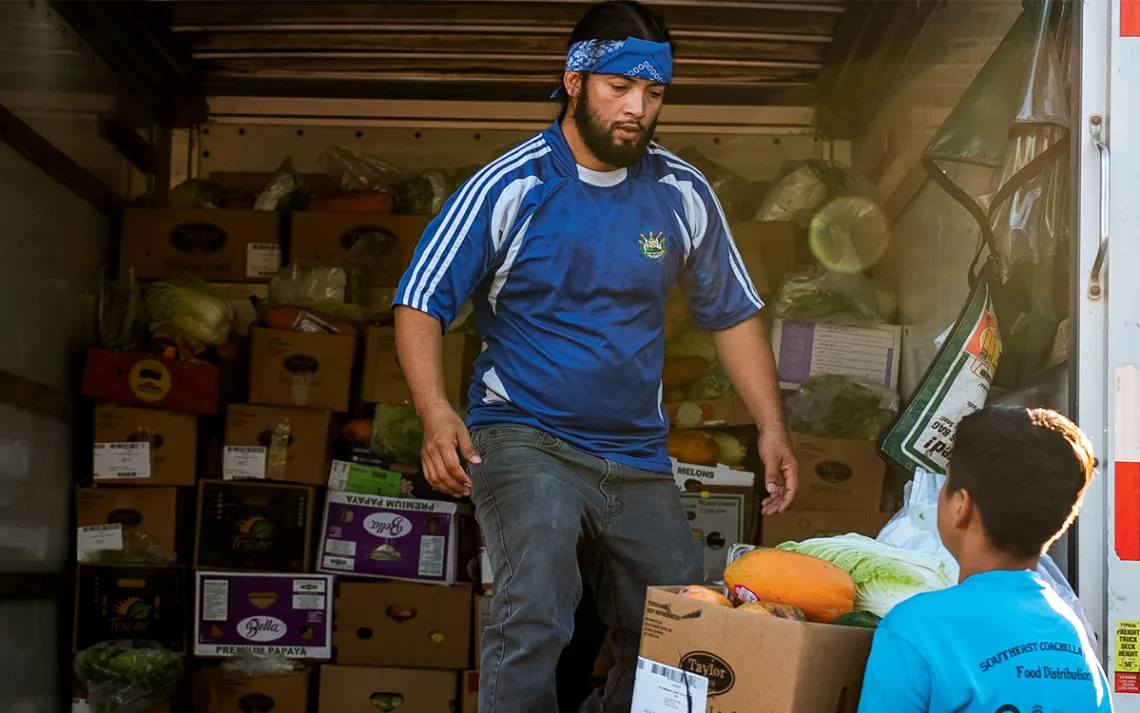
Volunteers with Alianza Nacional de Campesinas distribute cartons of produce to California farmworkers and their families.
On a September morning in the Inland Empire of California, sunlight peeks through fronds of date trees, scattering shadows on the ground. Mily Treviño-Sauceda has been awake since 4:30 a.m., prepping a truck with a team of volunteers for a monthly food drive.
“We have to deliver to the cars passing through as quickly as possible,” Treviño-Sauceda says. The midday heat can reach triple digits in the desert. “People who cannot have their cars on with an air conditioner have had health problems.”
Treviño-Sauceda is the executive director of Alianza Nacional de Campesinas, a nonprofit that advocates for labor justice in California and offers direct support to farmworkers and their families. She has spent the past five decades fighting for the dignity of the women harvesting the food that gets placed on American tables. Part of Treviño-Sauceda’s daily job is helping women who work long hours in the fields tackle the list of problems they regularly face, including sexual harassment, wage theft, pesticide-related illnesses, and heat stress. Her work has taken on a new urgency for two reasons: rising temperatures because of climate change and the hardline immigration policies of the Trump administration.
With such a full plate, Treviño-Sauceda starts her day with the basics—making sure that farmworkers have enough to eat.
We arrive in the parking lot of Mission San Jose at 6:45 a.m. A caravan of cars is already waiting for the 9 a.m. drive-through to open. A majority of those in line at this Riverside County church are low-income immigrant farmworkers who rely on the fresh fruit and vegetables to feed their families, Treviño-Sauceda explains.
“The box of food that people are getting right now—they’re going to try to make it last, not for a week but for two, three weeks,” she says. Despite harvesting tons of the crops that feed American families, these farmworkers are not always able to feed their own.
The Coachella Valley Music and Arts Festival, Joshua Tree National Park, and the city of Palm Springs draw visitors from around the world. But many tourists who pass through this region never see the cluster of sparsely populated, unincorporated communities—among the poorest in Southern California—in the Coachella Valley’s southeastern corner.
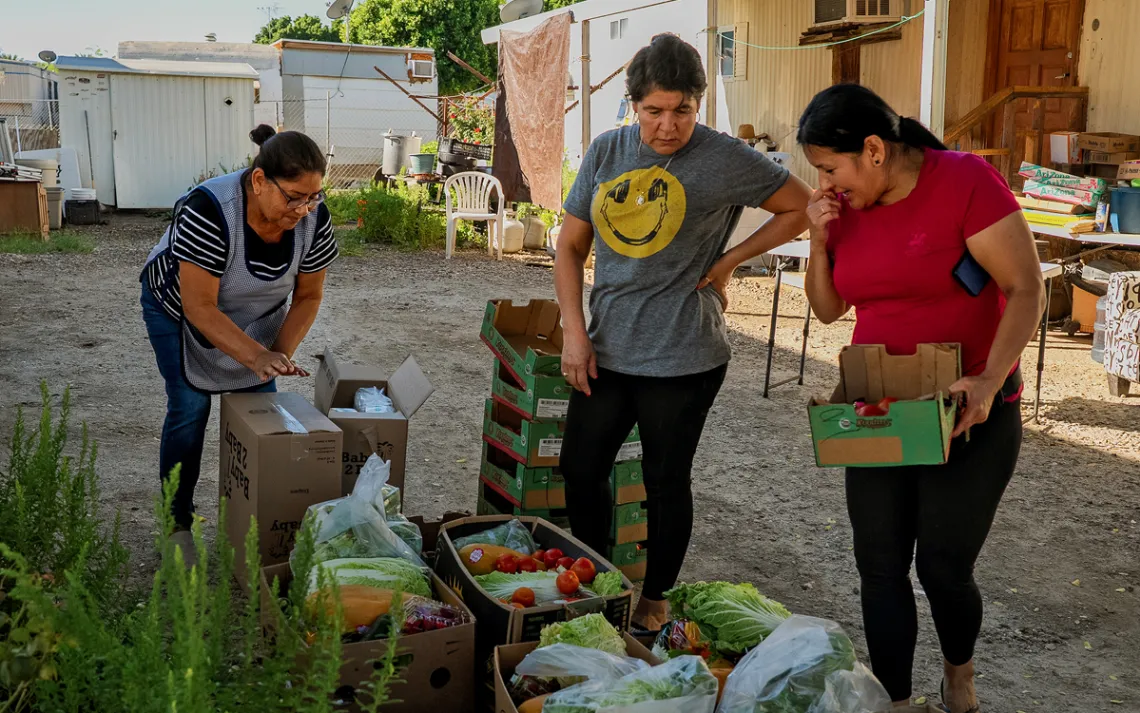
A group of volunteers and Treviño-Sauceda set off in several U-Haul trucks to deliver food boxes to a series of mobile-home parks that she calls “the work camps.” Some of the dwellings are little more than shanties, pieced together with scrap metal and fraying tarps. These properties often lack the proper air conditioning to combat temperatures that can reach a blistering 120°F in summer. As Treviño-Sauceda and I ride through the area, she points out that there is just one grocery store for miles, selling goods often priced so high that the workers can’t afford them.
We meet Deette Amezquita in one of the trailer parks. She offers thanks as volunteers hand over a carton full of lettuce, melons, papayas, cucumbers, bell peppers, and tomatoes. Nearby sits a giant plastic jug. Exposure to chemicals, in the fields and in tap water, is one of the most harmful realities of farmwork. Amezquita and her neighbors have filtered water delivered regularly.
“You peel off one layer of problems after another–federal, state, local–down to the body of the farmworker.”
“They keep us trained: how to keep hydrated, what to wear, what not to wear when you’re working in the fields,” Amezquita says of her workplace-mandated safety education. The 36-year-old mother of five takes extra precautions at home because of pesticide exposure from harvesting crops. “When we get home, we take clothes off in front of the washer . . . and never wash them with the kids’ clothes,” she says.
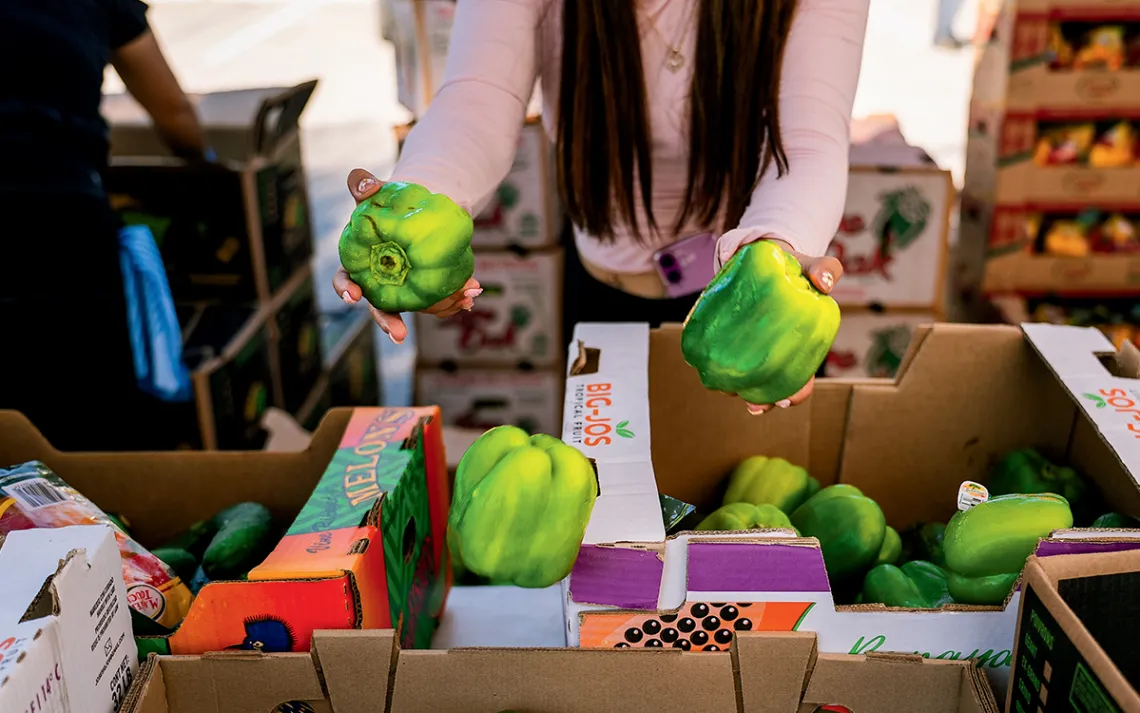
According to the National Institute for Occupational Safety and Health, farmworkers in the United States have some of the highest rates of occupational injury and deaths. Between 2021 and 2022, the agency found, more than 21,000 injuries during agricultural production forced workers to take time off from paid work. Many other injuries go unreported.
Climate change is contributing to the deadly working conditions. According to the National Oceanic and Atmospheric Administration, the summer of 2024 was the Golden State’s hottest on record. Twenty years ago, California passed landmark legislation mandating that employers provide water, shade, and rest breaks during heat waves. But farmworkers are still falling ill, and critics say enforcement of these laws has been lax.
Without proper resources such as rehydration stations, workers face the risk of cramps, exhaustion, and heat stroke. “It creates a lot of issues when you’re out working in the fields,” Treviño-Sauceda says. “Workers get sick, end up in the hospital . . . some have died.”
Treviño-Sauceda became a farmworker at just eight years old, sorting fruits and vegetables in the fields of Idaho. She continued the same work after her family moved to California. Over the years, she witnessed how women working the fields, especially mothers, endured long hours of hard labor without breaks. She wanted to do something about it, so in 1988, she became an organizer.
Treviño-Sauceda cofounded the grassroots organization Mujeres Mexicanas and in 1992 helped establish Líderes Campesinas, a women-led nonprofit advocating for farmworkers by addressing domestic violence, workplace abuse, and health protection in California. Over time, the group has added climate change to that list of issues as farmworkers increasingly face rising temperatures in the fields.
In 2011, Treviño-Sauceda formed Alianza Nacional de Campesinas, which represents the national interests of over a dozen grassroots organizations advocating for women farmworkers. That coalition—along with Earthjustice, the Center for Food Safety, and Farmworker Justice—sued the Environmental Protection Agency in 2021 to end the use of paraquat, an herbicide banned in the European Union since 2007 after studies tied it to Parkinson’s disease.
Pesticide use is so pervasive in the eastern Coachella Valley that PFAS, known as “forever chemicals,” are leaching into the groundwater, making it unsafe for drinking or showering in some areas. The improper mixing and spraying of pesticides can also have deadly consequences for workers, Treviño-Sauceda says.
When Manuela Ramirez, an organizer with Líderes Campesinas, was working in the fields as a teenager, farmworkers weren’t informed about the health risks posed by their jobs. To this day, the 59-year-old cannot definitively link her heart condition to the years she spent inhaling a cocktail of unidentified chemicals. But Ramirez is still paying the price, spending hundreds of dollars a month on medical bills to treat various ailments.
“I was 18 when I had my first pregnancy. That’s when they diagnosed me with tachycardia,” Ramirez tells me in Spanish as Treviño-Sauceda translates. Ramirez still wonders if any of that pollution affected her child in the womb. “Because we were working for different companies with different kinds of crops, the pesticides changed. We never learned anything about the chemicals,” she says.
It can be hard to trace the poor health of farmworkers to any one cause. Ecosyndemics is the term that Matt Sparke, a professor of geography and globalization at the University of California, Santa Cruz, uses to describe the compounding health impacts from environmental pollution.
“Just like peeling an onion, you start to cry because so many problems are piled on top of each other,” Sparke told me by phone. “You peel off one layer of problems after another—federal, state, local—down to the body of the farmworker.”
Treviño-Sauceda's work has become increasingly vulnerable under the Trump administration. According to some estimates, more than half of California’s approximately 350,000 farmworkers are undocumented. Immigration and Customs Enforcement agents have been cracking down on worksites throughout California. Sparke said this has had a “terrorizing effect” on farmworking communities.
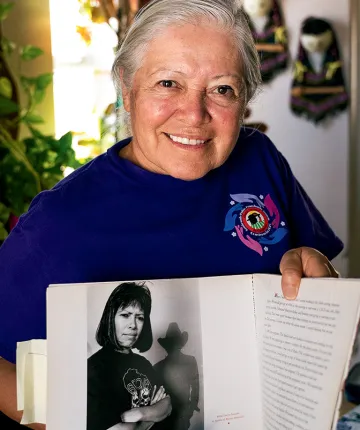
Mily Treviño-Sauceda has spent decades advocating for farmworkers. A photo of her as a young labor rights activist appears in the book Organizing for Our Lives.
Treviño-Sauceda tells me that hundreds of cars used to come to Mission San Jose to pick up food boxes, but “right now, [it’s only] 100 and some.” This is why Alianza Nacional de Campesinas delivers food directly to where the families live. Many are afraid to leave their homes because they fear being picked up by ICE. The city of Coachella canceled its annual Mexican Independence Day celebrations for the same reason.
Alianza Nacional de Campesinas also faces new challenges as resources are being stretched thin.
Earlier this year, the Department of Government Efficiency slashed funding for the Occupational Safety and Health Administration, shuttering local oversight offices—a move that the Center for Law and Social Policy described as an “imminent threat to all workers.” As the budget cuts took effect, according to Treviño-Sauceda, Alianza Nacional de Campesinas lost a large grant it had received from the Department of Labor and was forced to cut five staff members.
Treviño-Sauceda believes that independent watchdog organizations are becoming even more vital as the regulatory power of the government continues to shrink: “Money comes and goes, but people don’t. We want to make sure that people are always there, that we can count on them, or that they can count on us.”
Back at Mission San Jose, under the low hum of cicadas, a dozen volunteers continue to sort pallets of produce into the early afternoon. They rotate breaks in the shade, sipping icy agua de jamaica and munching on homemade burritos. Some have come from as far as Los Angeles to pitch in; others are local residents, like the two 13-year-olds Dane Shryock and Angel Ibarra.
“Every time my aunt comes, I’ve asked if I can come,” Shryock says. He loves giving back, “knowing where the food is going.”
Ibarra nods in agreement as he takes a bite of his burrito. “I wake up at 3 a.m., but I get here at 5,” he says. This Saturday, he gave up sleeping in to tag along with his parents. “I just like coming to help.”