The Hawaiian Green Sea Turtle Is Making a Comeback
How locals and conservationists are helping the honu resurgence
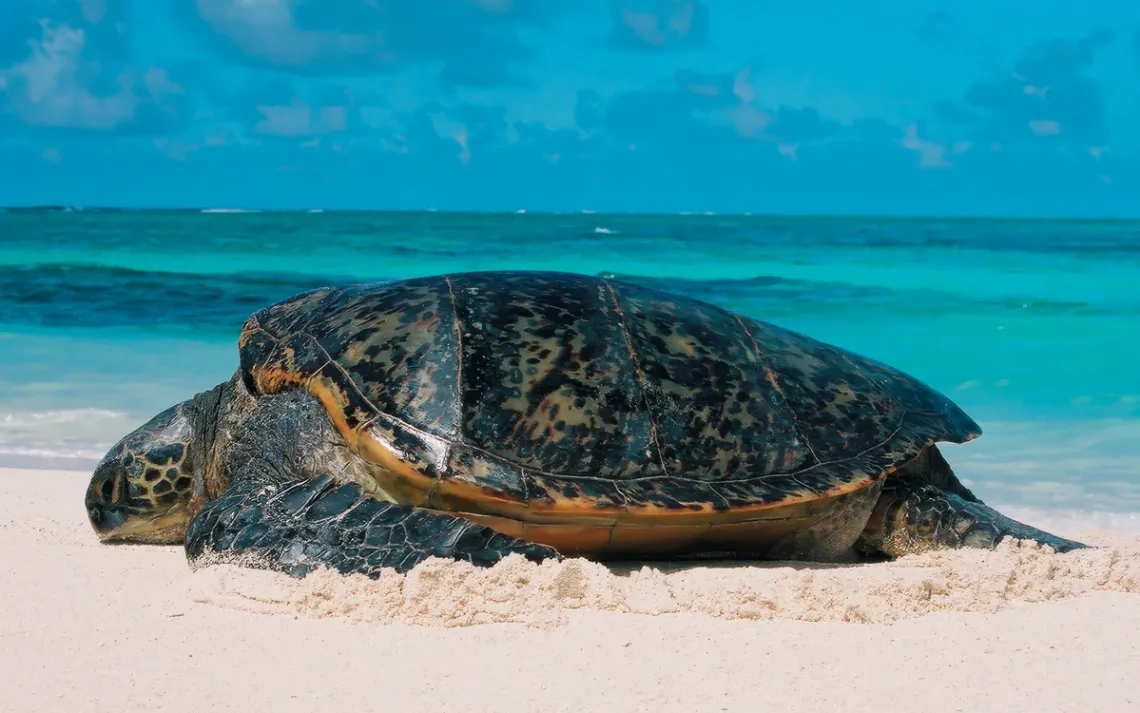
A Hawaiian green sea turtle on the remote atoll Lalo.
We hiked along a beach on Marine Corps Base Hawai‘i, on the windward, eastern coast of O‘ahu, looking for signs of hope. It was May. As we entered a restricted area, Lance Bookless, the base’s natural resource program manager, explained that the ground was mostly barren here when the military was active. Then, after most training stopped in the late 1990s, vegetation returned. Thriving native plants now surrounded us—bright-green bushes called naupaka and Jacquemontia beach vines with delicate light-blue flowers.
Bookless stopped at a sandy berm and pointed. Just above the high-tide line, we spotted what we wanted to see: the shallow pits and fluffy sand mounds of nesting honu, the Native Hawaiian term for Hawaiian green sea turtles.
Nest sightings on the base were unusual until recently. Only seven digs were identified in 2019. Last year, there were 85. Scientists confirmed that 34 of those nests had eggs in them.
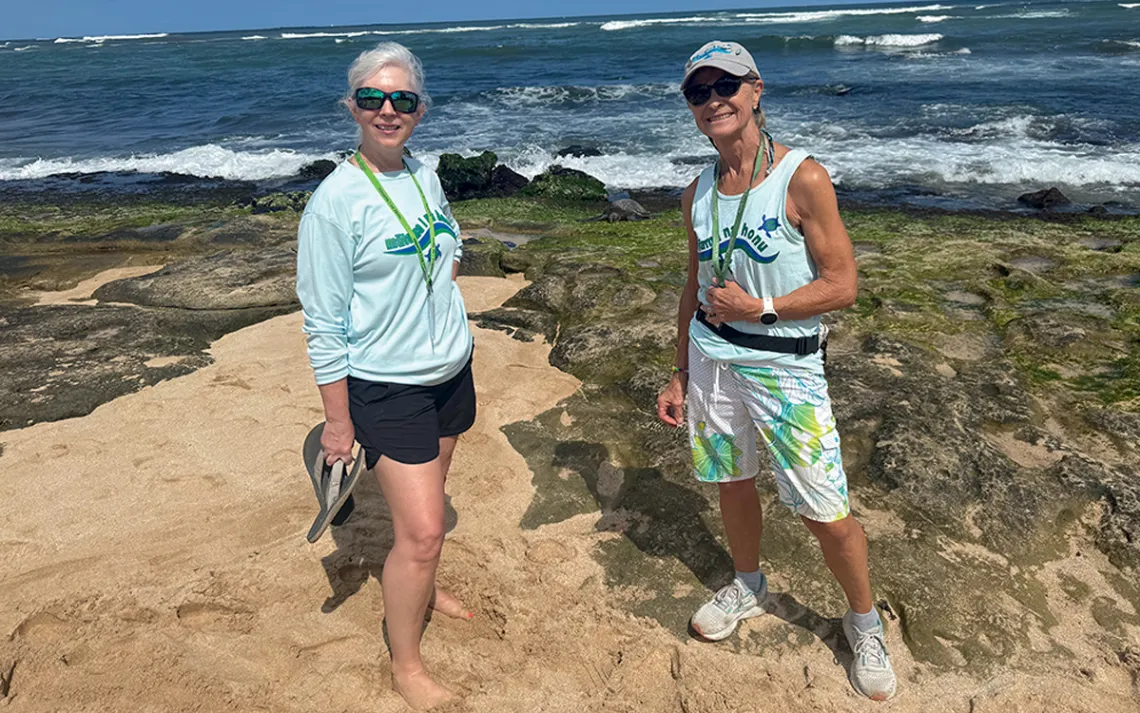
Volunteers educate the public on how to coexist with sea turtles.
For centuries, Native Hawaiians hunted honu sustainably through balanced resource management. Specialists called konohiki oversaw ahupua‘a, sections of land and water. They set rules for harvesting animals and crops, understood how to support honu during nesting season, and could impose a kapu, or ban, to protect the species.
Then commercial traders and other outsiders came to the Hawaiian Islands and began rapaciously hunting sea turtles and selling their eggs and meat. The honu were nearly wiped out. Since then, Native Hawaiians, scientists, and volunteers have rallied around the turtles to save them, and their efforts have paid off.
Today, it’s not unusual for lifeguards and residents of beachfront houses to come across nests. Green sea turtle advocates are working to educate residents and tourists on the best ways to coexist with the animals so they will continue to thrive.
In 1969, George Balazs, a 26-year-old from California, and his wife, Linda, anchored their sailboat off the coast of Lahaina, Maui. When they came ashore, they saw a ramp where men were unloading live, roughly 100-pound Hawaiian green sea turtles from a boat into a pickup truck. Linda cried when she saw how rough the men were with the turtles. Balazs asked the men what they were doing. Taking them to a restaurant, they said.
Two years later, Balazs, who had a master’s degree in animal sciences, began studying sea turtles at the Hawai‘i Institute of Marine Biology. In 1973, he flew to a remote atoll called Lalo also known as French Frigate Shoals and now part of Papahānaumokuākea Marine National Monument—to study nesting mothers. Over a summer, he camped on 11-acre East Island, just six feet above sea level and covered with roughly 30,000 screeching seabirds called sooty terns. He counted only 67 nesting sea turtles on that prime rookery and knew the commercial take he witnessed in 1969 couldn’t be sustainable. Balazs went public with what he’d found and called attention to the plight of the turtles.
Now surfers regularly spot honu coming up for air, and snorkelers see them feeding on algae.
In 1974, the state made it illegal to hunt Hawaiian green sea turtles for commercial purposes but allowed individuals to harvest the creatures for home use. Four years later, both were banned under the Endangered Species Act. The population of turtles on East Island recovered to more than 800 by 2014.
Then, in 2018, Hurricane Walaka virtually wiped East Island off the map, which set back efforts to track the turtles’ recovery. Nearby Tern Island, a former military outpost, became their main nesting ground, but abandoned and deteriorating structures there trap and kill nesting females. The turtles’ chances of survival may improve as more of them nest on higher ground on the main Hawaiian islands. And they are doing just that.
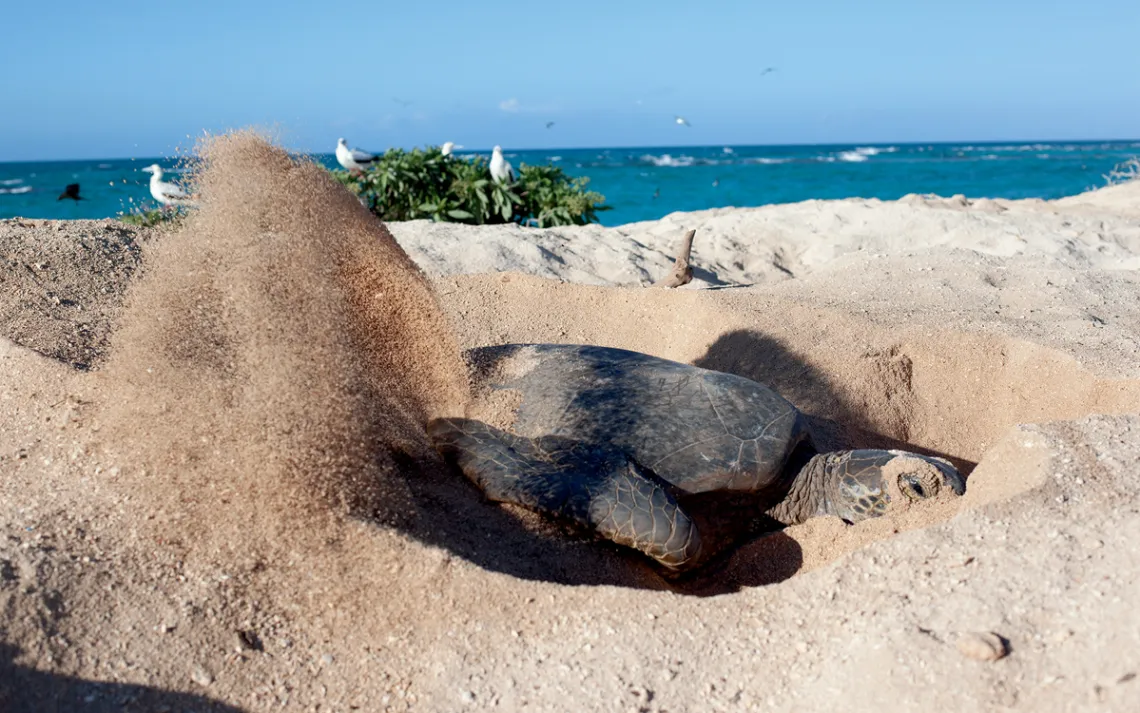
A nesting Hawaiian green sea turtle in Papahānaumokuākea Marine National Monument. As their numbers rebound, the turtles have become an increasingly common sight for residents and tourists across the islands.
For decades, turtle sightings on the islands were rare. “If you saw a turtle, you saw its ass as it was fleeing away from you with the greatest of fear,” Balazs told me. Now surfers regularly spot honu coming up for air, and snorkelers see them feeding on algae.
To see for myself, one morning I drove to Laniakea Beach, on O‘ahu’s North Shore, where sea turtles are known to bask. Tourists park in a dirt lot or along the Kamehameha Highway and then cross to the beach, often holding up traffic. On the beach, signs caution visitors to give turtles 10 feet of space.
At 9:30 a.m., the morning’s first turtle crawled onto a rocky shelf covered in bright-green algae. Ten tourists gathered around, oohing and aahing as the honu’s wet, two-foot-long, brown-and-yellow shell glistened.
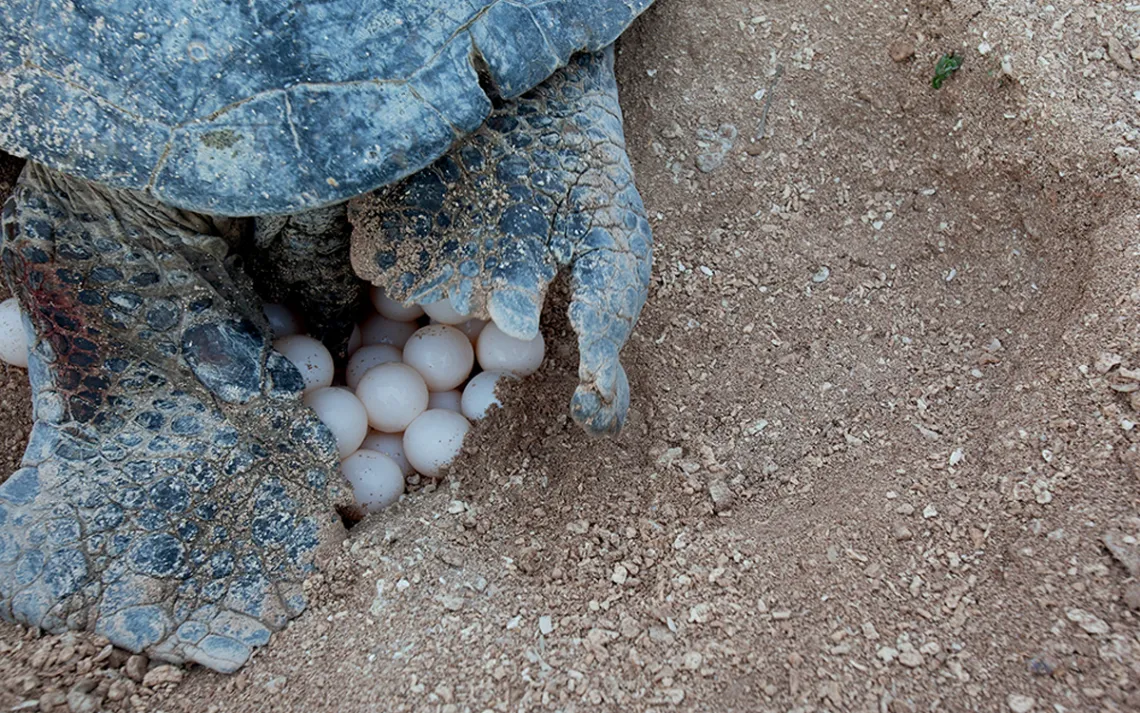
Human activities, including driving ATVs, can threaten turtle nests.
Two volunteers in light-blue shirts from the turtle nonprofit Mālama i nā Honu shared information with onlookers. Sea turtles provide many benefits to Hawai‘i. They eat algae that could otherwise smother coral reefs. Their nests enrich beach ecosystems with organic matter, nourishing plants and stabilizing dunes. The honu are also a central part of Hawaiian culture, appearing in local art, chants, and storytelling. And they support the local economy as the focus of guided snorkel tours and beach visits.
Mālama i nā Honu volunteers also get their message out in other ways. They hand out stickers to children. They send letters to beachfront homeowners, advising them to turn off their lights. (Hatchlings crawl toward the lights, mistaking them for the reflection of moonlight off the ocean.) They leave notes on the gates of rental properties.
“In a given day, I talk to people from all over the world,” said volunteer Denise Lopiano.
On a June morning, US Fish and Wildlife biologist Sheldon Plentovich and I hiked over worn ATV tracks on the northeast shore of O‘ahu. We came to a fresh turtle nest amid the tire marks. Plentovich created a barrier using posts, signs, and blue tape to reroute future drivers and educate them on the importance of minding nesting areas. Although the weight of an ATV on a nest won’t affect hatchings, she said, it compacts the sand enough that many baby turtles can’t dig to the surface and will die without help.
More than 100 volunteers from Mālama i nā Honu patrol 37 beaches on O‘ahu and Kaua‘I and document turtle nesting in an app. As we hiked, Plentovich checked the app for each nest and erected barriers to protect the new ones.
Sea Life Park at Waimānalo on O‘ahu also supports these conservation efforts through education and breeding. When the turtles housed there lay their eggs, Michelle Benedict, assistant curator of reef life, will later collect the hatchlings and release them that night on a nearby beach. More than 17,000 have been set free since the 1970s. Some tagged hatchlings have been identified alive years later. One turtle flown from Lalo to the park in the 1980s was raised by caretakers for roughly a year, then released, and was found nesting on Maui 19 years later.
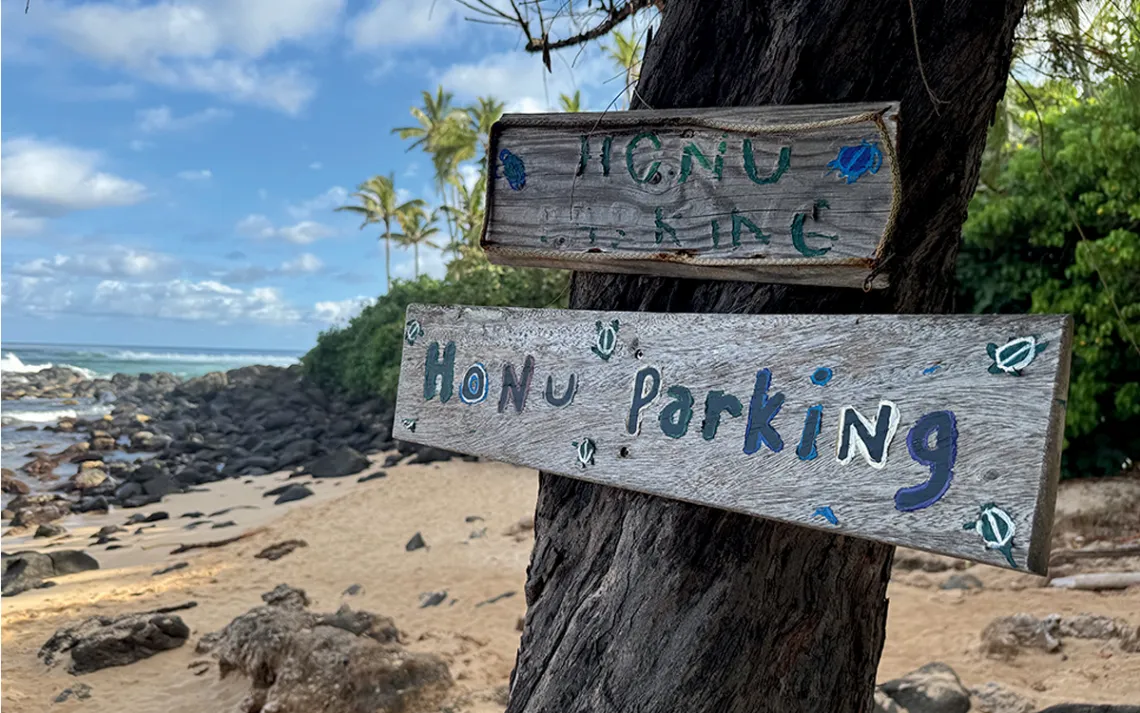
Signs indicate where sea turtles bask.
Plentovich wants the government to do more to protect the turtles from humans and is advocating for the passage of a light ordinance during nesting season. She cites the decrease in beach activity during the pandemic as the most likely explanation for the initial increase in nests. (Between 2013 and 2018, there were about two nests per year documented on O‘ahu. That number rose to 58 in 2020.) Plentovich also thinks that once turtles nest on a beach, they get attached to it and tend to return in subsequent years.
We picked up bits of plastic fishing net and line that could entangle hatchlings. Fishing line in the water has become the leading cause of honu strandings. In total, more than 400 turtles strand every year. Hatchlings that crawl inland toward artificial light face other dangers: They can be run over by cars, eaten by animals, or die of exhaustion.
“I’m responding to the threats every day,” Plentovich said.
Native Hawaiian Danny Akaka is the kahu hānai, or guardian, at the Mauna Lani resort on the Big Island. He shares Hawaiian knowledge with guests, through food, blessings, and history. Turtles anchor many Hawaiian stories, Akaka said, and can be ‘aumākua—ancestors who come back as animals, plants, or rocks to guide, protect, and inspire people.
Sea turtles that return to the nest where they were born are like Hawaiian navigators, Akaka said. They sail to distant islands using natural cues as guides and create a star path so they know how to return home.
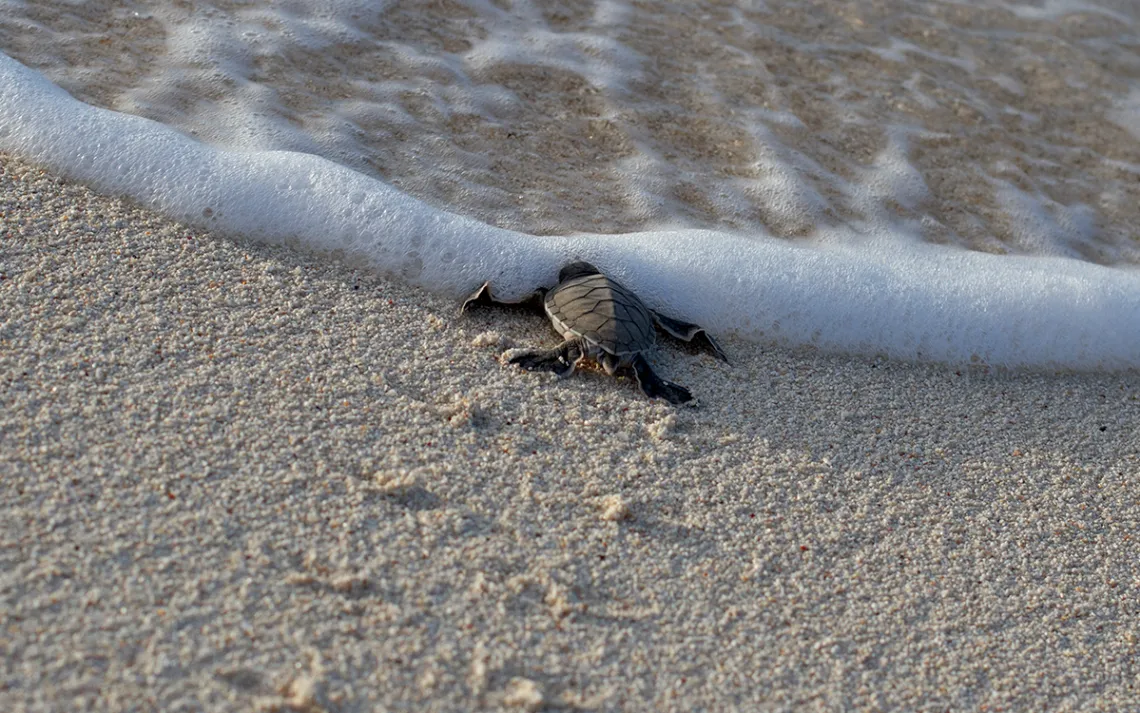
Hatchlings crawl toward light reflecting off the ocean.
The US government still lists the honu as a threatened and protected species. Though nesting is increasing on the main Hawaiian islands, continued conservation and public education are needed to support the turtles’ recovery.
At 82, Balazs still sends out frequent emails to a list of honu enthusiasts. In May, he sent one with photos of a nesting mother on the southeast shore of O‘ahu.
A day later, I drove to that beach. I walked past an older nest near a lifeguard tower to the new one with turtle tracks still visible, not far from a packed parking lot. Tourists walked the beach, and local bodyboarders jogged into the ocean.
Signs on sticks, with neon-green and pink ribbons tied around them, marked the nest to protect it, along with a wooden board propped up by driftwood and rocks. A message was written in silver duct tape.
“Honu, Kapu, Keep Out!”