 The Magazine of The Sierra Club
Corals Face an Existential Threat as the Super El Niño Heats Up
These marine invertebrates are already at risk as the climate crisis drives ocean temperatures higher
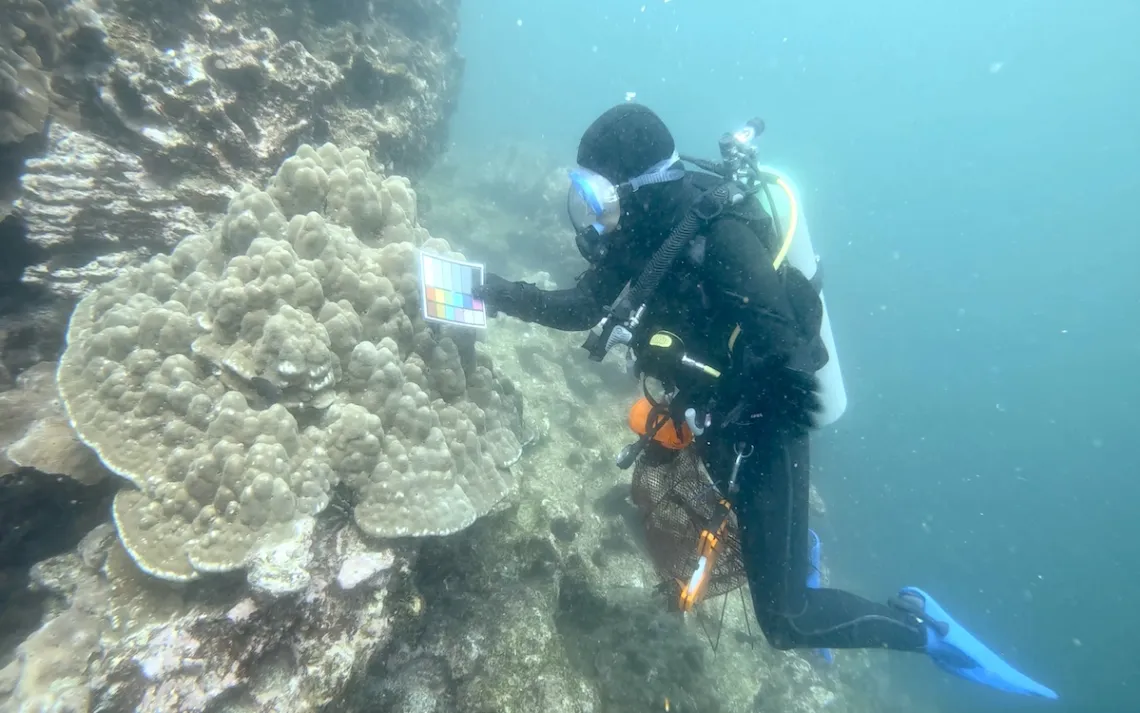
Lucinda Anderson checking Porites lobata coral for bleaching. | Photo courtesy of Jon Witman
Diving 196 feet below the surface in the Galápagos Islands this September, Alejandro Pérez-Matus noticed something strange. Normally, the ocean water abruptly shifts from warm to cold, in a transition known as the thermocline, creating a multilayer temperature cake.
Instead, it was a warm and swift 77°F, and Pérez-Matus opted to wear a wet suit, which offers less insulation, over his normal dry suit.
“The water was overwhelmingly hot, as opposed to the previous three years of experiences that we were conducting diving in mesophotic depth, which is beyond 30 meters [98 feet],” said Pérez-Matus, an associate professor at the Pontifical Catholic University of Chile. In August 2025, the temperatures at the same depths were 59°F—a stark 10° shift. “That's very surprising,” Pérez-Matus said.
The water was just as hot across several other sites the team, including Jon Witman, surveyed. “I've never ever seen anything like that in 26 years of underwater research in Galápagos and oceanography,” said Witman, a recently retired professor of ecology at Brown University. Witman has visited and worked throughout the remote islands that line the equator in the Pacific Ocean region since 1999.
Normally, August is the cold season, known as Garúa, which means “mist” or “drizzle.” Water temperatures are typically 69.8° to 71.6°F and teeming with life. The dive team found that the majority of the coldwater fish fauna were also gone.
Ocean temperatures in the Niño 3.4 region of the Pacific Ocean have surpassed previous years’, reaching 3.05°C (5.49°F) above average as of September 21—a clear sign that this year’s super El Niño is already strong and gaining steam. California Governor Gavin Newsom has declared a state of emergency in response. The phenomenon, a delicate and orchestrated dance between the atmosphere and the ocean that occurs every few years, may be on track to be among one of the most powerful El Niño events ever recorded, according to climate scientists.
“In the past 40 to 50 years, it's been more intense than anything we saw,” said Julia Cole, a climate scientist who uses corals to study temperature change. That could spell disaster for coral populations around the world. Corals thrive at temperatures between 73.4° and 77°F.
There have been four global coral bleaching events recorded since 1998, with coral experiencing its sharpest decline of nearly 9 percent between 2023 and 2024, according to a recent report. This also took place during an El Niño and led NOAA’s Coral Reef Watch to introduce three new categories to their Bleaching Alert Levels, with level 5 indicating “near complete mortality,” putting more than 80 percent of corals in an area at risk of dying, according to a report. Each event contributes to a 6.5 to 9.9 percent loss of global hard coral cover, pushing ecologists to ring the alarm bell that this may soon accelerate mass bleachings as climate water patterns escalate. In June, the National Oceanic and Atmospheric Administration (NOAA) announced that the fourth coral bleaching event likely concluded at the end of 2025.
Effects of El Niños on reefs
The implications of mass coral population collapse are global. These ecologically diverse reef systems support 30 percent of all marine species and protect shorelines from storms and erosion.
Coral is a foundational species, said Manuel Gonzalez-Rivero, an author of the report and principal research scientist at the Australian Institute of Marine Science. “They are like trees in a forest. They provide structure,” he said. Scientists like Gonzalez-Rivero have been trying to understand the long-term impacts of warming ocean temperatures on corals since the second global coral bleaching event began in 2014.
Kim Cobb has been studying El Niño since 1997 when she visited Christmas Island, also known as Kiritimati—a remote coral atoll, which is around 1,200 miles from Hawai'i in the Pacific Ocean, during the warming event that year. “This was, at the time, the largest event on record,” said Cobb, the director of the Institute at Brown for Environment and Society, at Brown University.
Eventually, Cobb returned several years later to find that these corals recovered. Today, she says, things feel far worse.
“2015 and 2016 killed about 90 percent of the corals at my research site, anything over about a softball size. Which was very different than the 1997–1998 event,” Cobb said. During that year, the super El Niño reached 2.3°C above zero. Cobb reported that 5 percent of the remaining surviving corals were bleaching.
Bleaching occurs when the symbiotic relationship between coral and its main food source, microscopic algae known as zooxanthellae, which live in its tissues, is disrupted. The algae give coral their vibrant color. If ocean temperatures shift or if heavy precipitation pushes runoff or pollution to coral near the shore, they expel the algae. In its absence, coral turns white and is more susceptible to disease.
Having seen the impacts of five climate warming and cooling cycles, called El Niño and La Niña in the Galápagos, which is in the heart of its territory, Witman is worried about the future of corals too. “There's a lot of resilience in the system, [but if] it reaches a tipping point where the system can't recover anymore, that's one of my biggest worries about these multiple El Niños,” Witman said.
Recovery time intervals are shrinking by 50 percent—from 10 years to five or six—leaving corals vulnerable in many regions. The report states that we have not reached a point of no return. However, this year’s climate warming cycle is already breaching past 2°C.
Witman said with repeated stressors, the long-term concern is that coral reefs will transform into low diversity and poorly functioning marine ecosystems. This can affect their productivity, in turn causing issues with fishing and overall human health, as coastal communities often rely on protein from fish. The economic impact could also be widespread: Coral reefs provide an estimated $3.4 billion annually as of 2013, the report said. This is a conservative estimate.
Long-term solutions
Gonzalez-Rivero made clear that there is still time to act, and action, he stressed, begins with addressing the causes of climate change: the fossil fuel emissions driving global warming and supercharging these El Niño events.
“The window for action is still available, but the action [needs] to be more concerted and faster than what we have taken so far,” Gonzalez-Rivero said. “We might not realize that other ecosystems will follow based on the impacts that we see in our coral reefs.”
It will also be essential to support local efforts to conserve the remaining 64,062 square miles of coral reefs across 71 countries and 100 territories that have the strongest potential to survive climate change. These include reefs in the US.
Other strategies include identifying resilient species. In the Galápagos, the massive coral Porites lobata (lobe coral) is known to withstand higher temperatures, survive bleaching, and recover. Studies show that across several regions, when bleaching occurs, they rely on alternative food sources by consuming zooplankton and breaking down organic carbon.
Some researchers are getting even more creative by 3D printing coral made out of clay, which has seen some success, specifically on Beqa Island in Fiji. “They are being colonized,” Witman said. “That's very encouraging. It's a natural ceramic, so it's not introducing something harmful in the ecosystem.” A study found that it can help replanted coral survive by 66 percent.
“It's no longer rocket science. We are not taking seriously the consequences of a warming planet for coral reefs and ourselves,” Cole said.