Are Sea Otters Safe?
Orcas, bird flu, pathogens, and warming seas make for an uncertain future
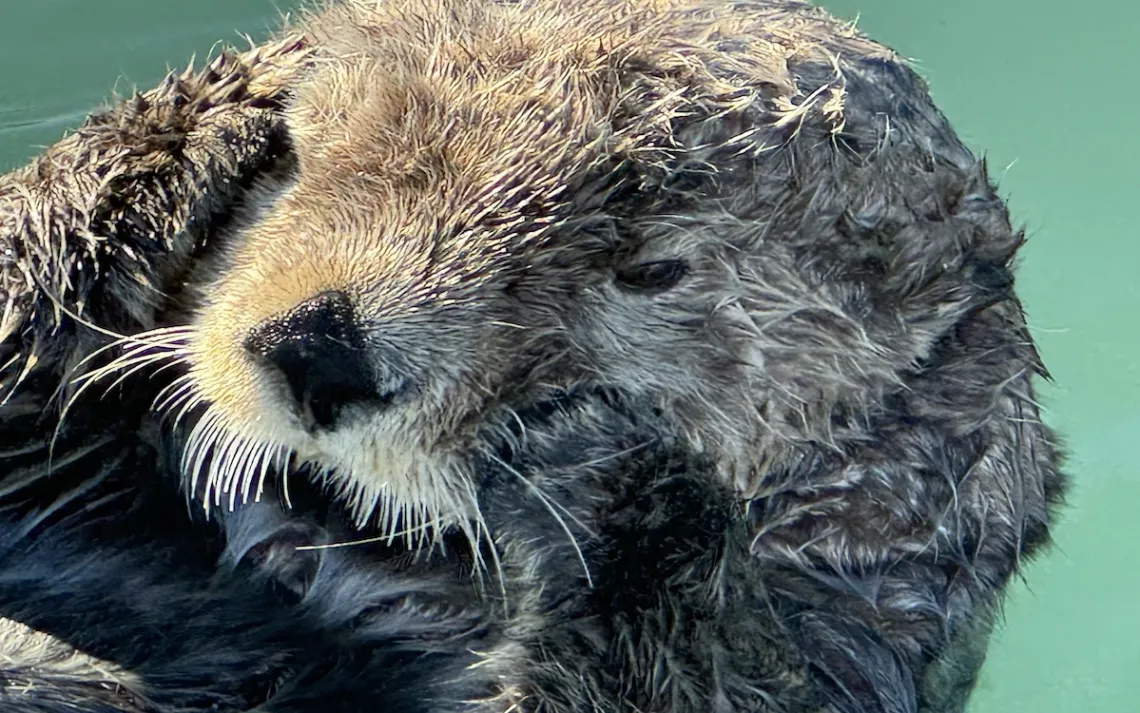
Photo by David Helvarg
Sea otters are the largest of the weasel family and the smallest of the marine mammals. Lacking blubber, they have some of the finest, densest fur in the world to warm them. They constantly groom it to add insulating air bubbles, plus they have a firebox metabolism—they can eat up to a quarter of their body weight every day. Sea otters are the keystone predators of North America’s kelp forests, consuming sea urchins that otherwise would overgraze the kelp forests, converting them to urchin barrens. We need otters to thrive.
But they are in trouble.
The animals were nearly exterminated by English, Russian, and American traders selling “royal fur” to China during the 18th and 19th centuries. Their numbers crashed to 1,000 to 2,000 by 1900, then recovered under various forms of legal protection to some 120,000 animals today. Ninety percent of them (the larger northern sub-species) are afloat in Alaska. Sea otters today are considered a major marine mammal recovery story, if still a fragile one.
“Otters are a creative and adaptable species, notes Tim Tinker, a wildlife biologist at Dalhousie University in Canada and one of the world’s leading sea otter authorities. “They can vary their diet. I don’t see the (global) loss of kelp or HABs (harmful algal blooms) as an existential threat at the level of the fur trade, but with massive changes (in the ocean) taking place there are limits to what even sea otters can control.”
Other otter experts agree there’s no immediate danger of population collapse, but there are many worrying trend lines.
“I think there might be fewer otters (in Alaska) than five years ago,” says Brenda Konar, a coastal ecologist at the University of Alaska, Fairbanks, who studies kelp forest and sea otter interactions. “Rafts [where the otters congregate in the kelp to keep from drifting] aren’t as big as they used to be.”
Killer whales
In the 1990s, scientists began seeing orcas chasing and eating large numbers of otters in Alaska’s Aleutian Island chain. Jim Estes, who first identified the “trophic cascade” connection between otters, kelp, and urchins, concluded that the killer whales were now eating seals and sea otters because their traditional prey, the great whales, had been decimated by post-war Japanese and Russian whaling.
Orcas went from targeting the largest to thousands of the smallest of marine mammals. In 2020, Russian researchers found a dead female orca with seven sea otters in her stomach. More recently, orcas have begun chasing and eating otters in Kachemak Bay just outside Anchorage. There’s even a YouTube video of an otter jumping onto a boat to escape an orca.
“I’ve been working in this area for 26 years and don’t remember that ever being a thing,” says Konar. “Killer whales have to eat too. I just wish not otters in Kachemak.”
Oil and sharks
The smaller-sized southern sea otter population of just over 3,000 has not increased significantly in several decades. With 80 percent of them concentrated in California’s Monterey Bay area, one of the greatest fears is their getting wiped out by an oil spill.
“An oiled otter is toast,” says Tinker, explaining that they rapidly die from ingesting the oil on their fur if they don’t first die of hypothermia. Forty percent of all otters in Alaska’s much larger Prince Williams Sound died of oiling after the 1989 Exxon Valdez oil spill. Disregarding the law that forbids drilling within the Monterey Bay Marine Sanctuary where these otters reside, the Trump administration has proposed opening the entire West Coast to offshore oil drilling.
Otter expansion outside Monterey Bay has been limited by the success of the Marine Mammal Protection Act. With the return of tens of thousands of seals, sea lions, and elephant seals, the white shark population has thrived. As otters move north or south to try to colonize new territories, curious sharks will give them exploratory bites that usually prove fatal.
“The rate of mortality becomes over 50 percent,” notes Jesse Fujii who runs the sea otter rehabilitation program for the Monterey Bay Aquarium. The US Fish and Wildlife Service has been exploring plans to bypass the sharks and relocate otters farther north to eventually reconnect the southern and northern populations, a proposal that has drawn opposition from some commercial fishermen and support from coastal tribes, kelp ecologists, and environmentalists.
Diseases and HABs
The bird flu death of a southern sea otter in California—along with 18 other animals including elephant seals—was confirmed by the Center for Infectious Disease Research and Policy earlier this year. The bird flu virus has now been transmitted from poultry to wild birds and marine mammals. An outbreak in an elephant seal colony in Argentina in 2023 killed over 17,000 animals.
However, unlike elephant seals who are often in the company of seabirds, there are only a handful of otters known to grab and eat grebes and other seabirds, and so the likelihood of transmission remains much lower, though surveillance is ongoing.
Lethal diseases more common to sea otters include Toxoplasmosis (linked to cat feces) and Sarcocystis (ditto for opossums) that then get washed offshore.
“You have a buildup in the soil [of the parasitic eggs] so there’s higher risk with big storms and flushing events,” notes Tinker. The 2026–27 winter, expected to include a historic El Niño, will likely mean fiercer storms and flooding (flushing) along much of the West Coast’s sea otter habitat.
Algal blooms are also on the increase globally according to the United Nations, as are harmful algal blooms (HABs) involving toxic algae. Those trends will increase as oceans continue to warm due to climate change driven by fossil fuels and increased nutrient runoff from agriculture and urban pollution. In California, a number of otters have ingested domoic acid, a neurotoxin linked to HABs, resulting in tremors, seizures, and death for dozens of them (about 20 percent of all dead otters found on area beaches).
Sea otters are one of those “charismatic megafauna” critters like whales that generate hundreds of millions of dollars in tourist revenue from Japan to Canada to California. A 2023 study by the Monterey Bay Aquarium and Center for the Blue Economy found that the small town of Moss Landing, California, where some 120 marine weasels reside, generates $3.2 million a year in “sea otter tourism.”
A study in Canada found that reintroduced otters in British Columbia’s waters added not only $42 million in tourist revenue but also saw a 20-fold recovery of kelp forest habitat. While there was a $7 million loss in the shellfish and crab fishery (to hungry otters), there was a tripling of lingcod and other kelp-forest-dependent fish (such as salmon, cod, and herring) so that the fishing industry also came out ahead financially.
On a bluff at the Hopkins Marine Station on Monterey Bay, I watched a large raft of some 80 to 100 otters lounging, diving, and interacting on the outer edge of the kelp beds as half a dozen sea lions went leaping past. Some of them had their paws linked (it looked like they’re holding hands) while others groomed themselves, rubbing their heads and pretzeling their bodies in the water.
It was only 6 million years ago that two new species evolved that would have a profound effect on the world’s kelp forests and their inhabitants—humanoids and fish-eating otters. One would evolve into an intelligent, adaptive tool-using creature, and the other became us. Now, our decisions determine much of our blue marble planet’s fate. As Tinker noted, “There are limits to what even sea otters can control.”