Chasing Marine Snowstorms to Understand Carbon Storage
How the multicolored specks floating throughout the ocean can help us understand shifting conditions
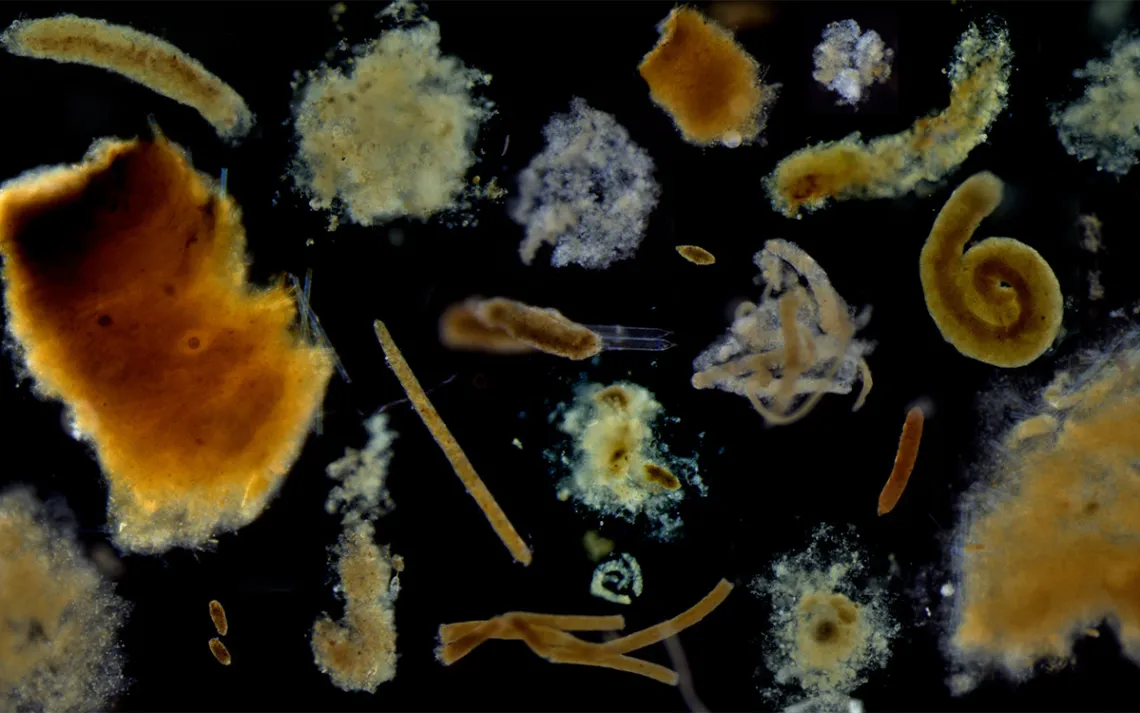
Marine snow particles. | Photo courtesy of Colleen Durkin
Colleen Durkin couldn’t believe what she was seeing a mile below the surface. There was an array of particles floating off the coast of Monterey Bay in California. As an oceanographer, Durkin said she envisioned this section of the ocean as an “empty, nothing land.” That was until a video captured from a remotely operated vehicle completely changed her perspective in 2016.
Today, Durkin, now a scientist at the Monterey Bay Aquarium Research Institute, is striving to understand how these white and brown snowlike particles, known as marine snow, transport massive amounts of carbon from the surface to the ocean floor.
“It looks like a comet,” said Deborah Steinberg, a professor of marine science at the Virginia Institute of Marine Science, William and Mary, who researched the organic material in the 1980s. “Some of them have a snowflake vibe to them. Some of them are clumps of feces or fecal pellets from zooplankton.”
As phytoplankton photosynthesize and zooplankton secrete waste and die off, their materials aggregate to form marine snow. These fluffy white, brown, and even green or gray particles often start at half a millimeter and can grow to several millimeters. They clump with other particles, including carbon, and sink. As the snow descends to the ocean floor, sometimes taking weeks to travel depending on its weight, it serves another critical purpose.
Marine snow is the ocean’s critical carbon pump, responsible for shuttling between 2 and 4.5 billion tons of carbon from the atmosphere to the deep sea, feeding marine animals along the way. Just a small percentage of carbon makes it to the seafloor, where it is stored for a millennium. Even the small amount of carbon largely impacts our planet.
“The amount of carbon that manages to get out of the upper 3,280 feet of water down into the deep sea matters a lot to how much carbon is in the atmosphere, and how much carbon will be in the ocean in the future,” said Clarissa Karthäuser, a postdoctoral fellow at Woods Hole Oceanographic Institute.
The amount of marine snow available in an ecosystem is dependent on how nutrient-rich it is. As ocean temperatures increase, this directly impacts how organisms creating marine snow interact with one another, and the materials it’s composed of.
“We know from monitoring studies that the supply of carbon to the seafloor has a direct impact on all the animals that live on the seafloor. The surface ocean is changing, and that's definitely changing the formation of marine snow,” Durkin said.
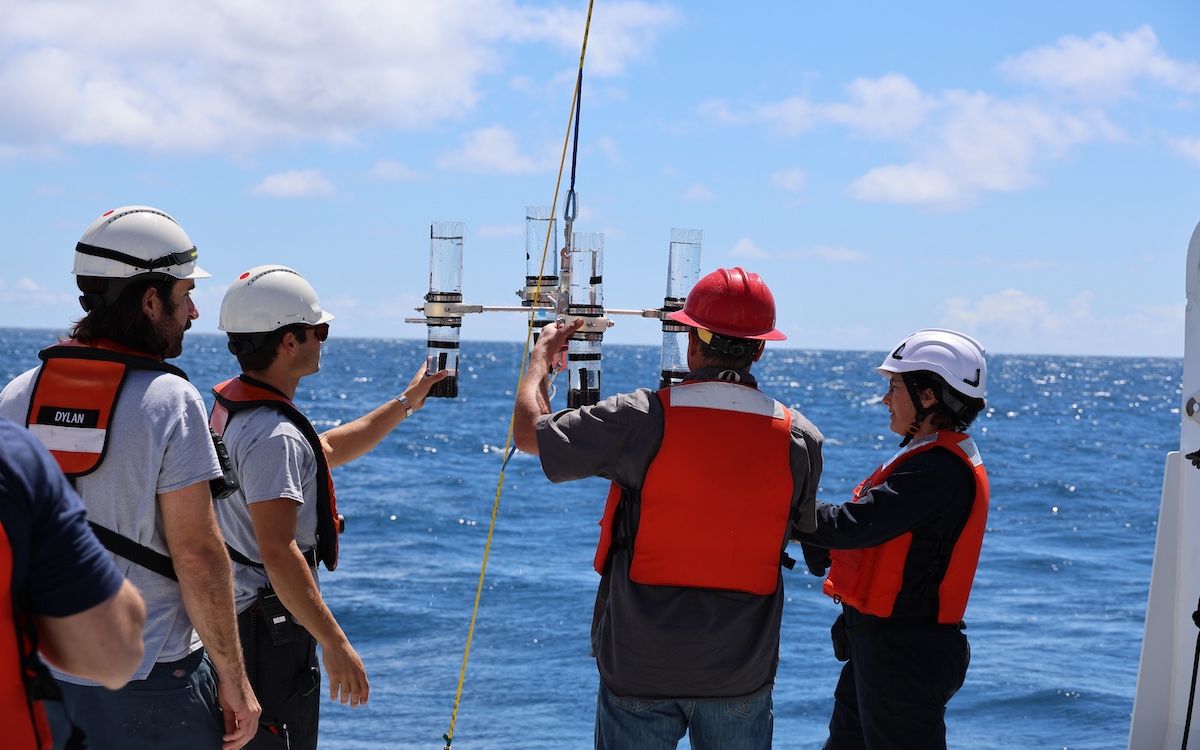
Photo courtesy of Larissa Lemon/MBARI
The carbon conveyor belt buffet
The composition of the falling material serves as a critical food source and “bus stop” habitat center for animals living in nutrient-scarce environments. “There's a giant cake factory falling from the sky,” said Sonya Dyhrman, a senior staff member and professor of earth and environmental sciences at Columbia University.
The particle is a platform where organisms can form little communities, according to Karthäuser. But rising ocean temperatures and ocean acidification may be stimulating bacterial production. This breaks down the matter in marine snow, releasing carbon dioxide back into the atmosphere before it can reach the deep sea. Overall, it can impact the amount of food available.
Another key component is calcium carbonate, found in shells and certain types of phytoplankton. It happens to be one of the heavier ingredients of marine snow, and changing ocean conditions reduces its availability. This influences the already varying size and weight of sinking particles.
“Marine snow is this conveyor belt. That process could be affected by the changing ocean conditions,” Dyhrman said, “If you had a lot of calcium carbonate, but you keep raising the pH of the ocean. Or it goes through a zone that is particularly altered in terms of pH, and all of that hard part starts dissolving, then that influences sinking and composition.”
This can impact the ocean’s ability to store carbon: “Without the biological carbon pump, we would have much much higher carbon dioxide concentrations in the atmosphere,” Karthäuser said. More research is needed to understand how exactly climate change is impacting marine snow, according to Durkin.

Photo courtesy of Larissa Lemon/MBARI
New technology
Currently, Durkin is hoping for new camera systems that they can place off the coast to capture high-resolution images of the intricate structure within marine snow over time. The same imagery that inspired her to study the material nearly 10 years ago. The camera will likely take pictures every few minutes, allowing them to study it more critically.
“I think the future of improving our understanding is getting these scalable observations. By scalable, I mean not requiring a human and a ship,” Durkin said.
Studying marine snow does not always require venturing into the deep sea. But it is one way of collecting it, which involves ships and remotely operated vehicles. This technology is expensive, though.
Capturing the changes in marine snow over time proves to be useful and builds off previous efforts. Researchers collected sinking particles in sediment traps over the course of 30 years at Station M, which sat around 13,000 feet off the coast of California.
They did find an increased amount of marine snow reaching the seafloor due to more frequent, high intense pulses of marine snow events in the last 10 years compared with the first 20 years. “The most interesting takeaway from that was how connected the processes in the surface ocean are to this really deep sea delivery of material,” Durkin said.
As ocean temperatures continue to climb, understanding how this could impact carbon storage is increasingly important. This technology could begin to answer these questions. “As the surface ecosystem changes … it's definitely going to change the supply of marine snow to the deep sea,” Durkin said.