How Lee Zeldin Turned the EPA Into a Shield for Polluters
Across the country, from West Virginia to Louisiana and beyond, communities are feeling the impacts
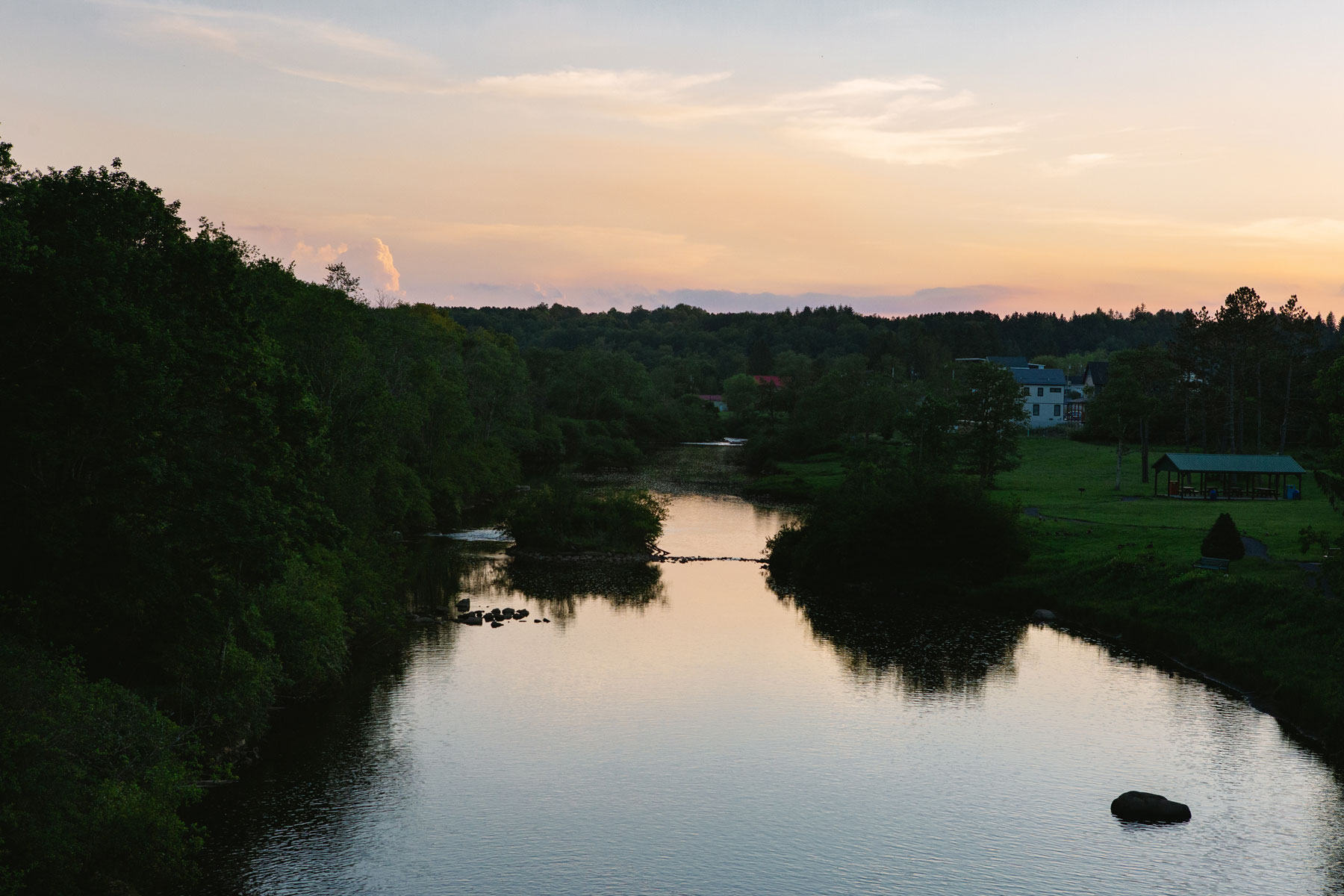
Residents in Davis and Thomas worry that a proposed data center will pollute their air and the Blackwater River. Michelle Gustafson for Sierra
How Lee Zeldin Turned the EPA Into a Shield for Polluters
Across the country, from West Virginia to Louisiana and beyond, communities are feeling the impacts
From Mount Storm Lake came sounds of happy children. On the dock, fishermen stood with their lines in the water. The sun turned the surface of the lake a light, ethereal blue. It was a picture-perfect June weekend in West Virginia’s eastern panhandle.
For residents and tourists alike, the appeal of this region is indisputable. People are drawn to its photogenic beauty. At Blackwater Falls State Park, for example, hiking trails wind past waterfalls edged by cliffs. Black bears prowl the thick pine woods.
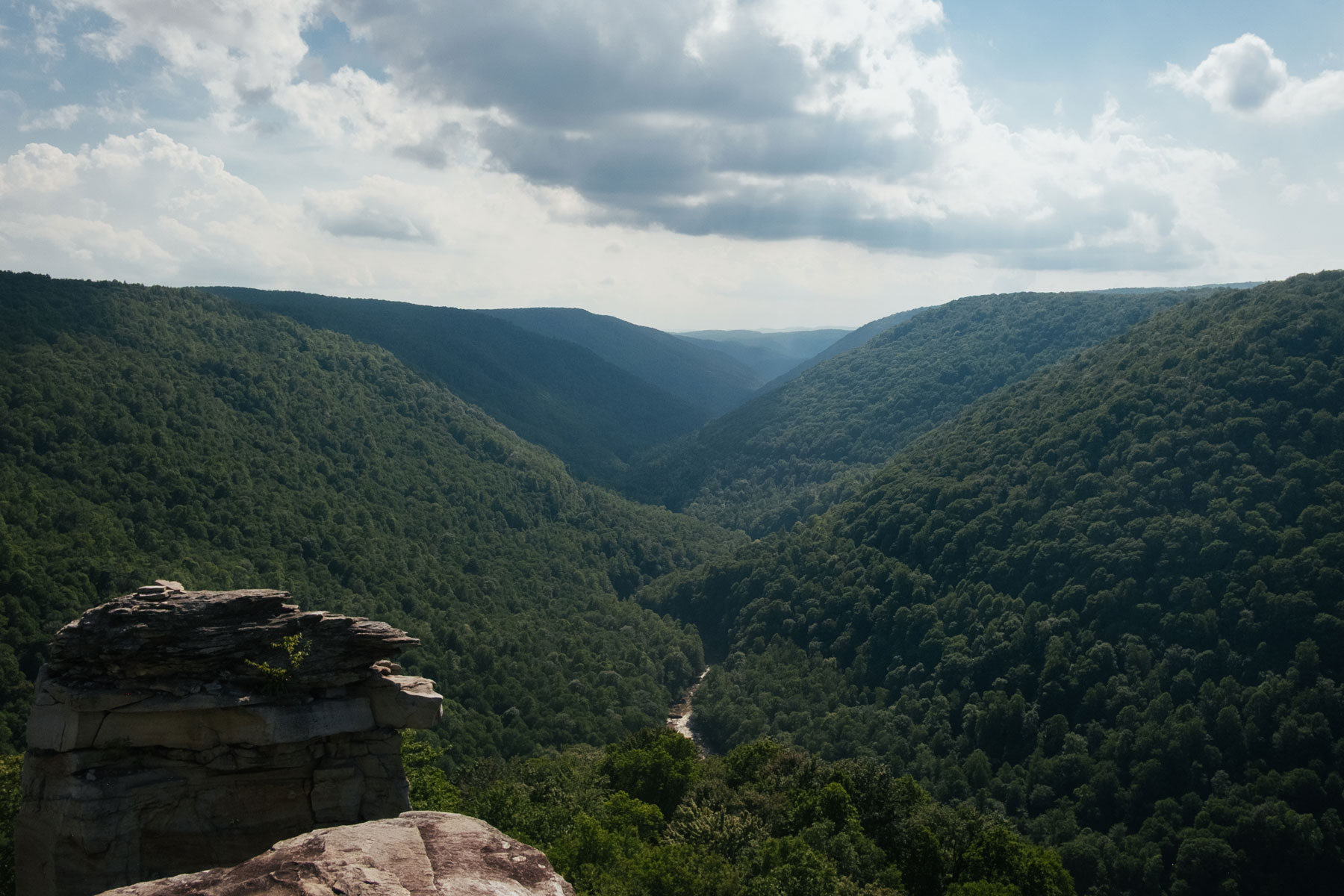
Tucker County, West Virginia (view from Lindy Point toward Blackwater Canyon). Michelle Gustafson
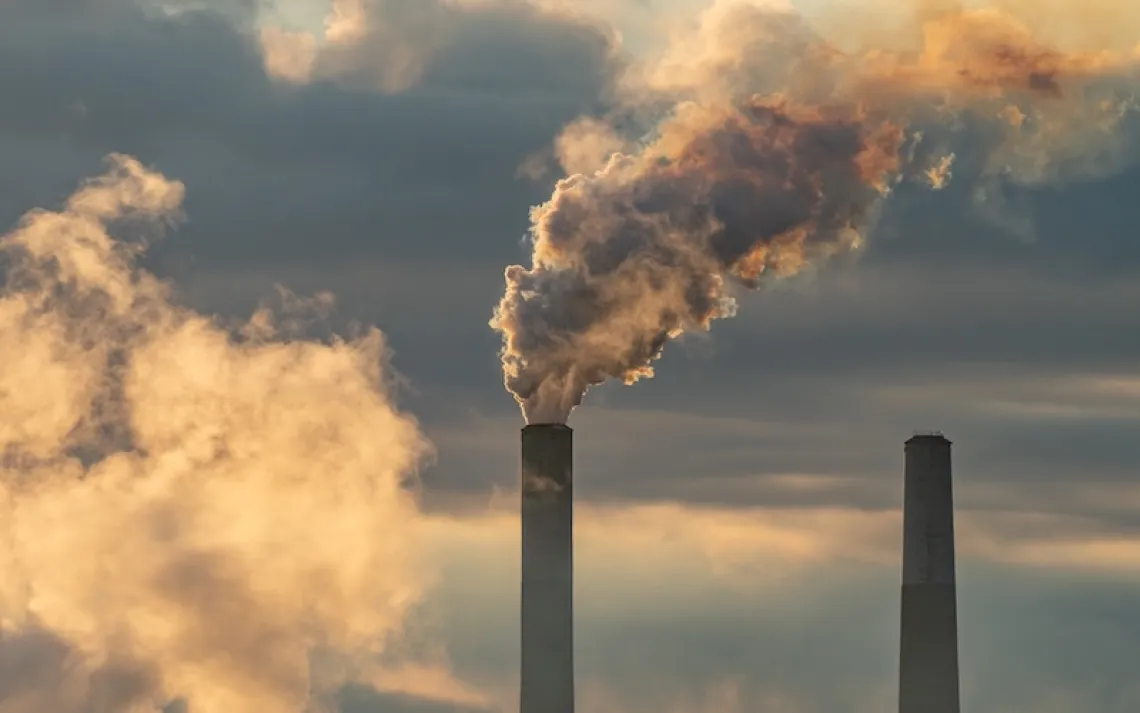
Then there’s the Mount Storm Power Station, which burns 15,000 tons of coal per day, towering over the lake.
The station’s smokestacks are 730 feet tall.
The coal-fired Mount Storm Power Station.
Michelle Gustafson
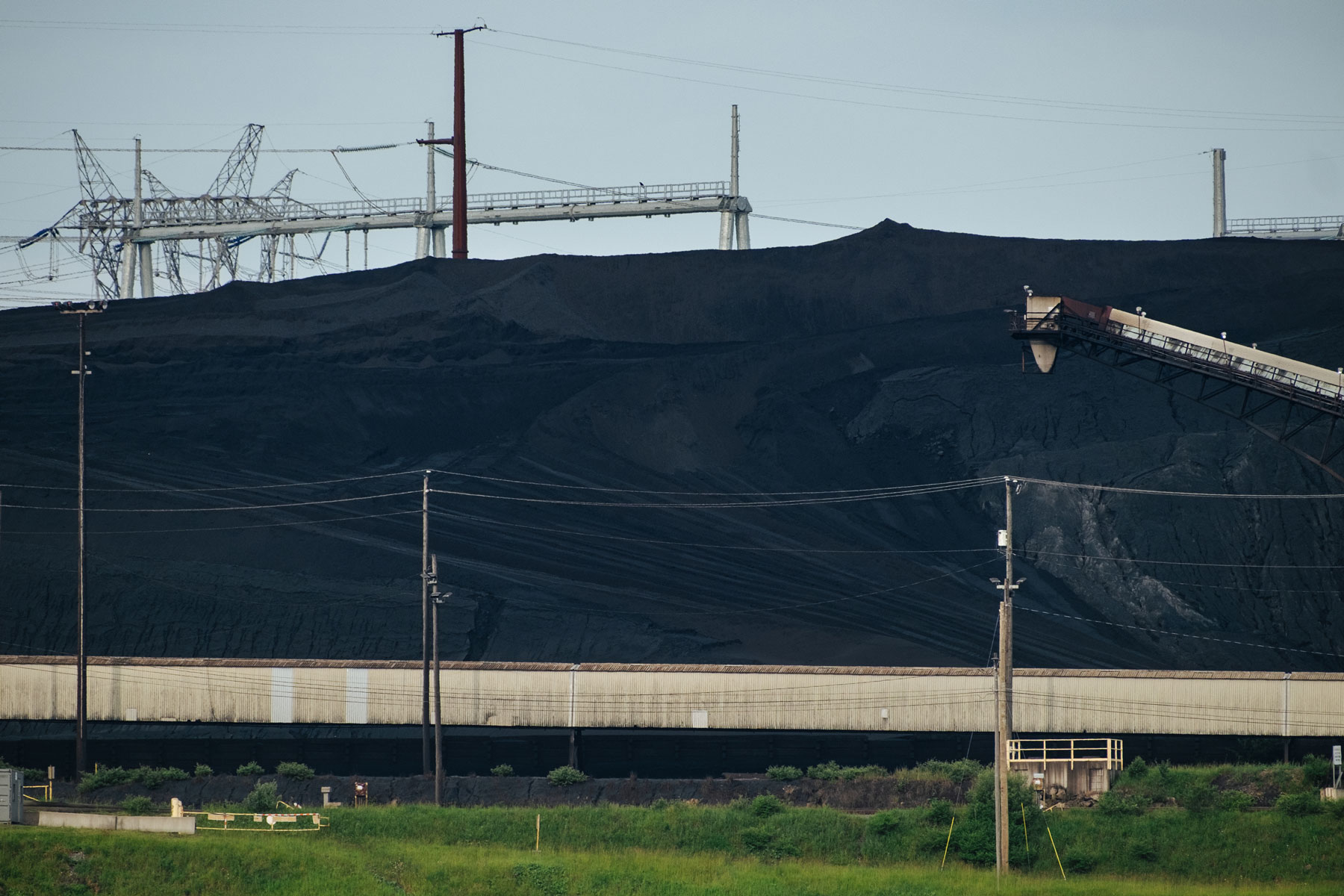
Their plumes can be seen from miles away, billowing across the hilly, forested landscape.
The Mount Storm Power Station burns 15,000 tons of coal every day.
Michelle Gustafson
I climbed a fire tower in the Monongahela National Forest, and there they were, punching through the horizon.
For over a century, West Virginia’s fortunes were tied to one of the dirtiest forms of energy on the planet. In the process of mining coal, cleaning and transporting the rock, and burning it for energy, coal operations dump planet-warming carbon dioxide and methane emissions into the air and heavy metals into the soil and bodies of water.
According to one state estimate, the production of coal in West Virginia peaked in 1997, then started falling. At least 10 coal plants have been retired since 2005.
Now greener sources of energy have come online, thanks to a combination of grassroots activism and progressively cheaper renewable energy. Along a ridgeline of the Allegheny Front, the Mount Storm Wind Farm boasts 132 wind turbines capable of generating up to 264 megawatts of electricity.
But President Donald Trump loves to promote coal and slam wind farms.
Where there’s coal, pollution follows
Even after waves of retirements and fuel switches, dozens of coal-fired power plants dot West Virginia and its neighboring states. In addition to emitting tons of greenhouse gases and toxic coal slag, these plants’ towering smokestacks rain pollution across their surroundings. One single coal plant’s emissions can be detected in dozens of counties surrounding it. The Sierra Club’s Beyond Coal campaign has tallied the toxic cargo of coal plants and calculated the number of additional deaths per year they cause. Mount Storm is believed to be responsible for an estimated 36 deaths a year from soot and another eight from the effects of smog pollution.
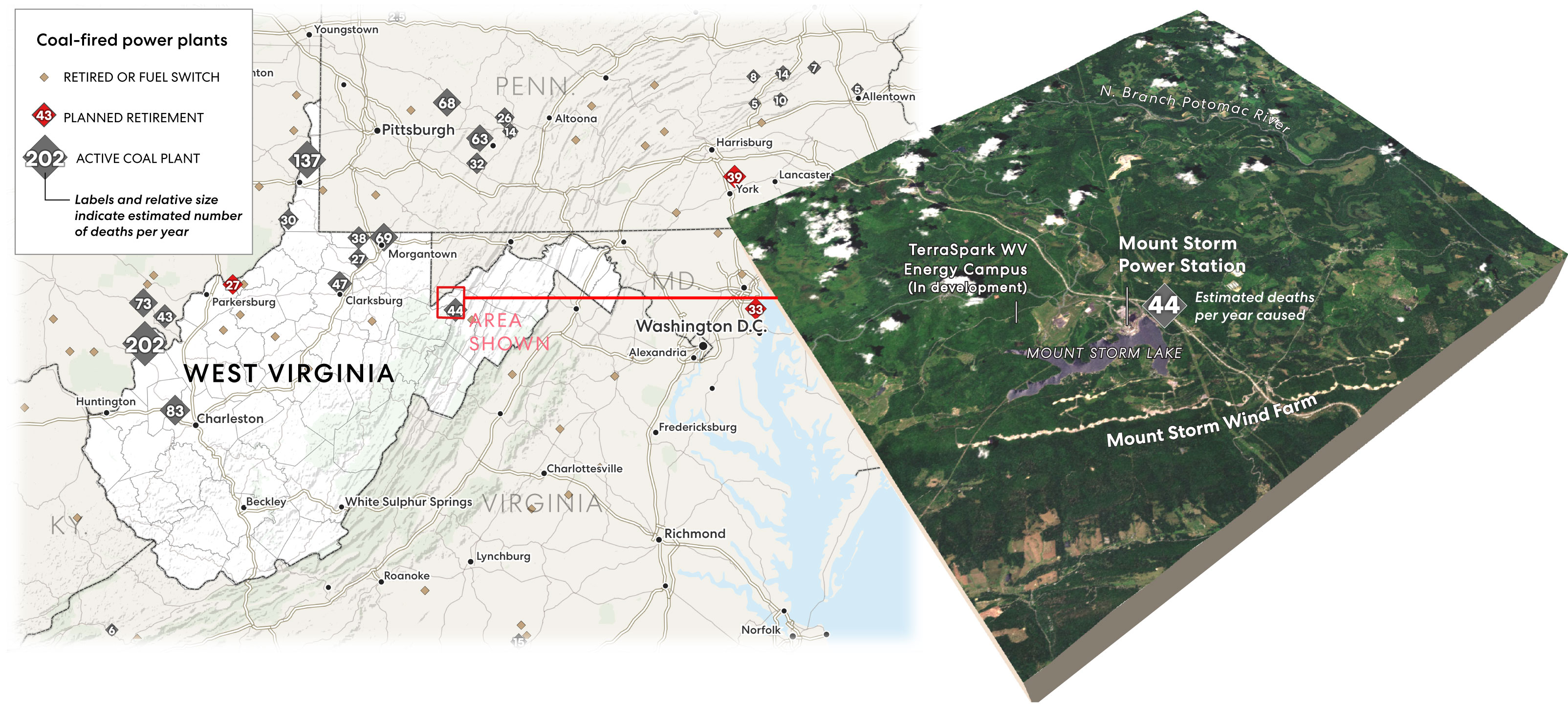
Sources: Planet Labs (imagery); Sierra Club Beyond Coal campaign (deaths per year); Natural Earth data Geoff McGhee
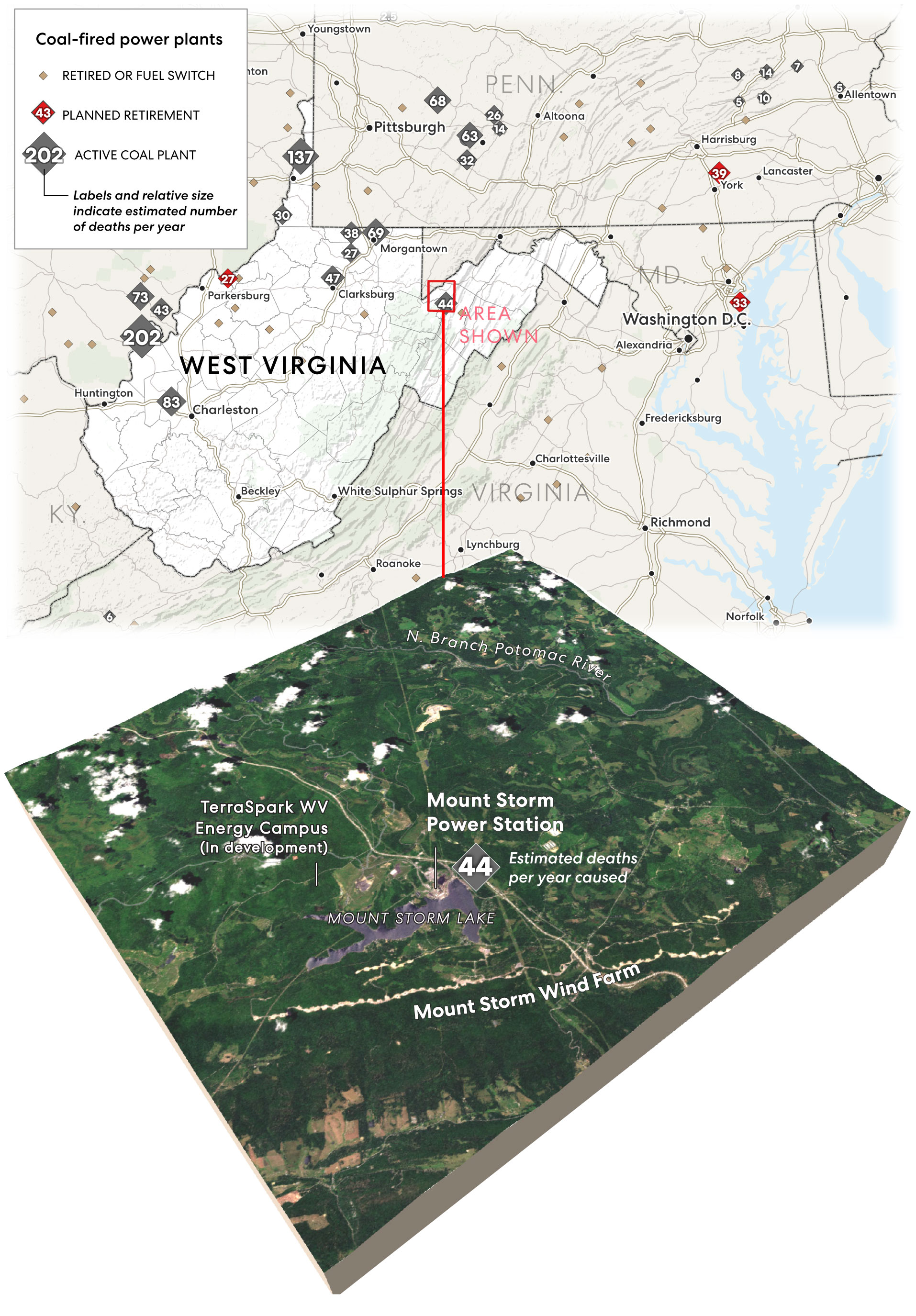
Sources: Planet Labs (imagery); Sierra Club Beyond Coal campaign (deaths per year); Natural Earth data Geoff McGhee
The day before I drove to Mount Storm Lake, Trump announced up to $850 million in funding for coal-related infrastructure. The money will purportedly go to updating and reopening power plants as well as constructing new ones. That includes $18.5 million to start building a 1.6-gigawatt plant near the Mount Storm Power Station. The company slated to build it is co-owned by Alex Phillips—a conspiracy theorist who platformed Trump’s lie that the 2020 presidential election was rigged and was spotted at the US Capitol on January 6, 2021.
“Coal is a great business, really a big business. And it’s real power,” Trump said when he made the announcement from the Oval Office. While he has claimed that wind farms cause cancer, he doesn’t seem concerned about coal. Overall, coal is good for jobs and “energy dominance,” according to the president. In truth, it is responsible for a witch’s brew of health impacts, from cancer, asthma, and black lung disease to permanent neurological damage from mercury exposure. And burning coal for energy releases more greenhouse gas emissions than any other energy source.
As Trump spoke, several cabinet members flanked him. Among them was a middle-aged Long Islander who tends to keep a low profile. He is not a regular at Washington, DC’s private clubs. He is not known for edgy social media posts. He does not throw dinner parties for Peter Thiel or Elon Musk. And yet Lee Zeldin, the administrator of the US Environmental Protection Agency, is the most consequential official in Trump’s cabinet when it comes to policies on the environment.
Under the guise of what he calls the Powering the Great American Comeback Initiative—a kind of Project 2025 spin-off—Zeldin has mounted the most dramatic assault on environmental policy in modern US history. If enacted, his dozens of deregulatory policies will make it easier for power plants to dispose of coal ash; expose more communities of color to air and water pollution; and, on the whole, make air, water, and soil dirtier for all Americans. One of his gravest actions was the revocation of the 2009 EPA Endangerment Finding, which had determined that carbon dioxide, methane, and other emissions threaten human health. According to some estimates, that repeal could result in billions more tons of planet-warming emissions.
Tracing EPA policy back to its source
Authored during the Biden administration by the right-wing Heritage Foundation, the conservative governing blueprint Project 2025 seeded policy proposals that are taking root across the second Trump administration. The effects of the president’s pro-industry programs on environmental policy are extensively covered in the news. Project 2025 Tracker is a volunteer effort to trace back many of these policies to the original document and to measure their progress toward realization. Hover or tap on the information icon below to see where different EPA policies got their start.
Complete
In progress
Not started
Sources: Heritage Foundation; Project 2025 Tracker; U.S. EPA; White House; news reports Geoff McGhee
Zeldin is transforming the EPA in the process—closing offices, canceling grants, and dismissing scientific experts. He is doing it methodically, without hesitation, and seemingly with the president’s approval. In Trump’s upside-down world, dismantling a federal agency meant to protect the environment and human health, then turning it into a shield for polluting industries that are known to harm the environment and human health, is just logical.
“Administrator Zeldin has demonstrated that the EPA can care for the environment and restore common sense,” White House spokesperson Taylor Rogers told me.
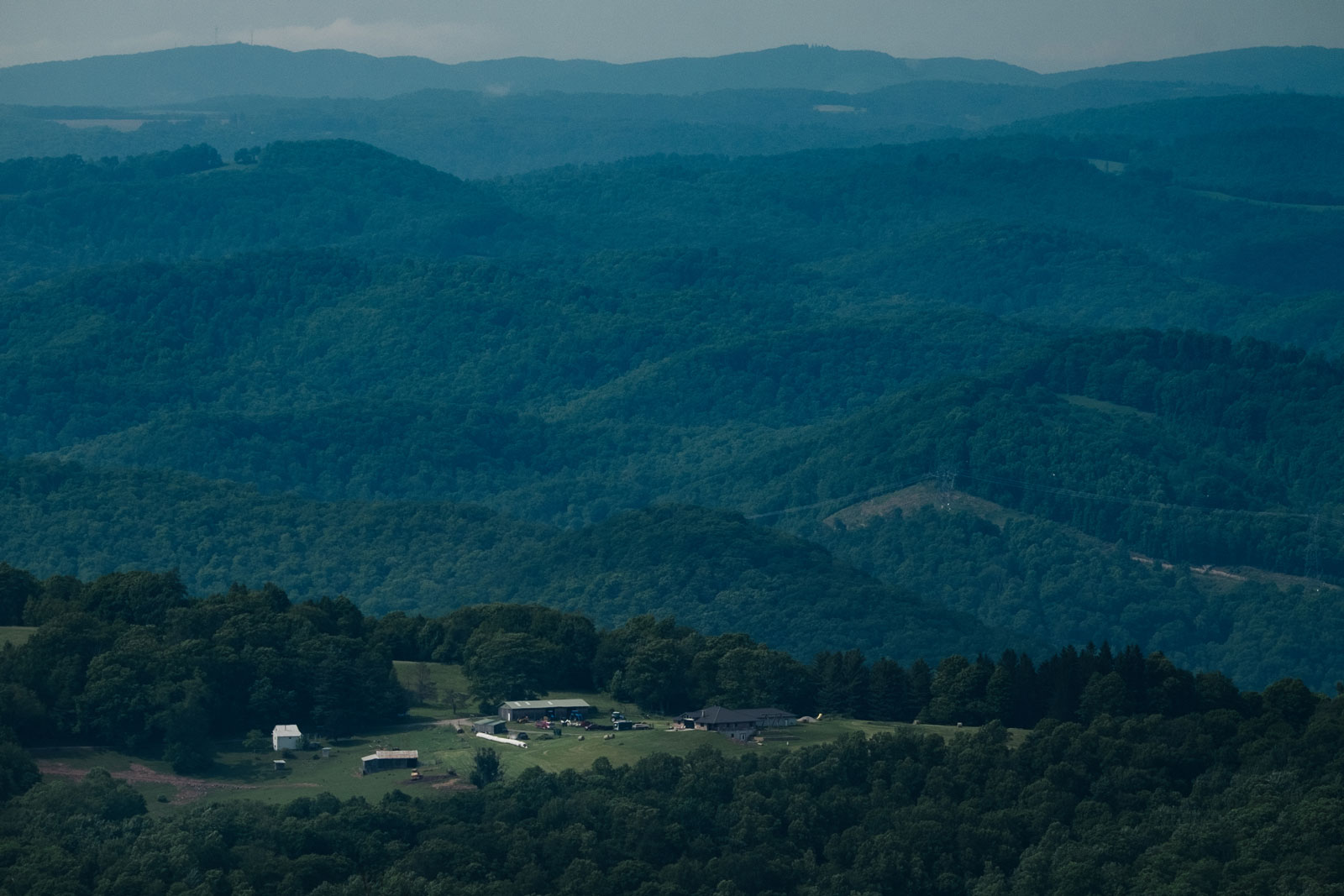
Tucker County, West Virginia (view from Fred Long Centennial Park in Hambleton). Michelle Gustafson
For the past half century, Americans have lived with the implicit understanding that the federal government has a responsibility to protect them from environmental harms. The founding of the EPA in 1970 and the passage of landmark laws like the Clean Air Act and the Clean Water Act have pulled the nation back from a time when rivers once caught fire and smog choked our cities. The government may have sometimes fallen short, but the assumption was that it recognized such protections as necessary.
Now that assumption has been upended, and the stakes could not be higher. As climate change accelerates globally, and environmental harms continue to put innocent lives at risk locally, the nation’s environmental watchdog has been reconfigured to defend big polluters—a paradox that Trump and Zeldin created together.
“The policy choices are appalling,” said Stan Meiburg, who spent nearly four decades at the EPA and served as its acting deputy administrator. Based on conversations he’d had with people who still worked there, Meiburg said there was “institutional confusion in significant parts of the agency.”
Pressure mounts on career EPA staff
While the administration targeted new hires for termination, it also ramped up the pressure on longtime staff to accept buyouts and early retirement offers.
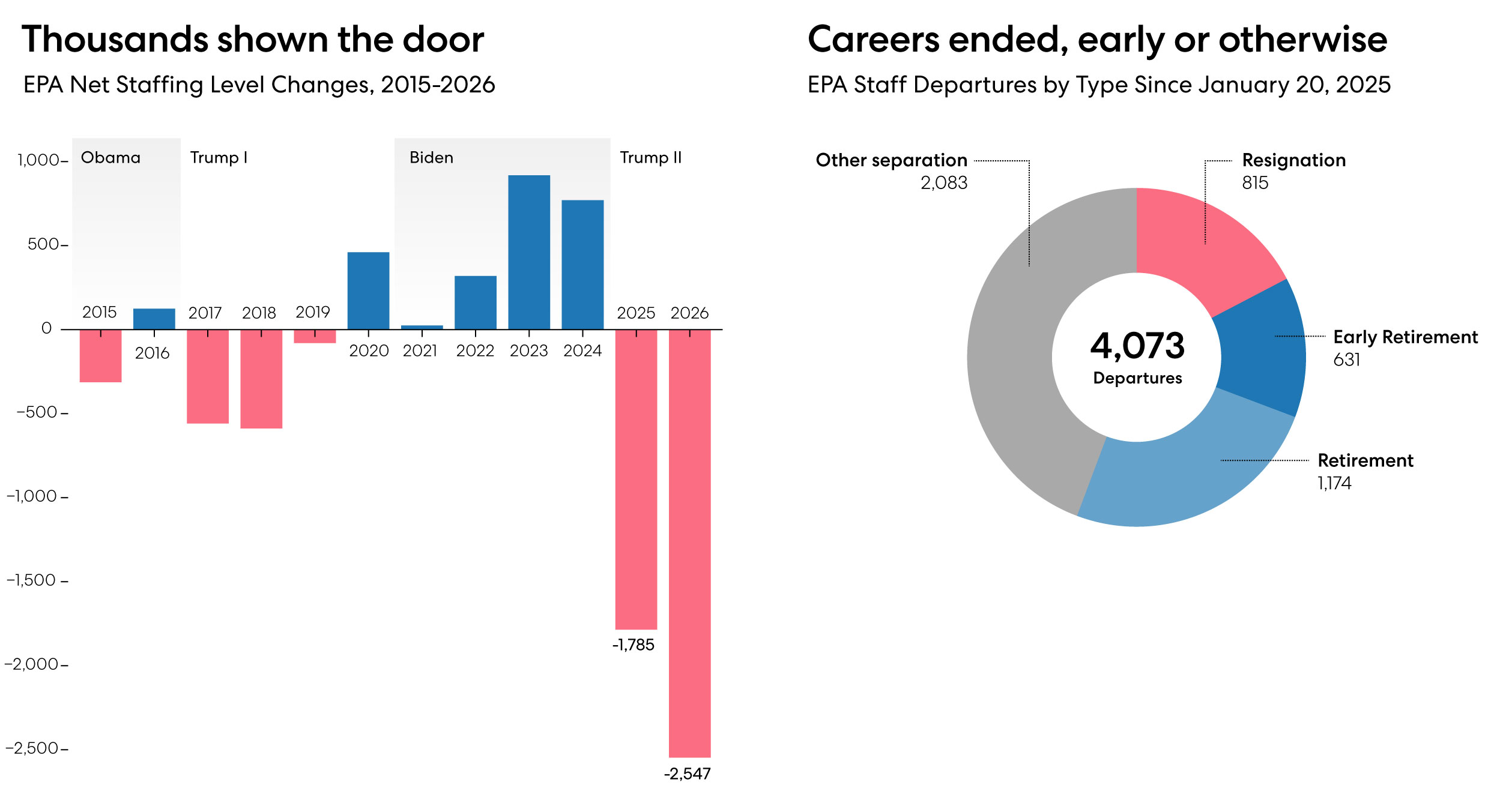
Source: U.S. Office of Personnel Management Geoff McGhee
Source: U.S. Office of Personnel Management Geoff McGhee
This seems to be the point: Quickly break as many environmental policies as possible so it will take years, or even decades, to bring them back.
The Zeldin Paradox
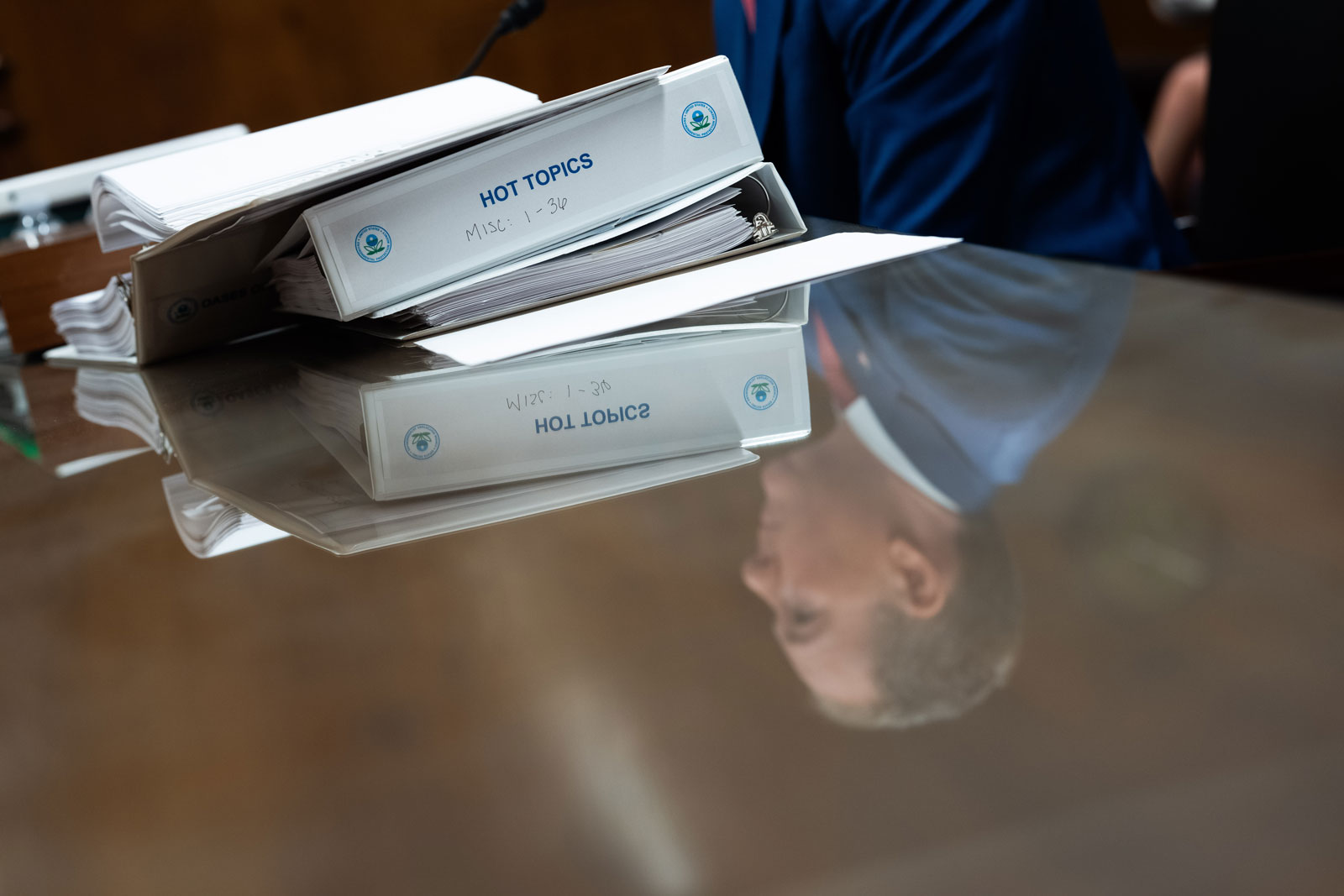
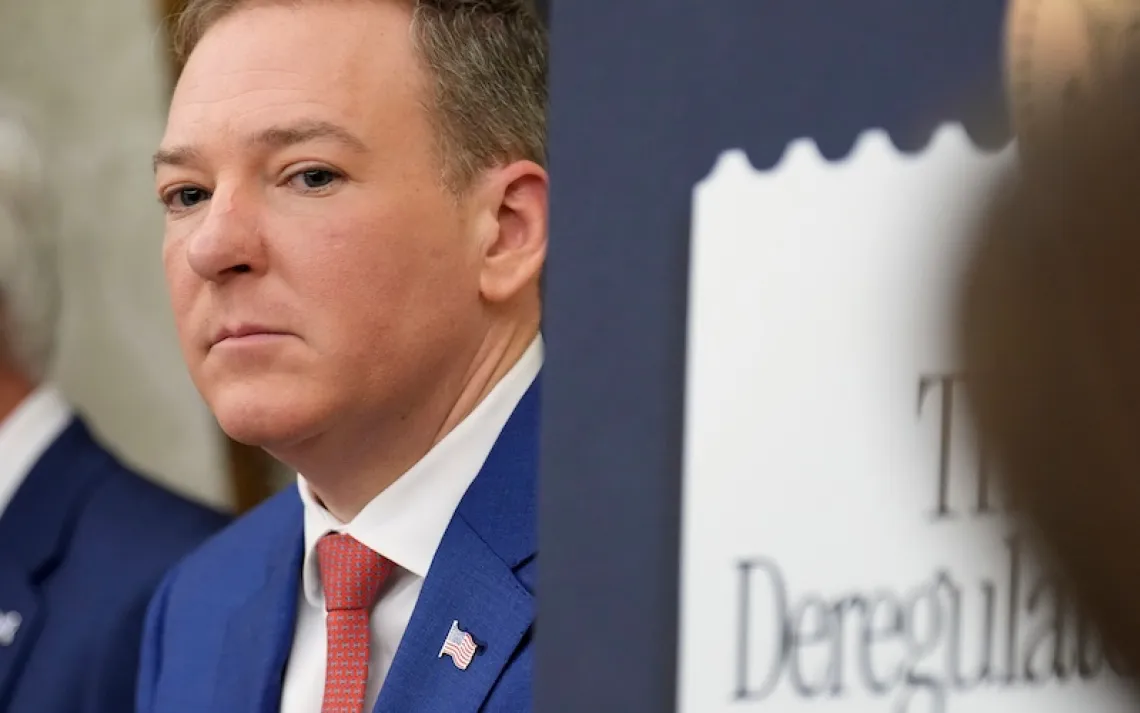
Lee Zeldin, administrator of the Environmental Protection Agency, during a Senate Appropriations Committee hearing in May. Aaron Schwartz/Sipa via AP Images
Lee Zeldin’s superpower is invisibility. He is the perfect tip for Trump’s spear aimed at the heart of the EPA because it’s so hard to see him coming.
Zeldin has no flare, no obvious ambition that makes him stand out. He executes Trump’s wishes capably and quickly, seemingly without trying to enrich himself. Zeldin’s appearances on Fox News are to the point. He seems to avoid the clumsy sycophancy that has been known to irritate Trump. His story is remarkably unremarkable.
Zeldin was born in 1980 to a middle-class Jewish family. After his parents divorced, he was raised in Shirley, a hamlet in Suffolk County on Long Island. With its high population density and overlapping areas of industry and agriculture, Long Island was a prime spot for environmental contamination. In 1979, Suffolk authorities discovered that the Union Carbide Corporation was allowing aldicarb, a highly toxic insecticide, to leach into the soil. In 1985, algal blooms known as brown tides appeared off the shores of Long Island, wreaking havoc on bay scallop harvests.
“I remember in his introductory speech [as EPA administrator], he talked a lot about being from Long Island and working on water quality. And I was like, ‘Well, maybe that’s a good sign,’ ” said a now-retired EPA veteran who spent decades working on air quality and spoke on condition of anonymity to discuss the agency.
When he first joined the US Congress in 2015, after a four-year stint in the New York State Senate, Zeldin seemed aligned with the principles of conservation. He became a member of the climate caucus and co-chair of the Long Island Sound Caucus, helping introduce a five-year, $65-million-per-year allotment to “protect and restore the Long Island Sound.” In 2017, Zeldin ranked 39th on the Lugar Center–McCourt School Bipartisan Index (rating 438 members of the House of Representatives on how well they work with members of the opposite party).
Then came Donald Trump’s rise to power. Zeldin defended Trump after the January 6 Capitol riot and voted against certifying the 2020 election. As other Republicans began to waver in their support for Trump, Zeldin stayed quiet. In 2022, he ran for governor of New York against Democratic incumbent Kathy Hochul with a campaign focused on crime. He lost.
After Trump was reelected president in 2024, in a move few saw coming, he nominated Zeldin to lead the EPA. “I think he has all the ability and political savvy to be a great deregulator,” said Myron Ebell, a former Trump adviser and well-known climate change denier.
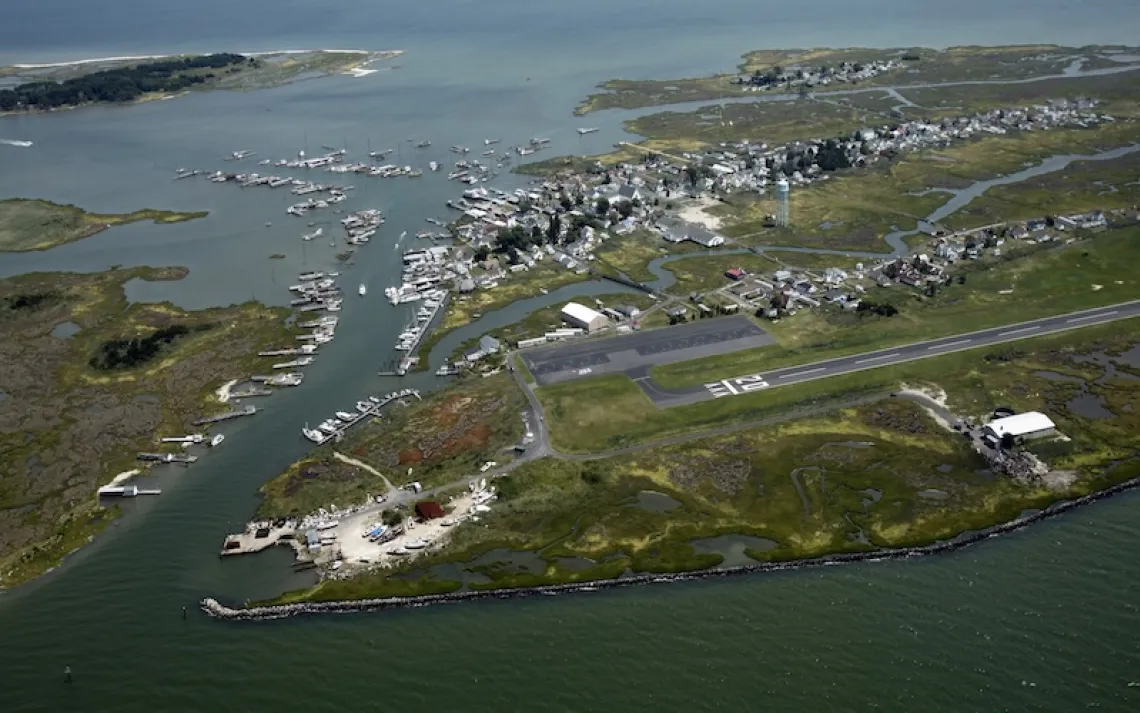
One of Zeldin’s earliest trips as EPA administrator was to Annapolis, Maryland. There, he acknowledged the Chesapeake Bay Program, a landmark effort to clean up the nation’s largest estuary. “The Chesapeake Bay watershed is extremely important to our nation’s history, economy, and environment,” Zeldin said, “and it is imperative we continue to do what we can to protect the waterway.”
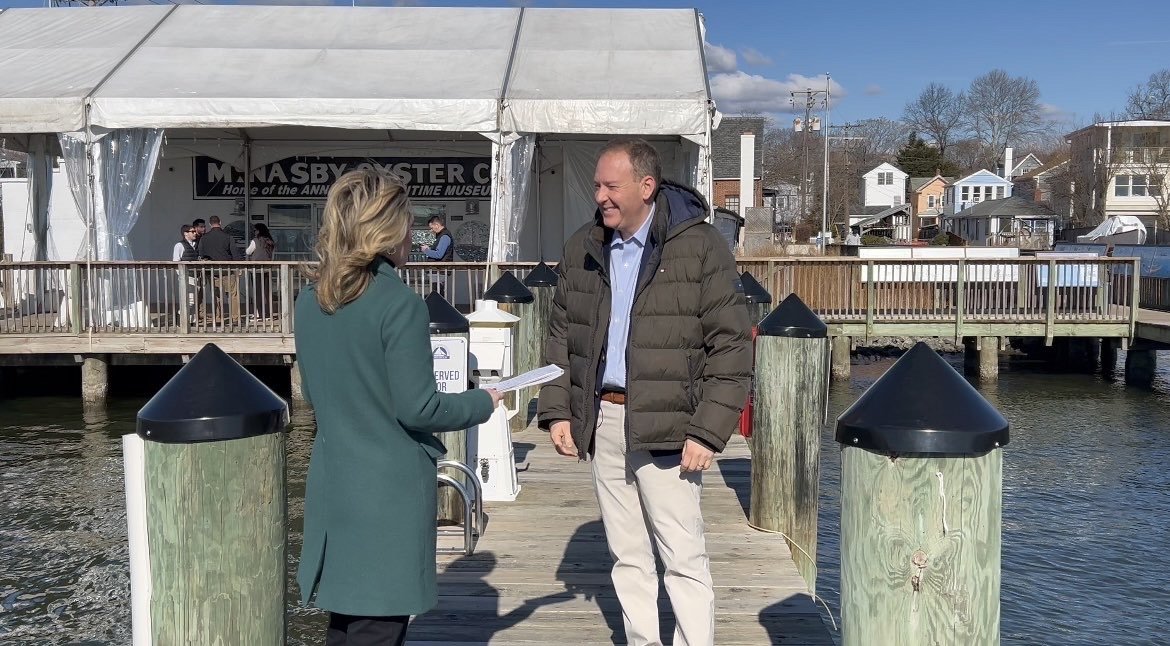
Lee Zeldin on tour in Annapolis, Maryland, in February 2025. U.S. EPA
With a drainage basin of more than 64,000 square miles, the Chesapeake abuts some of the most populated and industrialized land in the United States. Until about 50 years ago, agricultural runoff flowed freely into the bay. The EPA called it “an ecosystem in decline.” Only with the first Chesapeake Bay Agreement, struck in 1983, did the various state and federal entities involved agree on a path back.
The plan worked. The waterway is now known for its beaches, wetlands, and recreational opportunities. Yachts bob on its waters while oysters make a comeback beneath.
Then, in fall 2025, Zeldin announced a revision to Waters of the United States, or WOTUS, a rule under the Clean Water Act. The new amendment, if it survives litigation, will curtail some of the protections WOTUS offered, to wetlands in particular. There are 282,291 acres of tidal wetlands along the Chesapeake.
“They have jeopardized decades of bay restoration progress,” Keisha Sedlacek, senior policy director of the Chesapeake Bay Foundation, said of Zeldin’s move. “For more than 40 years, the federal government has worked with the states to reduce pollution in the Chesapeake Bay, and the administration is putting all of that at risk.”
But one of the biggest threats to the Chesapeake is rising seas caused by a warming planet. “The Chesapeake Bay is on the front lines for climate change,” Sedlacek told me.
After he took office, Zeldin said that he was going to drive “a dagger straight into the heart of the climate change religion.” That’s code for killing renewable energy while protecting fossil fuels. Under Zeldin, the EPA has moved to do both with a discipline and speed unseen in modern times.
One of Zeldin’s first actions was to attend an event for Trump’s National Energy Dominance Council to announce that the EPA would be loosening mercury and air toxic standards for coal plants. The standards had been imposed by the Biden administration. After that, Zeldin ordered the repeal of “all greenhouse gas emissions standards for fossil-fuel-fired power plants” and granted power companies “flexibility” when it comes to cleaning up coal ash, a toxic byproduct that contains several carcinogens such as arsenic, chromium, and lead.

Instagram post from the EPA promoting the “Great American Comeback’ in February 2026. U.S. EPA via Instagram
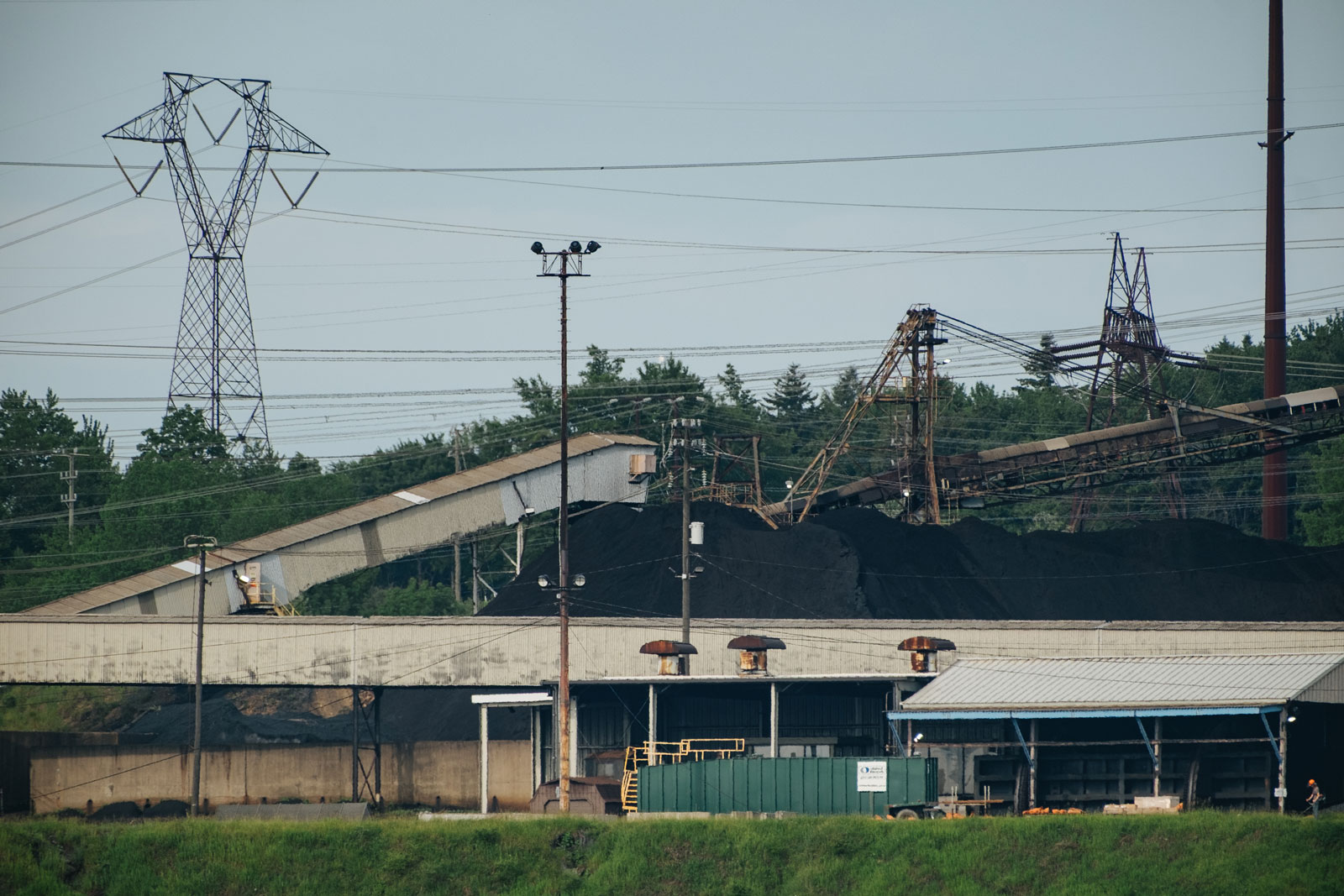
In June, the Trump administration announced up to $850 million in funding for coal-related infrastructure, including $18.5 million to start building a 1.6-gigawatt plant near the Mount Storm Power Station. Michelle Gustafson
But it is the EPA’s move to repeal the endangerment finding that could be the most consequential in Zeldin’s war on climate action. In 2002, the Sierra Club sued the EPA over its failure to enact federal greenhouse gas emissions standards as required under the Clean Air Act. That lawsuit helped pave the way for the 2007 Supreme Court decision in Massachusetts v. EPA, which found that greenhouse gases are pollutants subject to regulation under the act, all but ensuring that the EPA would have to limit those emissions. Two years later, under the Obama administration, the agency followed through, issuing a decision that greenhouse gases endanger public health and welfare. Since then, the endangerment finding has been the bedrock for regulating the nation’s emissions across the economy, from the power and transportation sectors to extractive industries like oil and gas. Killing the finding is one of the greatest gifts Zeldin could have delivered to polluting industries.
Zeldin, of course, is not the only industry-friendly conservative to take the helm of the EPA since it was founded. The agency was started by a Republican, Richard Nixon, and EPA administrators in subsequent Republican presidencies implemented a conservative approach that was, at times, slower and more cautious than environmentalists would have liked but, on the whole, in keeping with the agency’s original mission.
Nixon’s first administrator, William Ruckelshaus, put in place many of the basic environmental protections we take for granted, such as the ban on the toxic pesticide DDT, and pushed for cleaner cars, including phasing out leaded gasoline. Later, during the George H.W. Bush administration, William K. Reilly tried to persuade private industry to take greater responsibility in regulating itself, sought to reduce ozone emissions, and strengthened parts of the Clean Air Act. Christine Todd Whitman, the former Republican governor of New Jersey, often found herself at odds with the George W. Bush administration but still advanced the EPA’s mission. Whatever their differences, none of these administrators attempted to dismantle the agency they had been appointed to lead.
If anyone could have pulled off such a brazen agenda, most would have bet on Scott Pruitt—Trump’s pick to lead the EPA in his first administration. As the attorney general of Oklahoma, Pruitt sued the EPA 14 times in a bid to block environmental regulations and support the polluters most impacted by them. After Pruitt was confirmed to lead the agency in 2017, however, he grew careless and self-interested, prompting over a dozen ethics investigations into allegations that he was abusing his office, misusing staff, and wasting taxpayer resources on absurdities like a $43,000 secure telephone booth.
But Zeldin has done nothing to draw attention to himself, giving Democrats few openings to attack his credibility.
Once there was a small museum at the EPA’s headquarters in Washington, DC, on Pennsylvania Avenue, to serve as a tribute to its environmental protection legacy. Zeldin closed it. The space is now empty, an apt symbol of a hollowed-out agency that no longer follows science or conducts meaningful oversight of potential polluters.
Congress still matters
Although the Trump administration has targeted the EPA for deep cuts to many programs, a significant portion of those cuts were restored in congressional appropriations for fiscal year 2026. The administration has resubmitted many of those cuts for 2027. Nevertheless, funding amounts alone do not dictate the effectiveness of the agency in an executive branch hostile to its mission.
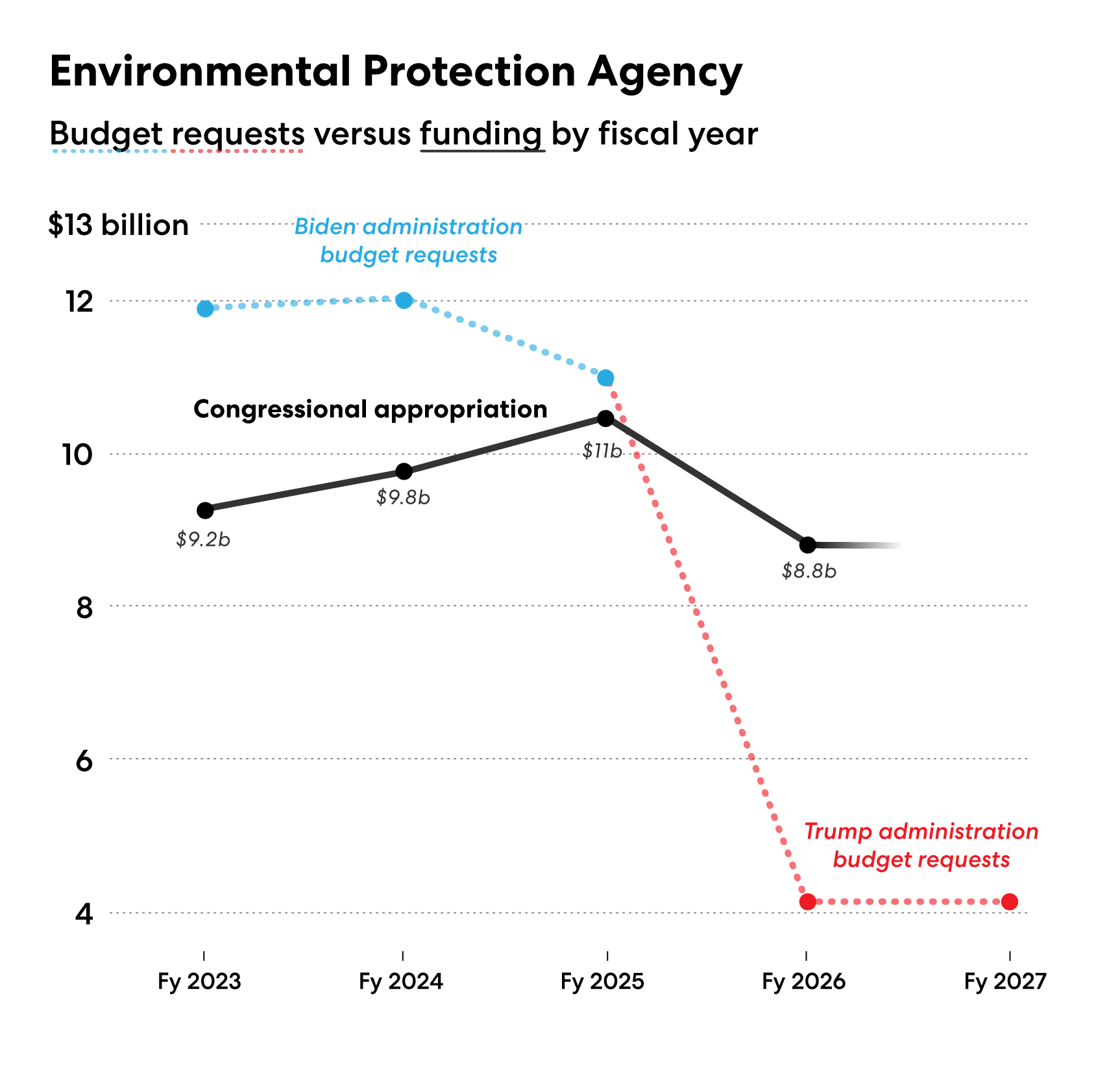
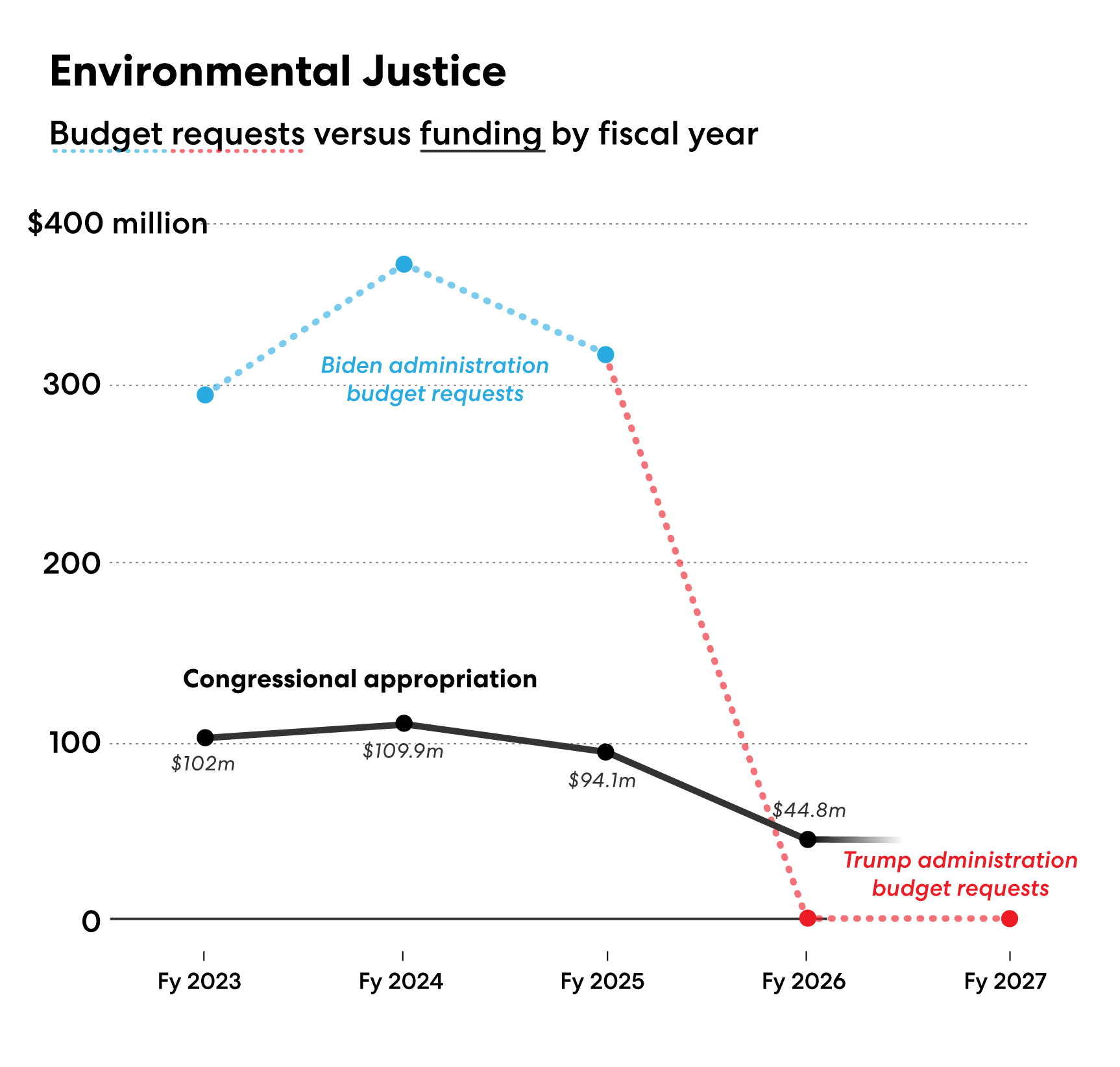
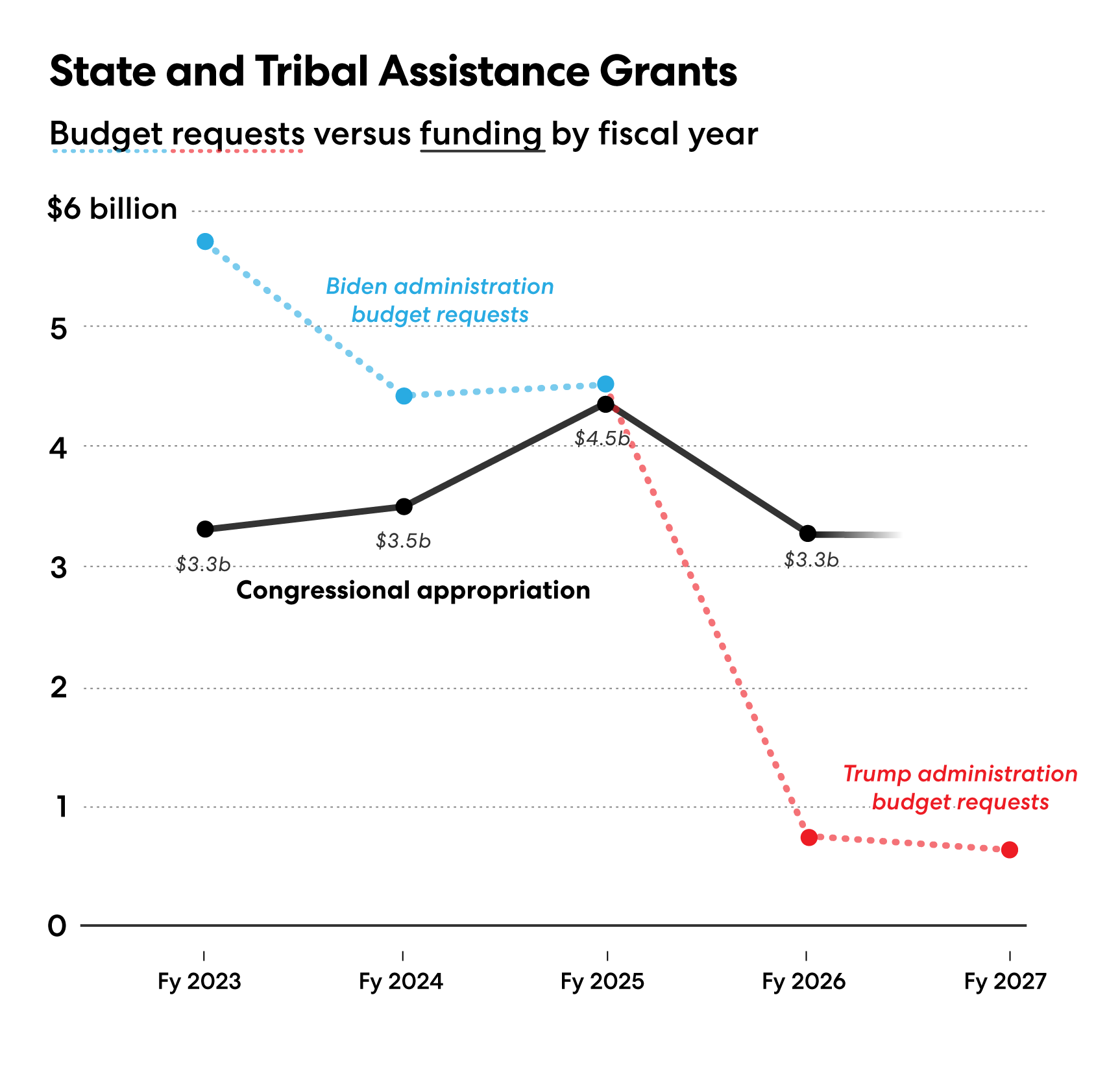
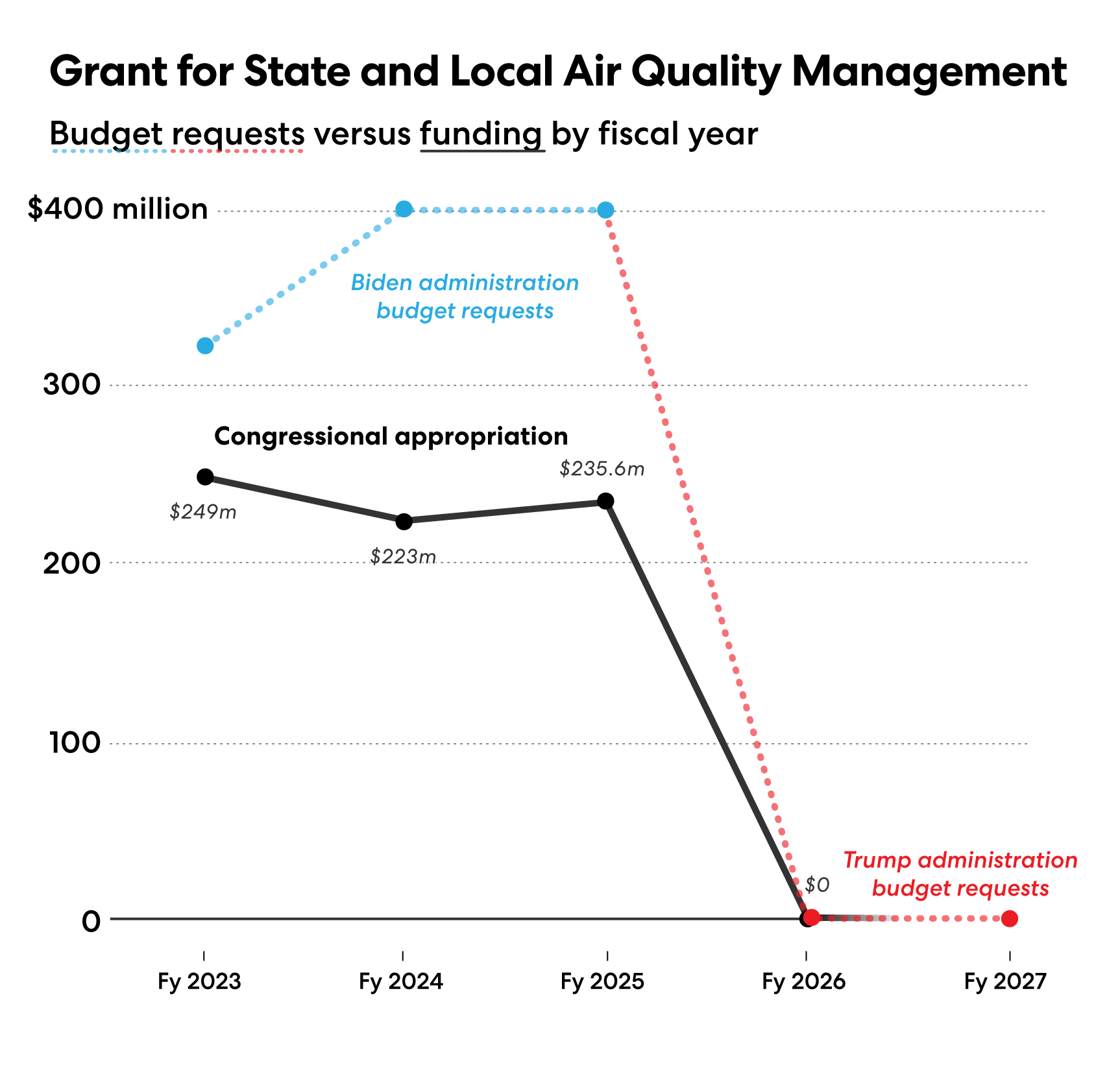
Source: EPA budget in brief, fiscal years 2023-2027 Geoff McGhee
“It’s like our voices don’t matter.”

Homes in Thomas, West Virginia. Michelle Gustafson
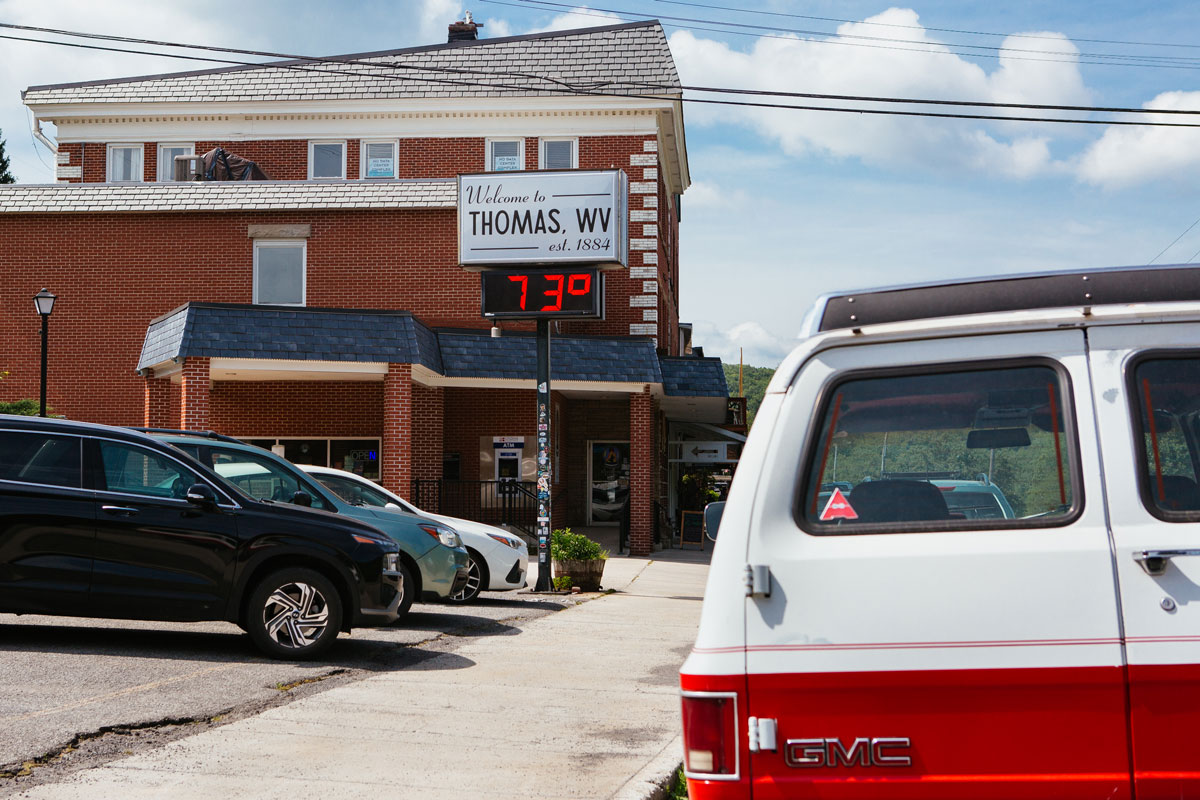
Downtown Thomas. Michelle Gustafson
Environmental justice is based on a simple reality: Clean air, clean water, and exposure to pollution are not distributed equally. Fenceline communities, near industrial infrastructure, often bear the brunt of pollution, while wealthier neighborhoods enjoy the benefits of a modern economy without worrying about living next to power plants or data centers.
For the current administration, environmental justice is a “leftist buzzword,” as Zeldin put it in an op-ed last year. He referenced a Biden administration official’s offhand assertion—captured in a hidden recording by a right-wing activist—that grant money intended to support environmental-justice initiatives was the equivalent of “tossing gold bars off the Titanic.”
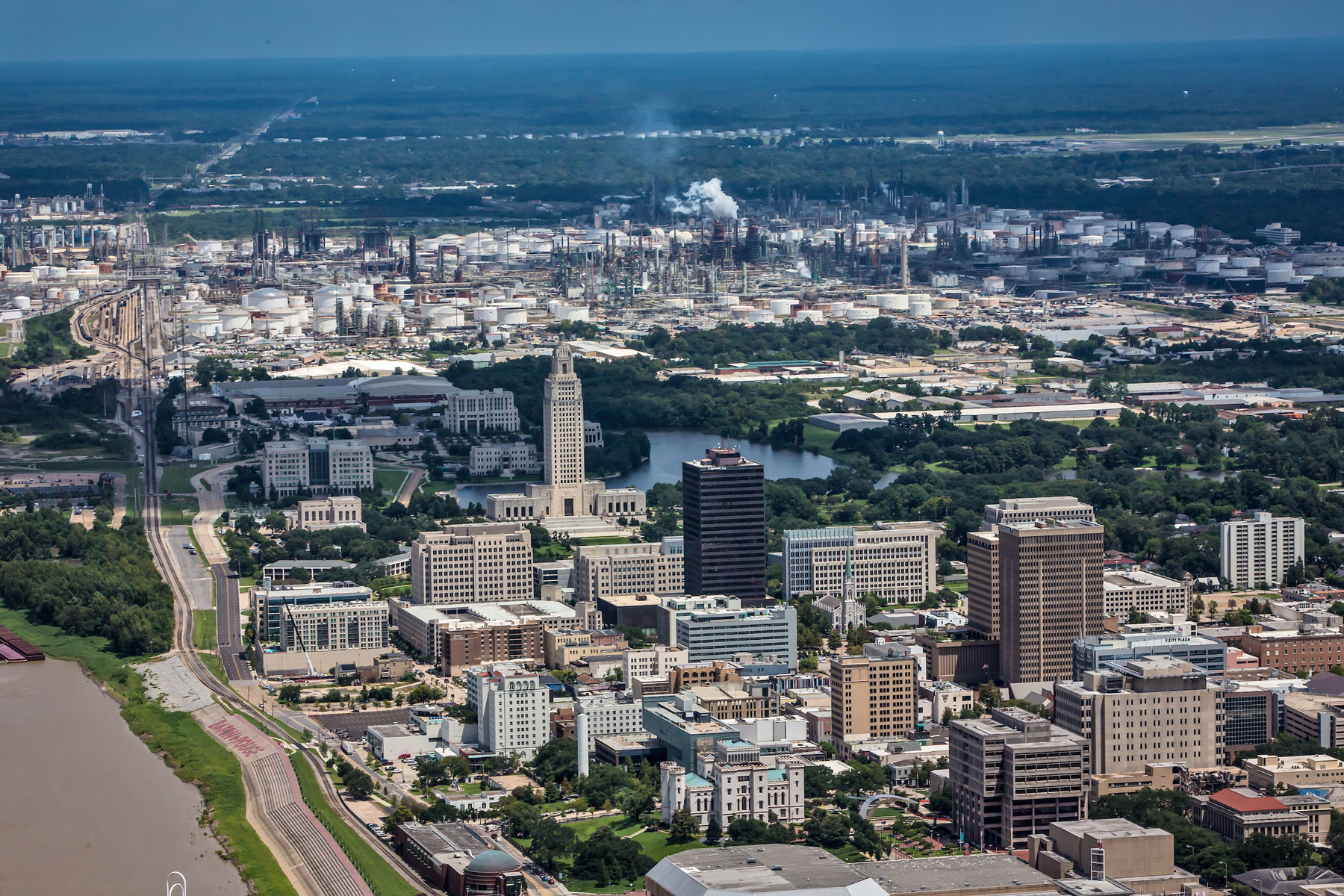
The ExxonMobil refinery in Baton Rouge. Julie Dermansky
If metaphorical gold bars were being disbursed by Washington, they never made it to the people in Louisiana who call “Cancer Alley” their home.
Long before Zeldin took over the EPA, an 85-mile stretch of land between New Orleans and Baton Rouge, largely populated by communities of color, was chosen as a hub for petrochemical production. Over time, more than 150 refineries, factories, and plants were sited along this stretch. Today, about a quarter of all the nation’s petrochemicals are processed here. That has meant a windfall for Louisiana state coffers.
Why “cancer alley” got its name
Communities along the Mississippi River between Baton Rouge and New Orleans lie amid one of the most intense industrial zones in the country. Plants in the area process about a quarter of the United States’ petrochemical products, creating extreme air pollution and exposing residents to highly elevated risks of respiratory, reproductive, and other health harms, including cancer. The dots below represent industrial sites in Louisiana included in the EPA’s Toxic Release Inventory model.
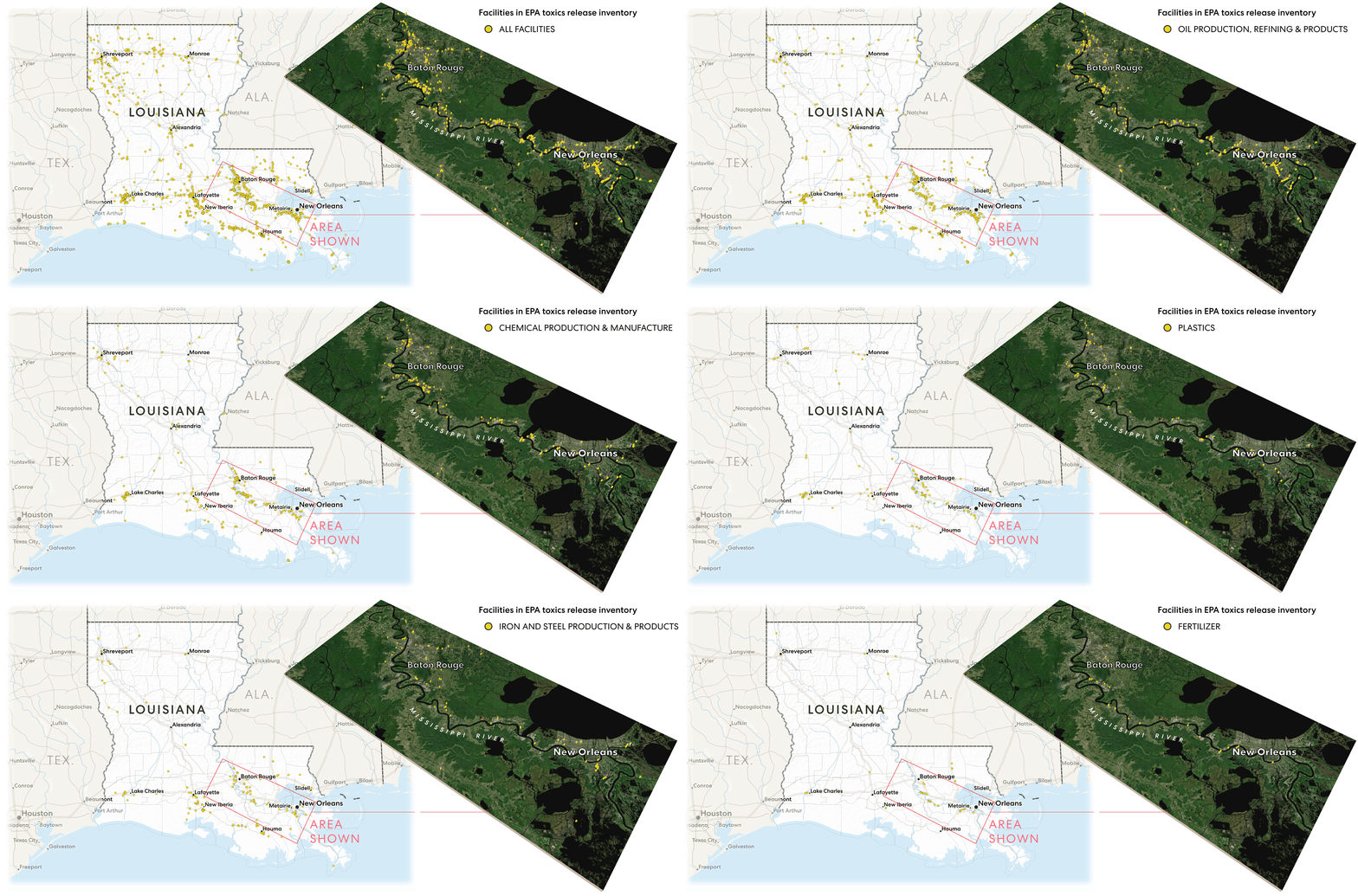
Sources: Mapbox (imagery); EPA (toxic release sites); Natural Earth data Geoff McGhee
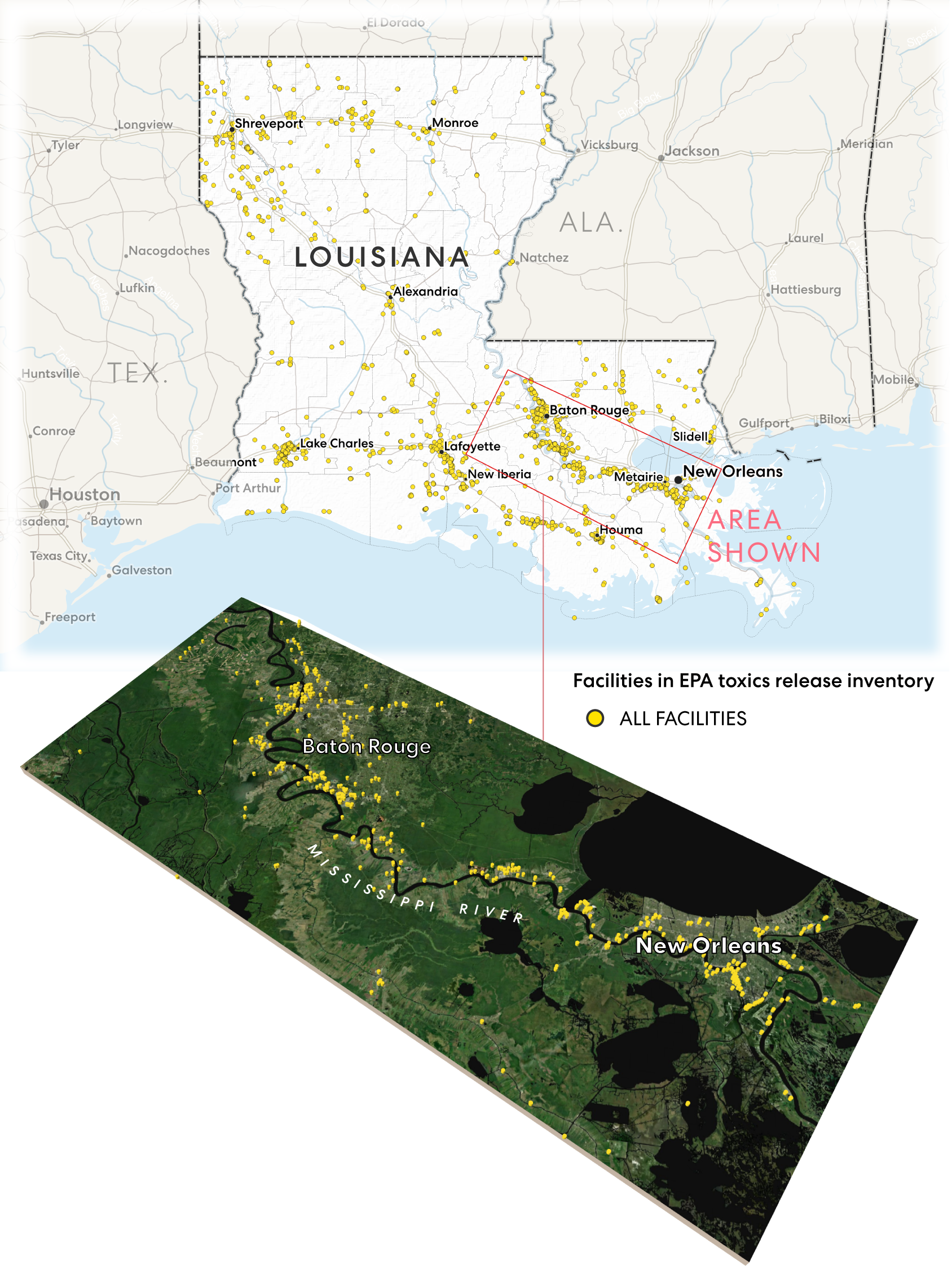
Sources: Mapbox (imagery); EPA (toxic release sites); Natural Earth data Geoff McGhee
The communities around these facilities, such as St. James and Ascension Parishes, don’t benefit from that money. Instead, they live with some of the highest rates of cancer anywhere in the United States.
Twila Collins and her husband live in Modeste, an unincorporated community in Ascension Parish. State route LA-405, which hugs the Mississippi River, is only a few feet away from their front door. Trucks rumble incessantly down the two-lane road, which wasn’t intended to handle such heavy traffic. One had overturned the morning I visited.
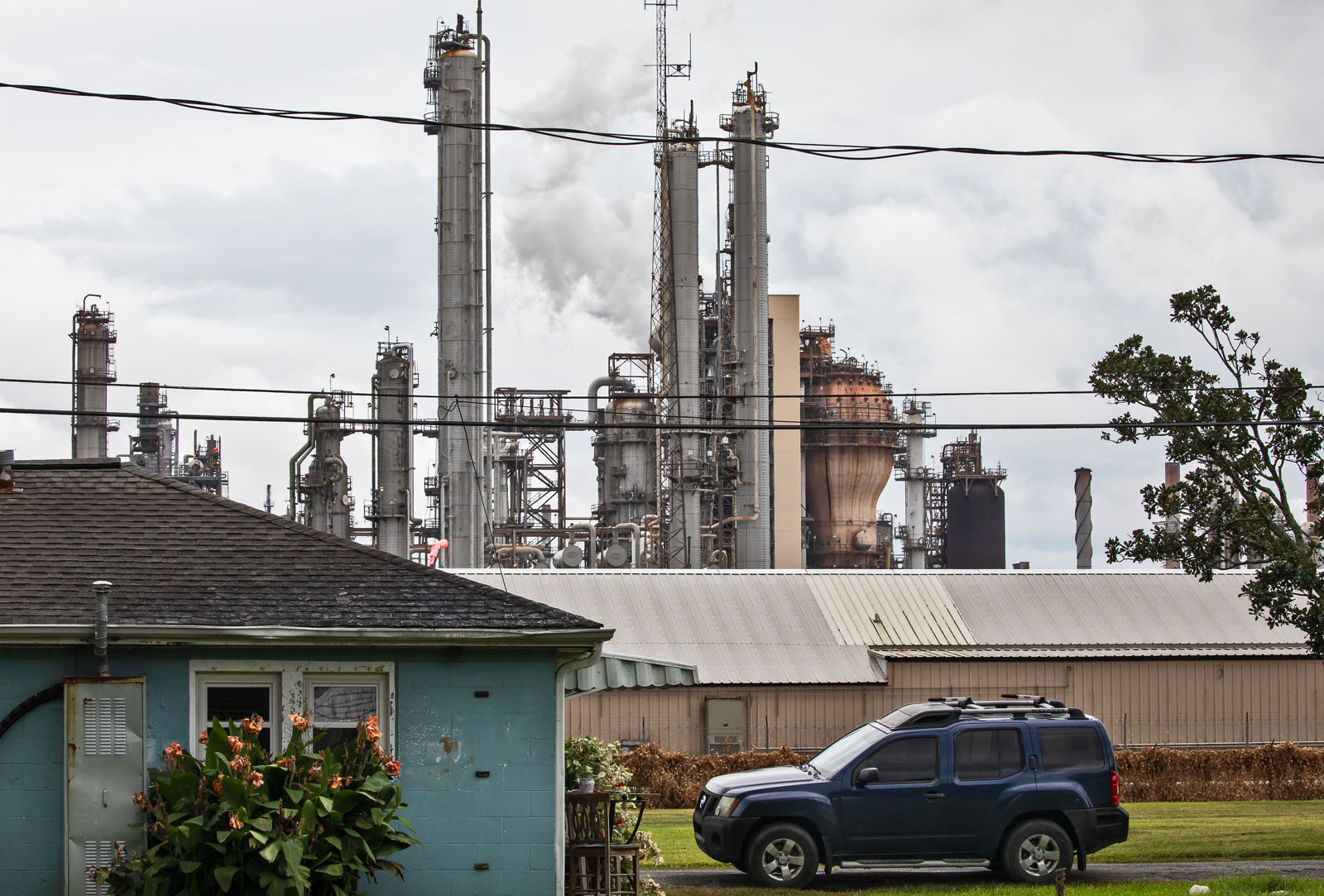
A home in front of Shell’s Norco 2 plant in St. Charles Parish, Louisiana, in 2019. Julie Dermansky
Collins feels completely unseen by the politicians who are supposed to represent and care for her community. “It’s like our voices don’t matter,” she told me in her tidy living room.
Many of the refineries are built on the sites of former plantations where enslaved people worked sugar fields in the broiling Louisiana heat. Now many of their descendants live in the shadows of chemical plants owned by Koch Industries and BASF.
“It’s the same dynamic as it was 100 years ago,” said Anne Rolfes, director of the Louisiana Bucket Brigade, an environmental-justice nonprofit. Rolfes and her coalition are fighting the approximately $10 billion RiverPlex MegaPark in Ascension Parish, which, if built, would become one of the largest conglomerations of industrial facilities on the Gulf Coast. Once operational, the site could emit millions of tons of greenhouse gases each year.
I drove around St. James Parish with Harry Joseph, the pastor of Mount Triumph Baptist Church, in his pickup truck. The church is 115 years old but now has only about half a dozen members. Everyone who can get out does, he said. “It’s just a bad place to live, man.”
The EPA was created explicitly to address situations like the one in Cancer Alley. But instead of trying to do something to make it right for the people suffering here, Zeldin, early in his tenure, made it worse. At the request of Zeldin’s EPA, the Department of Justice dismissed a lawsuit against Denka Performance Elastomer, which runs a polluting neoprene plant in LaPlace. An accompanying press release said that dropping the case was about “delivering on President Trump’s promise to dismantle radical DEI programs,” a reference to diversity, equity, and inclusion initiatives. Residents got the message: Black communities don’t matter to Trump or Zeldin.
They aren’t going to give up the fight. The stakes are too high. “Every family got somebody [who] got cancer,” Joseph said. “This stuff is all over.”
Two other local women, Gail LeBoeuf and Barbara Washington, started the environmental-justice organization Inclusive Louisiana in 2020—guided by their Christian faith as well as personal loss.
“This fight has been very personal to me,” Washington said as we spoke at Inclusive Louisiana’s headquarters, a ranch-style house that, like most other houses here, borders an industrial plant. Her nephew died of cancer in his early fifties. Washington’s sister died from metastatic lung cancer, despite never having smoked. The surrounding neighborhood is similarly afflicted. “The guy from right across the street died last year of pancreatic cancer,” Washington said.
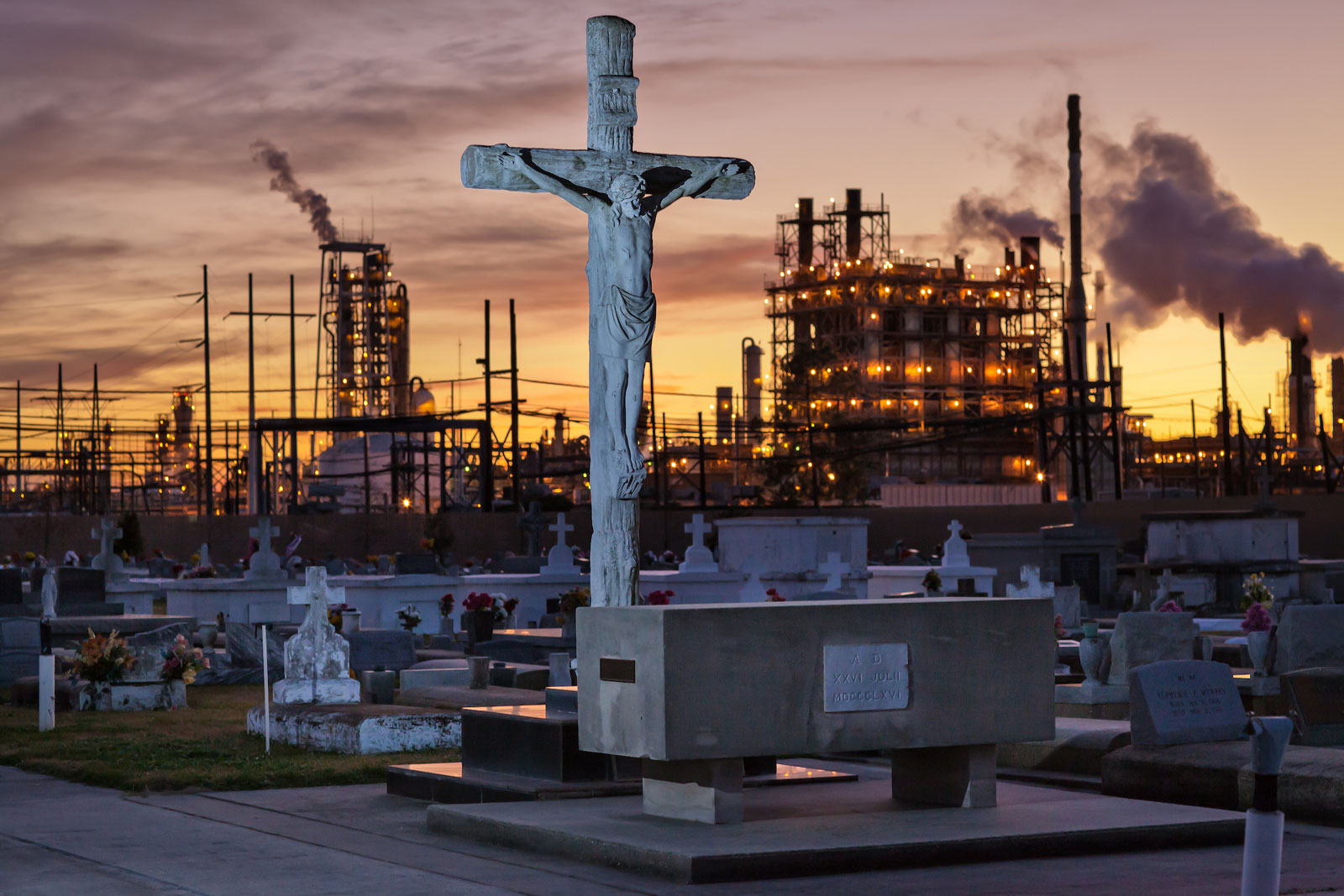
The Holy Rosary Cemetery next to a Dow Chemical plant in Taft, Louisiana, part of Cancer Alley. Julie Dermansky
While it may be impossible to trace those cancers back to a specific source like a petrochemical plant, the accumulation of evidence is enough to dam the Mississippi. A study published last year found that in four Cancer Alley parishes surveyed by researchers, the cancer risk was as much as 11 times higher than what EPA models had predicted.
To Protect What’s Wild and Wonderful
Despite having been pillaged by extractive industries for well over a century, West Virginia has worked strenuously in recent years to live up to its “Wild and Wonderful” motto.
It is, after all, home to the New River Gorge National Park and Preserve, more than 70,000 acres of sparkling, protected whitewater rapids and soaring river gorges.

Trump’s campaign to boost West Virginia’s coal industry could imperil the state’s attempt to reinvent itself as a tourist destination.
The Blackwater River in Davis, West Virginia.
Michelle Gustafson

Tourists at Blackwater Falls in Blackwater State Park.
Michelle Gustafson

A forest floor of buttercups in Tucker County, West Virginia.
Michelle Gustafson
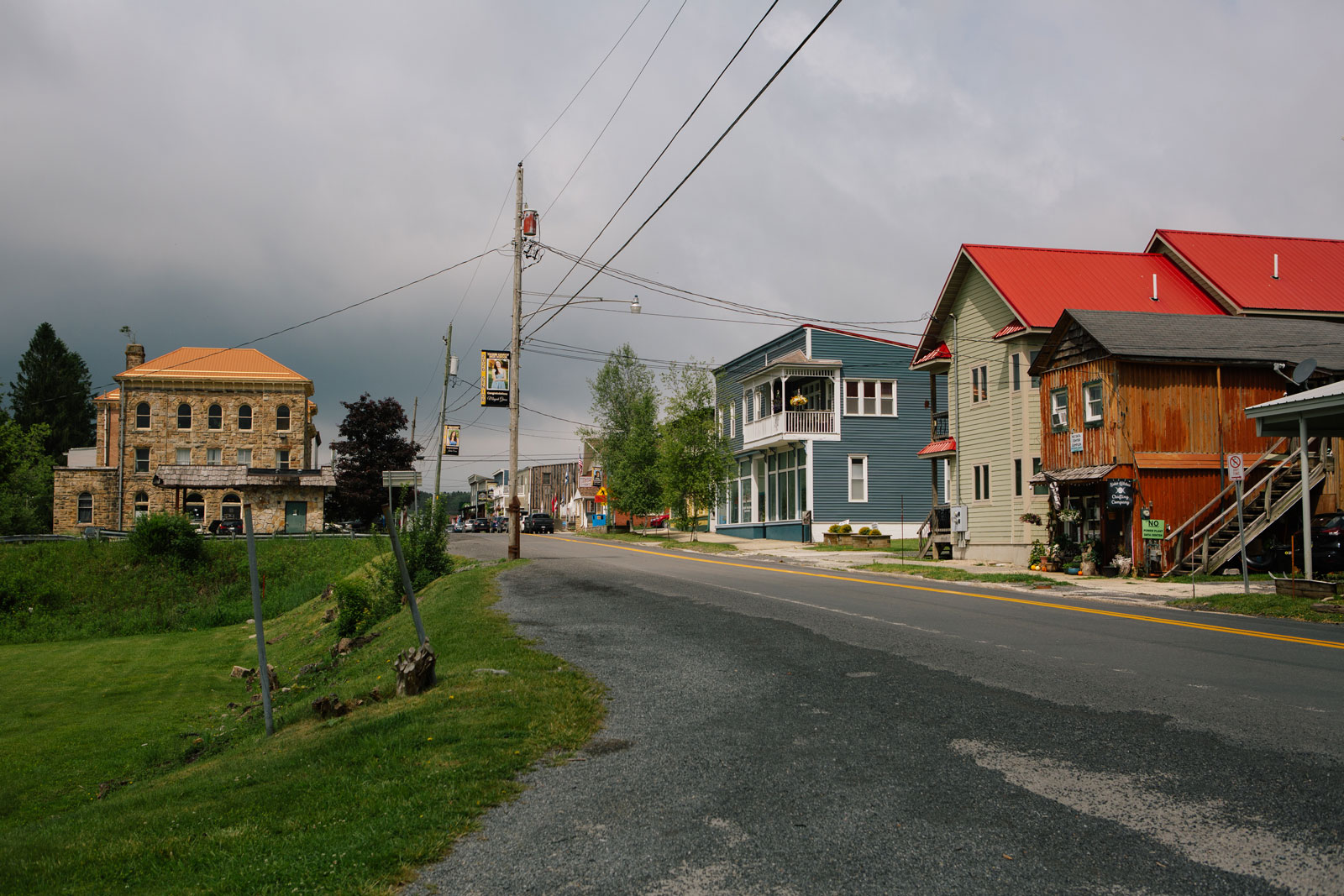
Downtown Davis, West Virginia. Michelle Gustafson
Now another threat looms, a manifestation not of the nation’s fossil-fuel-burning history but of its digitized future: data centers.
West Virginia’s Republican Governor, Patrick Morrisey, has argued that data centers are vital to the state’s economic growth. West Virginia is close to the Eastern Seaboard and has a lot of inexpensive land. Last year, Morrisey signed the Power Generation and Consumption Act, which he claimed would “make West Virginia the most attractive state in the country for data centers and help America better compete with China in the technology arms race of the future.”
The law, known as HB 2014, effectively prevents counties and municipalities from opposing data centers based on “horticultural, noise, viewshed, lighting, development, or land use ordinances, restrictions, limitations, or approvals.” They also cannot enforce code, conduct inspections, or require licensing if the state’s Department of Commerce has given approval to build a data center.
HB 2014 also takes away the ability of West Virginians to pass ordinances or resolutions that would prohibit the building of data centers—steps that some jurisdictions elsewhere are trying to take. And it includes provisions to boost coal production and burning, a giveaway to the state’s legacy industry.
Shortly before HB 2014 passed, a little-known Virginia company called Fundamental Data applied to build a data center between Davis and Thomas, towns that tourists tend to visit as a pair. The data center would occupy about 500 acres above the towns.
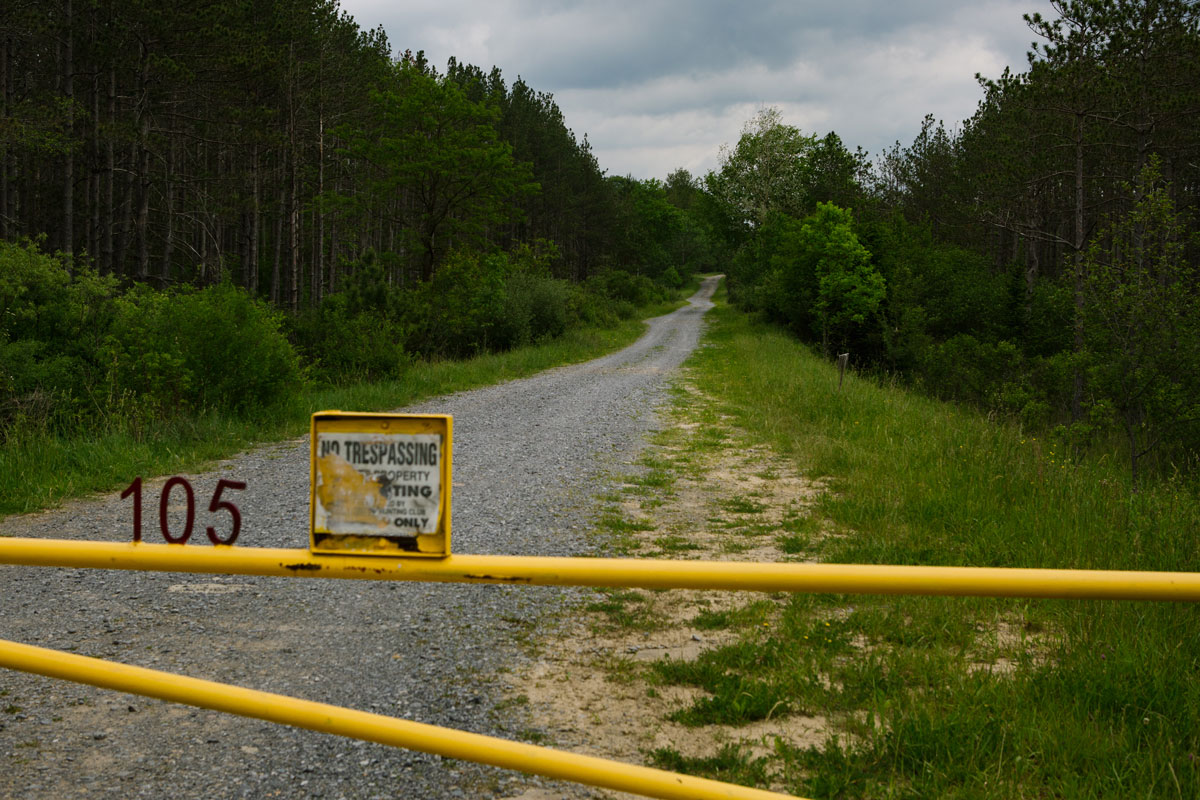
A road leading to the location of a proposed data center complex near David and Thomas, West Virginia. Michelle Gustafson
Thousands more acres would be reserved for gas turbines and a solar field, plus, possibly, a nuclear power plant, as the expected energy needs of the data center are so great. Until a local organization called Tucker United started asking questions, Fundamental Data seemed intent on saying as little as possible. In recent months, it has been forced to disclose more of its plans. (Neither Fundamental Data nor Governor Morrisey responded to requests for comment.)
Judging by the ubiquitous signs against the data center throughout Davis and Thomas, those plans have not been well received.
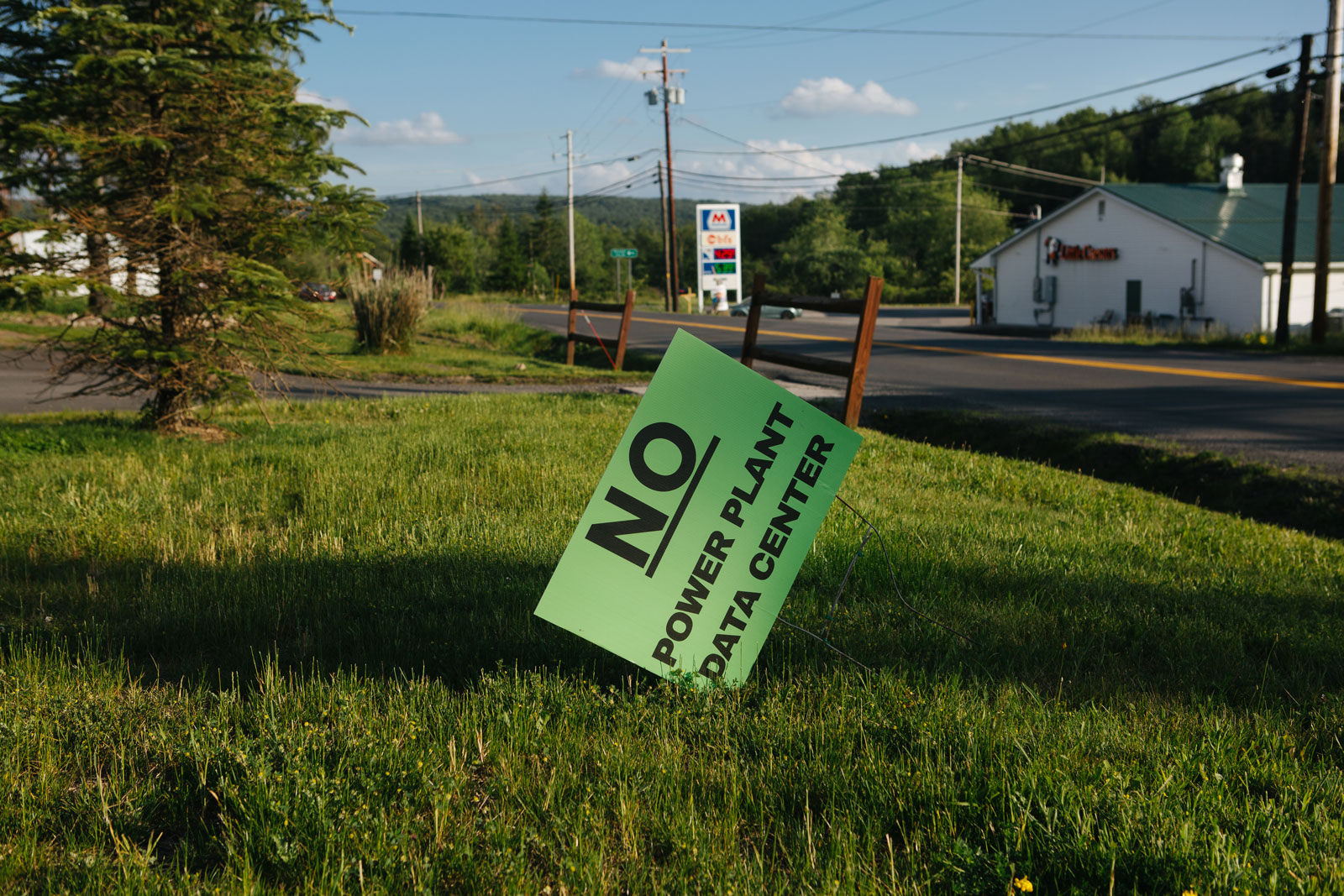
A sign in Davis, West Virginia, opposing a data center and gas-fired power plant. Michelle Gustafson
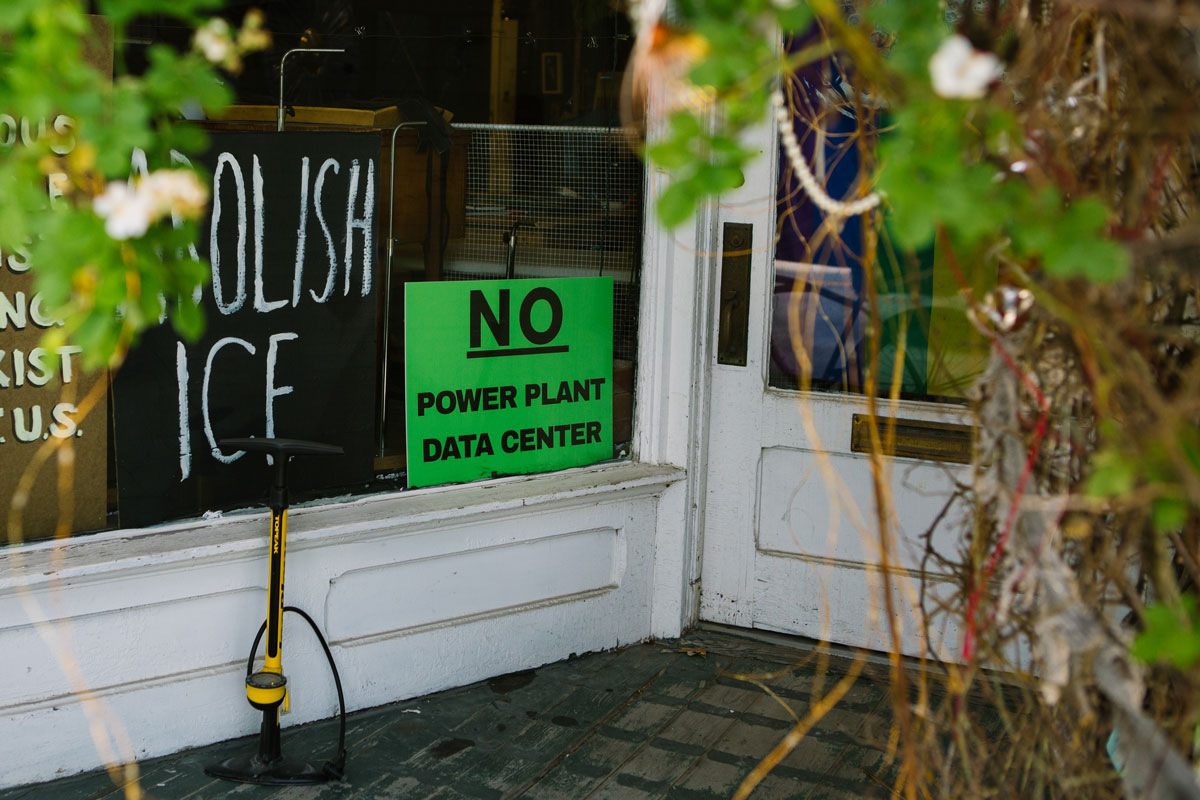
Signs opposing the power plant appear throughout Thomas and Davis. Michelle Gustafson
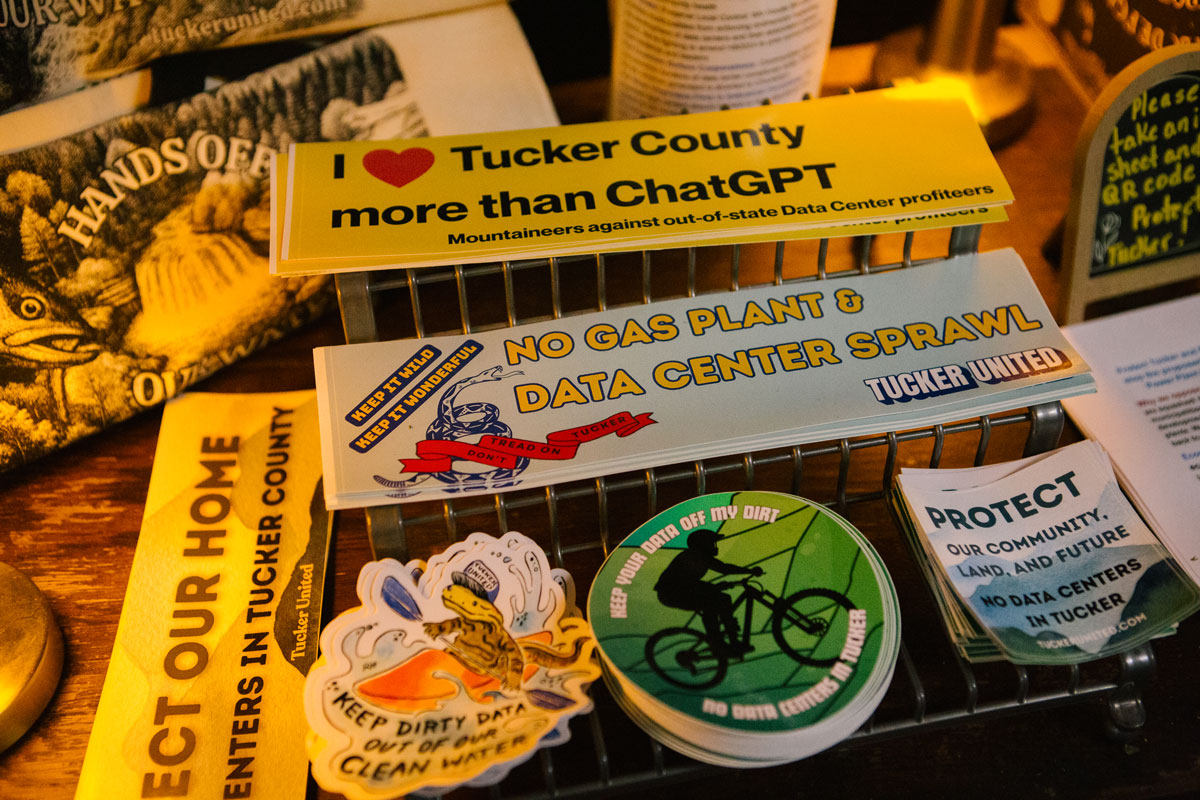
The activist group Tucker United created stickers opposing data centers in Tucker County. Michelle Gustafson
Decades after the coal industry flattened mountains and polluted streams, locals worry that data centers will threaten the health of the Blackwater River and bring noise and light pollution.

“It feels like a kick in the back.”
Carrie Hawkins, a resident of Davis, West Virginia, and a member of the town council.
Michelle Gustafson

“These things are being pushed onto people without their consent.”
–Carrie Hawkins
Carrie Hawkins, like many Davis residents, is against the proposed data center development.
Michelle Gustafson
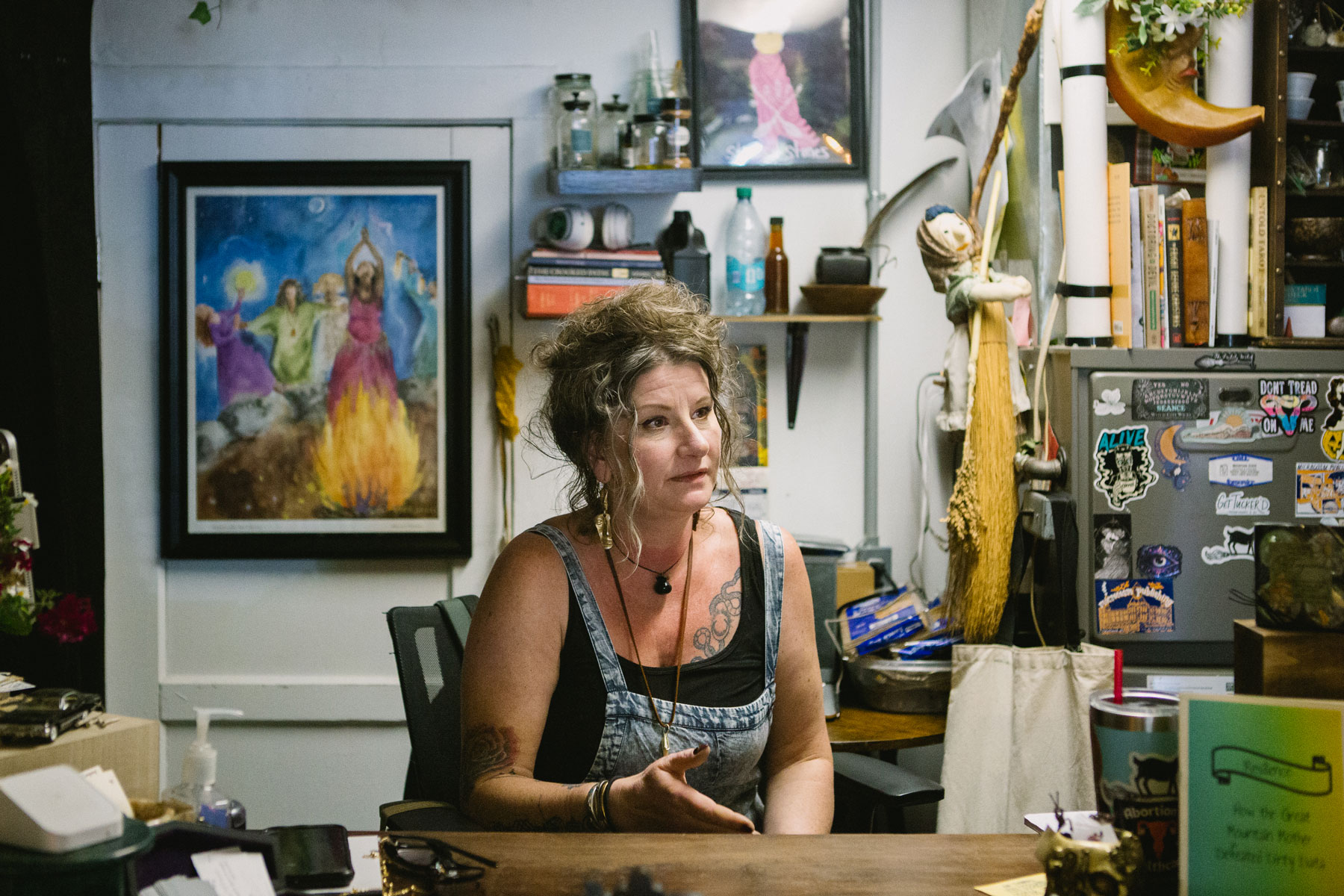
Shaena Crossland, an organizer for Tucker United, is fighting the planned data center near her town.
Shaena Crossland, owner of the Sister Witches store in downtown Davis.
Michelle Gustafson
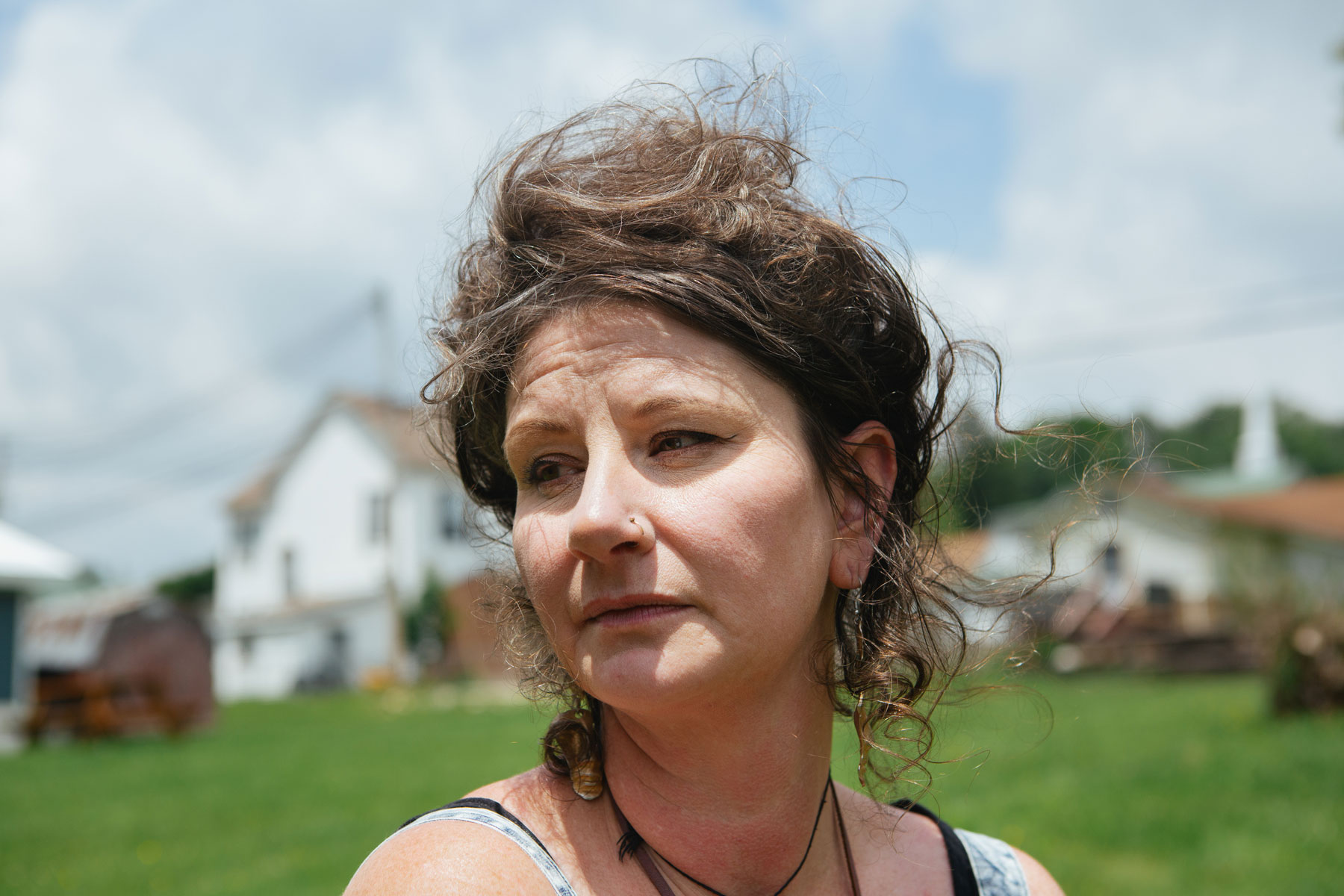
Her husband worked in the coal industry for three years, which exacerbated the effects of a previously collapsed lung.
Shaena Crossland is a member of Tucker United, opposing data centers in Tucker County.
Michelle Gustafson
Coal left West Virginia with a mess to clean up, Crossland, an organizer for Tucker United, said during an interview in her Thomas store. While the industry brought jobs and fed families, she said, “There’s dirty water, there’s poisoned land, and there’s poisoned people. So if another extraction industry is going to come into our state, I want proof that you are actually going to do the right thing.”
Who, or what, will get industry to do that if not the Environmental Protection Agency? If EPA regulators don’t demand that proof—if those regulators have been pushed out of their jobs, or their jobs have been reduced into irrelevancy—then doing the right thing becomes a matter of choice. Without an EPA helming the nation’s policies for protecting the environment and human health, communities like those in West Virginia and Louisiana are left to take the fight against extractive industries on for themselves. Because of Zeldin, that’s exactly what’s happening.



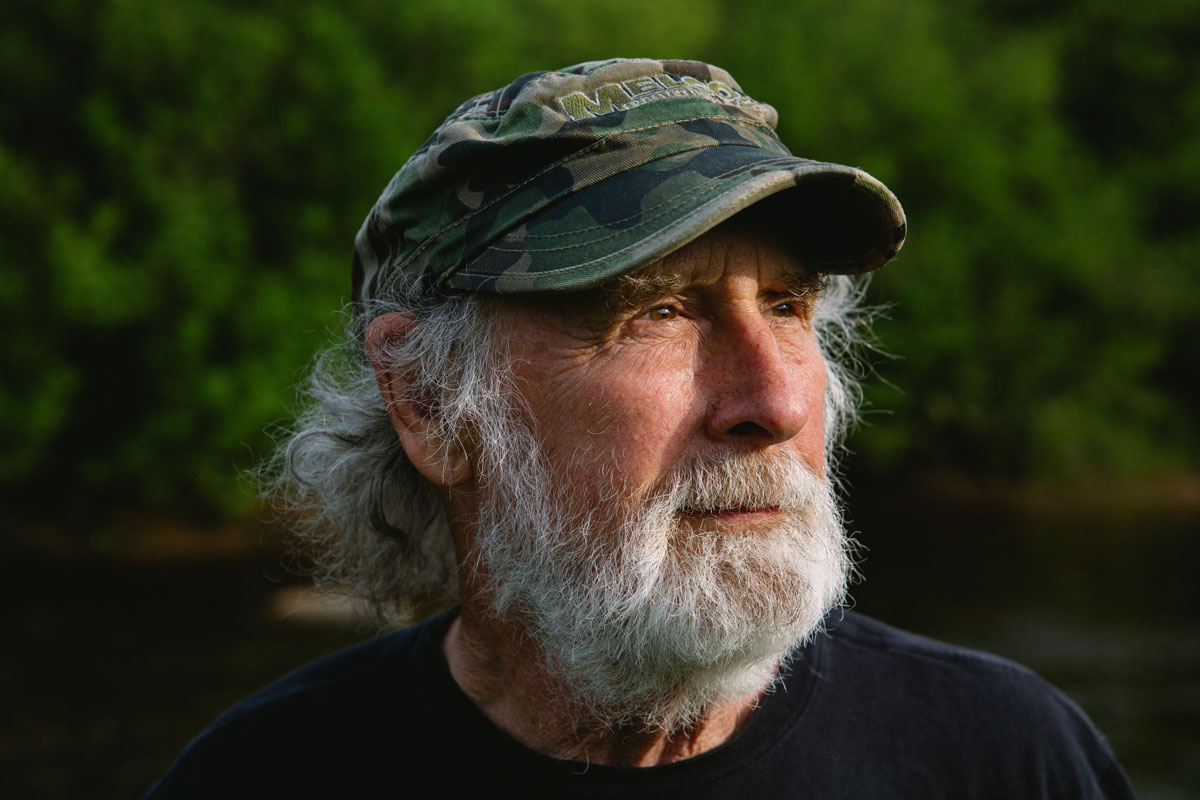
Thomas and Davis residents and opponents of the proposed data center (clockwise from top left): Katherine Fleishman, Cris Parque, Ed “Doc” Radar, and Robert McClung. Michelle Gustafson
Trump and Zeldin may have turned the EPA inside out, but they have also unleashed movements of opposition as communities across the country take a stand—whether it comes to data centers yet to be built or coal and petrochemical plants already poisoning their air, land, and water.
“It’s always a fight for Mother Nature,” Hawkins said.
What You Can Do
Tell Congress to make the EPA do its job to protect our environment:
sc.org/epa-accountable.
Alexander Nazaryan has written about national parks, data centers, and water pollution for Sierra.
Michelle Gustafson is a freelance photographer based in Philadelphia. Her work has appeared in The New York Times, The Wall Street Journal, and other publications.