A Toxic Undercurrent at Clark Fork
A Montana river gets a major cleanup after decades of mining
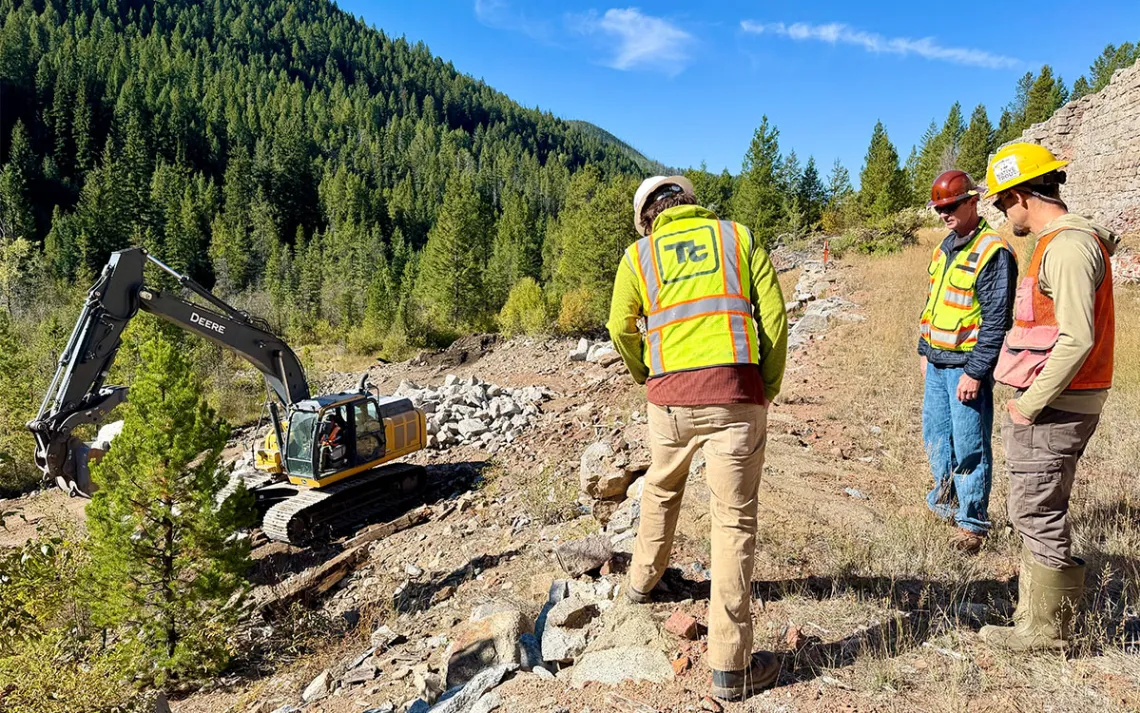
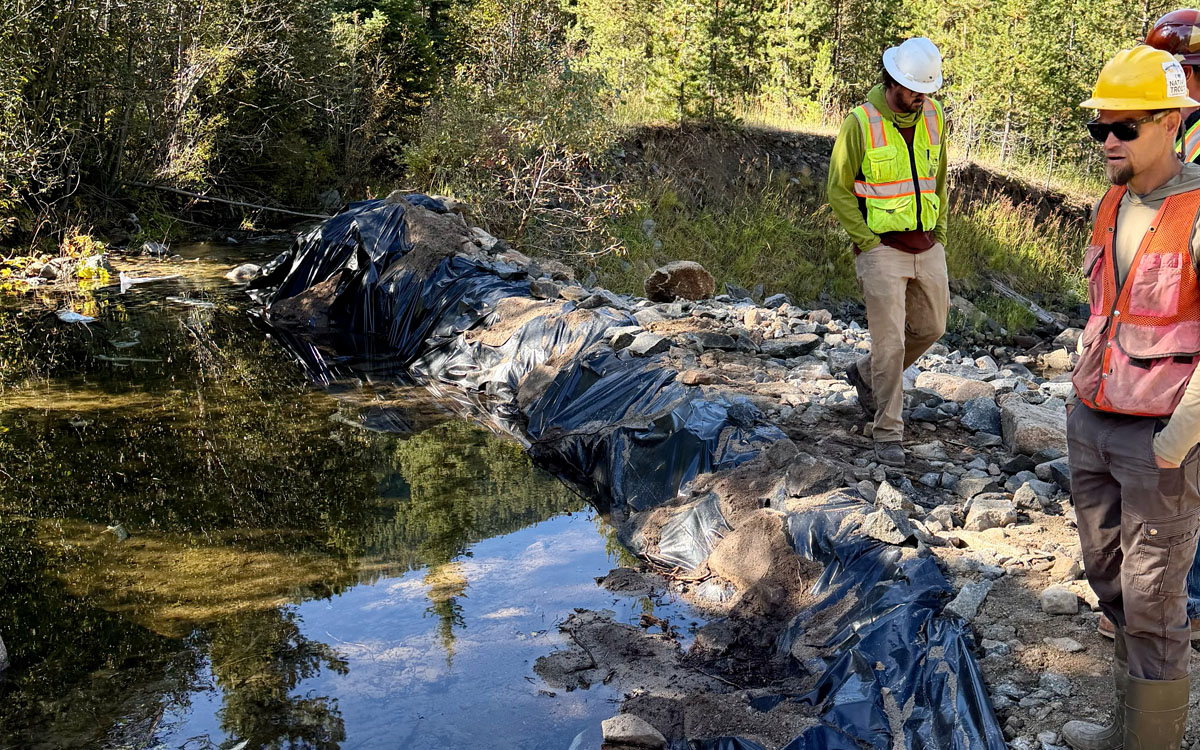
Trout Unlimited's Rob Roberts, EPA on-scene coordinator Eric Vanderboom, and a third-party engineer inspect a dam that was created to reroute Fred Burr Creek for mining operations.
Philipsburg, Montana, is a small town with a long history of extractive industry. The municipality of less than 1,000, tucked along the Continental Divide of the western United States, revved up in 1867 because of a mining boom—first silver, then timber and sapphire extraction. Today, the town boasts glimmering alpine lakes, skiing, and mountain biking, and even enjoys the designation of a “Conservation Town.”
Philipsburg also abuts one of the nation’s biggest Superfund sites, known as the Clark Fork River Superfund Complex.
Superfunds are areas so toxic that the Environmental Protection Agency has to step in and manage the mess. The neighboring town of Butte is mostly responsible for how that mess came to be. Butte was once the world’s largest producer of copper; decades of mining the metal polluted the river with large amounts of chemicals like arsenic, lead, and cadmium. Nearly $1 billion has been spent over 43 years to remove these contaminants, but recent research shows that cleanup measures have largely ignored the mercury left behind.
“The way we approached remediation and restoration of the river, we ignored the mercury—which may have been counterproductive in some cases,” said Heiko Langer, the environmental chemist who authored the study showing that high mercury levels are still in segments of the Clark Fork near Philipsburg. “We may have even helped it become more toxic in some areas.”
Mercury is more volatile than other, harder metals that are typically left over from hard-rock mining. It liquifies and can even vaporize at room temperature, which makes it difficult to capture, and more dangerous in terms of public and environmental health. The metal can become more toxic as it moves up the food chain. When mercury is present in river sediment, it can transfer to aquatic plants, then to fish, then to humans, becoming increasingly toxic as it goes—a phenomenon known as bioaccumulation.
Bioaccumulation is what led Lagner and his team to discover the toxin in the first place. In partnership with University of Montana and Raptor View Research Institute scientists, their work helped trace the Clark Fork River’s pollution through blood and feather samples from hundreds of ospreys, whose fish-based diets provided clues about where legacy mining toxins were entering the watershed.
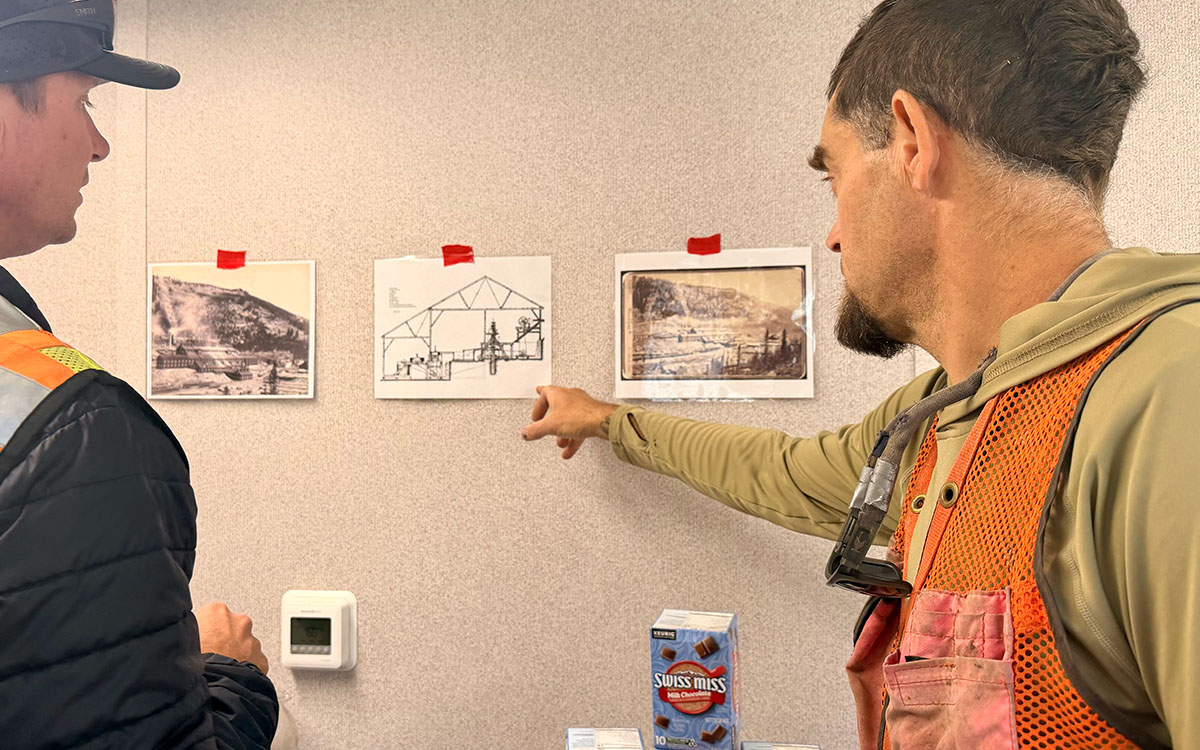
Roberts and Vanderboom look at original blueprints and historic photos of Rumsey Mill, which was constructed between 1888 and 1889.
Currently, Montana state and tribal agencies advise against eating any fish caught in a 148-mile stretch of the Clark Fork River, which includes the watershed near Philipsburg. According to the 2026 Montana Sport Fish Consumption Guidelines, fish found in this segment can contain everything from historic mining metals and industrial pollutants to newly discovered chemicals like PFAS, also known as "forever chemicals.” Mercury concentrations, according to Lagner’s research, remain well above the threshold where harmful effects start to occur for over 40 miles downstream from the known hot spot near Philipsburg. According to the guidelines, there is no method of cooking or cleaning fish that will reduce the amount of mercury in a meal.
“We’ve never really seen mercury as a priority contaminant in the Clark Fork cleanup,” said Lagner. “But when you look at the consumption limits for fish, or the general factors that limit our environmental value, mercury is so important now.”
The mercury in the Clark Fork has been traced from a site known as the Rumsey Mill near Philipsburg, which served as one of the epicenters for the town’s silver boom. In the late 19th century, more than 100 tons of mercury were used to extract precious metals to separate them from the surrounding rock. Some of that mercury was captured and reused at the time, but much of it remained behind and has lived on for over a century in mine tailings in and around the old mill site.
When the silver industry collapsed, miners abandoned Rumsey Mill. For decades, locals scavenged the area for mercury droplets that had accumulated around the mill, selling what they could recover. Those efforts removed some contamination, but also likely disturbed and redistributed it throughout the surrounding landscape. According to Rob Roberts, senior project manager for Trout Unlimited, which has been working on river restoration in the Philipsburg area, once mercury has been released into the environment, it doesn’t follow a predictable pattern.
“This is not an uncommon situation with old legacy mines where contaminated material starts being dispersed,” said Roberts. “But mercury in particular is really unique and separate from the rest of the metals that people are trying to track, trace, and reclaim as a result of hard-rock mining.”
According to Roberts, Trout Unlimited has been aware of the heavy mercury levels since the early 2000s, but because mercury can end up pooled in certain areas, and not in others, cleanup is tricky. He says that reclamation methodologies look very different for mercury as compared to lead or arsenic. Random sampling patterns of water quality and soil aren’t as accurate. To date, Trout Unlimited has been closely involved with preliminary measures, alongside efforts from locals, aimed at getting the mercury removed from the Rumsey Mill site once and for all.
“We've got proof of concept; we've put the money on the ground; and we've put money into the local economy for people to move dirt and reclaim the system,” said Roberts.
Craig Myers, the EPA’s on-scene coordinator in the Superfund and Emergency Management Division’s removal program, has overseen much of the agency’s involvement in slating Rumsey Mill’s cleanup. According to Meyers, the EPA’s main role was in acting as a liaison to the private property owner whose permission was needed to access and remediate the site. After years of a holding pattern due to both Covid delays and administrative changes, the mill’s restoration project has finally broken ground.
In Myers’s 20 years at the EPA, this is the largest mercury extraction the agency has executed. “A lot of the mining work that we do is in a mining district that's so distributed that it's hard to attribute the contaminants in the river to any one place,” said Meyers. “This is one of the first times in my 20 some years that there's really one spot.”
Because of mercury’s chemical volatility, vapor-related worker safety issues are a top concern. There are also engineering challenges for remediating the toxins out of a steep, confined canyon slope. The EPA plans to dig up the mercury‑contaminated mill waste by scraping it up from the bottom of the stream bed and moving it upslope into a contained repository. They will then cap and armor that repository so water can’t easily reach or wash it out. After restoring the disturbed creek banks, they’ll test the water next year, in a low‑flow season, to ensure that mercury levels downstream have dropped.
According to a recent press release, the EPA says the work is intended to substantially reduce the ongoing release of mercury and arsenic into the tributaries of the Clark Fork, while improving water quality, habitat, and the stability of the site. The agency expects the cleanup to be completed by November 30.
But mining cleanups are rarely straightforward. Even with years of sampling and geophysical surveys, Meyers says they can’t be entirely sure what’s happening until groundbreaking begins. High contaminant readings at a site like Rumsey Mill, he says, can even hide other unseen sources of contamination.
“We think we understand what’s going on at the site because of all of the sampling and the geophysical investigations and other things that we’ve done on the property, but we never really know until we break ground,” Craig said. “There is always a chance that it's masking some other discharge.”
For Langer, whose research helped reveal the contaminant’s cascading effects downriver, the project is an opportunity to address a pollutant that has largely escaped the focus of the Clark Fork’s decades-long cleanup. Philipsburg’s story may also be a warning for communities beyond Montana. On Nevada’s Carson River, another historic mining watershed, researchers recently found mercury levels in wood ducks up to 60 times the FDA limit for human consumption—showing how legacy mining can continue to impact ecosystems and public health long after operations have ended.
“Rumsey Mill is just another illustration to show that whatever happens upstream matters downstream,” said Lagner.