On Tangier Island, the Waters Keep Rising
As the Trump administration continues to ignore the climate crisis, Virginia's Tangier Island continues to sink
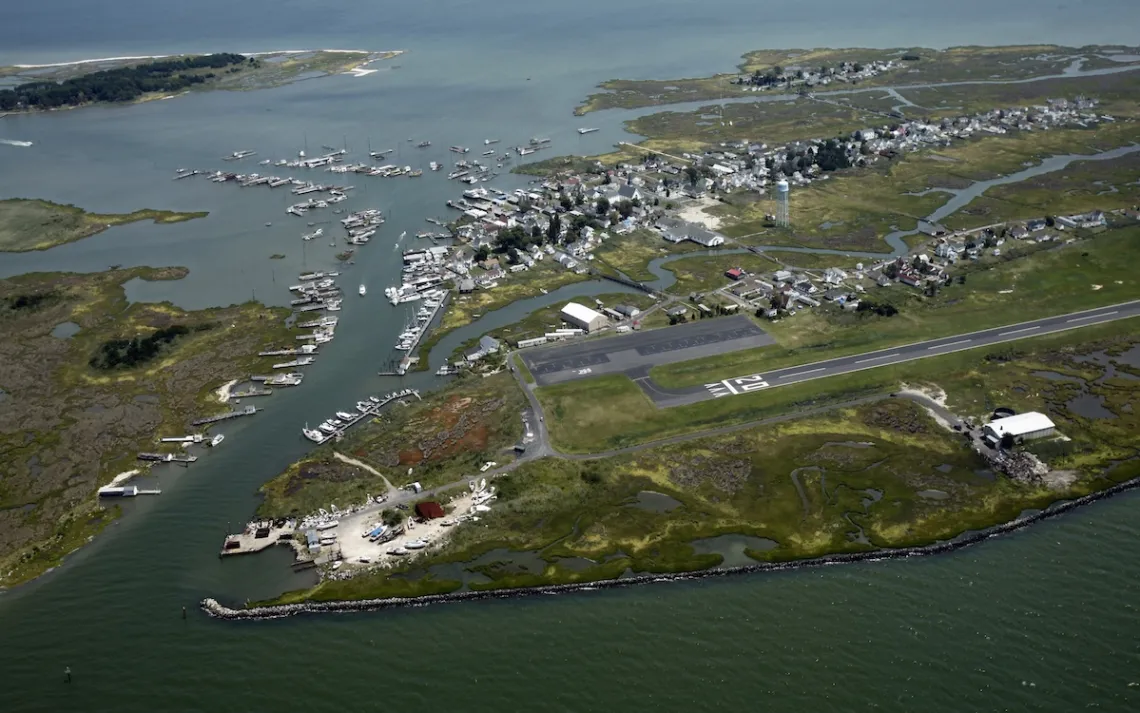
Tangier Island, Virginia. | AP Photo/Richmond Times-Dispatch, Bob Brown
Tangier Island is a speck of land in the middle of Chesapeake Bay, with about 10 miles of water separating it from Maryland and Virginia. While small, the island is rich with natural beauty and a seafaring legacy that goes back generations. It is also on the front lines of climate change—rising seas pose an existential threat.
To get to Tangier, you drive east and south for about three hours from Washington, DC, through flat farm country where Harriet Tubman once toiled. You park in Crisfield, Maryland, a faded seaside town, and hop on a small ferry, where you are likely to be the only person who doesn't know everyone else on board. Then it’s another 45 minutes across the Chesapeake’s flat, calm waters.
The calm is deceptive. Over the next century, the waters of the Chesapeake could rise as much as 5.2 feet. This isn’t apparent on a daily basis unless you live on Tangier Island. There, it’s a reality as inescapable as the water itself.
“I guess you could say the bay gives and the bay takes away,” one resident says in Been Here Stay Here, a documentary that premiered in 2024. The film as well as a crop of books (including Earl Swift’s Chesapeake Requiem) and magazine features (“Tangier, the Sinking Island in the Chesapeake,” which appeared in The New Yorker in 2018) have turned Tangier Island into a symbol of where our entire overheating world may be heading.
Tangier was first explored by John Smith in 1608 and settled in the late 18th century by English families. Once, there was a bustling oystering economy, but it has faded in recent decades, and nothing has replaced it. Crisfield looks bustling by comparison.
Few would be inclined to invest in Tangier now since it may not be around for much longer. Between erosion and rising water levels, the island is losing about eight acres per year. This loss has persisted for well over a century: It is estimated that since 1850, Tangier Island has lost 1,400 acres, or two-thirds of its land mass.
Rising waters are especially perilous for an island only three feet above the water level. More frequent storms, another result of climate change, only worsen land loss. A 2021 research paper offered a grim prospect: “We predict that the town will reach a population of 0 by the year 2053.” So much land will have been lost by then that Tangier Island will be uninhabitable.
The people of Tangier don’t need scientists to tell them of their fate. The population has shrunk from a peak of about 1,100 in the early 20th century to about 250 today. The remaining population is older (the median age is about 66) and sinking into the lower middle class. Houses that were once beautiful sit neglected or abandoned. There are junk piles everywhere, and paved roads are intermittent.
Trump support is ubiquitous. Of the 198 votes cast for president in 2024, 176 were for Trump.
The most consequential politician on the island is practically a kid. Cameron C. Evans, now 25, is the island’s vice mayor. He has held that position since 2024, when he lost to the longtime incumbent mayor, James “Ooker” Eskridge. Evans is a crabber and tour guide. He also runs a photography studio out of an old dockside barn. His photos are sweeping, filled with vivid color, nature, and humanity lovingly detailed. They are Tangier Island at its best, as it once was and could be.
“They back Trump, and they pray,” Swift wrote of the islanders in 2018. In the last three presidential elections, Trump won each time with about 88 percent of the vote, according to the Virginia Public Access Project.
Trump called Eskridge in 2017 after he saw a segment about the island on CNN. “He said we shouldn’t worry about rising sea levels,” Eskridge said to The Washington Post of his conversation with the president. Trump told him that “your island has been there for hundreds of years, and I believe your island will be there for hundreds more.”
Nearly 10 years have passed. There has been no major federal effort to ensure that Tangier Island will, in fact, survive. The Army Corps of Engineers has constructed a jetty, and there have been allocations for dredging, but not nearly enough to keep the island from continuing to lose land.
“A lot of people just write us off,” Evans told me.
He has been fighting for state and federal authorities to conduct the kind of land reclamation projects that would slow erosion and save Tangier Island. But nobody seems to care, the water only keeps rising, and people keep leaving for the mainland.
As we tour by boat, the island slowly drifts by, bathed in majestic spring light. Evans stops his boat to pull out crab cages. Once, you could expect each cage to be packed with crustaceans, but climate change and other factors have devastated the once famous blue crab population. In the cages Evans pulls out, only one or two scuttle along the metal frame.
The water has been Tangier’s lifeblood and could also be Tangier’s destroyer.
“We are losing land by the day,” Evans told me. People live along one of three ridges that run longitudinally down Tangier. Canton Ridge is already largely depopulated and is expected to become a wetland by 2051, while West Ridge is expected to be the first to sink. Most people are sandwiched between the two, on Main Ridge.
“If you can’t necessarily protect or rebuild these areas, you have no hope for a future when it comes to land restoration efforts,” Evans said. In his view, saving Tangier Island would show a commitment to other coastal communities now fighting for survival. Those include the lowlands of Isle de Jean Charles in Louisiana, now almost totally gone. Indigenous villages in Alaska face the same threat, compounded by melting permafrost. Though it is much more prosperous than Tangier Island, much of Miami-Dade County in Florida could succumb to water by 2060.
Washington, DC, does not seem especially interested in these efforts. The EPA canceled a $20 million grant to Kipnuk, an Alaskan village that was devastated by floods. Aberdeen Gardens, a historically Black community in Hampton Roads, along the Chesapeake, also lost $20 million that had been dedicated to climate-resilience programs.
Meanwhile, the waters around Tangier keep rising. The population keeps shrinking. The past becomes rosier, the future bleaker.
“It’s a good example of what happens when you don’t address the real changes happening on the ground,” said Keisha Sedlacek, senior policy director of the Chesapeake Bay Foundation, an environmental nonprofit.
“Unless we do something and step in, both in the state of Virginia and on the federal level, to ensure that we’re addressing climate change,” Sedlacek went on to say, “there’s just no way that this community, these islands, are going to survive.”
The EPA is no longer reining in greenhouse gas emissions. Under Lee Zeldin, the agency is failing to address climate change and has become a shield for polluting industries. Read more at sc.org/zeldin.