Adventures in Animal Miscasting
Researchers call out wildlife mistakes in movie magic
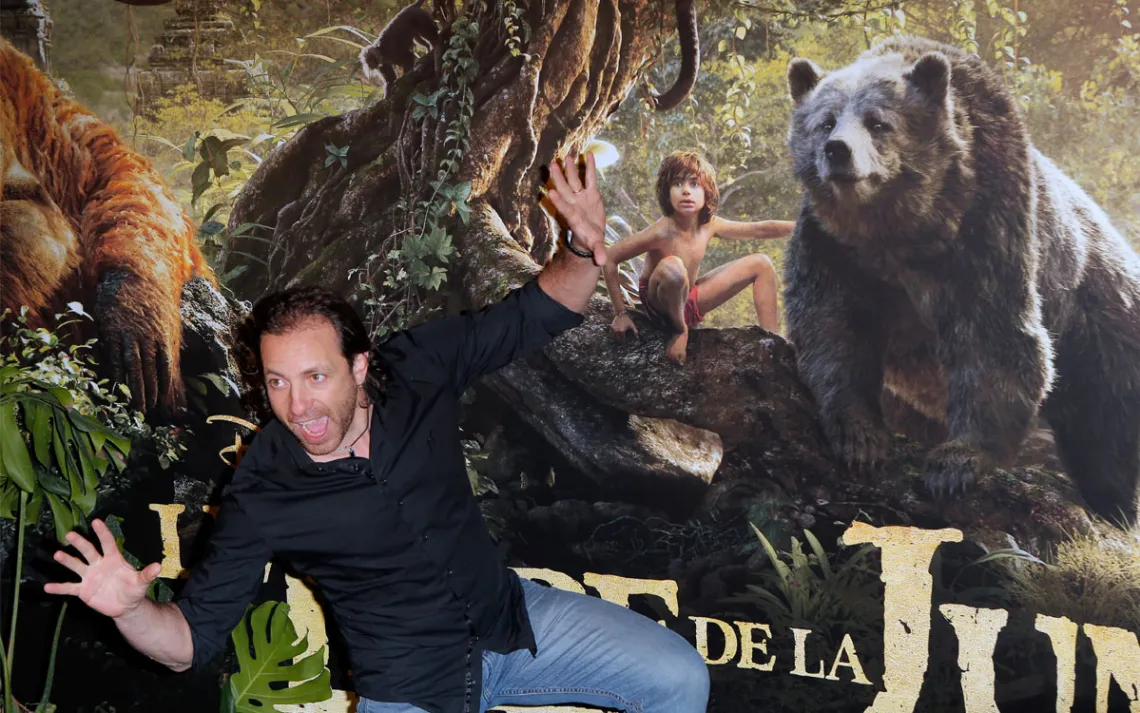
Former French Olympic skater Philippe Candeloro at a screening of The Jungle Book in Paris. | Photo courtesy of AP Photo/Francois Mori
Michelle LaRue fondly remembers the 1988 comedy The Great Outdoors, featuring John Candy and Dan Aykroyd and set in her home state of Wisconsin. But as she learned more about animals, she noticed a flaw: the huge grizzly bear that, at one point, crashes through the front door of the protagonists’ vacation cabin. Grizzlies don’t live in Wisconsin, and there’s no record of them doing so since at least the last ice age.
LaRue, now a professor of wildlife ecology at New Zealand's University of Canterbury, has since come across many amusing animal errors in the media, but this one stands out for sheer audacity. It’s a sentiment that many academics or even animal fanatics are familiar with: They’re watching a movie or reading an article and laugh or groan when they notice a creature comically out of place.
Such was the case for wildlife biologist Forrest Galante, an author and TV personality, on a flight recently with his six-year-old son. They decided to pull up a favorite childhood movie, Ace Ventura: Nature Calls. Barely 15 minutes into the movie, his son asked, "Dad, why are there toucans in Africa?'" (Spoiler: There aren't.) "It's so funny because I remember being 10 or 12 when that movie came out, maybe a bit older, and thinking the same thing,'" Galante recalled.
Even if filmmakers wanted to get every single detail right, biologists would probably catch them in errors nobody else would ever notice. Take the red-tailed hawk, common across North America. There are actually 16 subspecies, according to the Cornell Lab, so if you set a movie in Connecticut, don't try to sneak in the West Coast version.
"It only stands out when it's accurate, honestly," said Nick Lund, a nature writer based in Maine who makes a hobby out of pointing out bird-related errors. "Birds are wrong every time."
Movie magic
Even CGI or AI, which allow creators to add virtually any detail, is not enough to save producers from the follies of putting an animal out of place. Josh Moyar, a coordinator for the International Wildlife Film Festival in Missoula, Montana, praises the live-action The Jungle Book for its attention to detail, but points out that the character Baloo is identified as a sloth bear yet digitally rendered as a Himalayan brown bear. More egregiously, the Brad Pitt movie Bullet Train features a computer-generated boomslang, a dangerous venomous snake. Except it's not, Moyar said. "There are no features that even resemble a boomslang."
Or, take cockroaches. Moyar said what appears on the screen is almost always a Madagascar hissing cockroach. These insects are big, dramatic-looking, and nothing like the one that just ran behind your couch.
In addition to drawing the ire of keen-eyed animal lovers, the clichés of the animal-mistake genre can reshape the way the wider public thinks about a creature. This includes the wide range of audio that is frequently mismatched or out of place. For instance, talk to almost any biologist about this, and they'll mention the scream of the bald eagle (think of the testosterone-laced intro to The Colbert Report, for example). The only trouble is, bald eagles don't scream. Red-tailed hawks do, and when producers swap the audio, they end up with a much more satisfying eagle.
"An eagle's cry is not majestic, and it's not iconic," said David Mills-Low, operations manager for the International Wildlife Film Festival. "It's kind of weird."
Let's not forget the loon, that staple of horror movies and any scene that needs a nice eerie bird wail, full of mystery and emotion. Loons are aquatic and frequent colder, northern climates, but you wouldn't know that from their incredibly diverse on-screen habitat. Erim Gómez, an assistant professor of wildlife biology at the University of Montana, heard one amid the sand dunes in Prince of Persia.
Other liberties in audio-fraud might be more subtle. For example, if you think a frog says "ribbit," you're quoting the Pacific chorus frog, Gómez noted. Probably not coincidentally, this species lives in California. Once when Gómez pointed out the phenomenon at a conference, an attendee shared that when her father, a sound engineer in Hollywood, needed a frog sound, he used to just find some pond on the outskirts of Los Angeles. Apparently, all the other sound engineers had the same idea.
When it matters, and when it doesn't
Many biologists just laugh knowingly when Hollywood gets it wrong. "When you're making an Ace Ventura movie, that is shenanigans from start to finish,” Galante said. “Whether he's climbing out of a rhino butt or running after a white bat, that's entertainment."
On the other hand, if a serious movie like 2015's The Revenant featured a polar bear in the American West, that would be a major problem, LaRue noted. Not to worry—in this meticulously crafted film, the grizzly chewing on Leonardo DiCaprio is right at home. Except, whoops—in the background of the entire movie, listeners might notice the soundtrack of European birds, Lund said. So close.
Some mistakes will only upset a few obsessive types, Mills-Low said, but others may depict potentially hazardous errors. "Somebody decides that they can pet bison because somebody showed it in a movie,” he said. “Or they're like, 'Bears are friendly.'"
The International Wildlife Film Festival, which he and Moyar help produce, features scientific and educational documentaries. To get the details exactly right, they rely on experts like faculty from the University of Montana's Wildlife Biology Program. Fact-checkers like these are crucial to credibility in nonfiction films. "The storytelling aspect of filmmaking, of photography in magazines, newspapers, and books, is the accuracy and the believability," said Chris Johns, former editor in chief of National Geographic magazine. "People have to trust you."
Still, while the bar is higher for nonfiction, LaRue, who specializes in penguins, occasionally spots news articles about emperor penguins accompanied by photos of king penguins. And Lund remembers watching a Werner Herzog documentary about rural Russia that included background vocals of black-throated green warblers, a solidly American bird. "When you watch it, and the birds are all wrong, you're like, 'Well, what else is all wrong if you're trying to tell me that this is a true story in some ways?'"
Telling the story
Claude Paré, who has served as production designer for movies ranging from Night at the Museum to Rise of the Planet of the Apes, knows that story and reality don't always quite match. That's an accepted feature of movies. His team's meticulously designed sets for Night at the Museum and its sequel veered from the real-life museum interiors.
It's not as if they don't care about details, though. "When it comes to decisions where. . . . There could be discrepancies that people would pick up when they watch the movies. We hire consultants," Paré said. "It's a no-brainer, because then you know you're not making a mistake that will be noticed."
By anyone but the truly dedicated, that is. Moyar devoured animal encyclopedias as a youngster, so he noticed when Night at the Museum featured Dexter, a capuchin monkey, as part of the Hall of African Mammals. "A capuchin is a South American monkey,” he said. “And as a kid, I just couldn't get over this hang-up."
Even for knowledgeable viewers, though, a good story well told can overcome a multitude of biology sins. Mills-Low recalled watching the 2021 Western drama The Power of the Dog, allegedly set in Montana but shot in New Zealand. The mountains were wrong, the rocks were wrong, and the grass was wrong, he said. Even the insects were off. Yet he loved the film.
When asked about wrong bird calls in movies, Paré was a little nonplussed. "The audio of birds?” he asked. “You had people commenting on that?”