Advocates and Lawmakers Are Fighting to Save the USDA’s Flagship Campus
The Trump administration wants to get rid of the “crown jewel” of the Anacostia watershed
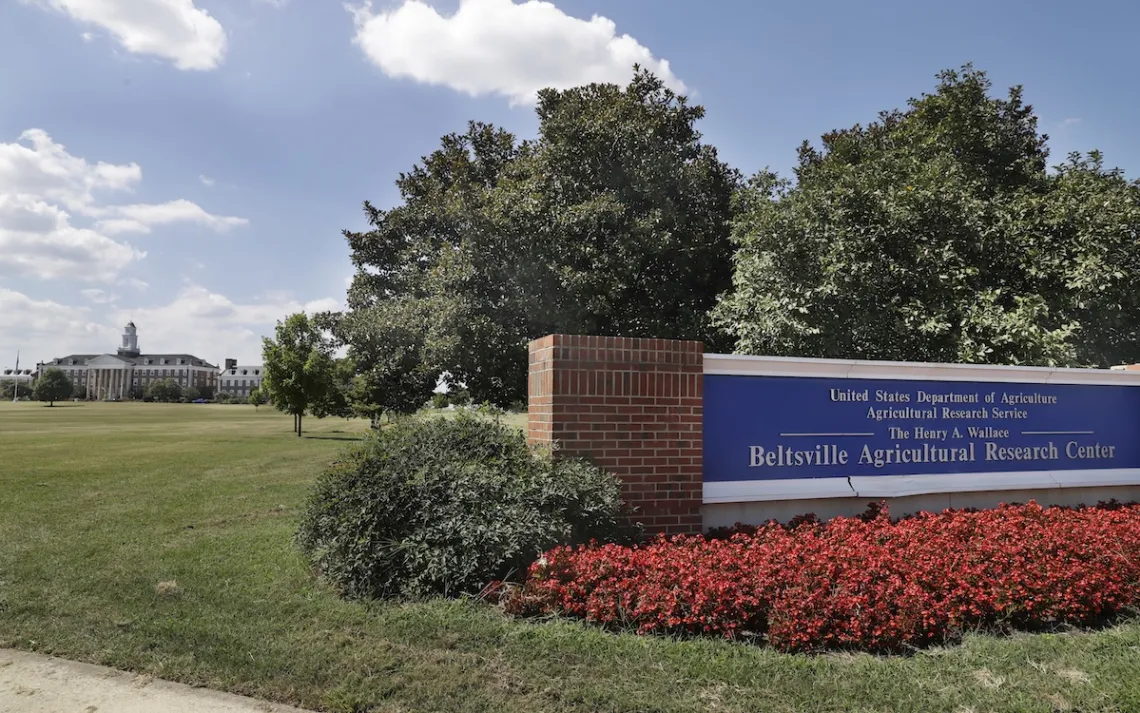
The Beltsville Agricultural Research Center. | Photo by Jacquelyn Martin/AP
About 12 miles northeast of Washington, DC, lies a 6,500-acre slice of wild green space. The dense woods here are home to some 230 species of birds. Freshwater mussels, now considered a rarity so far above the tideline, sit patiently in the creeks. Grassy fields feed cows, turkeys, pigs, and a host of insects. Nearby, scientists are hard at work studying everything from plant pathogens to hydrology.
This is the Beltsville Agricultural Research Center, also known as BARC, the flagship campus for the USDA’s Agricultural Research Service. Since 1910, it has served as both a cornerstone of US agricultural research and the largest relatively unbroken stretch of green space between the nation’s capital and Baltimore, Maryland. Now, advocates are fighting to save it.
In July 2025, the Trump administration announced plans to close the BARC campus and relocate its employees to one of five agricultural hubs across the country. In the accompanying memo, US Secretary of Agriculture Brooke Rollins also hinted at the possible sale of BARC’s headquarters.
The news hit the agricultural research community “like a sledgehammer,” says Ann Bartuska, a former undersecretary of research at the USDA.
It’s hard to overstate BARC’s importance to US science and agriculture. Over the course of its 116-year history, the center's researchers pioneered ways to make butter shelf-stable, helped eliminate parasitic screwworms in American cattle, developed the first near-red spectrophotometer, and discovered whole new classes of plant pathogens. They’ve investigated colony collapse disorder in honeybees—a growing threat to the US food system—and bred elm trees resistant to Dutch elm disease, which nearly wiped out North America’s elm population in the 1940s. Like a load-bearing pillar, the center has played a quiet but integral role in supporting the US food system.
Some of the research done at BARC could be carried out at other hubs, but the move would disrupt the flow of work and make it exponentially harder for scientists to coordinate across disciplines. The campus supports 17 labs, each with their own focus. And many of the place-specific experiments, including several long-running hydrology studies, could not simply be transferred to a different lab, Bartuska says.
Closing the campus could also mean losing hundreds of BARC scientists and staff. Bartuska points out that under the first Trump administration, the USDA relocated its Economic Research Service (ERS) from DC to Kansas City, Missouri. When this happened, more than half of ERS employees refused to relocate, choosing instead to retire or quit. BARC employees—who number more than 1,000—may be similarly reluctant to move.
“I have no doubt in my mind that we would have major attrition,” Bartuska says.
Another one of BARC’s strengths is its proximity to DC, says Richard Dolesh, chairman of the conservation organization Friends of Patuxent. Along with the adjacent Patuxent Research Refuge, which is managed by US Fish and Wildlife, BARC offers a tangible window into the natural and agricultural worlds for countless lawmakers working on Capitol Hill. This can, in theory, help keep conservation issues front of mind for members of Congress. “Everybody loves going to a wildlife refuge,” he says.
The campus also serves as an ecological haven in an otherwise highly developed area. It’s home to a stunning collection of habitats, from seep swamps and magnolia bogs to pine barrens and freshwater streams, which serve as tributaries to the Anacostia River, says Chris Williams of the Anacostia Watershed Society. “It’s an irreplaceable jewel in the crown of intact Anacostia watershed habitat.”
The Anacostia River and its surrounding watershed covers 176 miles within Maryland and the District of Columbia. An estimated 1 million people rely on it for clean water. The river was once notoriously polluted, but local and national efforts to restore the watershed have been underway since 1987. Today, the river is significantly healthier thanks to stormwater controls, community-led litter cleanups, and freshwater mussel release programs.
The headwaters of the Anacostia River just so happen to run right through BARC. If that land were to be developed, either by federal or private parties (as the Trump administration’s proposal suggests), it would greatly increase the amount of stormwater runoff sluicing into the waterways.
“That’s a vehicle for pretty much everything else—nutrient pollution, sewage and fecal pollution, moving toxins downstream into other environments, even thermal pollution,” says Trey Sherard at the nonprofit Anacostia Riverkeeper. This, in turn, could ruin water quality for everyone downstream, all the way to the Potomac and into the Chesapeake Bay, he says.
The move to close BARC appears to be broadly unpopular not only with scientists and conservationists, but also with its surrounding community. The USDA opened a public comment period for its proposals in fall of 2025. Of 2,185 comments submitted about BARC during this time, 2,015 of them expressed “strong opposition to the potential closure or reorganization,” Greenbelt News Review reported. Commenters went on to express worry about “potential loss of scientific leadership” and recommended that the USDA “protect and expand research centers.”
In its comments, the Maryland Chapter of the Sierra Club drew attention to the fact that closure of BARC would “irreparably disrupt” “ongoing research of great economic and public health value.” Additionally, it would hurt American farmers, waste taxpayer dollars, and threaten important wildlife habitat, rare native plant species, and globally rare natural communities.
Nine of Maryland’s 10 congressional members also pushed back, submitting a letter to Secretary Rollins opposing BARC’s closure.
This pressure has led to some success. Last November, Maryland Senators Angela Alsobrooks and Chris Van Hollen managed to secure $6 million in funding to help modernize BARC’s infrastructure. The Trump administration had previously cited the center’s aging buildings as a reason to close it permanently. The new funds could help; however, it’s unclear whether it will be enough to complete the renovations the USDA deemed necessary. The agency did not respond to an email from Sierra.
Regardless, advocates aren’t anywhere close to giving up. They plan to leverage every legal tool available, including a 1993 Maryland law that would designate the land “agricultural open space” should the USDA ever sell it.
“It’s only official, really, in the minds of the Department of Agriculture,” Williams says.