Boundary Waters Canoe Area Faces Uncertain Future Amid Budget Cuts
The Trump administration is also looking to revive mining in the popular wilderness area
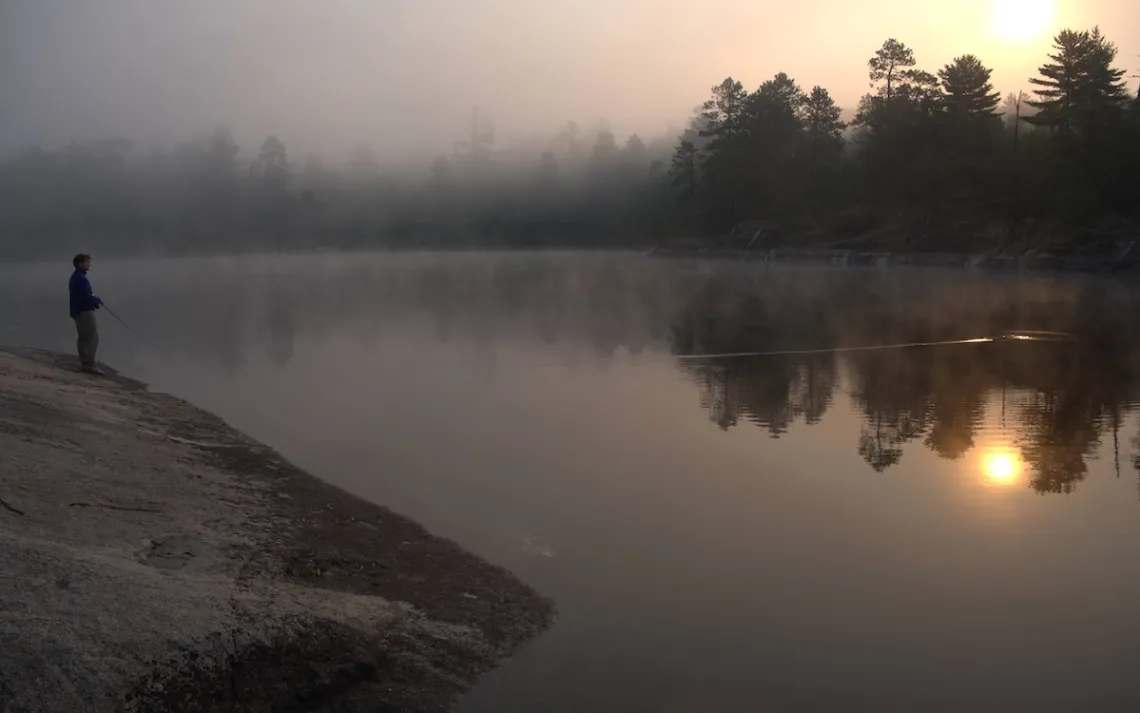
We’re paddling toward the bolded red “I” with a circle around it. It’s distinct—most of my map shows a land of blue lakes—and has my party’s curiosity.
Closing in, I can make out burnt-orange pictographs along the rock face: a moose, a heron, a person, a palm. These illustrations were created hundreds of years ago by the Anishinaabe people, also known as Ojibwe—a testament to the permanence of this place.
That sense of timelessness is part of what draws thousands every year to the Boundary Waters Canoe Area Wilderness (BWCA), an over-1.1-million-acre lake and forest region in northeastern Minnesota. But despite its protected status, this wilderness—like other public lands across the country—faces mounting pressures: funding cuts, layoffs, and mining projects.
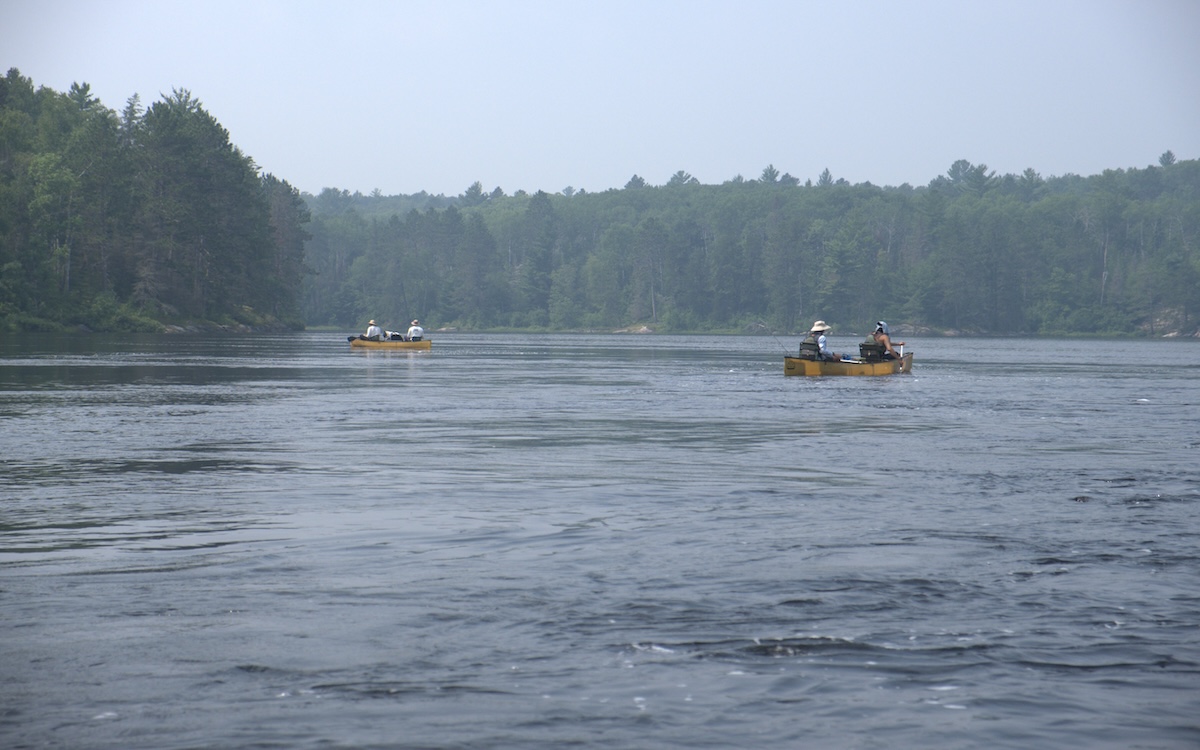
Here, the most efficient mode of travel is by canoe—either paddling or carrying them between lakes, called portaging. My first time moving through this landscape, I was a steadfast “lily dipper”—a paddler’s term for someone who is barely pulling their weight. I’ve returned a dozen times since.
As we push off the rock to continue our journey, I wonder what it means to leave a mark that lasts hundreds of years. Today, even the designation of “protected” feels more brittle than before.
Since the early days of the Trump administration, the federal government has pushed to expand extraction and roll back environmental protections on public lands. That tension is especially sharp here, where a long mining history runs alongside one of the nation’s most visited wilderness areas. Now, efforts are underway to lift a mining ban on 225,504 acres within the Boundary Waters’ watershed.
An unprecedented amount of federal employee layoffs and budget cuts have also left gaps in the management of public lands, raising concerns about the consequences for both these protected areas and adjacent communities. The Superior National Forest, which manages the Boundary Waters, didn’t hire seasonal staff this year due to Congress-approved budget cuts, and more could be on the way.
While the results of these recent policies are still developing and not yet fully understood, canoers and businesses that rely on this wilderness are already feeling the impacts.
“It’s more than just cutting jobs; it’s the small-town economy as a whole, and it affects visitor experience,” said Matthew Ritter, an owner of Voyageur Canoe Outfitters. “Recreational areas, national parks, BLM land, and all this stuff are huge things for people to take advantage of, and without employees, you’ll see those things degrade. So it’s not great for those of us who love the outdoors, wilderness, and adventure.”
The voyageur's highway
The city of Ely marks one of two regional access points into the Boundary Waters. It’s easy to see the wilderness’s footprint right away: There are trailered canoes on almost every block.
The Olson family, which owns Canoe Country Outfitters, commands an encyclopedic bank of knowledge of the area’s more than 1,000 lakes and wilderness. It even marks specific stretches of shoreline with a red B, N, or W (Bass, Northern, Walleye) to show what fish are biting where.
Outfitters like this collaborate with the US Forest Service (USFS) to prepare folks for the wilderness and distribute permits required for entry.
Besides tourism numbers being a little down, Brian Olson said the biggest change this year came in April when the USFS announced the local ranger station wouldn’t issue permits, although it’s historically one of the most popular pick-up spots. Seven local businesses are absorbing the additional work of giving out the 3,800 extra permits, including Canoe Country.
Olson said he was caught off guard by the news. “If there’s one of me here and two of them at the Kawishiwi [ranger] station, why can’t they do a permit too?” he said. “It would take a little bit of the heat off us.”
The business doesn’t make any money writing permits, which can be a 20 minute or more process. While they haven’t had any problems, Olson said it can take their attention away from paying customers. He estimated they’ve written about 400 more permits so far this summer than usual—25 percent of their annual total.
Minnesota Public Radio reported that cooperating businesses were told the permitting change was because of budget and staffing issues (the USFS didn’t respond to multiple requests for information about reasons for ranger station changes or staff changes in the Superior National Forest this year). A USDA spokesperson wrote in an email that the agency is reviewing and finalizing staff changes in the Superior National Forest, but local news reported that fewer than 10 employees working there were fired during federal workforce cuts in February, but were reinstated by mid-March.
Matthew Ritter’s outfitting business is on the Gunflint Trail, the other regional access point to the Boundary Waters. The USFS told him to expect fewer seasonal wilderness ranger crews this year, which he said are “essential” to keeping the area maintained by taking care of portage trails and campsites, enforcing rules, and more. The USFS is almost a year into its seasonal worker hiring freeze.
The wilderness ranger program was already understaffed in 2024, according to a press release that described staffing as “lean” and “strained.” That made objectives like monitoring and education fall “short of the need.” It predicted staffing in 2025 to be even more limited. Now the USFS is proposing a 40 percent BWCA fee increase to allow wilderness rangers to catch up on an $11 million maintenance backlog.
The USDA spokesperson said staffing shortages have created challenges at the Forest Service for several years due to factors like limited housing and remote locations.
Although public lands are seeing record use, they are also feeling the weight of shrinking budgets across the country through closed campgrounds, unmaintained bathrooms, overflowing trash bins, and halted conservation projects. Now, the USFS is facing a proposed $1.64 billion cut in 2026—a 35 percent drop from 2024.
Although the season started with suspicions of poor trail, campsite, and latrine management, Boundary Waters outfitters didn’t report deteriorating conditions so far this season. But Ritter is concerned about the long-term impacts to the wilderness if it isn’t maintained as well. “Hopefully we can get some funding to bring those folks back and keep this wilderness as beautiful as it is.”
A critical moment
The region has historically been known for its history of taconite (iron ore) mining, as well as for its expansive canoe and wilderness areas.
The industry’s legacy is visibly marked 60 miles southwest of Ely, where an 85-foot-tall Iron Man memorial honors the miners of Minnesota’s Iron Range. It’s a striking tribute to the region’s role in US industrial development since the 1800s—and a paradoxical presence in a landscape shared by the permanently protected Boundary Waters.
These industries and values have long coexisted, but as federal support for wilderness management shrinks, debates over the future of mining near the Boundary Waters are heating up again, especially around a proposed sulfide-ore copper-nickel mine in its watershed.
"Clean water is our heritage. And if we poison our water, then we poison what makes Minnesota unique and great.”
Twin Metals, owned by the Chilean company Antofagasta, aims to mine about five miles from the Boundary Waters. The company’s leases were canceled under President Barack Obama, reinstated by President Donald Trump during his first term, then blocked again by President Joe Biden with a 20-year mining ban, or mineral withdrawal, across 225,504 acres. This is one of three proposed sulfide mines in Minnesota. Three Ojibwe tribal nations exercise treaty rights in the area covered by the ban. Interior Secretary Deb Haaland signed that order in 2023, stating that “protecting a place like Boundary Waters is key to supporting the health of the watershed and its surrounding wildlife, upholding our Tribal trust and treaty responsibilities, and boosting the local recreation economy.”
Since Trump took office again, an array of executive orders, proposed legislation, copper tariffs, and a post on X show renewed efforts to revive the Twin Metals project. Environmental advocate Ingrid Lyons believes the ban may not hold. “It’s really setting up the pieces for them to say this mineral withdrawal is burdensome to the agenda being laid out by the president for domestic copper production,” said Lyons, executive director of Save the Boundary Waters.
Copper-nickel mining has never happened in Minnesota. It’s considered to be more environmentally risky than traditional iron mining because it can produce sulfuric acid and leach heavy metals into surrounding waters, although the company is taking steps to mitigate that risk. Even if the ban is overturned, the project would still face a lengthy review by state and federal agencies. There are also a number of different bills proposed to the Minnesota legislature that could make it harder to green-light copper-sulfide mining projects, although the governing body hasn’t heard a bill on the issue in over a decade.
“Minnesota has 11,842 lakes. We are a water state. We have Lake Superior, the Boundary Waters, the headwaters of the Mississippi River. Clean water is our heritage,” said Friends of the Boundary Waters executive director Chris Knopf. “And if we poison our water, then we poison what makes Minnesota unique and great.”
Meanwhile, Brian Olson will keep running his outfitting business as questions about preservation and progress remain unresolved. “The number one thing is that we need clean water up here,” he said. “I will say this too: Our town is dying. It is,” Olson said, explaining Ely doesn’t have the workforce, jobs, or businesses it once did. “This is not helping, this downturn [in tourism] during the summer. Everyone is feeling it.”
For Lyons, the wilderness is at a critical moment.
“The threat and the moment feels very different,” she said. “This is not business as usual, which has been a challenging thing to grapple with. It’s a really interesting and challenging time.”