Bringing Caribou Home
This Indigenous-led effort hopes to restore America's caribou population to the Northern Rockies
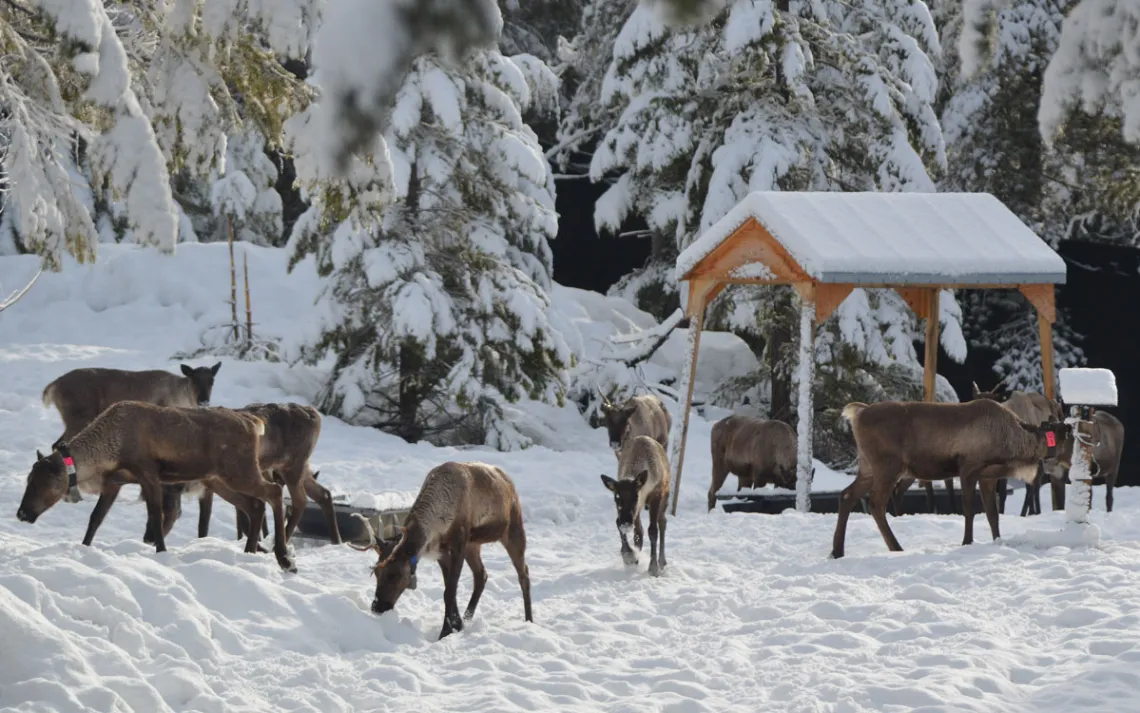
Caribou feeding in the snow. | Photo courtesy of the Arrow Lakes Caribou Society
Bart George, a wildlife manager for the Kalispel Tribe of Indians, keeps a caribou antler on his bookshelf. The taxidermied head of another hangs above the stairs, leading to a conference room with a framed photograph of a caribou bull. They’re all relics. Nobody has seen a southern mountain caribou on historic Kalispel lands, in Idaho, Montana, and Washington—or anywhere else in the United States—in seven years.
George is on a mission to bring the caribou back. His department has spent nearly a quarter million dollars supporting a herd 200 miles away, in Canada’s Arrow Lakes region. If caribou can rebound there, he said, reintroduction in the US could be possible.
Maybe not in his lifetime, but one day.
When the last known southern mountain caribou in the US was tranquilized, netted, and airlifted to British Columbia in 2019, it made national headlines. For most, that’s where the story ended. But in the northernmost reaches of Washington and Idaho, where the final American herd lived, a new story began. A small group of scientists, activists, and tribal leaders kept the faith. They worked to limit logging and snowmobile access in caribou habitat, despite the absence of caribou. Like George, many regularly make the pilgrimage to Arrow Lakes.
Unlike their tundra relatives, southern mountain caribou prefer cloistered spaces. Old-growth forests and deep snow keep them safe from wolves and cougars. Habitat fragmentation has forced them into closer proximity with their predators, while climate change has pushed them north. Fewer than 6,000 remain in the wild, half the number from just 35 years ago.
Some experts say it’s already too late for reintroduction. George remains steadfast.
“Caribou are a species that the tribe could always count on. Now, here we are with reversed roles,” George said. “They need the tribe to help them out.”
A big, wild, crazy thing
There were once two Arrow Lakes, connected by the Columbia River. A hydroelectric dam, completed in 1968, created a single, 144-mile-long reservoir. High above, in the Selkirk Mountains, hide an estimated 25 caribou.
“They’re the southernmost mountain caribou now, in Canada, or North America, or anywhere,” said Erin McLeod, staff biologist for the Arrow Lakes Caribou Society (ALCS), a nonprofit focused on the herd’s survival. “Hopefully, we can increase the population so that they can recover in areas they've been extirpated.”
The caribou conservation organization was founded in 2019 and is headquartered on the shores of the Arrow Lakes. Six miles northeast is the society’s maternity pen, a 10-acre enclosure made from wood and tarp. The pen is meant to keep predators out and allows biologists to closely monitor newborn survival rates.
McLeod calls maternal penning a measure of last resort. Each winter, biologists airlift the herd’s pregnant cows into captivity. They’ll stay for six months, enough time to birth and nurse their calves. The pen is reinforced with electric fencing, game cameras, and bear spray traps to keep them safe from predators. Volunteers, called shepherds, supervise feedings.
Like George, Lyndsey DuBrock lives in Washington and works for the Kalispel Tribe. She’s shepherded at the pen for the last four summers. Each time, she stayed in Canada for about a week, working from morning to dusk. Seeing the lengths people will go to protect wildlife, she said, has been inspirational.
“They’re capturing caribou in the wild and transporting them to this mountainside in Canada…,” DuBrock said. “That's such a big, wild, crazy thing.”

Caribou cows feeding in a maternity pen. | Photo courtesy of the Arrow Lakes Caribou Society
Homecoming
In 2024, ALCS signed an agreement with another US-based tribal government. The 12 tribes of the Colville Reservation, in northeast Washington, come from lands across the Pacific Northwest. They include the Sinixt, the Indigenous people of the Arrow Lakes.
In the 19th century, settlers and smallpox forced many Sinixt south, where they were severed from their homeland by the international border in 1846. It would take 175 years, and a decade-long legal fight, for the Supreme Court of Canada to recognize them as an Aboriginal Peoples of Canada. That decision granted the tribe, represented by the Colville government, a greater say in the stewardship of the Arrow Lakes, including its caribou.
“The Sinixt people have always had that responsibility, and we've always felt that responsibility. There's just things that have stood in our way,” said Rich Whitney, the reservation’s senior wildlife manager, and a Sinixt tribal member.
In July 2025, Whitney crossed the border to help ALCS release the year’s cows and calves, his first after two seasons assisting with their capture. Caribou he’d brought into captivity were returning to the mountains. A cow born during the pen’s first summer had become a mother.
For the occasion, he brought his son, who was seeing his first caribou.
Compromise and threats
From the Arrow Lakes, the Selkirk range runs south into Idaho and Washington. This is where caribou were last seen in America and where they may have the best chance of returning. Roads and snowmobile trails, which act as highways for wolves, are few. Logging is limited. The challenge will be keeping it that way.
Advocates say they passed one test this winter, when the Kaniksu Over-Snow Vehicle Travel Plan took effect. The plan, which regulates snowmobile access on US Forest Service land in north Idaho, was intended to protect caribou habitat. But by the time snowmobilers and conservationists met to discuss it, the caribou were already gone.
Over six months, the group found a compromise. They upheld a ban on snowmobiles in much of the Selkirks, while opening 17,000 acres to the south for recreation.
“It might not be my plan if I were king for a day. It was a plan that all of us could accept,” said Brad Smith, interim president of the Idaho Conservation League.
Moving forward, the Trump administration could make preserving caribou habitat more difficult. In June, the Department of Agriculture proposed rescinding the 2001 Roadless Rule, which protects 45 million acres of Forest Service land from road-building and logging, including in the Washington Selkirks. (Idaho has a separate roadless rule.)
Even with intact habitat, reintroduced caribou would face long odds. To survive, they’d need maternal penning, more old-growth habitat, and abundant lichens, which they almost exclusively feed on. Rob Serrouya, co-director of the Canadian nonprofit Wildlife Science Centre, worries human intervention would be required indefinitely because of climate change.
“I don't see how it would be possible to have self-sustaining herds in the Lower 48,” he said.
RJ Nomee, a Kalispel elder and ceremonial hunter, doesn’t know if the caribou will make it back either. He still supports his tribe’s Canadian quest.
On a sunny day this past fall, Nomee held court at the reservation’s community center, while a herd of reintroduced buffalo grazed next door. He has seen caribou in Alaska but never at home. It’s been generations since the herds fed the tribe. But whether he ever sees them or not is beside the point.
“Even if it doesn't directly benefit us, it will benefit the caribou. And that's more important,” Nomee said. “If our people are capable of helping, then we will help.”