New Science Recognizes the Plight of Emperor Penguins
Advancements in research reveal that this species faces a dire future in a warming world
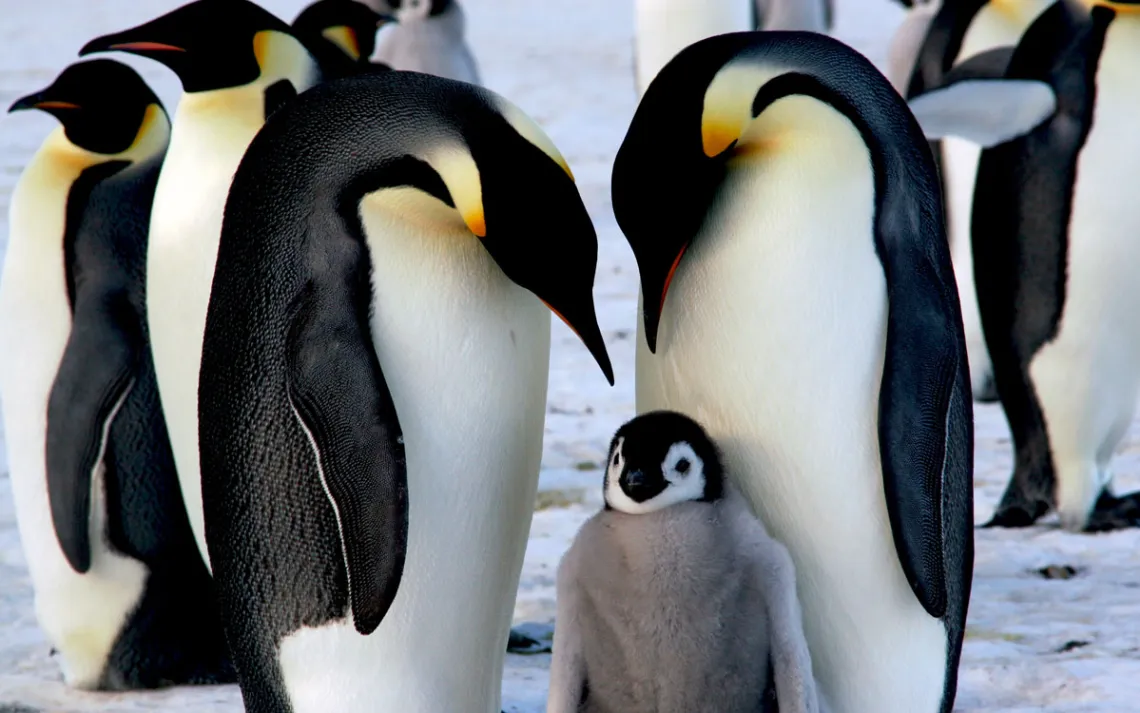
Photo courtesy of BernardBreton/iStock
After decades in limbo, emperor penguins have finally received the international recognition that conservationists have fought for since at least 2000. That’s due in part to advancements in science and technology that have allowed researchers to accurately study population trends and climate change. The findings behind this new data triggered the International Union for Conservation of Nature to add the species to its Red List, a comprehensive indicator of species conservation status, last month.
Researchers have long suspected that climate change is affecting emperor penguins, but assessing the extent of that impact has been elusive. For much of the year, their Antarctic home was too cold, dark, and remote for scientists to study, especially during the winter breeding season. Satellites offered a way to estimate population size, but even that had it limits. The pixels were large, making it difficult to distinguish individual penguins.
But using newer satellites with higher-resolution pixels and a layered modeling of threats, researchers determined last year that emperor penguin populations could decrease by over 50 percent in the next 50 years. That precipitous decline met one of the five criteria for the IUCN to list the iconic Antarctic birds as endangered. This listing is supported by months of research and analysis of the future outlook of this ice-dependent species, and now scientists hope this will galvanize decision-makers into doing more to protect the birds’ Antarctic home.
“What we hope is that people realize the seriousness of an assessment of a species that is endangered,” Rob Martin, Red List team manager at BirdLife International, said. “It's a very high risk of extinction within what is a relatively short period of time. And, obviously, it's a pretty scary thing to think about—that in a few generations you might not have something as iconic as an emperor penguin.”
According to the US National Science Foundation, Antarctica is warming five times faster than the global average. That’s spelled danger for this ice-dependent species that lives exclusively on the southern continent. From birth to adulthood, they require ice, Phil Trathan, a member of the IUCN Penguin Specialist Group, said. Chicks need stable ice to prevent them from drowning, and adults need it during their “catastrophic molt,” when they shed and regrow all their feathers. This means that the species as a whole relies on stable sea ice for almost 70 percent of the year. While emperor penguins have survived in Antarctic conditions for millennia, Martin said that ice sheets are breaking apart with increasing frequency and sea ice is disappearing faster than ever, giving the birds slimmer chances to escape to more stable areas.
Trathan’s group began the most recent assessment of the penguin’s population status early last year, collecting relevant data and information from research papers. In November 2025, they passed their drafted assessment to Birdlife International, where Martin checked it against the IUCN Red List categories and criteria. The two groups then worked together to make amendments and incorporate feedback from other scientists, resulting in an international collaboration to ensure the listing was warranted and accurate.
In addition to using better satellite technology to count individual penguins, researchers used the images to find when and where chunks of sea ice separate. These “breakout” events, as they’re called, can cause entire cohorts of chicks to drown, Trathan said. In some cases, colonies have experienced multiple breakout events.
Advancements in population modeling were also integral to the new listing. Originally, scientists created emperor penguin population models—which are generally used to study how populations change over time—under the assumption that penguin behavior was uniform across ages and sexes. However, new research shows that’s not the case. For instance, males, who rear the chicks, respond differently to the loss of sea ice than females, who are out at sea when the babies are at their most fragile stage.
Ecologist Stéphanie Jenouvrier said that over the past 20 years, researchers moved from applying their models to just one colony to including all known colonies across Antarctica. Each improvement pushed scientists closer to better understanding the species and the nuances surrounding their fate. Jenouvrier said that one of the biggest advances in population modeling happened when she began combining different threats simultaneously. These include ecological models, variations in climate, and greenhouse gas emissions.
“Under high greenhouse gas emissions, most colonies are projected to experience severe declines by the end of the century,” Jenouvrier wrote to Sierra. “Strong climate mitigation substantially improves outcomes and could preserve important climate refuges for the species.”
Wildlife ecologist Michelle LaRue also contributed to the IUCN assessment and has studied penguins for almost two decades. She agrees that the criteria used to list emperor penguins as endangered is accurate, but she advises taking the classification with a grain of salt. The current satellites used to capture images of the penguins cannot take accurate photos in the dark of winter—imagine trying to take a picture of ants on a sidewalk in the middle of the night. Because of this, the satellites can only start capturing images in the spring. These images have revealed that the springtime population of emperor penguins, which currently sits at around 600,000, has decreased by 10 to 20 percent in the past 15 to 20 years, but LaRue said scientists cannot use these estimates to determine winter abundance indices.
“Any index of abundance needs to be interpreted with extreme caution,” LaRue said. “And in the case of emperor penguins, we do not know if the number of adults in springtime is representative of the population.”
However, LaRue explained that scientists are beginning to use new radar imagery, which would allow them to detect emperor penguins on the ice during winter. She also added that there are additional technologies that could assist with other limitations to satellite imagery and population modeling. For example, since images capture only one moment in time, they cannot be used to see how the penguins move around on the ice. LaRue explained that genetic testing would show how related or unrelated different colonies are, which could imply movement between the groups.
LaRue and Trathan look forward to seeing what researchers will learn about the species as technologies and research methods continue to improve. In the meantime, Trathan said that local and global action is needed to address the declining emperor penguin populations. Trathan emphasized the need to decarbonize and work collectively to decrease greenhouse gas emissions.
Shaye Wolf, the climate science director at the Center for Biological Diversity, also emphasized the need to reduce the emissions, the cause of accelerating sea ice melt. Wolf petitioned the US Fish and Wildlife Service to list emperor penguins under the Endangered Species Act in 2011. The agency responded in 2022 by listing the species as threatened, one tier below endangered, in the US. Under the designation, American industrial fisheries are barred from depleting the penguins’ prey—such as Antarctic krill and silverfish. And it also creates a path for conservation funding. While Wolf was not involved in the most recent IUCN assessment, she believes that both the Endangered Species Act and IUCN listings could inspire stronger protections for the species.
“The threatened category under the Endangered Species Act and the endangered category under the IUCN are both just like glaring alarm bells that the species is facing extinction if governments don't take stronger action to rein in and slow down climate change,” Wolf said.
Martin said it’s disheartening whenever he lists a bird as endangered and has called for governments globally to make greater strides in reducing carbon emissions, giving the species a chance at recovery.
“There are things that we can do,” Martin said. “The penguins are just going to do what they do, for better or worse. . . . But we can, hopefully, as a society, make slightly better decisions.”