Counting Giants in Florida’s Blue Spring State Park
This researcher has helped create one of the longest-running manatee projects in the world
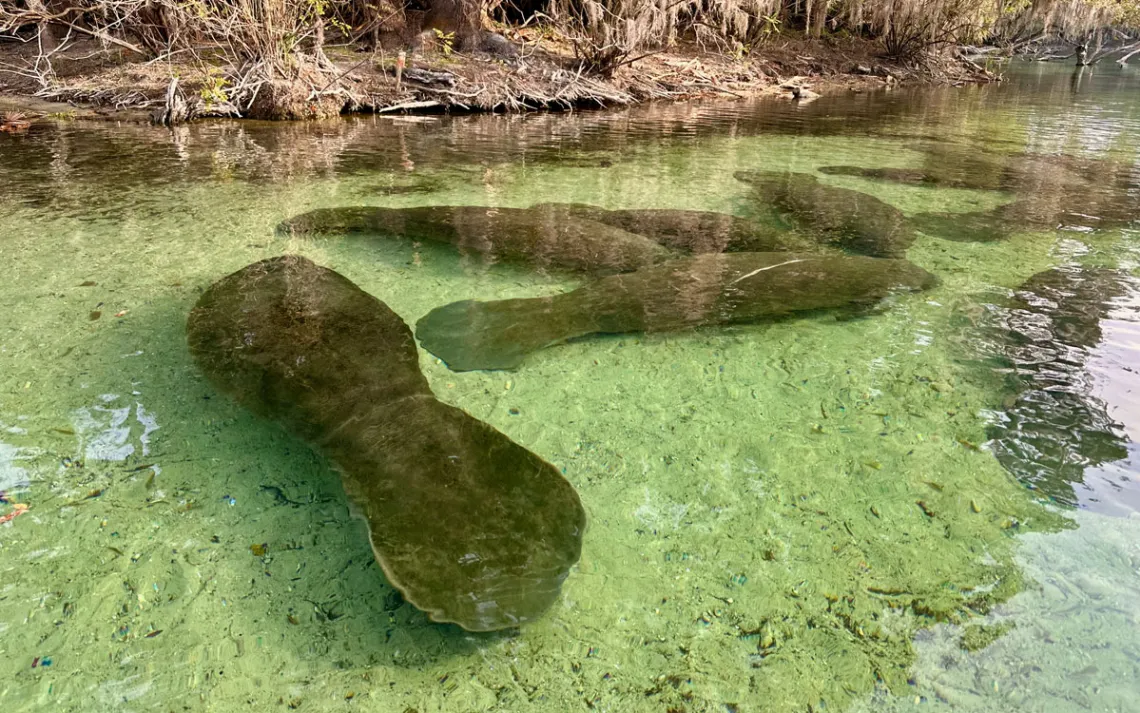
Manatees resting in the glass-clear waters of Blue Spring State Park. | Photo by Anietra Hamper
When the gates open each morning at Blue Spring State Park in Orange City, Florida, Wayne Hartley is already in his research canoe tracking manatees. To do so, Hartley, a manatee specialist with Save the Manatee Club, does it the old-fashioned way. “One, two, three, four,” he counted last month in a whisper.
This is how he has started every morning of the cooler months for the last 46 years. When manatee numbers are in the single digits, the task is easy, but some days there are hundreds of them. During this year’s cold snap in Florida, Hartley counted a record 859 manatees in a single day.
He has dedicated his life to understanding manatees and collecting historical data about them. Not a day goes by that he doesn’t learn something new, even about those he recognizes.
“What Wayne does—it's so important,” said Cora Berchem, manatee research associate for Save the Manatee Club. “He recognizes manatees that he's seen since the early 1970s, so it gives us pretty much the longest and consistent body of research in the world about how manatees are using this habitat and how they're doing so well here because of the protections.”
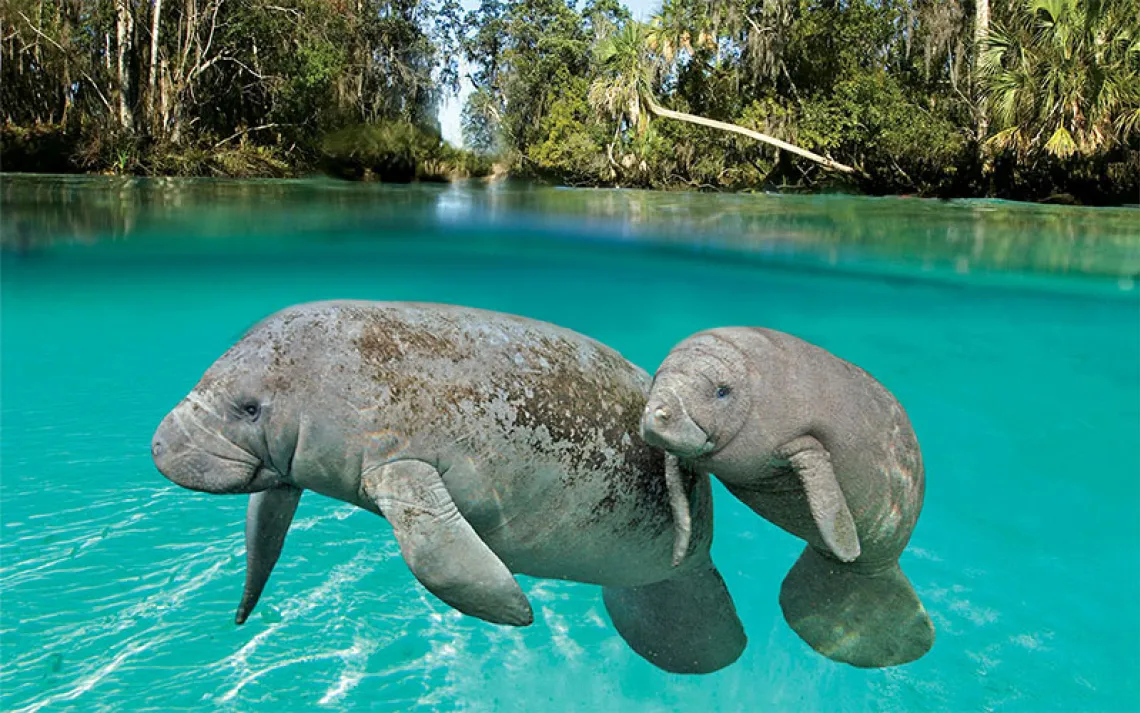
Between mid-November and mid-March, the 1,000-pound marine cows make their way into the park’s warmer waters overnight. They find refuge in the spring’s constant 72-degree water, migrating from the St. Johns River and its tributaries. Each documented manatee at Blue Spring is eventually assigned an identification number and transferred to a statewide individual photo-identification database. Hartley also names them and has turned to a series of books on the founding of England for naming inspiration: Eggbert, Eglaf, and Osbert are among the return visitors.
There are also many new arrivals each year, like U48 (Unknown 48), that have yet to be named or assigned an identification number. U48, like many previously unidentified manatees, has unique scar patterns from boat strikes. Because manatees don’t have distinct shapes, Hartley said these types of scar patterns are the only way to tell many of them apart.
“We have fingerprints,” Hartley said. “They have boat scars.”
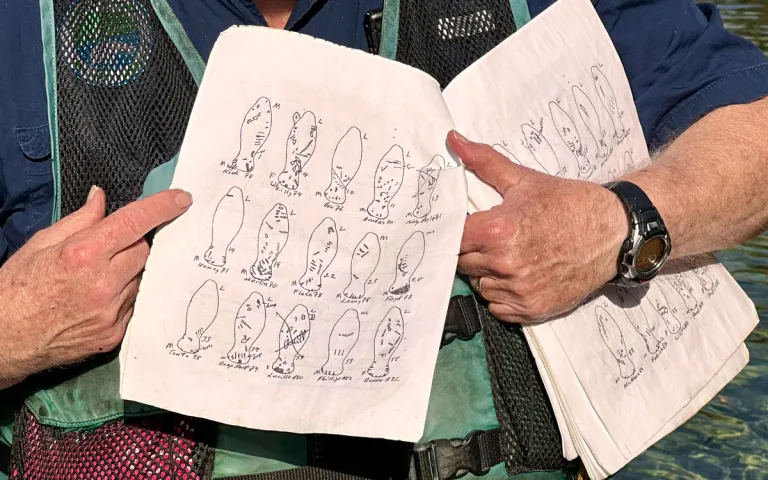
Wayne Hartley's manatee sketches with notes on scar marks. | Photo by Anietra Hamper
To date, 1,670 manatees have been assigned identification numbers, with approximately 85 added each year. In addition to manatee identification, Hartley collects data on their behavior, mating, movement patterns (morning versus night), birth and death rates, how many breaths they take, cow and calf interaction, and orphaned manatees. Orphans that are not adopted by other mothers are rescued, rehabilitated, and rereleased.
Hartley’s group is one of about 30 groups working in a coalition called the Manatee Rescue and Rehabilitation Partnership. The goal of the alliance is to push for legislation that ensures funding for manatee tracking and rehabilitation facilities.
The group is also focused on establishing more protected warm water sites in Florida. Over the decades, manatees have learned to go to the warm water outflows produced by the power plants, but as more of them close, the manatees will need someplace else to go. Protecting natural springs will become increasingly important because more manatees will be relying on them, said Berchem.
In protected habitats, manatees are safe from human or boat harassment, and they can forage for food sources, such as exotic and native vegetation, without traveling far to find it. The organization points to Blue Spring State Park as a prime example of how these protections are working. In the wintertime, there's no swimming, paddling, or scuba diving allowed. Only researchers like Hartley who have permits can access the waters, so manatees stay warm and protected without harassment.
“We have seen a significant spike in numbers here,” said Berchem. “They come in here, and they can sleep, rest, and conserve their energy.”
Though more sophisticated technology, like drones and AI tools, is available for data collection, none of it can capture the details that Hartley is able to collect manually, such as spotting new injuries on manatees that he recognizes.
“I think it's so special that what we do here, what Wayne does here, is that we use our brains,” said Berchem. “We actually still use our brains. We don't use an app.”
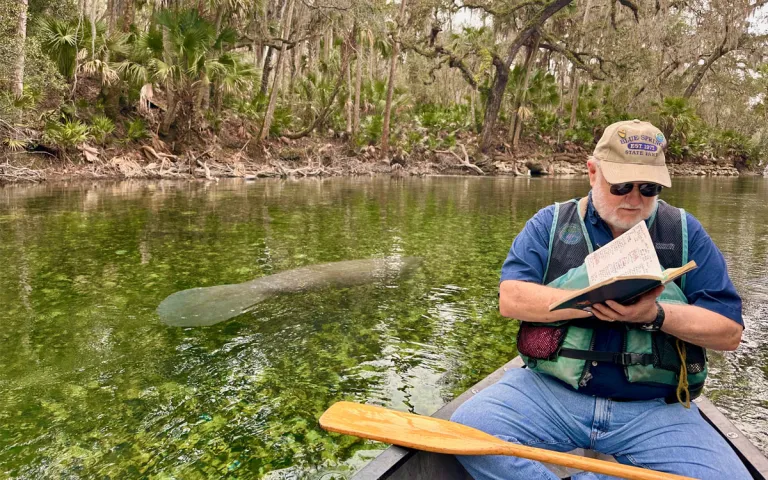
Hartley reviews his notes as manatees swim below. | Photo by Anietra Hamper
However, one type of technology that is useful for the research is satellite tagging that tracks both wild and rehabilitated manatees. It’s managed by the Clearwater Marine Aquarium Research Institute, which conducts independent manatee research throughout Florida to help state and federal agencies in conservation management decisions. The monitoring of manatee movement and behavior through tagging enables conservation leaders to make data-based decisions about waterway speed zone regulations, rehabilitation and release protocols, and the establishment of protected warm-water refuges.
According to Monica Ross, the director of manatee research and conservation at the institute, this research provides a year-round snapshot of how manatees live and use the waterways. “Having the technology to track a manatee gives you an idea of what habitat they're using outside of the three months they're at a warm water site,” Ross said. “You need to have a picture of how they're living their entire life from one year to another.”
Ross’s satellite research reveals that manatees do not stay in small areas, but instead they disperse hundreds of miles and make deliberate choices about staying in one habitat versus another. The data is used to understand how manatees adapt to environmental changes, revealing the potential threats that people might someday face too.
Ross points to examples of how red tide events on the Gulf Coast or the vegetation die-off along the Atlantic Coast impact manatee mortality rates. Identifying triggers, such as nitrate overload coming from septic tanks—a contributing factor for vegetation die-off—provides a better road map to help prevent those events in the future. Ross likens manatees to the canary in the coal mine, with the collective research gathered about them being essential for their survival and ours.
“This is a species that uses a vast amount of habitat that we also like to use for recreation. If they are not able to survive in it, then we are not going to be able to enjoy it later,” Ross said. “The research that we conduct gives us an idea of what they are having to modify for survival, and that gives us an idea of what we may have to do in the future.”
Hartley says there is still much more to learn about manatees, and collecting that research will take time. For example, he theorizes that manatees go through menopause, but as they live upwards of 60 years, there’s not enough data and sampling to prove it. He says it will take several more decades to monitor enough of them from birth to death to compile a more comprehensive picture.
As public education is one of the strongest missions for the Save the Manatee Club, Berchem said that Hartley’s visible work at Blue Spring adds an element of public awareness that typical advocacy cannot achieve. “Wayne is a person who people can relate to. He’s not the PhD scientist who talks in abstract terms,” Berchem said. “A lot of people want to meet Wayne, or they want to look at videos that feature Wayne, and I think that's important because you want that kind of connection from people.”
Berchem added that by inviting visitors to watch Hartley’s work in real time, they become an active part of the bigger picture of protecting manatees and their habitats. She said that when visitors adopt a manatee, ask the park volunteers questions, or log in to watch the underwater manatee webcams, they are moving the conservation needle from curiosity to engagement.
“You can't really protect something if people don't know about it, don't care about it,” said Berchem. “I think hearing about it from Wayne—people can relate to that.”