California Dreams Of Wildlife Coexistence
A newly passed bill lays out big plans for living with large carnivores
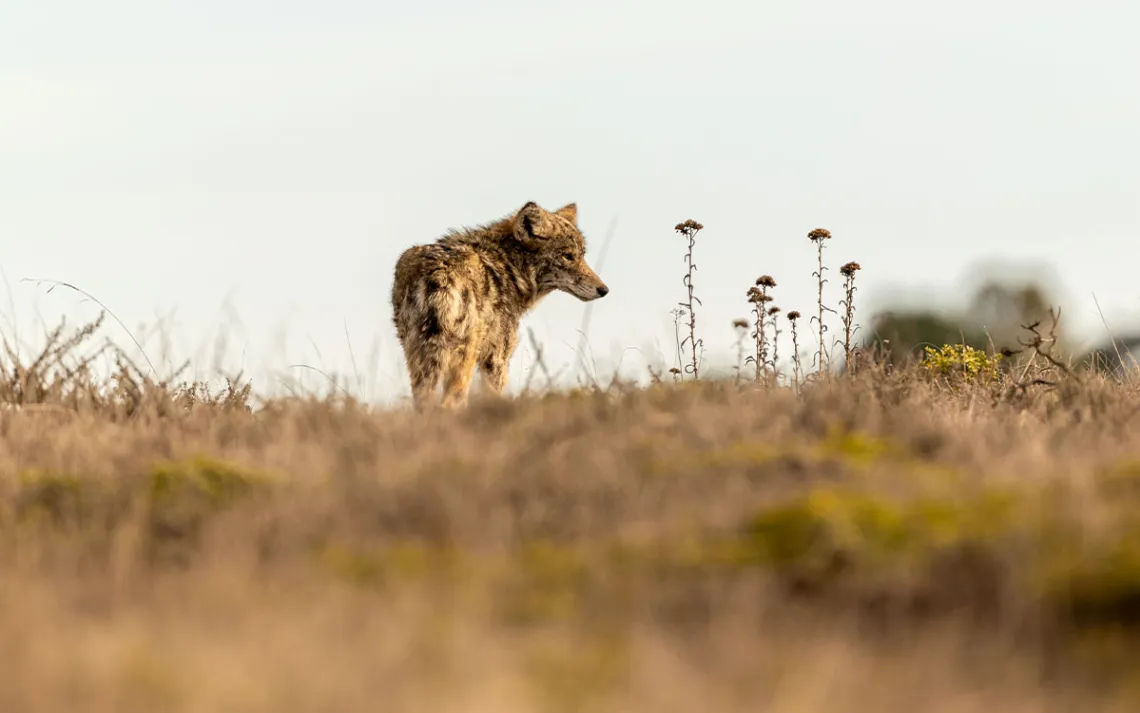
A solo coyote in Northern California's Milagra Ridge in Pacifica, California. | Photo by JasonDoiy/Getty Images
Last summer, Paul Roen, a county supervisor for Sierra County, California, spent every evening doing something he never imagined. Each night, he patrolled the woods adjacent to the ranchland that he helps manage to stand between his cows and a pack of gray wolves, which had begun preying on the unprotected cattle that spring. Pickup trucks blared sirens, drones circled, and wildlife officials shot at the wolves with bean bag guns—but predation continued.
By the time Roen and a team of wardens and biologists from the California Department of Fish and Wildlife’s Summer Strike Team started to take action, it was already too late. The wolves had become habituated. In the end, nearly 90 cattle died.
“We have to have more tools,” Roen said. CDFW determined that by the time they intervened, the Beyem Seyo pack had grown too accustomed to hunting cattle in the valley. Finally, agency staff killed four endangered wolves, leading to the dissolution of the pack.
This is not how the state of California hopes to live with wildlife. Aiming to avoid similar outcomes in the future, California Governor Gavin Newsom signed the California Wildlife Coexistence Act into law on September 30, codifying a proactive approach to living alongside wildlife. Overwhelmingly endorsed by local conservationists, the new legislation vows to prioritize the best-available science to both prevent conflict with our animal kin and keep them alive through challenging encounters, using nonlethal measures including range riders, electric fencing, guardian dogs, and adaptive husbandry practices—all of which have proved to be effective at reducing wolf predation.
California makes for a complicated, and important, stage for this issue. It’s the most populous state in the US, with the highest diversity of animal species calling its many microclimates home. While coexistence legislation has passed or is in the works in nineteen other states, according to the National Caucus of Environmental Legislators, California’s newest bill is perhaps the most sweeping. Under the new law, the state will create a Wildlife Coexistence Program and a Wildlife Coexistence Technical Advisory Committee.
Pamela Flick, the California program director at Defenders of Wildlife, supports the new bill. She has advocated for wildlife and public lands protections in the state for decades, including through her organization’s co-sponsorship of this legislation. She is especially excited about the creation of the California Wolf-Livestock Coexistence and Compensation Program, which will support ranchers, such as Roen, and wolf recovery in the state.
The need for coexistence infrastructure isn’t confined to wolves, though, or to rural parts of California. Bears bust into homes and cars in Lake Tahoe, mountain lions sprint down the streets of San Francisco’s Sunset, and coyotes occupy West Hollywood construction sites. “They’re finding solace and refuge in the spaces we built,” said urban ecologist Chris Schell, an assistant professor in the University of California, Berkeley Department of Environmental Science, Policy, and Management.
Schell swerved early in his career from traditional wildlife biology to studying how humans and animals shape one another’s lives and landscapes, inspired in part by growing up in Altadena. He researches coyotes, who regularly flit through backyards in his childhood neighborhood and is especially interested in how tensions spark when animals return to metro areas after their habitat is ravaged by drought and wildfire. Under the new program, he hopes to see CDFW innovate nonlethal approaches to reducing conflict, even with species that aren’t protected.
In some ways, much of what he envisions has already come to fruition. The California Wildlife Coexistence Act draws on a regional model the state piloted in 2021, in which human-wildlife conflict specialists fanned out to help the public deal with negative wildlife encounters. When that program lost state funding in 2024, CDFW let almost all of those highly trained workers go—but Californians didn’t stop running into wildlife or seeking support.
Over the past five years, Cort Klopping, a CDFW information officer, said that calls, emails, and field contacts increased 58 percent. And in 2025, federal wildlife managers killed about 28,000 animals in California in response to calls from aggrieved farmers, ranchers, and other agricultural operators. Among the animals killed were more than 3,000 coyotes who died by foothold traps, neck snares, and gunfire.
The Wildlife Coexistence Act outlines a vision for thorough statewide wildlife incident tracking by 2028 to better understand and work from the data that the state is receiving. The new legislation also mandates proactive approaches to sharing space before conflict arises. This can look like bear-proofing garbage, lining fences with fladry that whips in the wind and frightens predators, keeping cats indoors and leashing dogs in coyote habitat, and responding to research about animals’ rhythms across California’s landscapes.
Knowledge of new possibilities grows all the time: creating wildlife corridors across roads helps creatures move freely through densely developed spaces. Scientists are testing methods, including feeding or penning cattle at night, to make herds less attractive prey by clustering them closely together. Tracking correlations between factors such as outdoor activity, neighborhood wealth, and predator habitat can help wildlife specialists identify zones where animals and people are likely to interact.
But realizing this vision isn’t cheap. Dozens of organizations, including Flick’s, requested that California budget $48.8 million for the coexistence program’s first year and commit to a subsequent $15 million annually. The state budget allocation for 2027 is much tighter, at $5 million to support both livestock compensation and broader coexistence programming.
“I think that’s woefully inadequate for the first year in staffing up,” Flick said. For reference, the 2025 response in Sierra Valley alone ate up 18,000 hours of staff time, costing more than $2 million in a few months. Flick and her colleagues plan to work with the legislature throughout the budget process so that they can advocate for more funding to create tangible change.
Schell believes that robust legislation responding to human vulnerabilities would give wildlife policy a better chance of success. “If, for instance, we just do business as usual, and the income disparities continue to widen in California, and we pair that with how unaffordable it is to live really anywhere in the state, we’re going to constantly be displacing the people that have the local knowledge,” Schell reflected.
Coexistence can also hinge on people knowing their wild neighbors. San Diego’s poet laureate Paola Capó-García sometimes spies on “The North Park Coyotes” just after sunrise on her commute. She read an ode to them at the city’s University Heights Library this past spring: “The one with its bum leg / The other never far behind / Always a pair / Neighborhood celebrities / Zigzagging Alabama or Mississippi / Streets that were once / Their canyons.”
Up north, Roen hopes that new structures for coexistence can help rebuild trust after a couple of difficult years—and stave off more sleepless nights guarding his herd. His words on losing calves offer a window into how the many perspectives on living with wildlife in California may one day converge.
“It’s not about the money,” he said. “We care for our animals.”