Why Are Black Vultures Falling From the Sky?
Avian flu is hitting these birds hard, alarming researchers
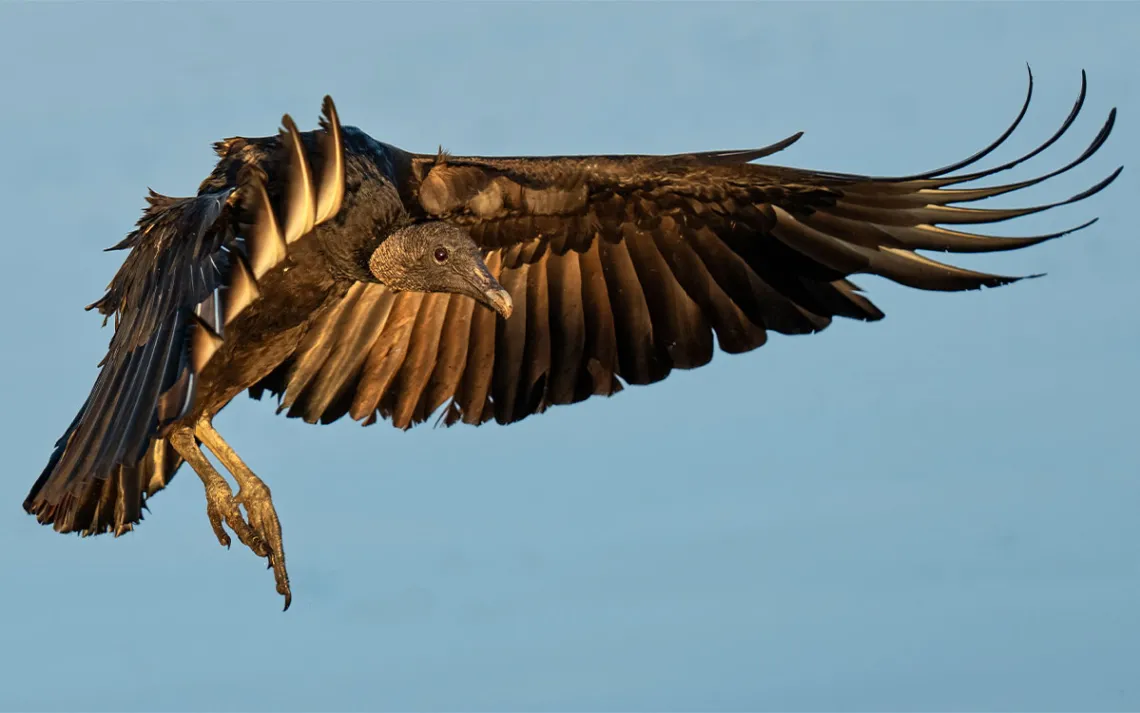
A black vulture. | Photo by Michael J. Cohen/Getty Images
Last fall, when teachers and staff returned from their Thanksgiving holiday to St. Bernadette School in Amelia, Ohio, they were greeted with a scene that would have been more fitting for Halloween. The fields outside the school were covered in dead birds that looked like they had fallen out of the sky. Over 70 large, feathered carcasses covered the infield and pitcher’s mound; they were even inside the dugout.
The birds were black vultures, and their deaths were far from the only ones. Three months earlier, also in Ohio, over 110 vultures had died in one mass mortality event. All over the American Southeast and Midwest, the same story was playing out over and over again. Black vultures were dying by the thousands, all victims of a pandemic. All these vultures had died of avian flu.
Highly pathogenic avian influenza (HPAI), better known as avian flu or bird flu, arrived in North America in the fall or winter of 2021 and started spreading through both wild and domesticated bird populations in 2022. Since then, wildlife officials have confirmed hundreds of thousands of wild bird deaths across dozens of species. Because of the disease, farmers have culled over 1,000 domestic flocks of chickens and ducks, totaling over 200 million birds.
Avian flu affects a wide variety of bird species, from ducks and geese to bald eagles. However, the diet and behavior of black vultures makes them especially vulnerable.
“Their behavior of scavenging is normally a wise one,” said Nicole Nemeth, head of the Diagnostic and Research Service at the University of Georgia’s Southeastern Cooperative Wildlife Disease Study. “It’s easy. They’re smart. But it came back to really hurt them in the case of HPAI.”
Black vultures are the most common vulture species. Many vulture populations around the world have plummeted in the past few decades due to poisoning, habitat loss, and other factors. But black vultures have actually increased their range in the 21st century, spreading farther north than ever before. They perform a vital ecosystem and public health service, but it makes them a prime target for flu transmission.
Because they are so specialized in finding and eating dead animals, black vultures often come in contact with infected prey. Black vultures also commonly roost in larger groups than their turkey vulture cousins. So once one vulture picks up the virus, it can spread quickly through a flock. Their large numbers, social nature, diet, and behavior all combine to make them one of the most vulnerable species to HPAI infection, researchers say. Nemeth recently estimated that even though scientists have counted black vulture deaths in the thousands, the real number is probably much higher, potentially in the hundreds of thousands since 2022.
When most people think of an influenza virus, they think of respiratory sickness. But when Nemeth and her colleagues looked at black vulture carcasses from the recent outbreaks around the Southeast, they found a surprising pattern: The real damage was in the digestive system. Vultures’ gastrointestinal tracts are some of the toughest in the animal kingdom. They have to be to handle their often-diseased carrion prey. But the dead vultures on Nemeth’s table had intense damage to their digestive tracts.
By feeding on infected animals, sometimes including members of their own flock who had died, they had gotten a concentrated dose of the virus, directly into their digestive system. Nemeth called the resulting damage “eye-popping.”
Black vulture HPAI detections in 2026 so far have been down significantly from last year, but those numbers have fluctuated up and down every year since the initial outbreak in 2022. According to the World Organization for Animal Health, there is also a strong seasonal trend, with numbers rising every fall and winter. That has wildlife pathologists like Nemeth braced for a possible resurgence as the weather cools.
“It’s like the calm before the storm again,” she added. “You can’t predict the future, but I suspect it’s getting ready to cycle back through.”
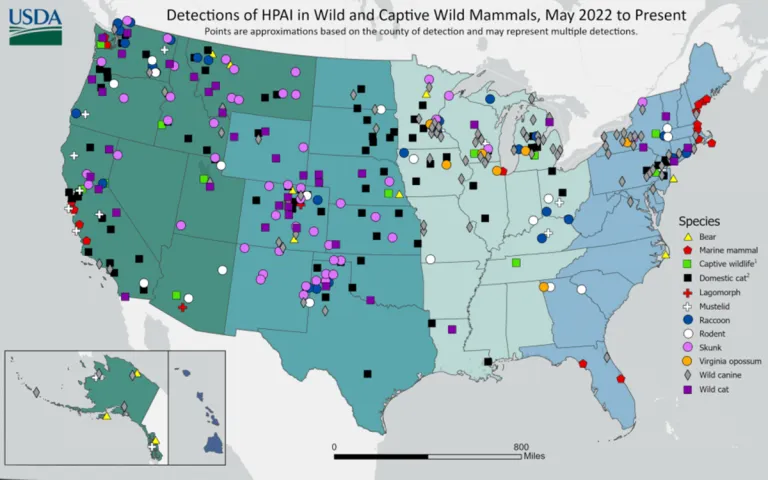
A map of HPAI detections across the US. | Map courtesy of the USDA
The virus started in, and is still most common in, birds. But one of the most concerning aspects of the virus over the past five years has been its ability to infect a wider variety of animals. This year alone, the USDA has confirmed detections in at least 17 species of mammal, ranging from seals and sea lions to terrestrial predators, including mountain lions, red foxes, and bobcats. Human-associated species, including house mice, Norway rats, and domestic cats, make for more potential interactions between people and infected animals. The virus has been detected in bottlenose dolphins, showing that even the open sea is no boundary to its spread.
The spread to mammals has human public health experts especially worried. A paper last year in the Journal of Virology warned about the potential for the virus to jump to humans and cause a Covid-like pandemic, calling the control of the current strain an “urgent public health need” and warning that every new mammal infection increases that risk.
The authors of another paper, in the May 2026 issue of Biological Reviews, put the stakes in clear terms: “HPAI in wildlife is not only a conservation issue threatening biodiversity, but also a serious concern for public health and food security.”
Whichever way the numbers go in North America this fall and winter, the disease continues to spread globally. In June of this year, it officially arrived in Australia, marking a grim milestone: detection of HPAI on all seven continents (scientists confirmed it in Antarctica in 2024.) In early August, the first reports started coming in of mass bird die-offs in Australia, including 28 penguins and over 1,000 terns.
Wildlife experts need the public’s help to monitor and detect the spread of avian influenza this fall and winter. If people find dead vultures, or any other bird or wildlife in their area, experts are encouraging them to report it to their local state wildlife agency. Though infection is unlikely from casual contact, people are advised not to handle infected birds.
Damien Joly, CEO of the Canadian Wildlife Health Cooperative, has studied the effects of avian flu on wildlife throughout North America. In a post last November in The Conversation, he stressed the importance of reporting infected wildlife and keeping monitoring programs going, saying, “The spread of avian influenza in wildlife, livestock, and occasionally people underscores how closely connected our health really is.”