
Decoding Elephant Conversations with Machine Learning
The latest breakthrough in elephant communication shows that the animals engage in group decision-making
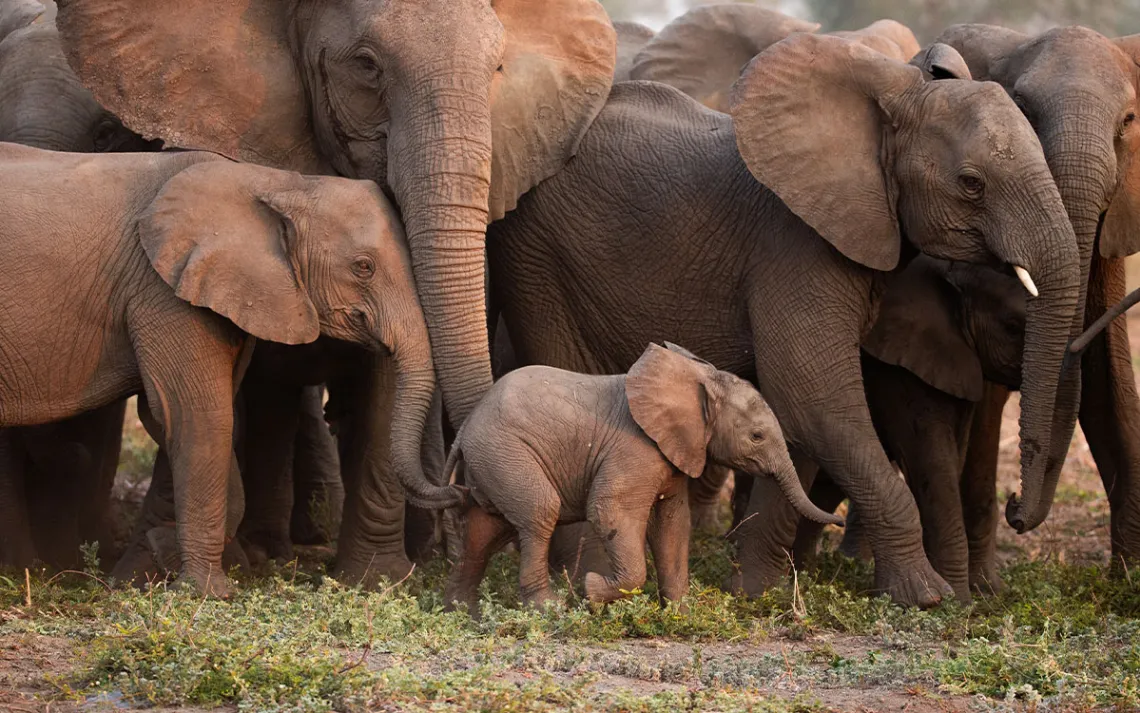
Matriarch, iJunia and her daughters engage in Coo-Rumbling as they shepherd an infant back to her family in Gorongosa, Mozambique. | Photo courtesy of ElephantVoices
Elephants produce a vast array of vocalizations, from earth-shaking rumbles and thunderous bellows to sharp trumpets and squeaky chirps. So it didn’t take long for biologist Joyce Poole, who began studying the animals in Kenya in 1975, to confirm they had a complex way of communicating. But she lacked the tools to decipher what they were saying.
“In the beginning, I was just trying to listen and associate the sounds that I heard with behavior,” said Poole, who is the co-founder and scientific director of ElephantVoices, a nonprofit organization dedicated to studying the voices, behavior, and culture of elephants. “But with very simple techniques, you can’t really get at the nuances of these calls.”
In the years since, Poole and other scientists have harnessed technology to reveal some of the intricacies of how savanna elephants communicate, from finding that they address each other with name-like calls, much as humans do, to finding that they are capable of imitating other species and even machines. Now, Poole and her colleagues have made another breakthrough in understanding how Earth’s largest land animal communicates. The research, published in Scientific Reports, focused on elephant choruses—overlapping, low-frequency rumbles that the animals often make. Some 60 percent of elephant rumbles occur in choruses, but scientists know little about their content because they are so difficult to untangle.
By using machine learning to analyze choruses, the team was able to predict which behaviors the elephants were engaging in, suggesting they might use choruses to communicate about what is happening. Choruses, in other words, seem like the elephant equivalent of having a conversation. “As far as using the term ‘conversation,’ I think that makes sense,” said Sara Keen, a research scientist at Earth Species Project, a nonprofit organization that develops AI to amplify the voices of nature, and co-senior author of the study. “That’s what we would use if it were humans.”
The findings were based on 903 audio recordings of 40 elephant families made by Poole and several colleagues between 1986 and 2022 in Amboseli National Park in Kenya. The new study also relied on the long-term knowledge collected by Poole and others for the Amboseli Elephant Research Project, which has tracked individual elephants and their relationships since 1972. “That kind of data is tough to get,” Keen said. “You really need to be aware of every elephant that’s vocalizing and what the entire group is doing.”
Rather than trying to isolate individual elephant rumbles, the researchers analyzed the choruses as a whole. They trained a machine learning model to predict the context of a chorus based on its acoustic characteristics. The model was significantly better than chance at guessing what the elephants were doing based on a chorus’s characteristics alone, without any prior information about the group or what it was doing. These behaviors ranged from older females reassuring calves, to what seemed like discussions about where to go next.
Given her years of observation, Poole was not surprised by the fact that elephants seem to be engaging in group decision-making. “Especially with the cadenced rumbles, where they have this sing-song pattern back and forth between them, I’ve always thought it was elephants discussing a plan of action,” she said. “In some cases, they will have this discussion and seem to agree to differ and go their separate ways, and in other cases, they seem to converge on a plan and then go off together.”
The researchers also studied how similar the different components of each exchange were to each other. They found that in certain contexts, the longer the elephants’ rumbles went on, the more their acoustics matched—a phenomenon called vocal convergence, which humans and some other species engage in, too. Convergence only appeared in certain types of chorus, however, all of which involved elephants locating each other, coming together and then seemingly making a plan for an upcoming activity. An interesting question for future research, Poole says, is whether such convergence is associated with elephants agreeing to move together as a group rather than go their separate ways.
According to Arik Kershenbaum, a zoologist at the University of Cambridge who was not involved in the study, the authors’ approach is notable for its use of both advanced technology and meticulous field observations gathered in the wild. “Intelligent animals like elephants have incredibly rich social behavior, and machine learning on its own can only take us so far,” he said. “By pairing new and advanced AI algorithms with detailed observations of what the animals are actually doing at the time that they are communicating with each other, we can hope to discover more about what kind of information is being sent back and forth in their conversations.”
Now that the study has suggested that choruses are not random assortments of overlapping calls but organized, coordinated signals, it opens up many new questions. One possible next step will be to study the particular roles that different elephants may play in the overall conversation, Keen says. “Are they chiming in at different times, and does that connect to their influence on the group, or the amount of impact they have in the decision that’s ultimately being made?” she asked. Poole also wants to know whether rumbles are a single unit or are composed of different syllables that might each carry its own meaning.
Given the pace of technology, scientists may be “on the cusp of decoding” many of the mysteries of elephant communication, Poole said. She is interested not just in understanding more of what they are saying, but in using elephants’ own perspectives to inform the conversation about conservation. “How can we bring their voices in?” she asked. “I think that their communication will take us a long way toward helping to protect them.”
Regardless of how good the technology gets, though, directly translating elephant conversations as though they were a foreign language probably will not be possible, Keen says. “We could never fully translate,” she said. “Because we could never have the lived experience of another species.”