 The Magazine of The Sierra Club
Can America’s Only Endemic Whale Survive the Next Four Years?
There are only 50 Rice’s whales in the world, but the current administration is putting conservation efforts at risk
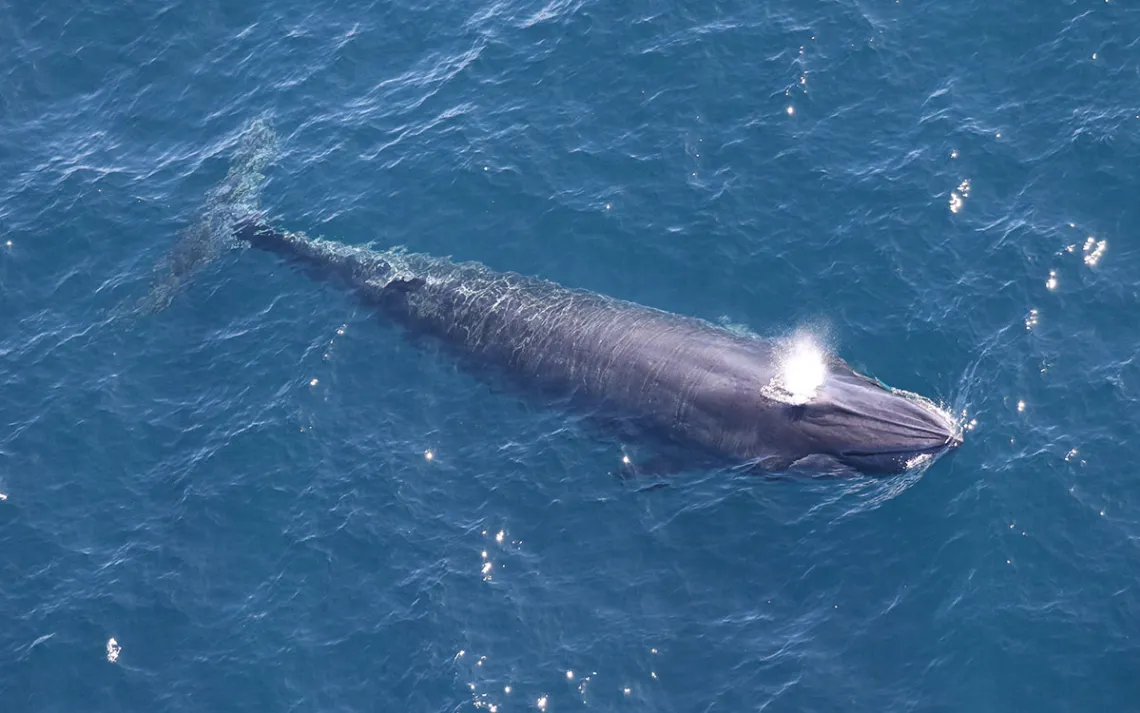
One of two Rice’s whales observed by the Southeast Fisheries Science Center in the western Gulf of Mexico during an aerial survey in 2024. | Photo courtesy of Paul Nagelkirk/NOAA Fisheries
Editor’s Note: This story was updated with news that on May 20th, NOAA released a new biological opinion, which conservation groups challenged in court.
Every day, wells across the northern Gulf of Mexico pull oil out from deep below the ocean’s surface. Cargo ships and tankers slice through these waters on their way to and from ports that line the Gulf Coast—where refineries turn crude into gasoline, kerosene, and other petroleum products, keeping the American fossil fuel industry humming.
This corner of the ocean—the source of approximately 15 percent of all oil produced in America—is also the only home on Earth for the Rice’s whale.
These baleen whales can grow as long as a city bus and inhabit a narrow strip of ocean from Florida through Texas. For decades, scientists believed this population of whales in the Gulf was a subspecies of Bryde’s whales, a species that lives in warm waters around the world. But in 2021, they discovered that these whales were actually a unique species, found nowhere else in the world but the Gulf of Mexico.
Immediately, researchers knew that the Rice’s whale was on the brink of extinction. The species’ total worldwide population is estimated at just 51 whales, each of which has to navigate threats like oil spills, underwater noise from offshore development, and vessel strikes in the highly industrialized Gulf of Mexico.
On the bright side, other species of baleen whales have demonstrated “remarkable resiliency” when given time and space to recover, according to Michael Jasny of the Natural Resources Defense Council. But the process of providing legal protections to the Rice’s whales has been touch and go, and some protective measures were recently rescinded by the Trump administration. Now, some advocates are bringing the fight for the species to the American people, hoping that with enough public pressure, we might be able to keep the newly discovered Rice’s whale around.
“The question is,” Jasny said, “can we keep the whales alive until there is sufficient political will to help them recover?”
People have long known that some kind of baleen whale lived in the Gulf of Mexico, but for years, their true identity remained a mystery. Whaling ships from the 18th and 19th centuries, for example, recorded some “finback whales” in the Gulf, many of which were likely Rice’s whales. By the mid-20th century, scientists had identified this population as Bryde’s whales, but in 2014, researchers at NOAA published evidence that these whales had a unique genetic lineage.
That paper showed that these whales were “really weird from a genetic standpoint,” said Matthew Leslie, a biologist at Ursinus College in Pennsylvania. A few years later, after one of those weird whales washed up dead in Florida, researchers finally had enough data on their genetics and anatomy to make the determination: These Gulf of Mexico whales were not Bryde’s whales at all, but an entirely new species.
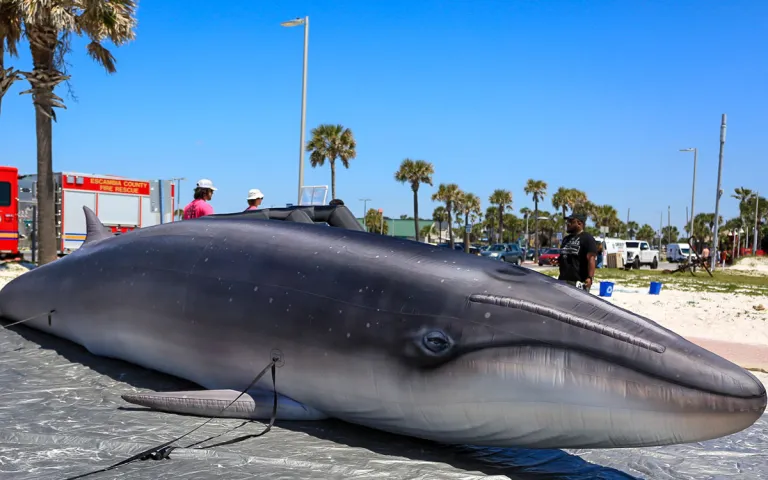
A blow-up version of a Rice's whale at the Gulf Coast Whale Festival at Pensacola Beach, Florida. | Photo courtesy of Ric Kindle--Sites Unlimited Photography
We don’t know exactly how many Rice’s whales may have lived in the Gulf of Mexico a few hundred years ago, let alone a few decades ago. But Leslie said that the current population is too small to have sustained an entire species for centuries. And the modern Gulf is full of potential hazards for the few dozen whales that still live there. The Deepwater Horizon disaster, which slathered the Gulf in oil in 2010, is estimated to have killed around 22 percent of all Rice’s whales alive at the time. Passing ships can slam into the whales—according to the National Oceanic and Atmospheric Administration (NOAA), Rice’s whales may spend a lot of time near the surface of the water at night, when it’s hard for people on boats to spot whales. In 2009, a Rice’s whale was struck by a ship, with its carcass eventually reaching Tampa Bay.
NOAA also notes that ocean noise from things like underwater seismic surveys could interrupt the whales’ communication. Ocean debris poses another threat—the agency said that the Rice’s whale that washed up in Florida in 2019 had a piece of plastic in its stomach and may have died as a result.
Some of these threats may exist for as long as the Gulf remains an industrial zone. “Ultimately,” said Christian Wagley, a coastal organizer with the nonprofit Healthy Gulf, “these whales can't recover without getting oil and gas out of the Gulf of Mexico.” But advocates have suggested some regulations that could help protect the whales within the current landscape of the Gulf, such as implementing speed limits in their habitat and reducing construction noise.
Notably, Rice’s whales have been on the federal endangered species list since 2019, initially listed as a threatened sub-population of Bryde’s whales. That brings some legal requirements—including that the federal government has to consult with NOAA before doing, funding, or allowing anything (such as offshore drilling) that could impact the species. In 2020, as part of this process, the National Marine Fisheries Service, a division of NOAA, said that continued oil and gas drilling in the Gulf would be “likely to jeopardize” the survival of the Rice’s whale and suggested some ways to avoid that risk, such as speed limits for oil and gas ships in part of the Gulf. But after that document was released, a group of environmental organizations (including the Sierra Club) sued the federal government, arguing that it offered insufficient protection to the Rice’s whale and other endangered species.
Last August, a federal judge ruled in favor of the environmental organizations, saying, in part, that while the agency had proposed mitigation measures for two threats to the Rice’s whale—ship strikes and ship noise—it didn’t address the threat of oil spills, underwater noise from seismic surveys, or marine debris. When asked for comment, a representative from NOAA noted that the agency was making progress toward a new biological opinion, which was released on May 20. The new biological opinion again found that the continued existence of Rice's whales would be imperiled by these oil and gas activities in the Gulf, and offered some strategies to reduce that impact. Environmental groups, including the Sierra Club, have already sued, claiming that the new analysis still does not do enough to protect Gulf wildlife such as the Rice's whale from threats associated with oil and gas drilling. A representative from NOAA Fisheries said the agency is unable to comment on matters of litigation.
In 2023, as part of the arguments around this case, the federal government did set some voluntary guidelines asking oil and gas ships to do things like slow down in Rice’s whale habitat and have observers on ships watch out for whales aboard the ships. Yet in February, the Trump administration rescinded those guidelines in response to the president’s “Unleashing America’s Energy” executive order. (Environmental groups, including the Sierra Club, have now threatened to sue to reinstate those guidelines.) In a separate case, another judge in March 2025 again ruled in favor of the Sierra Club and other environmental groups regarding a large oil and gas lease sale mandated by the Inflation Reduction Act. The judge said the federal government had not done enough to consider the potential impact of the lease sale on the Rice’s whale. The Bureau of Ocean Energy Management, which is the federal agency that oversees offshore drilling, did not respond to a request for comment on the intent to sue or the March 2025 case.
"In particular, the court called out the government for failing to consider its own science demonstrating that the whale persistently occurs in the central and western Gulf, which is the epicenter of oil and gas drilling activity," Devorah Ancel, a senior attorney with the Sierra Club's Environmental Law Program, said. "This represents the principal threat to the species' long-term survival."
Protecting this species, Leslie said, would require a lot of people caring a lot about these whales, and building up public pressure. And that’s where these whales might have the upper hand. “As people realize that they've got this incredible species in their backyard, they start caring for it,” Jasny said.
One local artist on the Florida Gulf Coast, for example, has sculpted the whale onto the side of a restaurant, and a composer from New Orleans has written a “Reverie for the Baleen of the Gulf of Mexico of Many and No Known Names." This year, Wagley, the nonprofit organizer, helped organize the second annual Gulf Coast Whale Festival at Pensacola Beach. More than 1,000 people came out to watch music performances, participate in hands-on activities, and gawk at a life-size, inflatable Rice’s whale.
Tommy Tucker, a research assistant at the Center for Coastal Studies who’s originally from around the Texas Gulf Coast, has made multiple Rice’s whale puppets and tapestries and helped organize some of this year’s festival activities in Pensacola. Growing up, Tucker says, they learned that our relationship with the Gulf was more about extraction. Now they want to help people “nurture love and tenderness” for the Gulf and the wildlife that lives in this ecosystem, including the Rice’s whale.
“I would love for every kid who is living on the Gulf right now to be excited about what’s in their water,” Tucker says. “Or the water that they get to swim in and share with these species.”