This Easy Solution Could Prevent Whale Deaths
New on-demand fishing gear reduces harmful entanglements
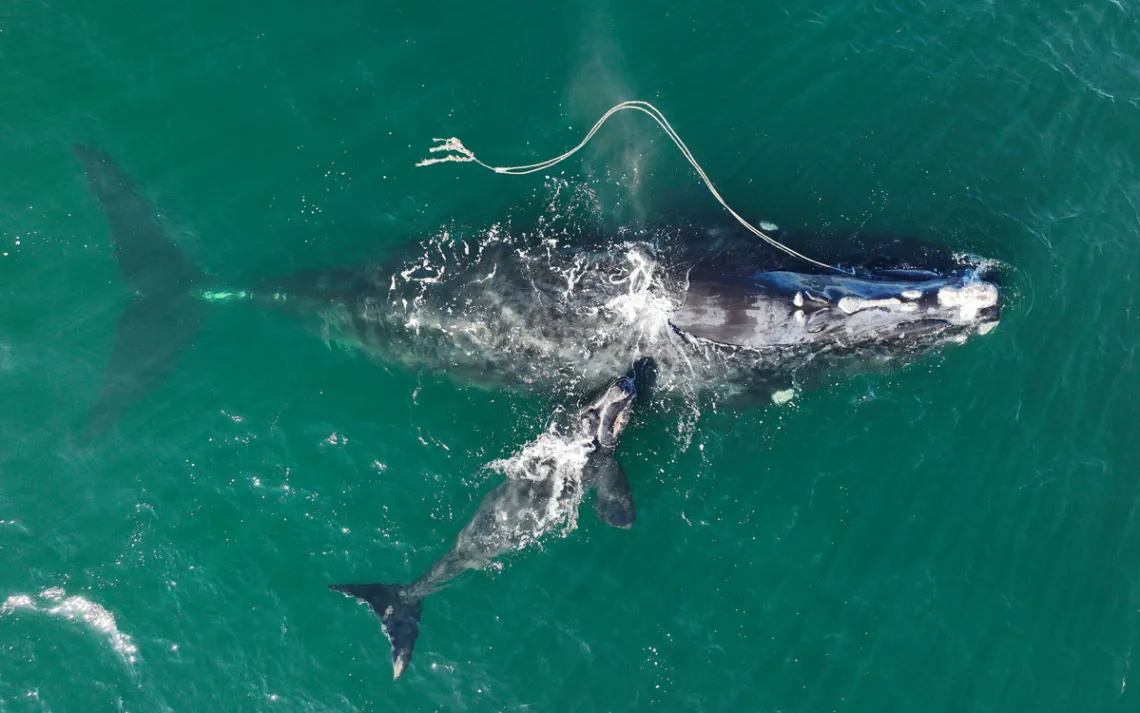
An endangered North Atlantic right whale entangled in fishing rope near Cumberland Island, Georgia. | Photo courtesy of the Georgia Department of Natural Resources/NOAA Permit via AP, File
Have you ever tried to untangle a knot of holiday lights? The more you try, the tighter it gets. Now imagine that snare encasing a 70-ton whale. “Whales typically get entangled around the rostrum (upper jaw), around the flippers, around the tail, around the body,” said Moira Brown, director of science for the Canadian Whale Institute. Based on Campobello Island in Canada’s Bay of Fundy, just north of Maine, Brown and her team respond to between 10 and 20 whale entanglement calls throughout the waters of Atlantic Canada every year.
While any rope in the ocean can entangle any whale, historically, North Atlantic right whales have been especially vulnerable because they feed in the same areas that commercial and private fishers set traps for crabs and lobsters. To find and retrieve their traps, harvesters attach a rope to the trap that leads to a buoy on the surface. These lines can be hundreds of feet long in the water column.
As whales forage, they collide with the ropes. Startled, they instinctively roll and twist to escape. This only tightens the rope’s grip. Unable to break free, whales can drag the rope, trap, and buoy for days, months, or even years—if groups such as Brown’s don’t rescue them. The rope cuts into the whale's body and creates gashes that can become infected and can even lead to drowning. More than 86 percent of North Atlantic right whales carry scars from entanglements—a devastating figure for a species listed as endangered by both Canada and the US governments. In fact, according to the US Geological Survey, fishing gear entanglements is a leading cause of death for North Atlantic right whales.
To try to prevent these deadly encounters, officials with the Canadian and US governments have closed fisheries when whales are migrating through an area. This, however, means that fishers can’t fish. Or can they? Companies, such as Ropeless Systems, based in Biddeford, Maine, and others, have created a solution that enables fishers and whales to coexist.
Commonly called on-demand fishing gear, rather than being tethered to a rope, the traps emit coded signals (similar to sonar) to a buoy. Harold Vincent, cofounder of Ropeless Systems, explained that when a fisher is ready to retrieve the trap, they send a signal that triggers an air-filled buoy to pop free, lifting the trap to the water’s surface. The buoy marks the spot where the fisher can collect the trap.
Some people who use the gear are hooked. In Santa Barbara, California, for instance, retired emergency doctor turned fisherman Greg Olsen tested on-demand gear when harvesting box crabs. In his part of the world, conservation groups and fishers are worried about migrating humpback whales. Unsure at first, Olsen nevertheless tossed the equipment without any rope attached into the murky abyss of the Pacific.
“The feeling I got in my stomach when I threw them over was an ‘Oh my gosh’ moment,” he said. “Would I ever see that equipment again?” But the system worked, and now he can’t imagine not using it.
Olsen’s success shows what’s possible. But as Sean Brillant, senior conservation biologist for the Canadian Wildlife Federation, points out, not everyone is so easily swayed. Introducing a completely new way of fishing to an industry grounded in tradition is not easy. Fishers require training on how to use the equipment, and until proven otherwise, there is, as Olsen initially experienced, skepticism that it will be effective.
Currently, it can only be used in closed areas with special licenses. These can be hard to acquire and involve a lot of red tape. It’s also not cheap. A single unit can range from around $700 to $3,500, according to Brillant. This makes the cost prohibitive and the gear better suited for large-scale operations. Brillant works with fishers through the organization’s CanFish Gear Lending Library in Beechville, Nova Scotia, to help them overcome these hurdles. Similar programs exist in the US, such as the Northeast Fisheries Science Center Gear Lending Library in New England.
“My organization started the lending program to take care of all these barriers to harvesters accessing and using this gear,” Brillant said. “A hundred percent of the fishers that we've been working with have also come around and say that if there was a whale closure and my choice was using this or not fishing, they could use the on-demand gear no problem.”
In 2022, for example, closures near Prince Edward Island due to migrating whales inspired fishers to use the gear. According to Brillant, almost 4,000 pounds of snow crab that wouldn’t have otherwise been caught were caught.
It’s not just crab and lobster fishers who are benefiting from on-demand fishing gear. The South Atlantic black sea bass fishery is as well. Utilizing a range of fishing gear, including traps, for over a decade, the pot and trap fishery has observed two seasonal closures each year off the coasts of Florida, Georgia, South Carolina, and North Carolina. This is to prevent whale entanglements as North Atlantic right whales migrate south to calving grounds and back north with their newborns. In 2025, the South Atlantic Fishery Management Council approved on-demand gear for use during the migration. “It’s the fishery closures that save the whales,” said Brillant. “And it's the ropeless gear that saves the fishermen.”
All these successes give Brown hope. “There are many people trying to change their way of doing things on the water to try and give right whales a chance and other species as well,” she said. She is looking forward to Canada’s federal Department of Fisheries and Oceans' new whale-safe gear strategy. Scheduled for release in 2026, its aim is to advance the use of on-demand gear and make it more accessible for harvesters.
In the meantime, Brown and her team stand ready for the next time the call comes that a whale is entangled. Their heroic efforts have been featured on Apple TV’s The Wild Ones, bringing global attention to the issue of whale entanglement. But, as gratifying as the awareness is, it's not what Brown is dreaming of. “I think I would be speaking for everybody on the whale rescue team, including myself, to say that we would love to be put out of business,” she said.