This New Sanctuary Could Be the Future of Captive-Whale Rehabilitation
A bold experiment is underway to save belugas facing euthanasia
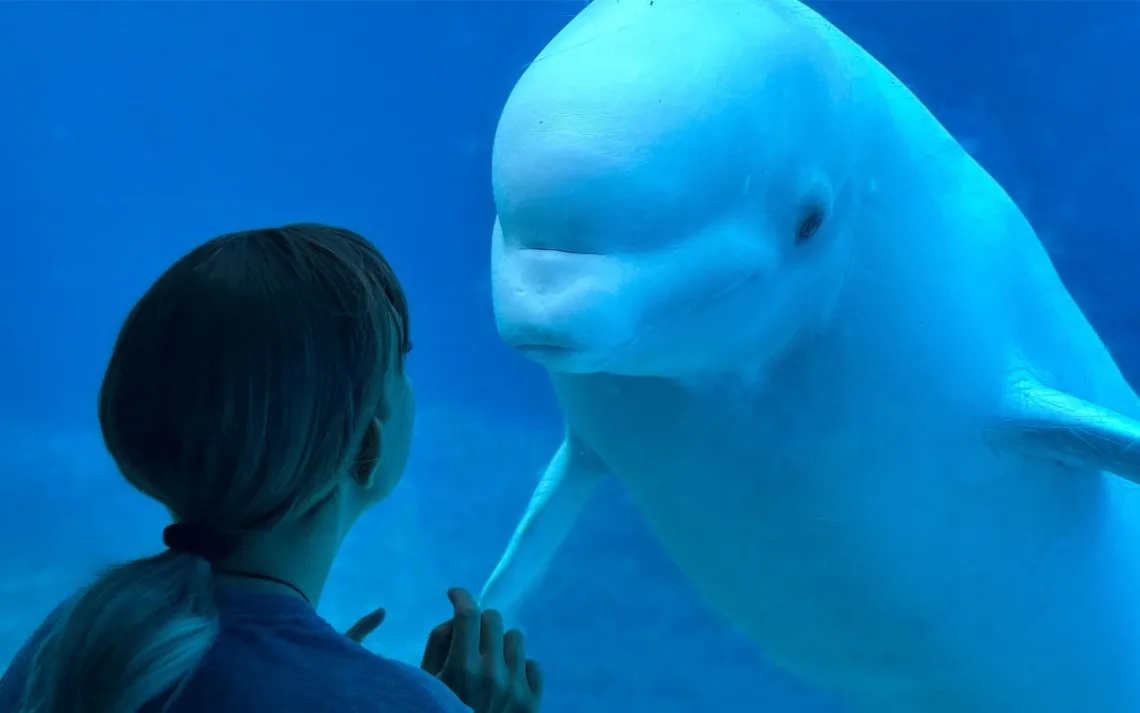
Kristy Burgess and the beloved Eve at Marineland in Canada. | Photo courtesy of Kristy Burgess
Kristy Burgess fell in love with the beluga whales she cared for at Marineland in Ontario, Canada. Working at the marine park from 2022 to 2025, Burgess developed deep personal relationships with each one. One of her fondest memories is of Eve, who approached her one day without prompting, something uncommon for the shy whale.
“She gave me her flukes for rubs, and I gave her little flukey rubs,” Burgess said. It was the start of a beautiful friendship between them. But now Eve’s fate, along with other belugas at Marineland, is in limbo. The park closed to the public in 2024, under a cloud of controversy. Infamous for its poor treatment of animals, the park was found guilty under Ontario's animal cruelty laws for its treatment of three young black bears.
Despite having closed, Eve and the other beluga whales remain at Marineland. But there is growing concern for their well-being. “They just don't have adequate conditions,” Burgess said. “The tanks are not clean and are falling apart. I would watch whales come in with chunks of concrete or paint chips in their mouths.”
However, that may be the least of the whales’ problems. Last fall, Marineland again made headlines when it warned that, unless the Canadian federal government provided funding for the whales’ care, they would be forced to euthanize them. This threat came after permits for the whales to go to Chimelong Ocean Kingdom in China were denied. In 2019, the Canadian government passed the Ending the Captivity of Whales and Dolphins Act, making it illegal to import or export a cetacean, such as a whale or dolphin, to or from Canada.
Similar laws exist in the US. For example, California has state laws prohibiting the holding of orcas in captivity for performance or entertainment purposes. Legislation also exists in South Carolina, Washington, and Connecticut.
This leaves Eve and other whales housed in marine parks in a state of uncertainty. As governments pass laws limiting their exploitation, it highlights an evolution for zoos and marine parks and poses ethical quandaries for the animals. Andrew Fenton, a bioethicist at Dalhousie University in Halifax, Nova Scotia, believes there is a moral duty of repair to the whales currently in captivity. “We denied them lives that we had no right to deny, especially when they were wild caught and when we bred them in captivity,” he said.
Now a solution has emerged. The idea of creating whale sanctuaries in isolated coastal waters is gaining traction. “The coastal sanctuary will allow us to give back some of what we took,” Fenton said.
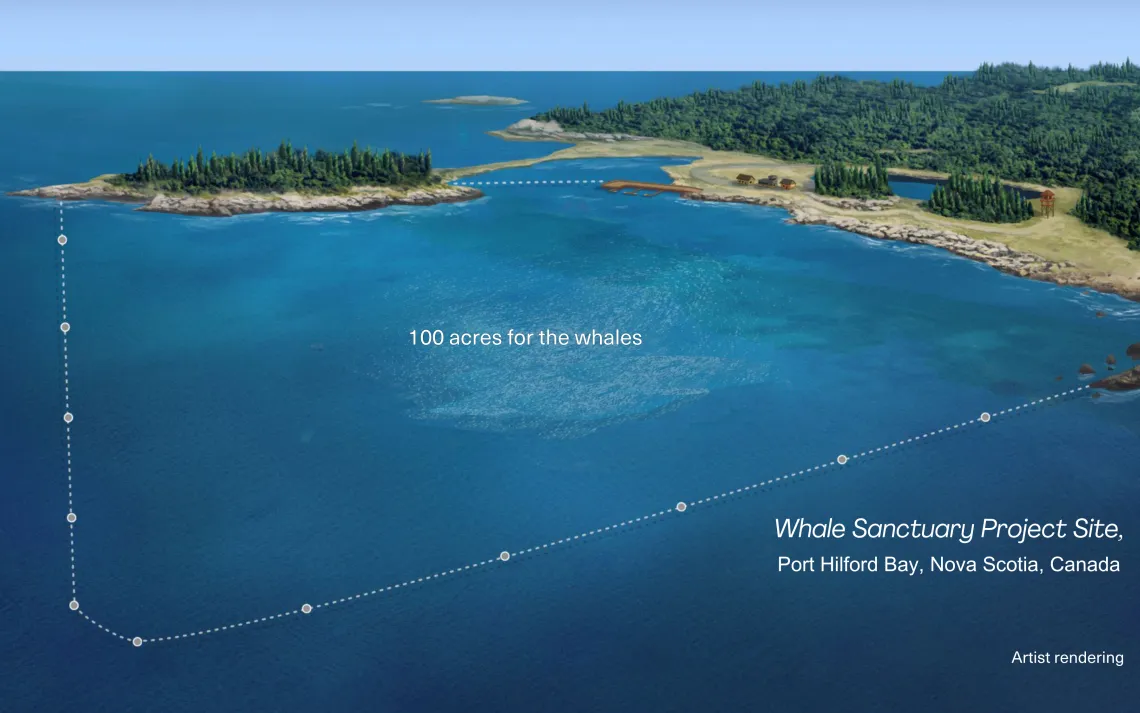
An aerial photo of the whale sanctuary in Canada, with an artist's rendering that outlines its borders. | Photo courtesy of the Whale Sanctuary Project
Since 2020, the Vestmannaeyjar Islands off the south coast of Iceland have been home to a project just like this, where two belugas named Little Grey and Little White live. Owned by the British-based Sea Life Trust, the two arrived in Iceland from a Shanghai water park. Proponents of Canada's first whale sanctuary believe that a coastal bay south of Port Hilford, Nova Scotia, could provide similar benefits and give back what captivity in marine parks denied to the mammals.
In a recent scientific paper, Lori Marino, a neurobiologist and founder of the Whale Sanctuary Project, outlines the harms whales experience in captivity, including shortened life spans, deep emotional trauma when separated from family groups, and restricted natural swimming behaviors, such as deep diving. Port Hilford Bay is large, almost 100 acres and 60 feet deep in some places. That’s 150 times larger than the tanks typically found in most marine parks. A large net will separate the whales from the open ocean, keeping them safe.
But, this again raises concerns among some whale lovers that one form of captivity is being swapped for another. “I just think the animals have not been exposed to other pathogens that they would come across in natural waters,” Burgess, who does not believe the whale sanctuary is a good idea, said. She does not believe a coastal open ocean whale sanctuary is a good idea. She would like to see a hybrid model in which the whales are kept in tanks, but do not perform and live in an inland habitat.
Marino disagrees. “To say that we're simply swapping one form of captivity for another really misses out on what a real sanctuary is,” she said.
She pointed out that the sanctuary is in the ocean, there are other critters, and the whales won’t have to perform. “We will promote their autonomy,” Marino said. “It's a complex environment and a natural environment. That makes the qualitative difference.” She also pointed out that whales currently held in captivity cannot be released into the open ocean, as they have lost their ability to sense danger or to feed themselves and have become dependent on humans for their survival
Reintroducing whales held in captivity to a natural environment can admittedly trigger stress responses that affect the immune system, which is why Marino said the process will be slow and carefully monitored. “The first thing is to bring in expert veterinarians,” she said. “We want to know everything about their health, their pathogen load, etc. Then, once we know what we're dealing with, we will fortify and strengthen them and make sure their immune systems are up to speed.” They won't, according to Marino, just be let go into 100 acres; a very close eye will be kept on them, and only when the whales indicate they’d like to explore more of the area will they be let into the larger sanctuary. If there is a stress response, help for the whale will be immediate.
At the moment, the Whale Sanctuary Project has no plans to release whales fully back into the wild, but that could change depending on their behaviors. In the US, several elephant sanctuaries care for and rehabilitate elephants, including the Elephant Sanctuary in Tennessee and PAWS in California. Research, here, has indicated that once the animals were introduced to their new environment, they grew healthier, and slowly their natural behaviors, such as feeding, began to re-emerge.
In the meantime, for the whales trapped at Marineland, the sanctuary’s opening can’t come fast enough. If all goes according to plan, it could, according to Marino, be ready to accept whales by the end of next summer. But, it will only be able to house 10 to 12 whales. There are 30 whales at Marineland, including Eve. The sanctuary in Iceland can accommodate 10 whales. Around the world, there are 345 facilities in 56 countries housing captive whales and dolphins. This makes the sanctuary in Nova Scotia a small drop in a big bucket.
The good news, according to Fenton, is that a template has been created that he believes can be used to create more sanctuaries. “What's exciting about Canada and it's one of our underutilized superpowers, is our range of coastline,” he said. Canada has the longest coastline in the world, measuring over 150,000 miles. Fenton believes that if there were the money and the political will, the country could replicate what’s happening in Port Hilford Bay all along Canada’s coast and start taking in other whales. “We could actually help other countries with their ethical debt,” he said.
In the meantime, Eve and the other belugas at Marineland anxiously wait for their fate to be determined and for the ethical debt owed to them to be paid.