Caving Pennsylvania’s Laurel Caverns
A new state park promises an underground experience like no other
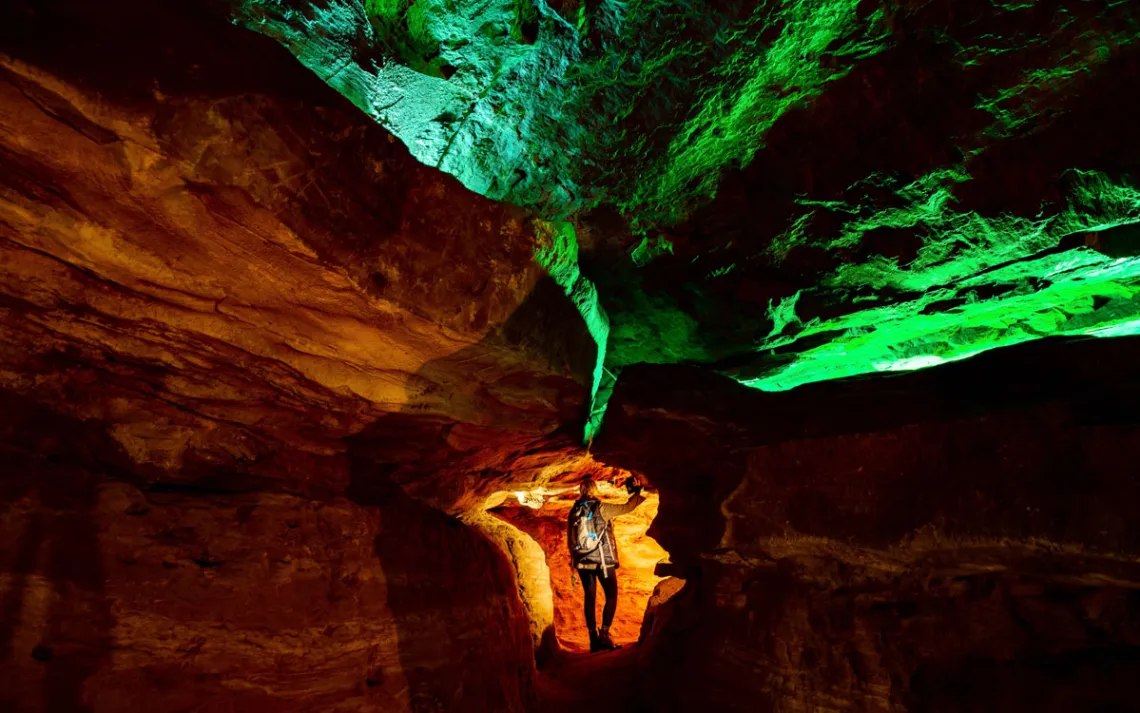
Laurel Caverns illuminated by neon lights. | Photo courtesy of Alex Byers from GO Laurel Highlands
In late July, an intense heat wilted over the hills of western Pennsylvania. David Cale wore a gray suit—a stifling choice had we been anywhere else. But inside Laurel Caverns, the temperature remained at a cool 52°F. We plodded down dark, narrow passages slick with moisture. I had a flashlight. He did not. He knew this underground system by memory, navigating each step and turn as if moving through the familiar rooms of a house.
This cave is his home.
Cale has explored, managed, and protected Laurel Caverns—the largest cave in Pennsylvania and one of the largest calcareous sandstone caves in the world—for over 60 years.
Now, through the Laurel Caverns Conservancy, he and his wife, Lilian, are preparing to donate the karst cave and its surrounding 428 acres to the Commonwealth of Pennsylvania. Once the budget is approved, it could be the state’s 125th state park and its first underground park. “Laurel Caverns has always belonged to the people,” Cale said. “We’ve just been its caretakers for a while.”
Carved out of limestone by rainwater, karst formations, which include caves, springs, and underground rivers, are some of the most underprotected and neglected ecosystems in the world. They are also some of the most important.
While karst terrain makes up only about 20 percent of the United States, its aquifers hold 40 percent of the nation’s groundwater that millions of people depend on for drinking. But as pollutants from increased urbanization, agricultural runoff, and sewage seep into subterranean regions, the mounting environmental and public health risks have made hidden karsts impossible to ignore.
Why caves matter
Located roughly 50 miles south of Pittsburgh, Laurel Caverns is perched at the top of Chestnut Ridge and surrounded by Forbes State Forest. Because the property above the cave is entirely preserved, every drop of water that seeps underground originates from the safeguarded property. “The water is pristine,” Cale said. “It’s pure as can be.”
The same, however, cannot be said for other caves across the US. Unlike the mountainous region where Laurel Caverns is located, many caves are found in valleys underneath farmlands and towns. Since karst is porous, it absorbs surface contaminants, including pesticides, hard metals, and bacteria from sewage.
Around the world, caves “serve as time capsules,” said David G. Foster, president and CEO of American Cave Conservation Association (ACCA). “They preserve the earliest known remnants of human culture, art, archaeology, religion, and biodiversity found nowhere else.”
The US is home to some of the most scientifically significant caves in North America, sheltering more than an estimated 1,000 animal, plant, and insect species. Laurel Caverns alone is the largest natural bat hibernaculum by volume in the northeastern US, protecting the endangered small brown bat, the large brown bat, and the tri-colored bat.
“Caves harbor a high percentage of endangered species,” Foster said. “So if you're interested in the diversity of species on the planet, you need to be interested in protecting caves.”
Protect now, or fix later
The stream that flows through Laurel Caverns travels into the Fairchance Watershed, heads southwest toward Georges Creek, and eventually meets the Monongahela River. Protecting it has been a family calling since 1926, when Cale’s grandfather and cousins purchased the cave and its encircling land to shield it from land development and quarrying. In 1986, Cale and Lilian became the sole owners, driven by the same mission. While Cale works to prevent Laurel Caverns from environmental disaster, Foster knows what it’s like to inherit a cave after the damage has already been done.
By the 1980s, the Hidden River Cave, located directly beneath Horse Cave City in south-central Kentucky, was overgrown, forgotten, and written off as one of the most polluted caves in America. It was exactly the type of project the newly formed ACCA wanted to take on. Foster, then a Virginia caver, relocated to help lead the effort.
During its heyday in the early 20th century, Hidden River Cave operated commercial tours, attracting thousands of visitors eager to explore its half mile of passages. After only 27 years, it closed.
Lacking a proper sewage treatment, the town dumped waste into cave passages and nearby sinkholes, not realizing it was contaminating its own drinking supply. A nearby creamery poured its byproducts upstream, turning the water into milky waste with a lingering stench. Later, a metal-plating facility spouted toxic metals, such as chromium, into the river, killing what little life remained.
With help from hydrologists, biologists, and the cave’s last private owner, William T. (Bill) Austin, ACCA launched a decades-long cleanup initiative that united three surrounding towns to build one of the first multicity regional sewage systems. By the summer of 1991, Hidden River Cave once again supported endemic species like cavefish and crayfish. In 2015, a water-quality study by researchers from Western Kentucky University and Canada’s McMaster University confirmed it had recovered to “near drinking water standards.”
In an interview with The New York Times, Chris Groves, a professor of hydrogeology at WKU, said, “the restoration of Hidden River Cave is one of the most remarkable examples of a cave cleanup, one that could point the way back to health for other polluted caves.”
The rural divide
Today, ACCA operates Hidden River Cave and the American Cave Museum as an ongoing education initiative—using its polluted past and drastic restoration efforts to underscore the importance of protecting caves and groundwater resources.
However, despite Hidden River Cave’s conservation success story, Foster said it's still difficult to get awareness, especially in a lesser-known region.
“People in the field find it difficult to believe that a multinational conglomerate would be located in Horse Cave, Kentucky,” Foster described. “People just assume if you're going to do great things for the environment, you have to be from a big city.”
Foster noted that his late mentor, Tom Aley, principal hydrogeologist and president of the Ozark Underground Laboratory, pointed out a correlation between rural poverty and karst regions he “had never picked up on.”
“When you look at a map of karst regions in the US, they match up pretty well with rural areas … not all, but most,” Foster stated. He noted the Appalachian Plateau and the Ozarks, where caves and karsts underpin many poor rural regions in the country.
Those same areas often lack the resources to prevent or reverse expensive mistakes made from environmental damage. For example, natural depressions, known as sinkholes, dimple karst regions and are frequently treated as waste dumps.
Foster recalled a particularly difficult project in Somerset, Kentucky, that took two summers to clean up. Staff and volunteers had to haul 200 tons of garbage out of one 70-foot pit. Refrigerators, sinks, and a bass boat were also resurrected from the site.
That one sinkhole represents hundreds of others like it. When surface pollution funnels directly into groundwater, it carries chemicals from the waste along with it, leading to widespread contamination.
Severe weather events compound the risk. Earlier this year, heavy rain events arrived several times in a season. In April, flooding closed Hidden River Cave for 50 days, and Mammoth Cave National Park—the longest known cave system in the world—experienced its highest water levels in over 60 years. Something that, Foster said, “almost never happens.”
Ashlee Warren, operations manager of Hidden River Cave, said the cave post-flood was “in a catastrophic state” with mud three feet deep in some areas, up to his waist.”
It took almost two weeks to clean the initial debris and restore the pathways. “We are still feeling the effects, even this far on,” Warren said.
Hidden conservation
Pennsylvania Governor Josh Shapiro recently proposed designating Laurel Caverns as the state’s first underground park—a move that would secure the land against future development while keeping the Laurel Caverns Conservancy in charge of education and tours. For decades, Cale has passionately preserved the cave and its watershed under his care. Transferring it to the state ensures that protection won’t end with him.
“This has always been the plan,” Cale said. “It’ll stay in the hands of people who understand it and will take care of it.”
It also contributes to a much larger effort. The fragile and at-risk ecosystems of caves continue to require specialized management. “We need to keep acquiring green spaces and significant caves through the groups that fund conservation,” Foster said. “We're fortunate. We have groups out there that do great work.”
It’s easy to neglect what can’t be seen. But stewardship extends deep beneath the surface, protecting the hidden resources we depend on every day, and will need far into the future.