 The Magazine of The Sierra Club
Chinook Salmon Are Returning to This River After Nearly 50 Years
Cowlitz Tribe helps reintroduce the largest Pacific salmon species to watershed inside Mount St. Helens monument
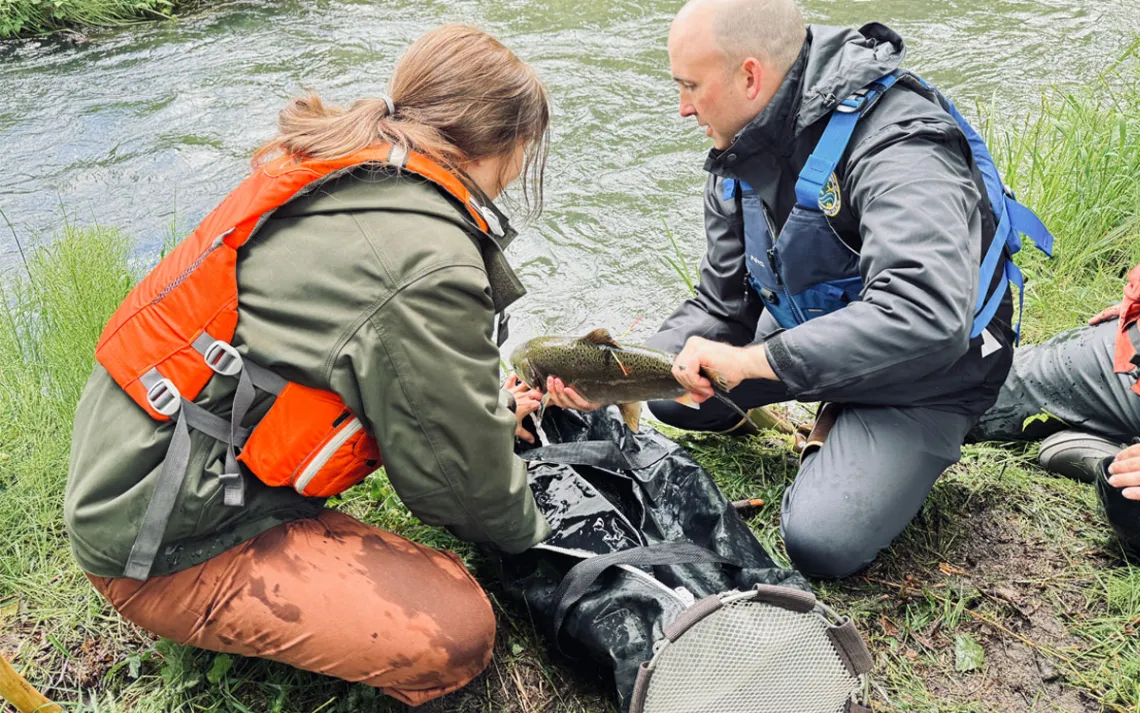
WDFW fish scientists and project leads Toby Harbison (left) and Thomas Buehrens (right) release a hatchery-origin spring Chinook salmon into South Coldwater Creek during an event celebrating the reintroduction of Chinook to the upper North Fork Toutle River watershed within the Mount St. Helens National Volcanic Monument on June 10, 2026. | Photo courtesy of Washington Fish and Wildlife Department
The salmon felt powerful in Bill Iyall’s hands as he guided it back into the river earlier this summer. He was releasing fish in the North Fork of the Toutle River as part of a larger effort aimed at restoration. Chinook, also known as king salmon, were missing from the watershed for over 45 years.
As Iyall placed the salmon into the water, he felt as though he was returning the fish to its home. These Washington waters are where Chinook used to spawn. Their young spend anywhere from months to a year in freshwater before eventually migrating to the sea. When they return several years later, they spawn and then die, bringing nutrients from the ocean to the riparian and forest ecosystems.
“I had the honor to release the first fish,” said Iyall, who is the chairman of the local Cowlitz Indian Tribe. “That was the most significant statement, my personal connection to the fish. Knowing that I could feel the need for that fish to get back into that basin.”
The reintroduction of the anadromous salmon, known for the popcorn-shaped spots, was a yearslong collaborative effort. In addition to the Cowlitz, the effort also included the Wild Salmon Center, the Washington Department of Fish and Wildlife, and the US Forest Service. The cohort of groups began releasing salmon outside the monument last year. But the ultimate goal is to restore fish passage from the ocean to the inland waterways of the Columbia Basin.
“It’s looking like it might be possible,” said Toby Harbison, a research scientist with the Washington Department of Fish and Wildlife, of the overarching ambition. “It felt positive and hopeful.”
The disturbance of an ecosystem
For over a century, salmon species migrated freely between the rivers surrounding Mount St. Helens and the Pacific Ocean. Guided by their keen senses, salmon memorize the unique chemical scent of their natal river, in a process known as “olfactory imprinting.” To find their way back from the ocean, they navigate Earth’s magnetic field while sniffing out their birthplace.
Once they return, females sift through gravel riverbeds with their tails to create nests called redds before laying their eggs. Males develop a hooked jaw, known as a kype, and sharper “breeding teeth,” then fertilize the eggs while sometimes fighting off competition from other fish. Spawning typically occurs from late August through early November for spring Chinook and from October to December for fall Chinook.
Before the eruption of Mount St. Helens, the area wasn’t just a place for salmon migration. It was known as the "Mount Fuji of America” for its summit—a smooth and pristine volcanic, conical shape, and as Lawetlat'la, or the Smoker, by the Cowlitz. However, on the morning of May 18, 1980, a 5.1 magnitude earthquake struck beneath the mountain, triggering the largest landslide ever recorded in US history.
Fast-moving magma melted snow along its face, which then gathered mud, rock, and other debris. The resulting sludge, called a lahar, traveled at speeds upward of 300 miles per hour. Acting like wet concrete, it surged 14 miles down the North Fork River Valley, wiping out homes, bridges, and emptying into the Cowlitz River, nearly 50 miles from the volcano. The flow suffocated the main stem of the Toutle, likely killing many of the fish, and deposited sediment 656 feet deep.
It also altered the ecosystem, forever reshaping the volcano into a horseshoe crater. Parts of the landslide came through Spirit Lake, just north of Mount St. Helens, filling its water with debris, increasing the depth by nearly 200 feet and nearly doubling the lake’s width from 1.9 to 3.5 square miles. It is no longer accessible.
“It was devastating,” said Will Atlas, the director of innovation and sustainable fisheries at Wild Salmon Center in Portland, Oregon. “It blocked the outlet of Spirit Lake. It created two new lakes: Coldwater and Castle Lake. There were formerly just creeks.”
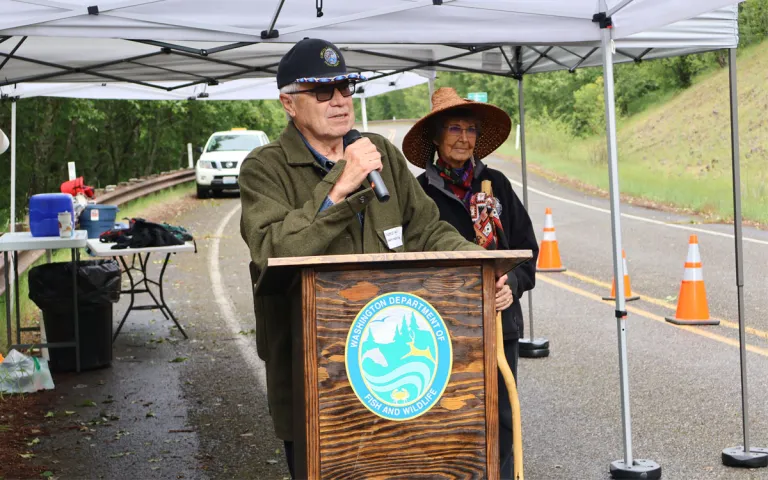
Cowlitz Indian Tribe chairman William (Bill) Iyall, along with spiritual leader Tanna Engdahl, delivers opening remarks during an event celebrating the reintroduction of Chinook salmon to the upper North Fork Toutle River watershed within the Mount St. Helens National Volcanic Monument. | Photo courtesy of the Cowlitz Indian Tribe
Slowly restoring a moonscape
Two years after the eruption, President Ronald Reagan and Congress designated 110,000 acres of land as Mount St. Helens National Volcanic Monument for research and education purposes. The first time Thomas Buehrens, a Seattle native, visited the area, he was less than 10 years old.
“It looked like a moonscape,” said Buehrens, when he visited about 15 years after the eruption. “It was just fields of ash, little seedlings, and fireweed was starting to come back. It wasn't really functioning much.”
Volcanic sediment was still clouding the watershed, with an average of 6.5 million tons per year flowing through the river. Eventually, Congress authorized the Mount St. Helens Sediment Control Project in 1985. The US Army Corps built the sediment retention structure in 1989.
While blocking sediment from traveling downstream, it also blocked all salmon passage. To restore fish migration, the US Army Corps built a fish collection facility roughly a mile downstream the same year, allowing for a trap-and-haul setup. Fish would congregate in the area, allowing researchers to capture them for release.
At the time, there weren't any Chinook coming back up the Toutle. The facility operated for specific months of the year: Beginning in October, as coho started to enter the facility, and until May when the steelhead trout were done. Researchers would transport fish to Bear, Alder, Pullen, and Deer Creeks for release. In the following years, starting in the late 1980s, the federal government listed Chinook and coho salmon and steelhead trout as threatened under the ESA in the lower Columbia Region.
In 2014, Buehrens, by then a research scientist with the Washington Department of Fish and Wildlife, noticed that the ecosystem was changing. “Quietly, nature's done what nature does,” he said. “The landscape has begun to heal.”
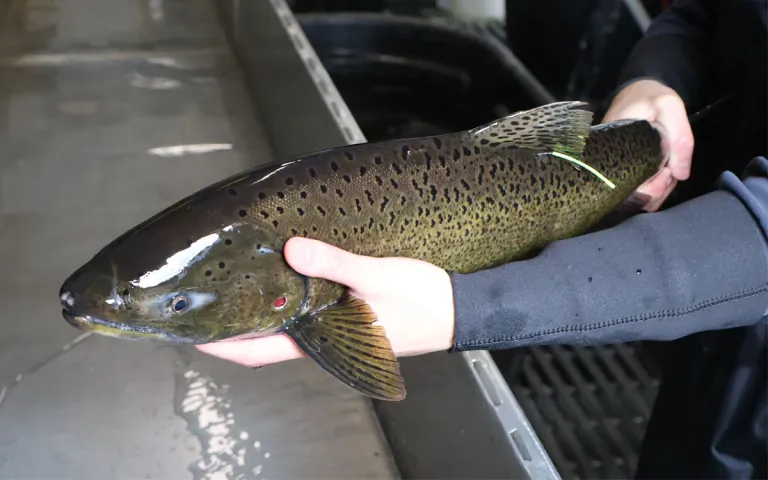
A hatchery-origin adult spring Chinook is tagged and loaded into a fish transport truck at WDFW's Kalama Falls Fish Hatchery before being released into the North Fork Toutle River. | Photo courtesy of Washington Department of Fish and Wildlife
Bringing Chinook back home
However, Buehrens and Atlas realized that the vast majority of habitat upstream from the sediment retention structure was functionally unoccupied by fish. “I looked at the Toutle and went, ‘Holy moly!’” Buehrens said. “The disconnect between the potential here and what's being realized is almost without parallel in Washington. We've got to do something.”
Habitat was being underutilized, likely because fish were not being evenly distributed once placed into those rivers, and Chinook remained absent. Trap-and-haul methods were surgically excluding them, closing operations around the time when they would reappear in the watershed, said Buehrens.
Hoping to provide a helping hand, the scientists applied for funding and federal approval to release Chinook in the North Fork Toutle River. This past February, that work was codified in the North Fork Toutle River Fish Passage and Reintroduction Plan, which serves as a road map to returning the species to these headwaters. “The habitat was not the limiting factor in getting the reintroduction going,” Harbison said, “It was the money and permits. The habitat has been able to support Chinook for a while.”
Despite Chinook being back in the North Fork Toutle, they are still facing barriers. To allow for free migration, trap-and-haul endeavors will likely continue and may open when Chinook are returning to the rivers. In addition, researchers are hoping to install a fish ladder, which would allow the fish to migrate without the intervention of people, but they need funding. There is also the option of modifying the existing spillway through the development of step pools to facilitate passage, which a 2007 study by the US Army Corps of Engineers suggested may be possible. Further engineering and designs must be completed though.
Another concern is where the salmon will be released. The creeks where researchers have previously released them are not expansive enough for the large fish, which can grow up to 4.9 feet and weigh 129 pounds. “They need big rivers,” Buehrens said. “We need a site in the main stem where we can release them to be viable and persist.”
To help ensure fish recovery is robust and successful, scientists like Harbison plan to test the stream’s microchemistry, looking at macroinvertebrate composition. What they’re hoping to ascertain is how the salmon’s return is affecting the broader ecosystem. Ultimately, the significance of the Chinook’s return goes beyond the watershed.
“It means bringing the salmon home,” Iyall said. “The migration of the salmon to the ocean and returning to its place of birth, that's the goal.”