The Hawk That Needs Ancient Forests
Rescinding the Roadless Rule in Alaska would mean trouble for the Queen Charlotte goshawk
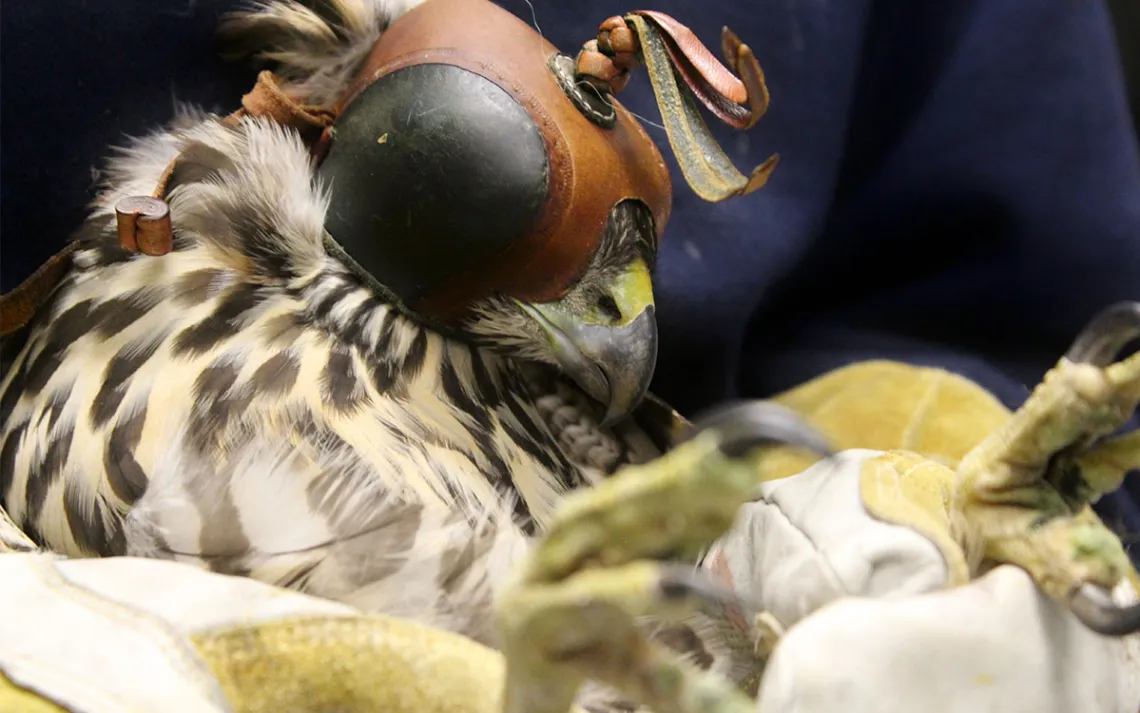
A juvenile Queen Charlotte goshawk being treated at Alaska Raptor Center in Sitka, Alaska. | Photo courtesy Alaska Raptor Center
Steve Lewis first spotted a Queen Charlotte goshawk about 20 years ago, just a week after he arrived in Southeast Alaska to start his master’s research. He was attempting to radio-track a goshawk near Juneau, Alaska, traversing his way through the wet, loose soil characteristic of the state’s temperate rainforest.
As Lewis approached the marked bird, he saw an adult male Queen Charlotte goshawk—the smaller and darker subspecies of the northern goshawk—fly overhead with prey in his talons. The male was soon joined by a female. Lewis watched the breathtaking pair for more than half an hour.
“It was incredibly exciting. I was just beginning my first field season for my master's research on goshawk diet, so finding a previously unknown nest, and seeing some of the places and ways these birds handled their prey was especially satisfying,” said Lewis, who is now a wildlife biologist for the US Fish and Wildlife Service. “It was also my first real introduction to the challenge of studying goshawks in Southeast Alaska.”
The Queen Charlotte goshawk is an elusive, imperiled bird that nests and forages in the temperate rainforests of British Columbia, Haida Gwaii, and the Tongass National Forest in Southeast Alaska—remote regions defined by towering trees and thousand-year old stands. The secretive and resilient subspecies thrives in dense, tall, old-growth forests with productive understories that supply enough food to support prey. They also need a vast forest canopy and large, secure trees to nest. To sustain a population, about half of their territory must be covered in old-growth forest.
Studying the Queen Charlotte goshawk requires a “combination of persistence, observation, and a willingness to explore some pretty difficult, but amazing places,” Lewis said. “After all these years, finding a goshawk nest in the Southeast Alaska landscape still feels like a special discovery.”
Despite its mysticism, the Queen Charlotte goshawk has a long and complicated history. The population has declined from more than 1,200 breeding pairs to between 275 and 575 breeding pairs, the Center for Biological Diversity estimates.
Conservationists first petitioned the species for protection under the Endangered Species Act in 1994, but the petition was unsuccessful. In a rare cross-border decision, the FWS declared in 2007 that Southeast Alaska and British Columbia each supported distinct population segments of the Queen Charlotte goshawk and that protection was warranted for the British Columbia population but not for that of Southeast Alaska. In 2012, the FWS officially listed the Canadian goshawk as threatened. Though this did not give the US FWS authority over Canadian forests and conservation, it used the ESA to protect the goshawk in ways that fall under US jurisdiction, like restricting import and trade of goshawks between the two countries.
While it was a win for Canadian goshawks, those in the Tongass were left without ESA protections. The FWS determined that the Tongass’s existing forest management plan, which includes the Roadless Rule—a rule established in 2001 that protects over 58 million acres of forest across the country from road construction and extractive industries—was sufficient in protecting the goshawk.
Now, President Donald Trump is pushing to rescind the monumental conservation policy, a heavily criticized move that would leave the Alaskan population of the Queen Charlotte goshawk almost entirely protectionless, experts say.
“The roadless rule protects some of the most intact, unfragmented, and important forests across the country. In the Tongass, in particular, it protects over 9 million acres of forest, including some of the last intact ancient old-growth forest stands left in the Tongass,” said Cooper Freeman, the Alaska director at the Center for Biological Diversity. “Goshawks, they need unfragmented habitat to be able to hunt and breed well.”
The Tongass National Forest is a vast and ancient landscape made up of rugged islands, deep, glacial fjords, and 1,000-year-old old-growth stands of trees. It’s part of the largest temperate rainforest on Earth and home to more than 400 species of land and marine wildlife, and 350 species of birds—about 40 percent of the bird species in North America. Roadless areas comprise about 55 percent of the 17-million-acre forest.
Its extensive areas of old growth provide the ideal conditions for the goshawk to nest, hunt, and sustain a population. Large trees make suitable nesting spots, and the dense canopy helps the goshawk hunt squirrels, grouse, and other birds. It’s one of the only viable habitats for Queen Charlotte goshawks in the United States, say ornithologists. But the old growth found in the Tongass has also long been appealing to extractive industries, said Brian Brooks, the vice president of advocacy and threats at the American Bird Conservancy. The trees are high-density and high-board feet per tree, which is the total volume of usable lumber from a standing tree or log.
“When you look at their [Queen Charlotte goshawks’] habitat, it’s in the place that these extractive industries have their eyes set on first. If you take that out, there’s not a secondary or buffer habitat that they're going to move into,” Brooks said of the consequences of rescinding the Roadless Rule. “They will no longer be there, and there won't be any nesting or successful reproduction.”
The Trump administration claims building roads in wilderness areas like the Tongass will help manage and fight forest fires, but there’s little evidence to back that up. Some research even suggests that forest fires are more likely to occur in areas with roads. Travis Belote, an assistant professor of landscape ecology at Montana State University, said that while forest management tactics like thinning and prescribed burns are essential in managing fire, road-building isn’t always necessary to do so.
“You can actually do mechanical thinning, and you can do prescribed fires in roadless areas with the intent of creating that diversity, that mosaic, that patchiness to try to reduce the spread of high severity fires,” Belote said. “You can do that stuff in roadless areas. You just can't build a road. We shouldn't oversimplify the narrative that more roads equals less fire.”
What roads do mean, however, is access to “resource exploitation,” Belote pointed out. He’s conducted extensive research on the environmental significance of roadless areas, which he said are some of the “wildest, ecologically intact,” areas left in the United States. There are no roads, no motorized vehicle access, and—unlike almost everywhere else in the country—there’s little disruption of ecological processes. Every roadless area provides habitat for at least two threatened or endangered wildlife species, according to a 2021 study.
“These are places where nature is still self-willed,” Belote said.
Though inventoried roadless areas make up just 30 percent of all national forest system, they are an important part of larger protected ecosystems and often act as safe corridors for animals to get from one habitat to another as they migrate, he added. “One of the things that science is teaching us is that we can't treat these protected areas—wilderness areas and national parks—as islands,” he said. “We have to be mindful that they're connected to their surrounding landscapes. That animals and water move, and they don't adhere to boundaries.”
Much of the Queen Charlotte goshawk’s habitat has already been decimated by decades of industrial logging in Alaska. In 1954, a pulp mill opened in Ketchikan, Alaska, and was contracted by the US Forest Service to process 50 years of timber from the Tongass. Just five years later, another pulp mill in Sitka, Alaska, opened with a similar 50-year contract. Logging skyrocketed, and more than half of the forest’s old growth was cut down by the time the state closed its last pulp mill in 1997.
“There has already been decades of industrial slaughter of the Tongass, and we're fighting to not have that come back,” Freeman said. “Roads would just dramatically increase the acreage available for the Forest Service and the Trump administration to offer for extractive clearcutting. And again, it's that fragmentation, it's that loss of habitat, that’s driving the goshawk into decline.”