 The Magazine of The Sierra Club
Coal Gasification Attempts a Comeback
The declining industry is looking for ways to revive itself
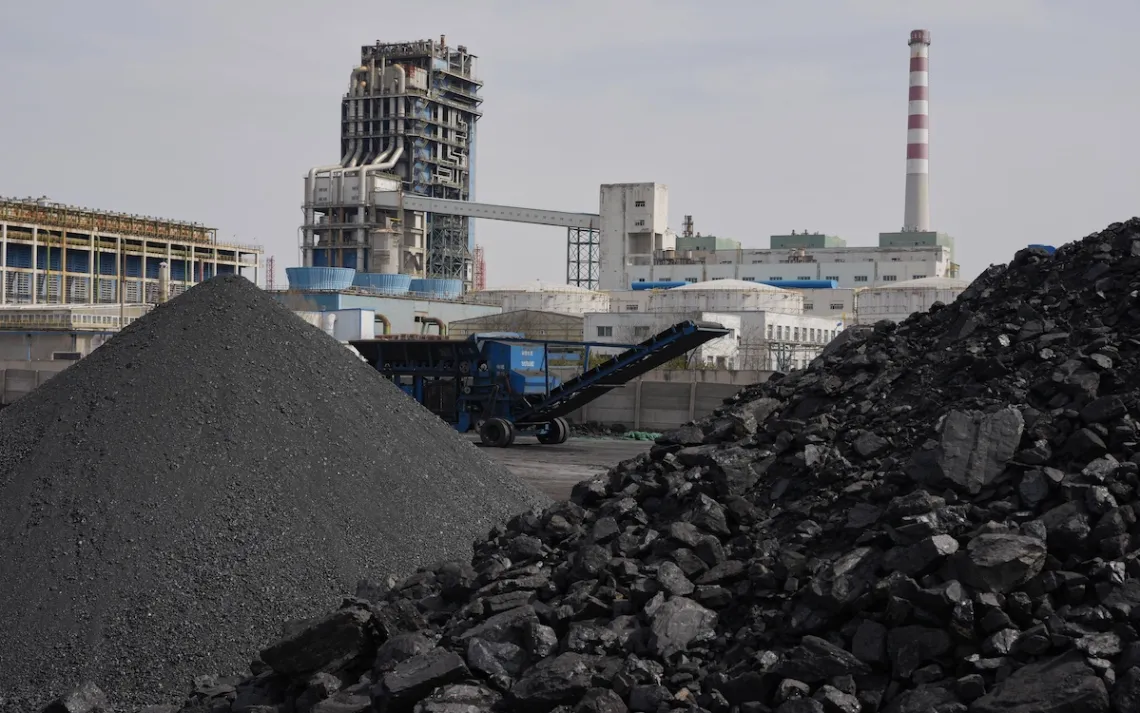
Piles of coal sit near a chemical plant in Datong, China, in March. | Photo by Ng Han Guan/AP Images
Coal has been in decline in many countries for two decades, thanks to escalating grassroots pressure and the drop in prices for renewable energy. Burning coal to produce power just doesn’t make environmental or economic sense anymore.
The coal industry has been looking for new ways to revive coal. Their latest plan: gasification.
In January, the Wabash Valley Resources coal-to-chemicals plant broke ground in West Terre Haute, Indiana, backed by a $1.5 billion loan from the Trump administration. The plan is to produce 500,000 metric tons of blue ammonia. If built, it will be the first large-scale commercial coal gasification plant in the United States, something the industry hopes heralds a new future for the fuel.
“The industry wants to sustain their business,” said Kerwin Olson, executive director of the Indiana-based Citizens Action Coalition. “It's a Hail Mary pass to save the dying coal industry, creating a new market to keep their businesses alive.”
Other countries are attempting the same thing. In China, there are now numerous newly opened and planned coal-to-chemicals plants. Indonesia, the world’s top coal exporter, is also pushing forward on plans to build several new coal gasification plants. If these are built, they could have widespread negative climate, environmental, and social impacts and make it harder to reduce emissions in line with science-based climate targets.
“The main risk for any country considering this route is that it can create a high-carbon lock-in,” said Xinyi Shen, a researcher at the nonprofit Centre for Research on Energy and Clean Air. “While coal conversion may reduce import dependence, it can worsen the climate problem and leave countries with carbon-intensive industrial assets that may become harder to justify economically.”
Why gasification, and why now?
Coal gasification is a century-old technology in which coal is turned into a gas, like methanol or ammonia, or chemicals, which can be used for industrial or transportation purposes. Despite its age, in recent years, the coal industry has revived it as an alternative to imported fossil fuels like natural gas and petroleum.
The United States, China, and Indonesia are among the largest coal-producing countries in the world. China has, nearly on its own, kept the global coal industry alive, more than making up for all the closures of coal-fired power plants in the US, Europe, and elsewhere, adding more capacity than the rest of the world combined in 2024 and 2025. While there are hopes that the country’s increase of solar and wind could finally lead to a slowdown in new grid coal, gasification, like in the US, presents another path for coal interests.
“More new coal gasification would make China’s overall transition more difficult. China is making real progress in power-sector decarbonization through rapid growth in wind and solar,” said Shen.
According to Urgewald, China has 21 projects planned or under development, which would add to the world’s largest existing fleet of coal gasification plants. In 2024, these plants consumed 276 million tons of coal, nearly the same as all of Europe, and now account for about 5 percent of China’s national emissions, and it's expected to grow at least until 2030.
“Our analysis found that it was the only major sector still seeing an increase in emissions and that planned expansion could add further pressure on China’s emissions trajectory,” said Shen.
Prices for ammonia and other fertilizers produced in Russia and the Middle East are rising because of the wars in Iran and Ukraine. That is making coal-to-chemicals seem viable.
Gasification may be coal’s last growth opportunity as coal-fired power plants are no longer competitive with renewables in many parts of the world. Proponents argue that turning coal into chemicals or fuels is essential as it takes advantage of a domestic fuel source, reducing imports and increasing energy security.
But critics note that gasification is too expensive, wastes public money, and has worrying potential upstream and downstream health and community impacts, and that cleaner alternatives exist. Edwardsport for example, Duke’s coal gasification plant in Indiana, costs customers $70 million a year to support.
“Hoosiers are already struggling with the highest increase in energy prices in two decades and skyrocketing bills because of utilities’ insistence on sticking with coal,” said Laurie Williams, director of the Beyond Coal campaign at the Sierra Club. “We’re long overdue for a clean energy transition that will lower costs while cleaning up our air and water.”
Social concerns
For Indiana residents, gasification is nothing new. Back during the George W. Bush administration, there was a plan for a $2.8 billion coal gasification plant in Rockport, Indiana, to produce a liquid fuel alternative to imported petroleum and natural gas. But the fracking and oil sands boom made that unnecessary. Despite millions spent on planning, the plant never broke ground and was canceled in 2013.
The Wabash plant includes many of the same environmental and social concerns as that project, Olson said.
“It will increase greenhouse gas emissions and be a significant threat to our water supplies and our water quality and public health through fugitive emissions,” said Olson, adding that the local community also fears pipeline ruptures, leaks, and even increased seismic activity.
In China, it's notable that many of the planned coal gasification projects are located in the far western region of Xinjiang, home to the Uyghurs, a mostly Muslim community.
“In recent years, particularly amid heightened energy security concerns, China has poured enormous resources into developing the coal gasification industry in the Uyghur region, especially because of the region’s abundant coal reserves,” said Peter Irwin, co-executive director at the nonprofit Network for Uyghur Rights.
Over the past several years, Xinjiang has seen a human rights crisis documented by journalists and researchers. Beyond suppression of religious, linguistic, and cultural identity, it includes a vast system of forced labor in detention camps and prisons. Irwin thinks it's no accident that China is choosing to put coal gasification here.
“Given that the industry itself is highly polluting, in a way you’re shifting environmental costs directly onto Uyghur and other communities in the region, while the rest of the country benefits,” said Irwin.
Indonesia’s push has stalled since the Pennsylvania-based Air Products withdrew from two planned projects in 2023, but the new pro-coal president, Prabowo Subianto, has pledged support from the country’s new sovereign wealth fund, Danantara. The goal is to produce 500,000 barrels a day of liquefied petroleum gas. According to recent news reports, Chinese funding may potentially play a role.
Risks
When there are active conflicts impacting fossil fuel exporting countries, creating real economic risks, coal gasification may seem attractive. But Shen cautions that this could have long-term consequences.
“Even if these projects make sense under a narrow energy-security logic, they may become less competitive over time if carbon pricing expands, product carbon-footprint rules tighten, or cleaner alternatives become cheaper,” said Shen.
There are alternatives too. Green ammonia—produced using renewable energy, not coal or natural gas—has been growing and could, over time, hit cost parity with traditional ammonia. One company in the US is testing direct nitrogen capture as an alternative source of fertilizer.
For Olson and others, one thing is clear: Gasification is not the answer. The past provides a lesson, as effective grassroots opposition played a role in the cancellation of not only Indiana’s but all the country’s coal gasification plans in the early 2000s.
“We were told 20 years ago that coal gasification was the future. It didn't happen,” said Olson. He hopes this time it won’t either.