Iowans Are Demanding Clean Water as Industrial Agriculture’s Impacts Grow
A majority say clean water is a top priority in these midterm elections
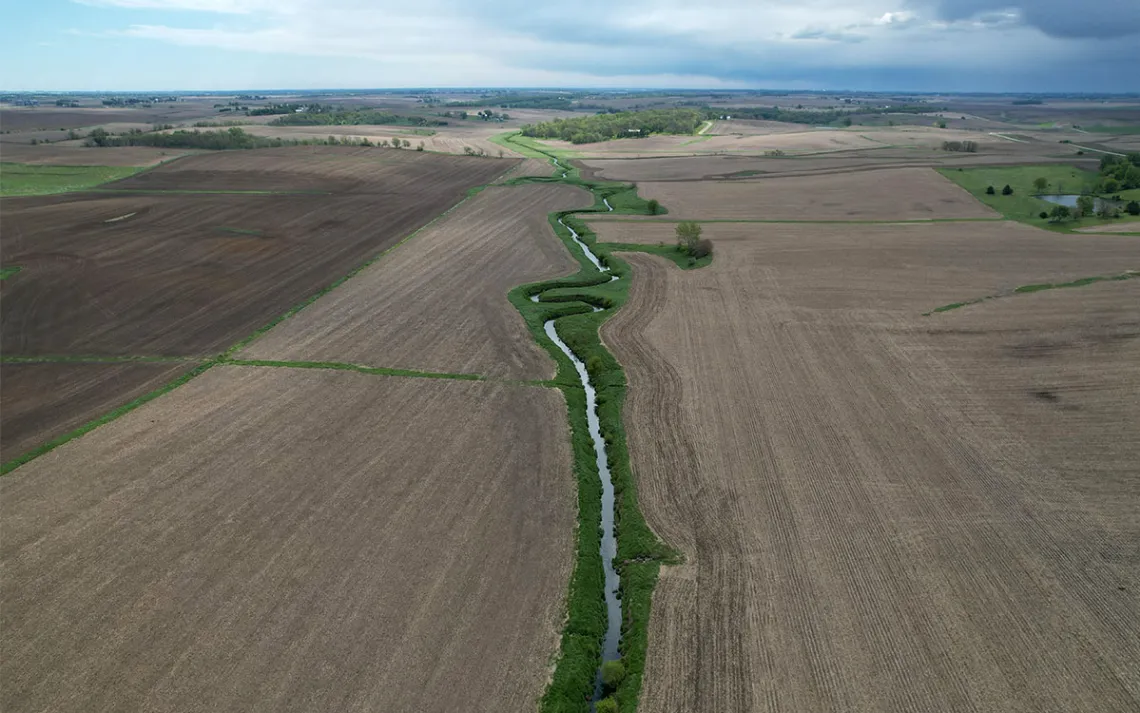
A stream cuts through a farm field near Marshalltown, Iowa. | Photo by Brittany Peterson/AP
For most of his farming career, Seth Watkins produced as much as he possibly could.
He farmed 4,000 acres with 600 beef cows and used pesticides to grow corn, oat, and alfalfa to feed his herd. Though he saw immense success, the fourth-generation beef farmer in Clarendon, Iowa, eventually realized the “get big or get out” mindset ingrained in the state’s agriculture was harmful not only to his land but also to his family’s drinking water.
Both of Watkins’s children were born with birth defects linked to endocrine disruption from exposure to drinking water polluted with pesticides and synthetic fertilizers. In the years since, Watkins has taken steps to downsize his farm and, though he’s not an organic farmer, has significantly reduced his pesticide usage, as well implemented practices to keep pesticides from contaminating water.
“When I started farming in the late '80s, we were told we had to make our farms big and we had to specialize,” Watkins said. “I’m seeing that might have been a really bad idea because a lot of that specialization came at the cost of both our natural and finite resources, and more obviously, at the cost of our health.”
A similar reckoning is now happening across Iowa, and it may just change the state’s red political landscape ahead of November’s midterm elections. Iowans are increasingly concerned about their water quality and demanding action. Amid public pressure, politicians on both sides of the spectrum are finally acknowledging the connection between water, public health, and industrial agriculture.
According to a survey from the Johns Hopkins Center for a Liveable Future, 60 percent of Iowa voters said drinking water was a top five concern ahead of November’s midterms, with three-quarters of Democrats and just over half of Republicans concerned about the state of their tap water. A similar poll by the advocacy group Food & Water Action found that 82 percent of voters are more likely to choose a candidate who makes it a top priority to protect clean water, including regulation on industrial agriculture.
“Elected officials or candidates should understand that this is an issue that's resonating with a lot of Iowans across the board, and people are concerned,” said Patti Truant Anderson, an assistant professor at the John Hopkins Bloomberg School of Public Health.
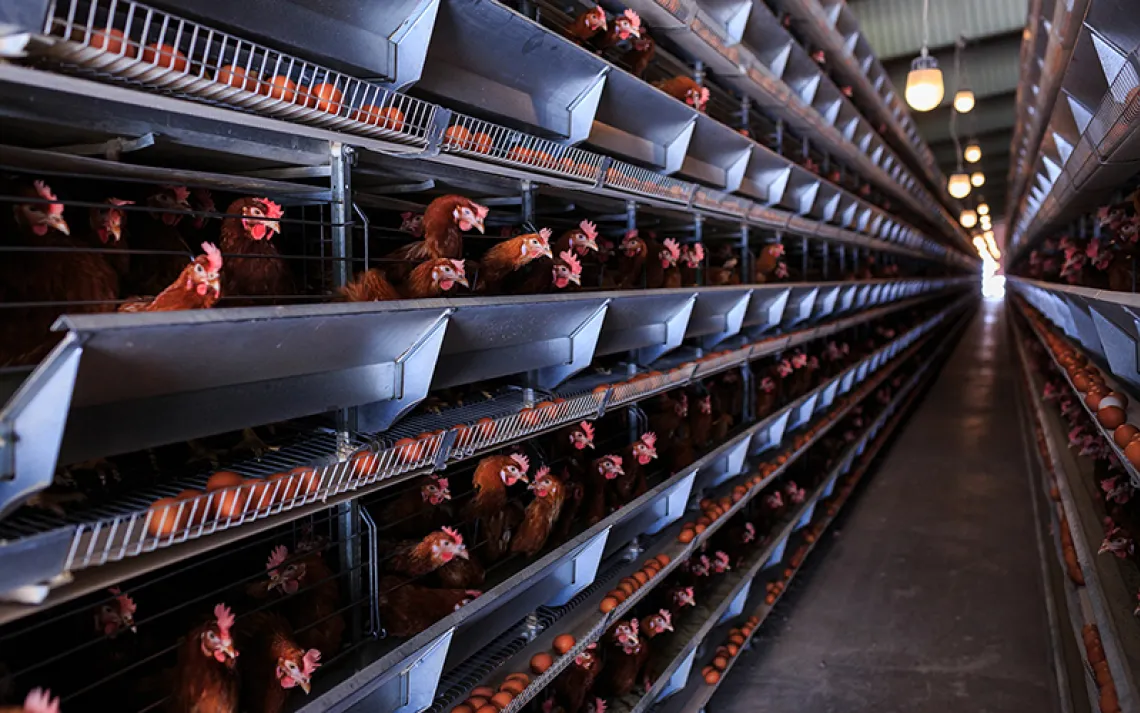
Iowa is home to more than 25 million hogs and produces over 100 billion pounds of manure every year. That waste, filled with plant nutrients like nitrate and phosphorus, is spread onto nearby crops as fertilizer in excess amounts. Nitrate and phosphorus can leach into nearby waterways and groundwater, which has led to a long-standing water contamination crisis in the state.
According to research from the Environmental Working Group, about 146 community water systems serving 1.2 million people, have elevated levels of nitrate. Iowa is also a major producer of corn and soybeans, with farmers applying about 53 million pounds of pesticides to crops in 2025, in part to grow feed for the millions of farmed animals in the state.
As water contamination persists, the state’s cancer rate has climbed well above the US average. Iowa has the second-highest rate of cancer in the country and is one of only three states where cancer rates are actively rising. While there is no direct correlation between Iowa’s cancer rates and drinking water quality, an established body of peer-reviewed research connects nitrate contamination to an increased risk of cancer, particularly colorectal, stomach, and thyroid. Pesticides like glyphosate (the primary ingredient in the herbicide Roundup), atrazine, and paraquat, which are ingrained in the state’s way of growing food, have been linked to cancer, reproductive and hormonal disruption, and respiratory challenges.
Despite this, historically few politicians have openly acknowledged the connection between “industrial agricultural production, environmental outcomes, and public health,” said Tommy Hexter, the executive director of the Iowa Food System Coalition.
“Too often, raising concerns about agricultural pollution is interpreted as an attack on farmers. That framing doesn't help anyone,” Hexter said. “Farmers are operating within an economic system shaped by commodity markets, input costs, land prices, crop insurance, processing infrastructure, and federal and state policy. We need to be able to discuss how that system works without blaming individual farmers for the challenges it creates.”
Chris Jones, a scientist turned politician running for secretary of agriculture, has done exactly that. Jones spent more than 40 years advocating for clean water and changes to industrial food production, a position that he says eventually led to his forced resignation as a water researcher at the University of Iowa.
In January, Jones announced he would run for secretary, dubbing his candidacy a “referendum on clean water.” He’s promised to regulate fertilizer and manure inputs, diversify commodity crops, more strictly enforce pesticide laws, and develop a strategic plan to help Iowa retreat from producing corn for ethanol. His approach would enforce pollution controls for industrial operations and provide financial support for farmers to transition to more sustainable practices.
The Sierra Club’s Iowa chapter has advocated for stricter compliance with the Clean Water Act; pollution reduction measures; the monitoring of discharge permits for industrial agriculture operations; and funding for public water sensors. In 2021, the group successfully sued the Iowa Department of Natural Resources over its approval for a 11,600-cattle farm in northeast Iowa. The farm’s manure management plans were deemed ineffective, and the operation was forced to reconsider how much manure it was spreading and where.
“It has required constant monitoring, constant pressure, kind of beating your head against the wall. What's so exciting about this year is our governor's race and our secretary of agriculture's race has made this a key campaign issue,” said Pamela Mackey Taylor, the director of the Sierra Club’s Iowa Chapter.
In the Republican primary for governor, Zach Lahn persuasively connected the dots between cancer and industrial agriculture, and he beat a Trump-endorsed candidate, Randy Feenstra, for the nomination. Now, Lahn is polling neck and neck with Democratic opponent Rob Sand, who has promised to invest in water quality monitors, hold pesticide companies accountable for “sickening Iowans,” and implement manure management systems.
In a recent debate, the two gubernatorial candidates were asked about how they would manage Iowa’s rising cancer rates and public health crisis. Both pointed to reducing excess nitrate contamination from large-scale farms. This is the first open race for governor since 2006, after the incumbent Republican Governor Kim Reynolds announced she would not run for re-election.
“It’s hard to overstate how important this issue has become in this election,” said Jennifer Breon, a senior organizer at Food & Water Watch. “I think it is really important to not just people's public health and well-being, but the sense that our politicians are accountable to us, that we can do something about this.”
She added that young people are making decisions about whether they want to stay and live in Iowa. “When you think about raising a family here, if the drinking water isn't safe and could end up giving your children cancer 30 years down the road, that’s not a great option,” Breon said.
As November’s election approaches, Breon, Mackey Taylor, and Watkins are hopeful that the attention to water quality will lead to improvements in the state’s water, food system, and public health. Amid the rising cost of living, President Donald Trump’s war in Iran, and waning social services, Watkins is relieved an issue so near to him is finally getting the attention it deserves.
“I'm very thankful that the citizens of Iowa have made water one of their primary issues,” he said. “They have a lot on their plate, you know, and for them to recognize this is pretty important.”