Trump Uses “God Squad” to Slash Endangered Species Protections
The decision could defang the Endangered Species Act and condemn the world’s most endangered whale to extinction
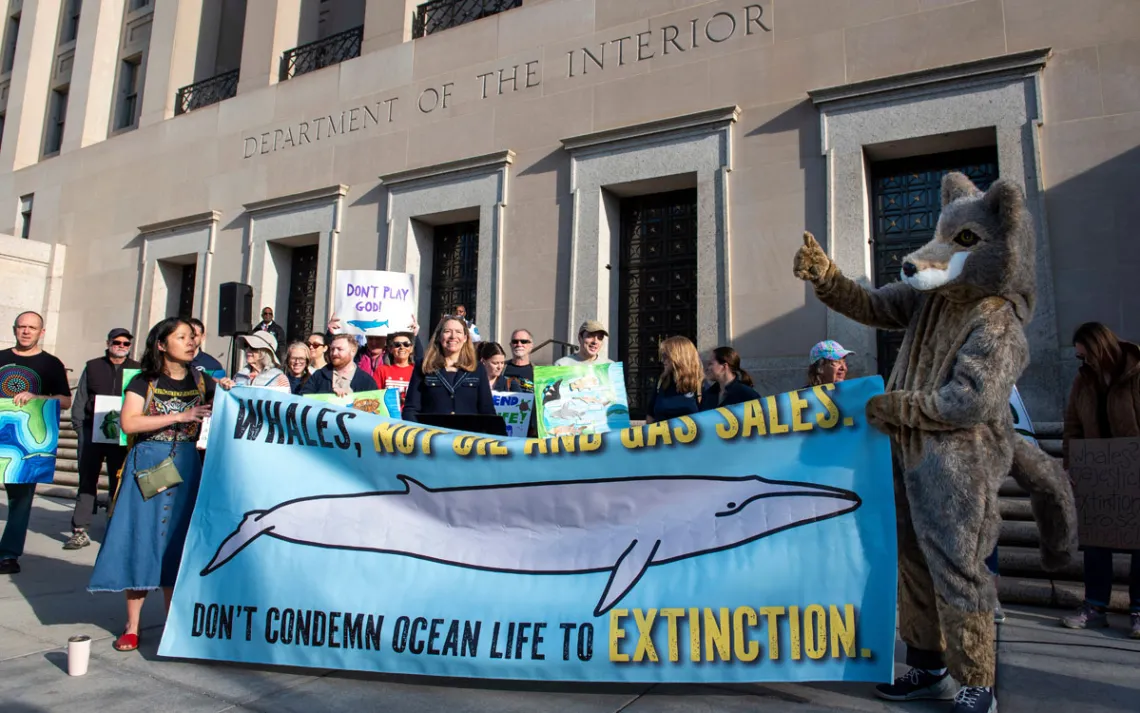
Conservation groups rally to oppose the Trump administration's convening of the Endangered Species Committee at the Interior Department in Washington, DC, on March 31. | Photo by AP Photo/Cliff Owen
On March 31, Trump administration officials gathered for an unprecedented and possibly illegal meeting. In attendance were the Secretaries of Defense, Interior, Agriculture, and the Army, along with the administrators of the Environmental Protection Agency, the National Oceanic and Atmospheric Administration, and the Council of Economic Advisers. The meeting lasted less than 20 minutes, and in that short time, a committee called the “God Squad” voted to dismantle Endangered Species Act protections for nearly two dozen plants and animals in the Gulf of Mexico.
Their reasoning? They claim that threatened and endangered creatures are holding back US oil development and weakening national security.
Experts and Gulf Coast advocates strongly disagree. On Thursday, several environmental groups, including the Sierra Club, sued the Trump administration to stop the ESA exemptions from taking effect. Devorah Ancel, a senior attorney at the Sierra Club, questions both the motivations and legality of the exemptions.
“It appears that the national security declaration is politically driven, to ensure record profits for the oil and gas industry at the expense of wildlife and frontline communities of the Gulf, who have suffered the burdens of water and air pollution wrecking their coastlines and driving up cancer and asthma rates,” said Ancel.
The Sierra Club is joined in the lawsuit by local nonprofit Healthy Gulf, the marine-focused Turtle Island Restoration Network, and Friends of the Earth US.
“Using war with Iran as cover, the Trump administration has invoked the rarely used Endangered Species Committee ‘God Squad’ to wage a new war on endangered sea turtles and whales in the Gulf of Mexico,” said Turtle Island Restoration Network founder Todd Steiner in a joint statement about the lawsuit.
The most immediate threat of the committee’s vote is the extinction of the world’s most critically endangered whale species, the Rice’s whale.
In the 20th century, humans killed almost 3 million whales for their oil, meat, and other products. In terms of pure biomass, it was the largest slaughter of wild animals in human history. Even so, in a near-miraculous testament to the resilience of these marine giants, no whale species went fully extinct from whaling. Some local populations were extirpated, and a few species were pushed right to the brink, but a 1986 moratorium on most whaling around the world saved the animals from blinking out completely.
Rice’s whales were never heavily hunted. But experts and advocates believe that if this policy stands, the American oil and gas industry could do what even centuries of whaling could not—drive a whale species completely extinct in our lifetimes.
The Rice’s whale is the only whale species endemic to the Gulf of Mexico, living its entire life solely in this body of water. But as NOAA’s own data shows, their habitat is even smaller than that. Off the Gulf Coast of the US and Mexico, they occupy a thin strip spanning the region’s continental shelf, the same territory most endangered by offshore oil and gas development.
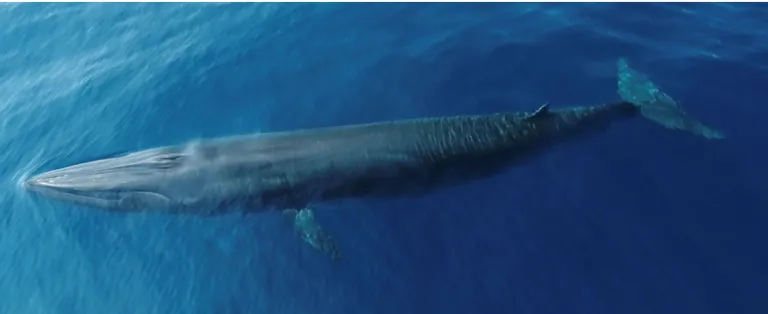
An endangered Rice’s whale is preparing to breach the surface of the water. | Photo courtesy of NOAA Fisheries/Ocean Alliance
Within that limited space, there are about 51 Rice’s whales left. That makes them not only endangered, but the most endangered large whale species in the world. In a 2022 letter to the Biden administration, more than 100 scientists urged more federal action to save the Rice’s whale. They also called oil and gas development “an existential threat to the whale’s survival and recovery.”
That conflict between whale survival and oil and gas in the Gulf is more than hypothetical. The Deepwater Horizon spill in 2010 polluted nearly half of the whales’ core habitat. NOAA has estimated that this single event caused the Rice’s whale population to drop by 22 percent.
“Unless significant actions are taken,” the letter went on to say, “the United States is likely to cause the first anthropogenic extinction of a great whale species.”
Whales aren’t the only endangered and vulnerable wildlife under threat if ESA protections are lifted in the Gulf. They share their habitat with sea turtles, seabirds, fish, and other ecologically sensitive species. Like the communities struggling with the health effects of oil and gas on the Gulf Coast, the marine ecosystems are also burdened with decades of pollution. They badly need federal money for restoration, warn advocates, not further industry abuse.
“Invoking national security cannot justify potentially pushing the Rice’s whale—or any of our nation’s irreplaceable wildlife species—into the abyss of extinction,” Andrew Bowman, president and CEO of Defenders of Wildlife, said in a press statement. “If this administration were truly concerned about national security, it would focus on what will protect our quality of life and a secure future for all Americans. That includes healthy lands and waters that support people and the wildlife that we love and rely upon."
Congress created the God Squad in 1978 in response to a dam project in Tennessee that threatened the habitat of the snail darter fish. Since then, it has only been invoked three times. It has long been considered the “nuclear option” of endangered species law. Every previous case has been about a specific project, two for dams and one for logging, which would have destroyed nesting habitat for the northern spotted owl. In each of those cases, the decision was either withdrawn or rendered unnecessary. The scale of this latest exemption, covering the entire oil and gas industry within the Gulf of Mexico, is far beyond anything the committee has issued before.
Another unique aspect of this exemption, compared to the few God Squad decisions over its 48-year history, is the fact that no oil and gas company or industry group requested the exemption. Compliance with the ESA has not stopped or canceled a single offshore oil contract or even slowed development activities. While some projects working in the Gulf would certainly welcome the chance to drive their ships a little faster in whale habitat, no one in the industry itself seems to think that ESA compliance is the existential threat that was presented at the March 31 meeting.
In that meeting, Secretary of Defense Pete Hegseth said that the ESA protections were both holding back oil development and endangering US national security. But lawyers for the organizations suing to stop the exemptions say there is no evidence for his claims.
“There is absolutely no evidence to demonstrate that Endangered Species Act compliance and related litigation are stopping oil and gas development or even slowing it down. And there are a lot of facts on the ground pointing in the opposite direction,” Ancel told Sierra. “The US is the top oil producer in the world, and we are a net exporter of oil and gas. This is not a proper justification for this seldom-used exemption.”
Ultimately, the courts will decide whether this unprecedented meeting can effectively overrule the Endangered Species Act, one of the most important pieces of environmental legislation in US history. But this case is just one battle in an ongoing war between the Trump administration and the legal standing of the act itself.
Just one day before the God Squad meeting, a federal judge threw out four provisions from Trump’s first term that weakened ESA enforcement. As in several other areas of law, the administration’s policies seem to be getting more extreme over time. While the first Trump term saw 22 new species added to the protected list, there are zero so far this term.
“In a moment of self-made crisis, the Trump administration has decided to manipulate the law to entrench offshore oil drilling in the Gulf for decades to come, even if it destabilizes entire ecosystems that communities and businesses depend on,” said Steve Mashuda, managing attorney for Earthjustice’s Oceans Program, in a statement. “This ‘go-ahead’ to offshore drillers to extract oil and gas in extremely sensitive ocean areas while killing whales, turtles, and many other species is unnecessary and shameful."