The Magazine of The Sierra Club
Critics Call Super-Pollutant Rollback “Worst Form of Gaslighting”
Trump’s EPA rolls out affordability talking points while rolling back environmental protections
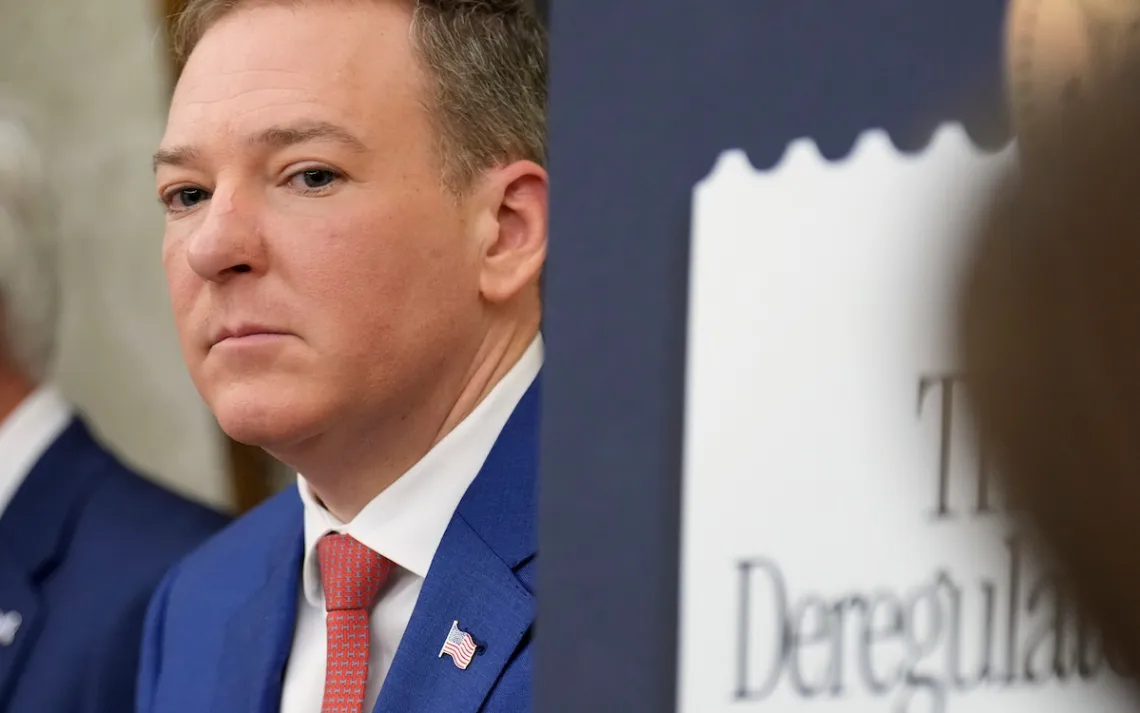
Lee Zeldin, EPA administrator, listens as President Trump talks about loosening rules on HFCs on May 21. | Photo by Jacquelyn Martin/AP
When the Environmental Protection Agency announced last week its intention to roll back restrictions on extremely potent greenhouse gases known as hydrofluorocarbons (HFCs), EPA administrator Lee Zeldin and President Donald Trump described the move as a response to the affordability crisis.
“Today’s reforms will deliver significant financial relief, saving American families and businesses more than $2.4 billion each year,” Trump said from the Oval Office. “Thanks to today’s reforms, the American people have lower grocery prices, cheaper transportation of goods, lower costs of air conditioning, at no detriment at all to our country. Zero, including environmental detriment.”
“The Trump EPA is fulfilling President Trump’s promise to lower costs and is fixing every problem we can under the authority Congress gave us,” EPA administrator Lee Zeldin said in a press release. “Our actions allow businesses to choose the refrigeration systems that work best for them, saving them billions of dollars. This will be felt directly by American families in lower grocery prices.”
But critics, including former EPA officials and some industry groups, say that the rollback will do nothing to lower grocery costs for consumers, and may even raise them.
“Families are already stretched thin by high grocery bills and everyday expenses, and weakening safeguards on these super-polluting refrigerant chemicals isn’t going to change that,” said Joseph Goffman, former assistant administrator for the EPA’s Office of Air and Radiation. “Even manufacturers are saying this delay likely won’t lower prices for consumers because supplies of these chemicals are already being phased down in favor of cleaner, innovative replacements. All this action does is slow the shift to cleaner technologies while risking continued releases of climate super pollutants and leaving families to face the much greater costs and health threats of dangerous climate change.”
HFCs: super pollutants
Hydrofluorocarbons are highly polluting greenhouse gases, used mainly as a refrigerant for cooling equipment. The gases are considered “super pollutants” because they are hundreds to thousands of times more potent in trapping heat than carbon dioxide (CO2). A 2023 rule under the Biden administration restricted their use. Now, the EPA has finalized revisions to that rule, which includes an update that extends compliance deadlines, effectively delaying the phaseout of these chemicals.
Avipsa Mahapatra, climate campaign director at Environmental Investigation Agency US, criticized the rollback as a “reckless step backward for climate action, public health, and economic certainty.” Mahapatra added, “Amid dangerous heat waves, climate-fueled disasters and rising energy costs, the administration is choosing to weaken one of the most effective climate measures available.”
In 2020, before leaving office, Trump signed a 2020 bipartisan bill into law called the American Innovation and Manufacturing Act that directs the EPA to phase down production and consumption of HFCs by 85 percent by 2036, aligning US industry with global efforts, via the Kigali Amendment to the Montreal Protocol, to address the super pollutants. The global agreement, if fully implemented, is projected to prevent up to 0.5°C of warming by 2100.
The EPA said in its statement about rolling back HFC restrictions that the change will make “a wider variety of refrigerants available to businesses while still meeting statutory requirements under the American Innovation and Manufacturing (AIM) Act.”
David Doniger, senior strategist for climate at the Natural Resources Defense Council, argued that the move to weaken HFC restrictions “will harm consumers and the climate and reduce American competitiveness in the global markets emerging for environmentally safer refrigerants and technologies compliant with the Kigali Amendment to the Montreal Protocol.”
“The EPA is catering to a small group of straggling companies by derailing the shift away from these climate super pollutants to safer alternatives,” Doniger said. “The affordability crisis is very real and deserves real solutions, rather than thinly veiled environmental rollbacks that leave the United States stuck with outdated technologies of the past.”
In addition to extending compliance deadlines for HFC phaseout, the EPA has proposed to “exempt all road refrigerant transport appliances from HFC leak repair requirements” that were established in a 2024 rule. The EPA claims that the Biden administration erred in subjecting the refrigerant transport sector to these leak repair requirements.
“By extending the compliance deadline, the EPA is maintaining and even increasing demand in the market for existing refrigerants while supply continues to fall under the AIM Act. So, instead of falling, refrigerant prices are likely to rise, resulting in higher service costs, and higher costs for consumers,” Stephen Yurek, president and CEO of the Air-Conditioning, Heating, and Refrigeration Institute, said in a statement.
Why grocery costs are rising
The price of groceries increased by nearly 3 percent in April compared with the same month a year ago; tomatoes are 40 percent more expensive than at this time last year, and coffee prices are up by 19 percent. Food price growth averaged 2.6 percent per year over the past two years, according to the USDA’s Economic Research Service.
Climate change is one factor contributing to rising food costs, as extreme weather disrupts agriculture and destabilizes food supply chains.
“Climate change has raised the price of food in the United States by a conservative estimate of up to 6.7 percent over the past 50 years, and its impact on food costs is becoming even clearer as extreme weather events intensify,” a December 2025 report from Center for American Progress states.
“Extreme events fueled by our warming climate are impacting every stage of the food supply chain and driving food prices higher,” Climate Central explains in a November 2025 fact sheet, which notes that in the US, food prices have risen faster than overall inflation over the past 10 years.
Trump’s own actions and policies like his war on Iran and tariffs are also driving up food prices and other costs on Americans. Not only do higher fuel costs impact the price of food and grocery items that are transported by trucks across the country, but the war is also choking off fertilizer shipments from the Middle East, which makes growing food more expensive.
“From filling up the car to booking a flight to buying groceries for a cookout, Americans are seeing prices pushed up by tariffs and an unnecessary conflict with Iran,” said Emily Gee, senior vice president for economic policy at the Center for American Progress. “Families are already worried about the cost of living, and the Trump administration’s policies are making everyday life more expensive.”
“Worst sort of gaslighting”
The UN’s Food and Agriculture Organization warned last week that time is running out to prevent a severe global food price crisis that could come within the next six to 12 months due to the ongoing Middle East conflict.
Critics point out that rolling back protections on climate-damaging super pollutants like HFCs will do nothing to address that crisis.
“This is the worst sort of gaslighting by the Trump administration,” Jamie Henn, director of Fossil Free Media, told Sierra. “Energy efficiency, new technology, and clean energy deployment are some of the fastest ways to drive down the costs of things that are making life unaffordable. The last 50 years have shown us time after time that environmental protection, lower costs, and economic growth can go hand in hand.”