The Dark Side of That Açaí Bowl
The fruit’s popularity has led to monocultures in the Amazon forest and significant waste
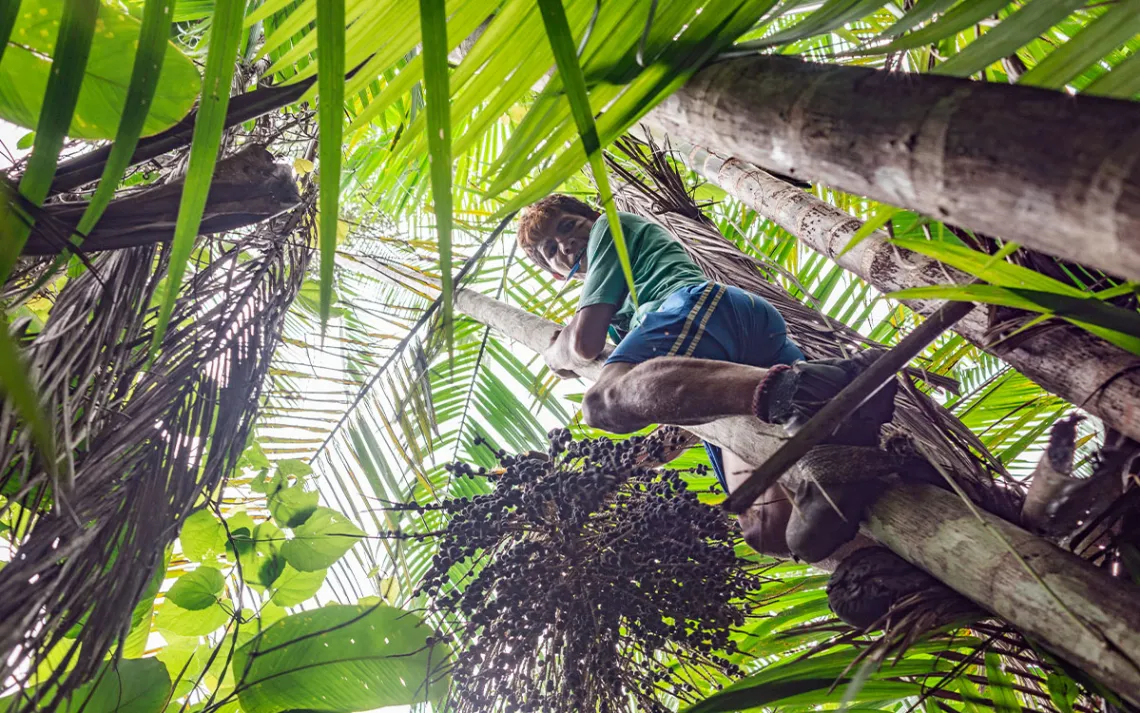
Photo by wagnerokasaki/Getty Images
Raimundo de Souza Oliveira is proud of his açaí. He owns two plots of land south of the Brazilian city of Belém, at the mouth of the Amazon, where he grows the trees. Silva de Oliveira has been cultivating açaí since he was 14 years old, though he is now retired. On a recent night, while relaxing at his home in the state of Pará, he sent a series of WhatsApp audio messages describing the best methods for growing açaí.
“I don’t take down other trees if I want to plant another açaí tree,” he said. “I simply select a nice spot and put the açaí down there. Others don’t do that. They cut everything down. I don’t like that. You need to keep the forest on its feet when you produce açaí.”
Souza de Oliveira doesn’t use chemicals and makes his own natural pesticides (“You can’t trust what you buy in the store,” he said in another message). Embrapa, a famed Brazilian research institute, came to visit his land, he said.
Souza de Oliveira is an exception to the conventional practice of growing açaí, which is far more destructive, toxic, and unsustainable. To produce the purple berries—which are widely popular in western nations, where açaí bowls, smoothies, and powders have become a staple of everyday life—growers often rip out or burn down surrounding trees so their açaí trees take in more sun. Toxic chemical use is widespread.
Between 2012 and 2022, export of açaí from Pará increased by 15,000 percent. Pará accounts for almost all of Brazilian açaí production. In 2023, 61,000 metric tons were exported from Brazil. By comparison, less than 1 metric ton was exported in 1999. That intense growth now promotes monocultures in the Amazon forest and produces significant amounts of waste.
“Açaí isn't seen as a problem yet,” said Madson Freitas, a biologist connected to the Federal University of Pará and the Emílio Goeldi Museum, a research institute in Belém focused on the Amazon. “In Brazil, it's seen as something that can support poor families in the Amazon. Outside of Brazil, it's seen as a superfood. But there are clear problems associated with its cultivation on this scale.”
Reduced diversity
For people like Freitas, or anyone living in Pará, açaí isn’t just a fruit. It’s a way of life. The biologist lives in a quilombo, a community descended from escaped African slaves, just south of the capital city of Belém in the municipality of Barcarena.
“We almost live together with açaí,” said Freitas. “It's a basic food for a family from Pará. We love açaí. Before it turned into a superfood, it was already a base staple for the people here.” In Pará, açaí isn’t just consumed as a sorbet, as it often is in other countries. Here, it’s often incorporated into savory dishes based on staples such as rice, beans, or fish.
A few years ago, Freitas and his colleagues started noticing the negative effects international demand for açaí was having and began studying those effects.
The growth in açaí exports, and the associated price increases, are pushing Amazon inhabitants to cut down trees and plants on their plots of land and replace them with as much açaí as possible, reducing biodiversity in these forests. Where the Amazon enters the Atlantic, just about any grower who owns land has started growing açaí. Studies by Freitas and his colleagues found a reduction in the diversity of tree and bird species in plots where açaí cultivation intensified.
“Açaí grows in the wild here,” said Freitas. “But these plants, which grow in the shade of others, are generally smaller. If you want to increase yields, you can take down other plants and trees around it, so açaí plants receive more sun and space. That's what people here are doing.”
Freitas noted that a small farmer today can earn an extra 5,000 to 10,000 Brazilian reais per year from açaí. That translates to around US$1,000 to US$2,000 per year, which, in the Amazon, can take a family a long way.
The boom has led to higher prices for açaí even for local families living in the Amazon. In places like Belém, poor families that cannot grow açaí face steep price increases that they can’t afford.
More sustainable uses
Açaí is often called a berry, but in reality, it’s closer to a stone fruit, like a peach. Only around 20 percent of the fruit is edible. The rest is composed of its seed (or stone) and indigestible fiber.
Dealing with this waste is a growing problem as cultivation increases. In major cities such as Belém, trash cans overflow with rotting açaí seeds, the stench posing a nuisance to surrounding communities and attracting pests. Sometimes the seeds are thrown into rivers, silting them up.
“I have seen rivers where the entire bottom is covered in açaí seeds,” said Lina Bufalino, a professor at the Federal Rural University of Amazonia, located in Belém. She’s originally from the southeast of the country but now leads a lab in the Amazon dedicated to finding better uses for açaí waste.
Bufalino’s lab has built machines to separate açaí seeds from the fibers, a key step to turning the waste into paper, with possible uses in packaging. “Açaí is my life," said Bufalino. "It could provide the raw material for a lot more things than it's used for today.”
Opaque chains
Açaí is far from the worst thing cultivated in the Amazon. Crops such as soy and activities like cattle rearing are much more problematic. Few people in Brazil would call for consumers to stop eating açaí, a crop on which many in the Amazon have based their livelihoods.
“Açaí is a major breadwinner for forest communities," said Salo Coslovsky, an associate professor of urban planning and public service at New York University, where he researches how to make açaí supply chains more sustainable. “These people live in the floodplains, islands, and next to rivers, and have few other income sources. We need to center them.”
A lot of açaí grows wild in forests or on small plots near the water, with some plantations inland. It’s hard to make that transparent and incentivize sustainability.
“Most açaí is traded through an opaque chain of intermediaries, so neither processors nor consumers know exactly where it is coming from. It's very hard to keep track,” said Coslovsky.
Education is key. Producers need to know they cannot burn down land, use unlicensed chemicals, or replace too many other plants with açaí. At the same time, producers' associations and traders need to step up to standardize the supply chain and make it more transparent. International buyers also need to be educated, since they’re often not well-informed about conventional açaí cultivation and processing.
Coslovsky isn’t necessarily worried about the sustainability issues of açaí. Those will start to resolve in the future. He’s worried about the livelihoods of the Amazon inhabitants, which might come under threat soon. So far, açaí is almost exclusively grown in the Amazon, but in the future, it might be cultivated in other regions or even countries.
Souza de Oliveira's process for growing açaí offers a more sustainable, and local, model for growth. He lists 20 varieties of açaí grown on his farm, right up to white açaí, hardly ever seen abroad.
“My açaí is different from that of others,” he said proudly. “And you can taste that difference.”