Wolves Eat More Than Meat
Researchers say the carnivores help sustain their ecosystems by spreading blueberry seeds
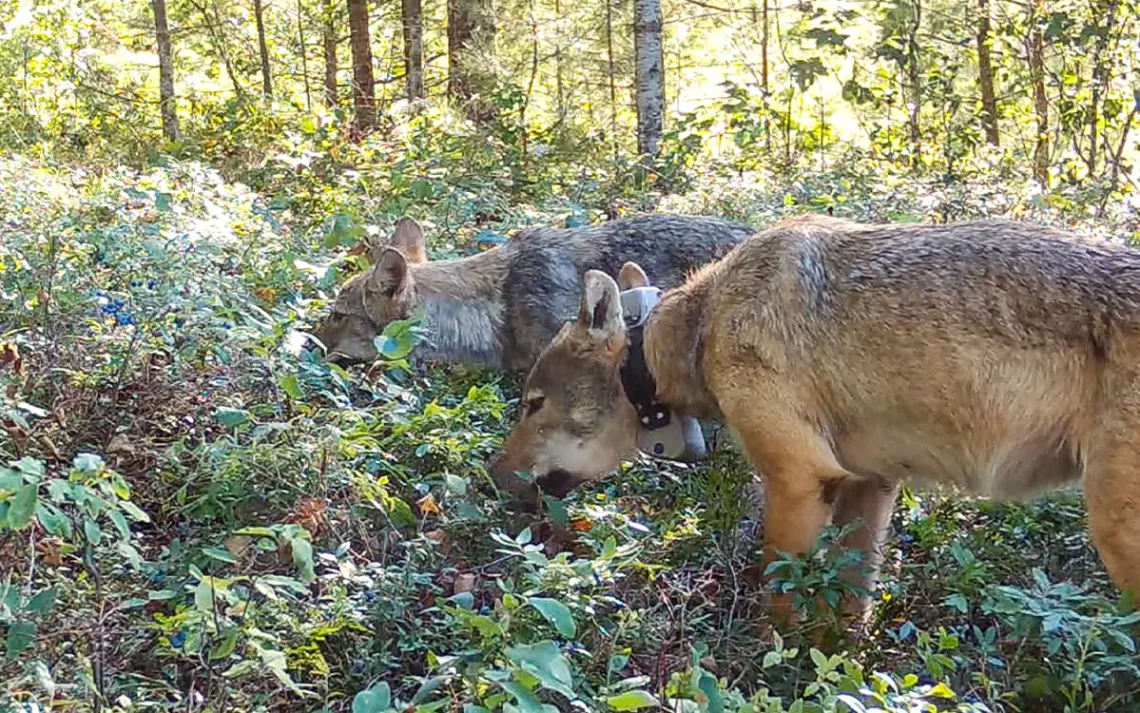
Two wolves eat blueberries in northern Minnesota. | Photo courtesy the Voyageurs Wolf Project
When people think of wolves and food, they’re likely to picture a hunt that involves lots of carnage. However, new research revealed that wolves have a bit of a green thumb too. That’s the key takeaway from a study out of Northern Michigan University: Wolves devour blueberries, in the process spreading their seeds and planting new patches.
Researchers from the study first noticed wolves eating blueberries during the summer of 2017. During the warmer months, deer fawns can outrun wolves and beavers spend more time in the water, making both species hard to access. With their usual prey increasingly difficult to hunt, wolves switch to gorging on blueberries, primarily the wild lowbush blueberry, Vaccinium angustifolium. From July to August, these berries make up as much as 83 percent of adult wolves’ weekly diet, researchers found.
Earlier studies had shown that some species, including red foxes, can have positive effects on seeds that pass through their guts. So the Northern Michigan University researchers, working in the Greater Voyageurs Ecosystem, wondered whether wolves were having any effect on blueberry seeds as well.
In a study published last August in the journal Biology Letters, they found that wild blueberry seeds that pass through wolves’ guts are more likely to sprout (or germinate) and do so more rapidly than seeds from uneaten berries. By simply eating blueberries, wolves spread blueberry seeds with a higher probability of sprouting and may create new blueberry patches. Alex Gross, the study’s lead author, is certain that this overlooked role that wolves have in boreal forests extends beyond the confines of northern Minnesota to other places with a similar ecosystem, including some parts of Canada.
“Given their tendencies of traveling long distances in short times, it's likely that they have a greater potential to spread these seeds farther than foxes or bears or coyotes in our area,” said Gross, who is a wolf predation and research technician with the University of Minnesota’s Voyageurs Wolf Project.
For Anna Traveset, an ecologist specializing in plant-animal interactions who wasn’t involved in the study, the findings highlight something that scientists know already: Every species has a role in keeping an ecosystem functioning well. The loss of even a single species can have a negative knock-on effect on important ecological processes such as seed dispersal, with cascading consequences for the ecosystem.
“These results underscore the importance of conserving all species, including large carnivores, such as wolves, which continue to be hunted in many regions, as do foxes, bears, and other carnivorous mammals,” Traveset said.
To study the effects that wolves have on blueberry seeds, the Voyageurs team spent the summers of 2017 and 2018 collecting fresh wolf scats, from which they extracted blueberry seeds. As a control, they collected seeds directly from blueberry plants in the Greater Voyageurs Ecosystem as well. They placed both the wolf-ingested seeds and the control seeds on petri dishes, under the same conditions, and measured the number of days it took for the first part of the seedling to emerge by about half a centimeter.
Overall, seeds ingested by wolves had a 27 percent higher germination success rate than the control seeds (96 percent versus 69 percent). And they sprouted faster too, taking 19 versus 26 days, respectively. Gross and his colleagues think that the wolf’s teeth and stomach acids pierce the seed coat, making it easier for the seed within to take up water and oxygen and start growing. It’s also possible that the material in wolf scat acts as a fertilizer and helps shield seeds from harmful microbes.
After noticing significant variability in germination speed and success among control seeds collected in different years, the researchers ran a comparison between the wolf-ingested seeds and the best-performing control seeds. Here, the difference in germination success rate was 5 percent (96 percent versus 91 percent). This might seem small, but the average blueberry-containing wolf scat has more than 20,000 seeds in it. In other words, even a small increase in germination success is likely to make a difference to the number of resulting new blueberry plants, Gross noted.
The summer of 2017 held another surprise for researchers in the Greater Voyageurs Ecosystem. They observed an adult wolf regurgitating blueberries to feed her pups. Wolves were known to regurgitate meat to feed their young, but this was the first documentation of a wolf feeding pups berries or fruit of any kind. The discovery was published in 2020.
It’s not just wolves who are eating large amounts of berries. In 2019, Sam Steyaert, an associate professor in terrestrial ecology at Norway's Nord University, and his colleagues published a paper showing that Scandinavian brown bears help bilberry (Vaccinium myrtillus, also known as European blueberry) seeds sprout a month earlier, which is advantageous in northern ecosystems with a short growing season. Their results pointed to a slightly different mechanism to that proposed in the wolf study.
“It was not necessarily passage through the digestive tract that was the benefit,” Steyaert noted. “It was more the fact that bears free the seeds from the fruits.” By eating the bilberries, they removed the fruit pulp, which otherwise delays germination.
As far as wolves and blueberries are concerned, Steyaert thinks that the seeds sprouting slightly faster or in higher proportions is less consequential than the long-distance dispersal. This is “the real benefit”, he said, because it can really boost the blueberry plant population on a large spatial scale.
Researchers have yet to see how long wolves retain blueberry seeds in their guts before pooping them out. But Gross’s team estimates that even if seeds were retained in the gut for just one to two hours, wolves could disperse them over long distances given that they can travel more than five miles in an hour.
In addition to blueberries, wolves are spreading mushrooms. A different study published in December last year found that wolves and other carnivores spread fungi necessary for forest health by consuming small mammals that have eaten fungal spores and depositing those spores in their scats. The study found that smaller carnivores, such as fishers and red foxes, which consume more small mammals than large carnivores do, disperse a higher diversity of fungi, and deposit larger spore loads. Meanwhile, larger carnivores, including wolves, leave lower spore quantities but transport those spores much farther from their source.
Gross acknowledged that many of the seeds wolves swallow may not grow into plants, especially if they end up somewhere inhospitable. “How many of these seeds are actually taking is unknown,” he said. Still, the fact that wolves help seeds germinate, he said, “shows another way in which wolves are connected to larger ecological processes in boreal forests in ways that are just underappreciated.”