Data Centers Have a PFAS Problem
While air and noise pollution are common concerns, little is known about PFAS contamination from the AI buildout
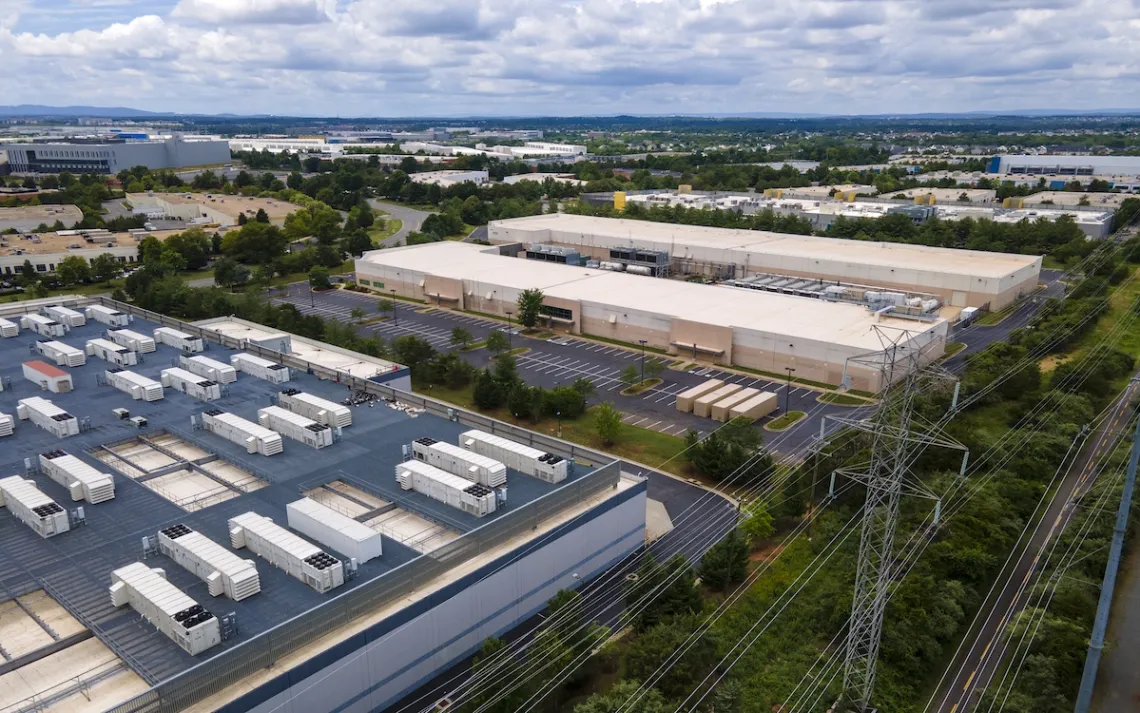
High-voltage transmission lines provide electricity to data centers in Ashburn, Loudoun County, Virginia. | Photo by Ted Shaffrey/AP
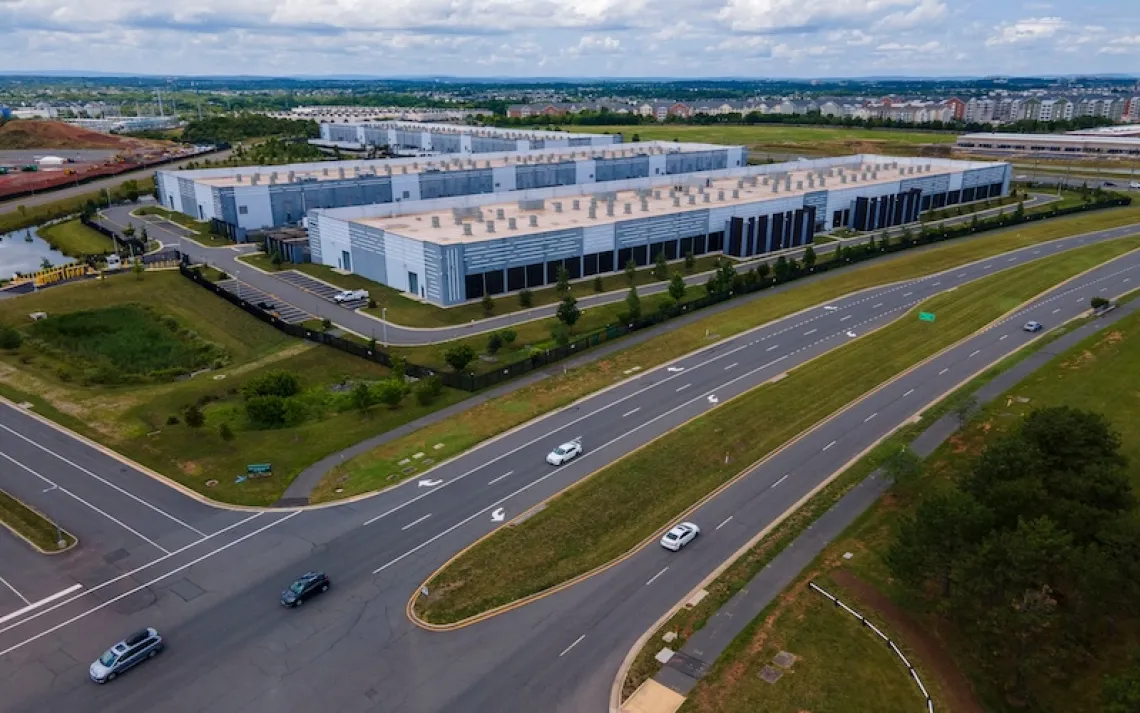
In suburban Virginia, a cluster of monumental gray buildings rise up around the unincorporated settlement of Ashburn in Loudoun County. Ringed by fencing and humming with AC, this is the new front of the digital economy—a place that has become known as Data Center Alley, the biggest data center hub in the world.
Popular large language models such as ChatGPT, Gemini, and MidJourney—marketed as artificial intelligence—need data centers to work. This has caused a boom in the construction of colossal compounds that require a massive amount of electricity and water. The companies building these compounds have brought billions of dollars in investments to Virginia, along with promises of jobs and improvements to the local economy.
For the Virginians living nearby, however, those promises have largely failed to deliver. Data centers take over the landscape, bring air and noise pollution, and guzzle as much as 2 million gallons of water a day. They also hit people in the pocketbook. According to one recent report, energy prices in states like Virginia have skyrocketed by up to 267 percent in the last five years as utilities have scrambled to build out the infrastructure needed to accommodate the data center boom.
All of this is changing local communities in ways that deeply impact quality of life, says Julie Bolthouse, director of land use at the Piedmont Environmental Council, a nonprofit dedicated to land and water conservation in Virginia. “[Data centers] are located in close proximity to houses and schools,” she says. “You're really changing those communities. These are huge boxes surrounded by fencing. They are not conducive to a walkable, livable environment.”
According to Data Center Watch, a citizen’s movement to block data centers is holding up $64 billion of investments in their construction. Noise and air pollution are among the most common concerns residents have.
Water is also a major concern, according to Paige Wesselink, digital strategy manager at the Sierra Club Virginia Chapter. In theory, data centers use water in a closed loop that continually circulates the water. In practice, the water gets so polluted over time that it needs to be removed, and might even get released in the environment.
“Today, there are no safeguards for water pollution of these data centers,” says Wesselink.
But data centers might also be a source of a toxic family of chemicals called PFAS—known as “forever chemicals” because they never break down in the environment.
“Most people realize that they are polluting the environment when they drive around with a gasoline-powered car,” says Lenny Siegel, executive director of the Center for Public Environmental Oversight and ex-mayor of Mountain View in Silicon Valley. He has worked for decades on the environmental issues surrounding the tech industry. “They don't realize that when they use AI on their computers and phones, they are doing the same thing.”
Forever chemicals
PFAS, or per- and polyfluoroalkyl, chemicals have been shown to harm human health and the environment. In 2024, the Environmental Protection Agency determined that there is no safe level of exposure to PFAS chemicals given how toxic they can be to humans and the environment. Some PFAS chemicals are classified as carcinogenic by the World Health Organization.
PFAS chemicals all have a certain bond in common, a fluorine atom or atoms attached to an alkyl chain, which makes them particularly durable and resistant to water. The chemicals are used in everything from nonstick cookware and flooring to fire-fighting foam and fracking.
Nevertheless, the Trump administration is considering relaxing rules on some PFAS chemicals because of their use in data centers.
Where data centers and PFAS meet
Computers in data centers run hot, and they need to be kept from overheating. Excess water is often used to keep them cool.
So are PFAS chemicals.
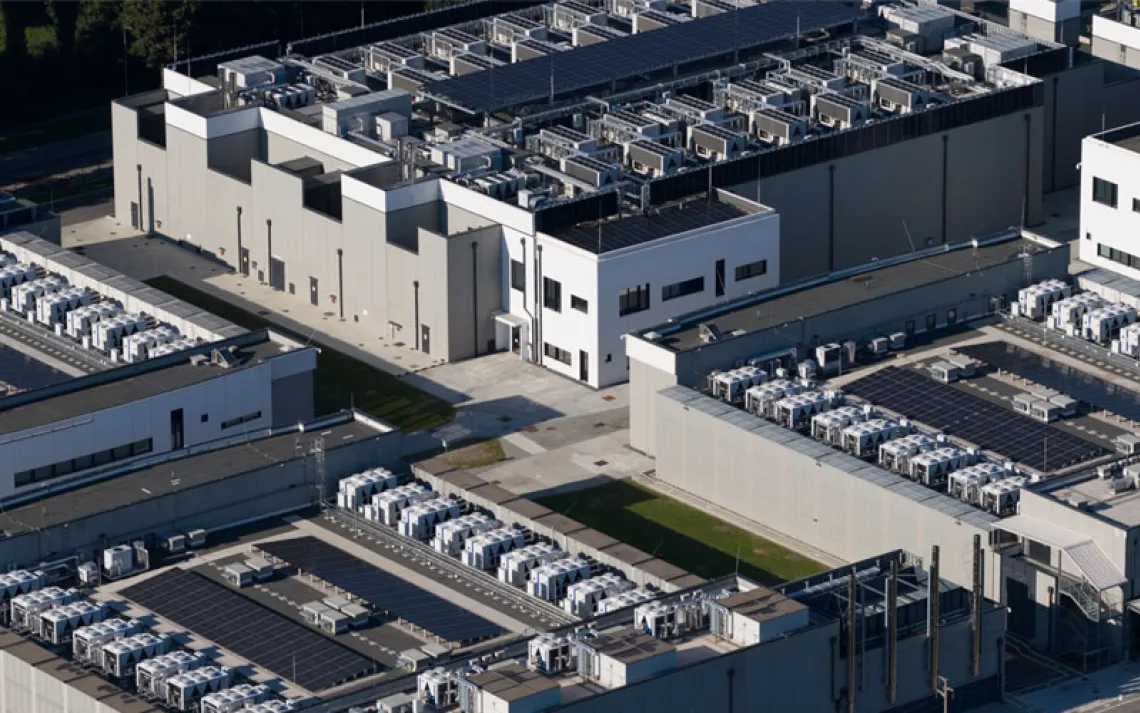
“This is the most common way of cooling in data centers,” says Norbert Conrad, deputy director of the High Performance Computing Center in Stuttgart, Germany. “It's similar to how a fridge is cooled, just much bigger. You use a compressor and gases to cool air or water for the computers.”
These gases can escape into the air, where they accelerate climate change. Some PFAS gases used in cooling of data centers have global warming potential that is thousands of times higher than CO2's.
PFAS chemicals can also be used in a different form of cooling, using immersion. Computers are submerged in a chemical fluid to which the heat transfers. PFAS fluids for applications like this can leak or seep into water sources, where they find their way to drinking water or are used in agriculture.
There are alternatives to cooling in data centers, such as propane or ammonia gases. But these solutions may not work as well. Propane is explosive. Other forms of non-PFAS cooling requires investment in technology.
“When you have enough evidence that something is harmful, you want to act, even in the face of uncertainty,” says Joseph Braun, a professor in the Department of Epidemiology at the Brown University School of Public Health. “We know there are consistent, harmful things about the PFAS family. Which is why we should reduce their use, particularly when there are alternatives.”
“The solutions are there,” says Conrad. “It’s just up to the companies to invest in them. That’s where the problem often lies. It’s not the alternative technology that is hard; companies just need to invest more money in them.”
An AI PFAS bubble?
Beyond the data centers themselves, the AI boom is driving a surge in semiconductor manufacturing, where PFAS chemicals are also used. Large language models run on high-end chips, which are built in high-tech factories called fabs. These fabs use PFAS chemicals in their production processes.
“There are over a thousand PFAS applications in the semiconductor supply chain,” says Judith Barish, coalition director of CHIPS Communities United, an NGO arguing for a more responsible semiconductor industry. “They use a lot of PFAS, and there are also few short-term alternatives for it. The US chemical industry is even citing semiconductor production as a reason not to regulate PFAS.”
Still, there is little information on PFAS leakage for both data centers and semiconductor production.
“We know there is PFAS in the wastewater of some semiconductor companies,” says Barish. “Vermont, for example, recently required GlobalFoundries, next to Burlington, to monitor PFAS in its wastewater. They found 13 different PFAS compounds in modest proportions. That being said, it flowed directly into a river that provides drinking water, which was worrying.”
In Virginia, opposition to the data center trend is rising. The Piedmont Environmental Council has registered a surge in efforts to stop construction plans before they advance, according to Bolthouse. “The impacts are getting real. People are seeing the transmission lines go up and the smoke from the diesel generators.”
“The AI bubble will eventually pop,” she says. “The real question is, How much damage do we do before it does?”