 The Magazine of The Sierra Club
In Rural Louisiana, Meta’s New Data Center Promises Growth—But at What Cost?
The Hyperion data center could have a major impact on a largely agricultural community
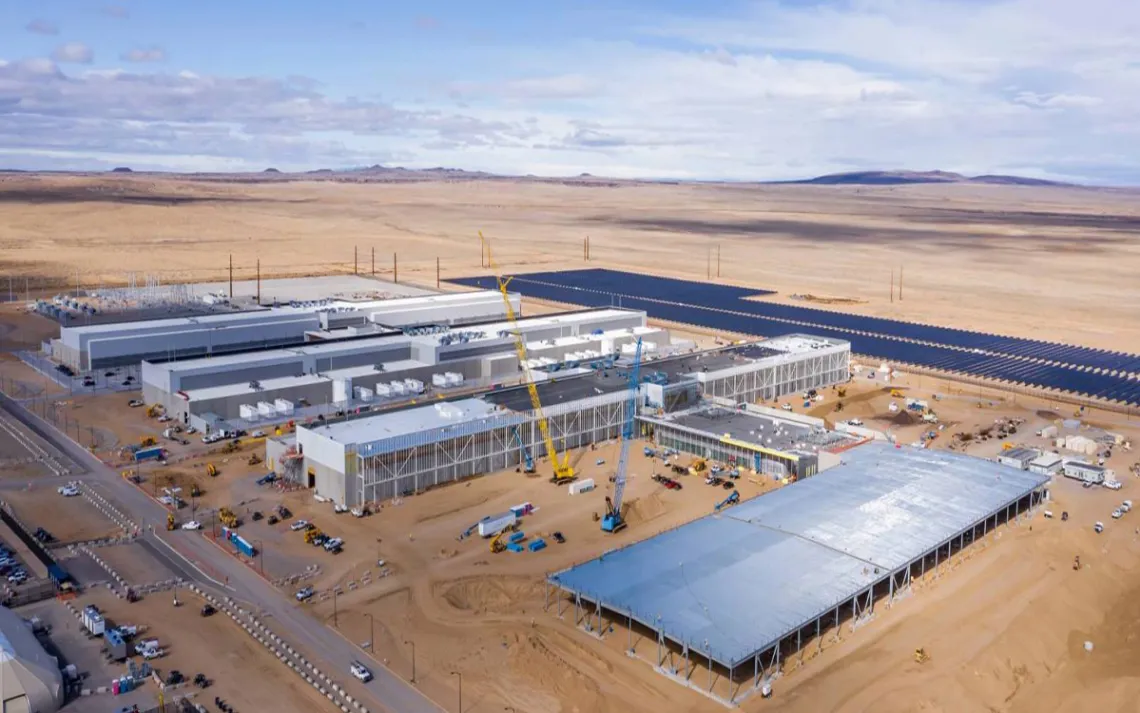
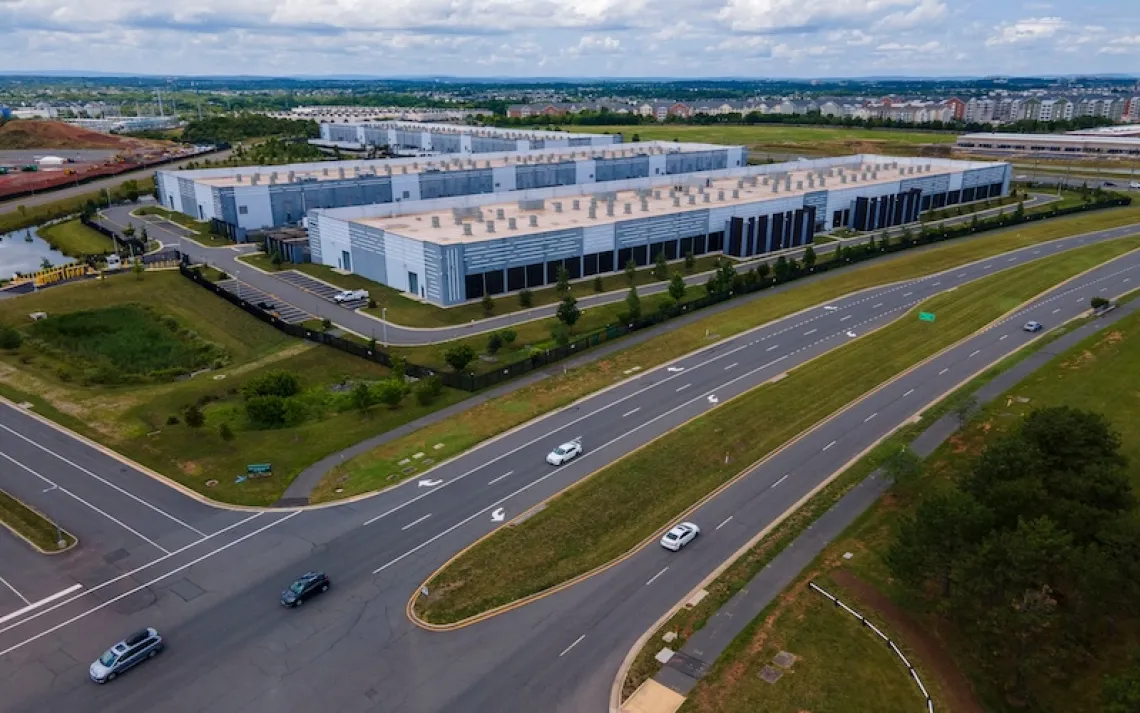
The Meta data center in Los Lunas, New Mexico, occupies 750 acres. The Hyperion data center will take up nearly two and a half times that amount of space. | Photo courtesy of Meta
Meta, the parent company of Facebook, Instagram, and WhatsApp, has broken ground on what could become the largest data center in the Western Hemisphere. Situated between a 200-student elementary school and swaths of farmland, the massive installation—called the Hyperion—will occupy 2,250 acres of previously state-owned land in Richland Parish in northeastern Louisiana. The data center would power Meta’s artificial intelligence-related features, and it has the potential to upend lives in a mostly agrarian area.
Meta has made sweeping promises to locals, as have state and utility officials, about the potential for prosperity from the installation: cheaper power, new jobs, and millions of dollars in community investment. But with the facility not expected to open until 2030, it is unclear whether those benefits will outweigh the costs—or whether the data center’s enormous power and water needs will strain the area’s fragile infrastructure instead of reviving it.
Across the United States, data centers have profoundly affected residents of the often impoverished communities in which they are constructed. In Memphis, air pollution from turbines at an xAI data center caused respiratory problems. In rural Georgia, tap water in homes near a Meta data center runs brown and dirty. The rapid buildout of such facilities greatly increases the risk of blackouts in the communities where they’re located, while Bloomberg reported that power bills more than doubled over a five-year period in communities surrounding data centers, costs borne primarily by consumers.
There will be data
For years, data centers were built near cities, where proximity to corporate headquarters and dense internet infrastructure helped reduce processing delays. But as land and energy costs in urban areas soared, companies began looking elsewhere—often to rural communities with cheaper property, fewer regulations, and eager local governments.
“The way a data center impacts northeastern Louisiana is going to be completely different to how it impacts Arizona, Texas, or Northern Virginia,” said Merritt Cahoon, the Deep Tech program coordinator at the Sanford School of Public Policy at Duke University.
For a largely agricultural community like the one in and around Richland Parish, water consumption is a hot topic. Large data centers use as much water as a small town to cool down the supercomputers that power them. This amounts to 5 million gallons of water per day, or nearly 2 billion per year, but it’s difficult to know the true number: Many data centers do not track or publicize their water and energy usage.
“There’s a lack of standardized practices, both in terms of how different data centers are operating and in how we even account for our understanding of what their energy or water consumption is,” Ian Hitchcock, a research associate at the Deep Tech Initiative, said. “This is because we don't have universal reporting requirements, and at the moment, data centers are not being terribly forthcoming about reporting on those things.” Earlier this year, Cahoon and Hitchcock co-published a report on the sustainability challenges that data centers pose.
Tech companies often work with local governments to keep information about their water and energy consumption under wraps. In Wisconsin, it took a lawsuit against Racine County for local officials to release records on the expected water use of a Microsoft data center. In Memphis, too, local officials signed nondisclosure agreements simply to begin discussion on the data center with xAI.
Some farmers in Richland Parish are unconcerned with the new strain the data center will put on the water grid. “I’m not debating the fact that other areas with data centers have had water shortages, but those areas don’t have the Mississippi River,” Dustin Morris, who farms corn and soybeans, said. Richland Parish is situated near the Mississippi River and receives its water in part from the Mississippi River Alluvial Aquifer. Because of this, farmers like Morris are confident that the aquifer will be refilled fast enough to keep pace with the new data center.
In addition to searching for large, cheap swaths of land and access to power, Hitchcock said, tech companies often look for utility companies that will build the infrastructure necessary to fuel a data center. Richland Parish checks all of these boxes. The State of Louisiana competed for the Meta data center by rewriting zoning laws and signing into law a sales tax exemption for data centers built before 2029. Land costs are low too.
Promises made, promises kept?
Each day, Meta’s Hyperion data center will consume about twice the energy used by New Orleans on a peak day, which could create problems with Louisiana’s aging and unreliable power grid. The utility company Entergy agreed to build three new gas plants on Meta’s behalf to support the new data center’s consumption. These new natural gas plants will most likely contribute to air pollution.
Entergy said, however, that Meta’s presence in the region would make customers’ electric bills “lower than they otherwise would have been.” But with such an energy-demanding neighbor, will Richland Parish residents be able to keep the lights on?
It’s likely that a greater electricity load, even if it comes from one large customer, will lead to higher bills for all customers—unless utility companies create a new rate class for data centers that requires them to pay more, instead of billing them as any other ratepayer. And while Entergy said that Meta will pay “the full cost of the utility infrastructure that will benefit their Richland Parish Data Center,” the “full cost” is tenuously defined: Meta will pay the first half of a 30-year loan for Entergy’s new gas plants, but the rest of that cost, plus $550 million for a new transmission line, will be covered by local customers, according to reporting from Wired.
Tim Cywinski, the communications director of the Virginia Chapter of the Sierra Club, is familiar with the burdens that data centers can place on communities. He worked alongside residents of Charles City County, Virginia, to delay and eventually stop the tech company Diode Ventures from building a data center in the rural county. “Big Tech is trying to buy up farmland because it’s cheap and it gives them the space they need,” Cywinski said. “They target small, financially struggling counties, and the result is that residents—many of whom are already facing economic hardship—are sold out to the highest bidder.”
To fight these characterizations, the large corporations behind data center developments invest millions of dollars in local infrastructure. Meta takes care to maintain a community-focused image: It has said that it will invest $200 million in improving infrastructure in Richland Parish, including roads and water systems. Meta also has Richland-focused social media accounts on several platforms, on which it features local businesses and spreads news about its competitive grants that fund schools, nonprofits, and other organizations.
Francis Jordan, a farmer who grows peanuts, corn, soybeans, and beans in northeast Louisiana, hopes that the data center and infrastructure investment that comes with it will be a lifeline for the area. In recent years, the agriculture industry in the United States has suffered from low crop prices, high operating costs, and labor shortages. “Having the data center will bring investment and money to help with the roads, the hospital, and the school system, especially right now, when agriculture is in such dire straits,” Jordan said.
Outside of infrastructure and grants, though, data centers provide few benefits to the communities surrounding them—even when it comes to employment, which is often touted as a perk. Once the construction period is over, data centers employ a very small number of people. This is true in Richland Parish. Meta has hired three construction companies from other parts of the United States to build Hyperion, totaling 5,000 jobs at peak construction. The temporary influx of people has created a boom in small business in the area—but this bubble will most likely burst once the data center has been built.
Meta has said that the data center will create 500 jobs once it is operational, but there is no guarantee that these jobs will go to locals, nor has Meta said how it estimated that number. Entergy said only that it anticipates adding some number of jobs in the area.
Even if those companies don’t hire locals or open up as many jobs as promised, Jordan hopes that the data center will attract other industries to invest in North Louisiana, creating indirect jobs and thereby bolstering the economy. This could help counteract the “brain drain” that many rural areas deal with. Jordan’s three children, who are now adults, left their hometown in pursuit of career opportunities.
“When Meta is finished and other industries follow it here, there may be jobs that let some of our children stay here and live,” Jordan said. “All the jobs aren't going to be for locals, but it still brings in people who are going to spend money here and raise their kids here.”
One report estimates that residents of northeast Louisiana will occupy 95 percent of jobs related to the data center—but this means only that those roles will be worked on-site, not that people native to the region will fill them. It’s often the case that data centers employ specialized engineers and technicians, who aren’t necessarily local to the places in which they work.
Who really benefits?
The outsize strain placed on local utilities, in combination with the lack of truly impactful economic opportunities provided by data centers, has led many to believe that they take much more than they give to their host communities. And in areas where economic growth has stagnated and resources are scarce, the eagerness to build data centers reflects a sense of urgency to improve local economic conditions.
“Communities that have faced decades of underinvestment can feel desperate for any kind of development, no matter how tenuous the benefits. But local officials need to ask hard questions and not just rubber-stamp anything that looks like economic growth,” Hitchcock said.
To many, the Meta deal evokes Louisiana’s history of allowing industry to operate at the expense of Louisianians. Such is the case with Cancer Alley, an 85-mile stretch of once-pastoral land along the Mississippi River that became inundated with petrochemical plants in the mid-20th century. Today, the area has some of the highest cancer rates in the country due to the extreme levels of pollution in the air, water, and soil.
“Louisiana has a track record of approving big, bad industrial projects that come with the tradeoff of making people sick, and the people never even see the benefits of that revenue,” Cywinski said.
In his time advocating for transparency around data centers, Cywinski has found that community action is the best way to enforce local demands and delay—or even stop altogether—the building process. Cywinski recounted how he and residents of Charles City County, Virginia, successfully protested the construction of the Diode data center earlier this year.
“We organized an educational town hall, and 200 people showed up. From there, neighbors formed a core group to fight back,” he said. “They spoke at every board of supervisors meeting, did their own third-party research, and made sure their voices were heard. Eventually, Diode realized they couldn’t win and pulled their application. The community won.”
Cywinski and Angelle Bradford Rosenberg, the chair and manager of the Sierra Club Delta Chapter, are preparing for an air permit hearing with the Louisiana Department of Environmental Quality on November 18. It has been challenging, Bradford Rosenberg said, to bring people together across the rural, remote area—but farmers, faith leaders, and landowners are organizing nonetheless.
“One of the first things that I always say when I go to communities is, ‘Our opponents always think that we're not smart enough or passionate enough or rich enough to stop them,’” Cywinski said. “But in my career, I have seen how everyday people can prove them wrong.”