The Fight Over Data Centers
They’re unsightly and power hungry. The White House wants to build a whole lot more.
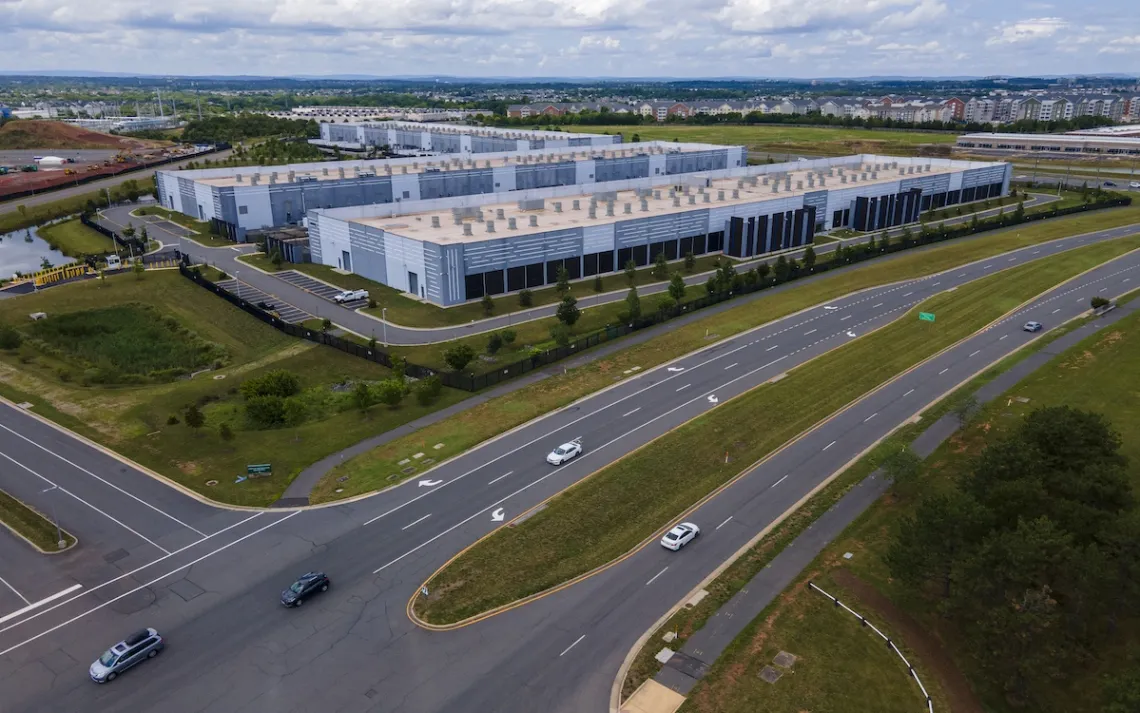
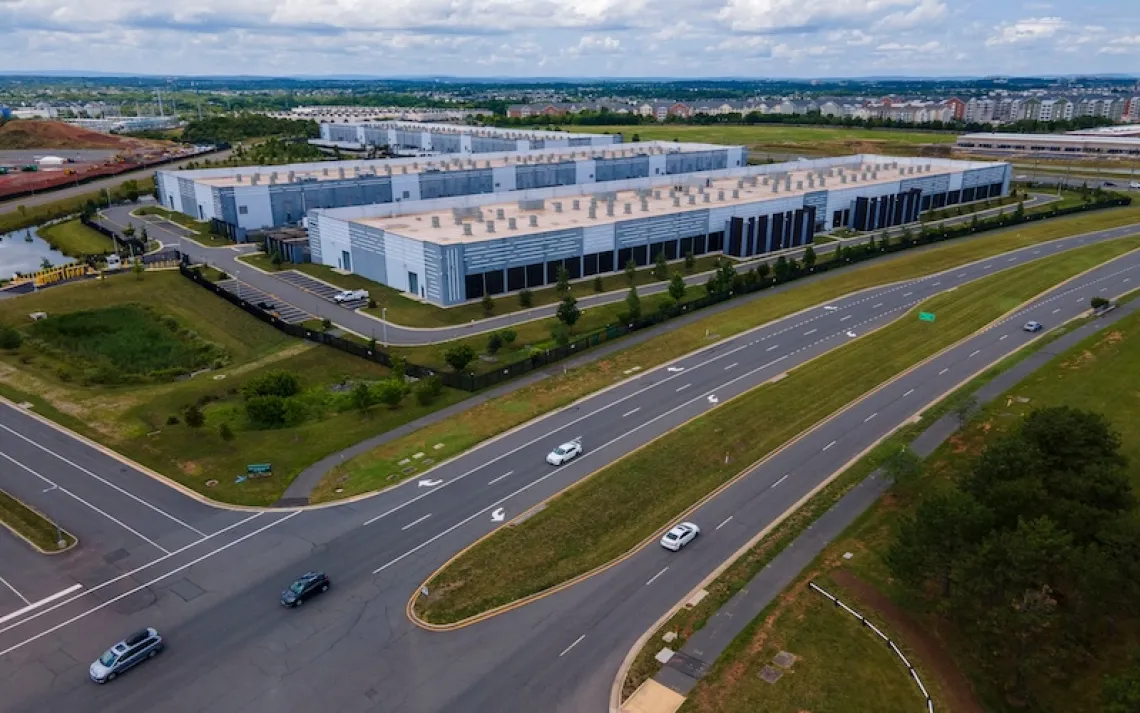
A data center in Loudon County, Virginia. | Photo by Ted Shaffrey/AP Photo
You first. That is the message Elena Schlossberg, an anti–data center activist based in Northern Virginia, has for President Trump, whose administration seeks to dramatically accelerate the building of data centers across the nation.
“Put the data centers at Mar-a-Lago,” Schlossberg, who heads the Coalition to Protect Prince William County, told Sierra. “Put the gas plants and diesel generators and transmission lines at Mar-a-Lago first.”
It is highly unlikely that Trump’s lavish South Florida golf club will play host to data center infrastructure anytime soon. Still, Schlossberg made her point. As a resident of a region that has the world’s highest concentration of data centers—13 percent of global capacity comes from Data Center Alley, a left-parentheses-shaped region of Northern Virginia around Washington Dulles International Airport—she is fighting their construction both where she lives and around the country.
“This is a kitchen-table topic. This will impact everybody at some point. We need to slow down and understand what those impacts are at some point before it’s too late,” Schlossberg said.
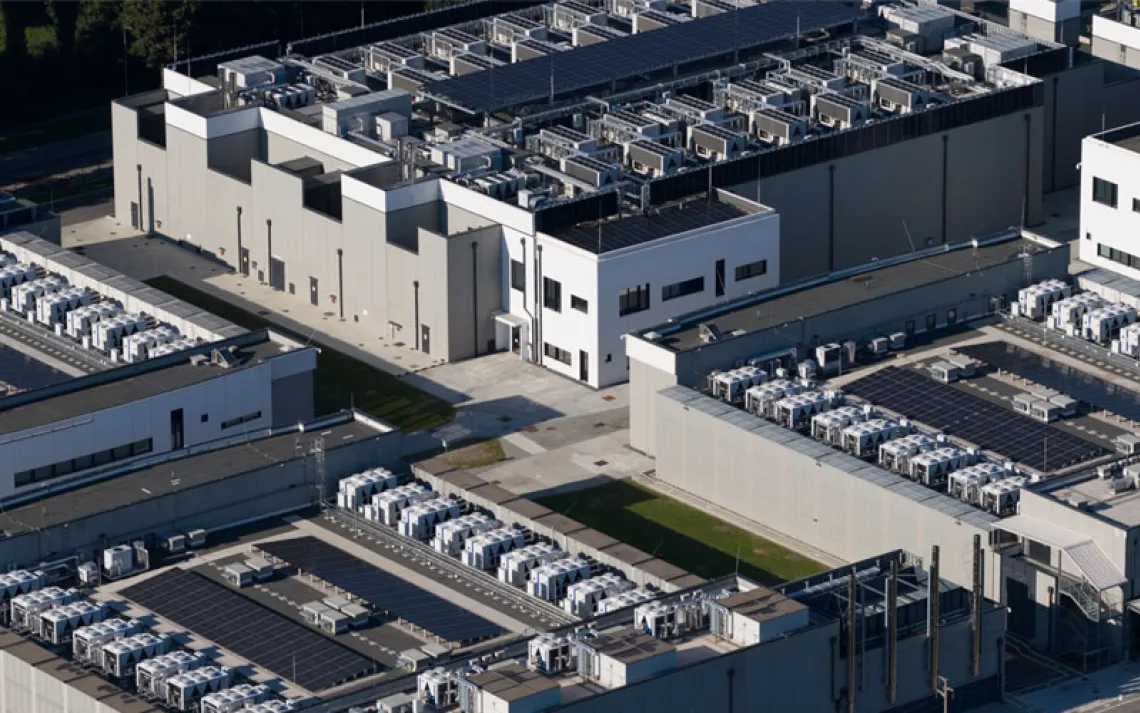
A data center—kin to the server farm—is the lymph node of the digital economy. Typically a windowless warehouse, it processes the enormous amounts of data we use on a daily basis. There are currently 5,426 data centers in the United States, according to information services firm Brightlio, a number that is expected to increase sharply because of the artificial intelligence boom. The consulting firm McKinsey points in a recent report to an “unquenchable need” for data centers in the next five years, with a projected $7 trillion devoted to the sector by 2030. That’s twice the gross domestic product of India.
Where should all those data centers go?
That question is being asked in Silicon Valley—and in small communities across the country, many of which are now grappling with whether they want to be the next data center hub. Some are coming to the same conclusion as Schlossberg and many of her Northern Virginia neighbors. A national poll conducted this summer found that 46 percent of Americans don’t want data centers in their own communities.
You can’t exactly blame them. The average data center is about 100,000 square feet in size. Inside are servers and other aspects of informational technology infrastructure. Cooling all the equipment requires enormous amounts of energy and water. A large data center may need as much as 500,000 gallons of water per day. And according to a US Department of Energy estimate from last year, data centers could account for 12 percent of US energy consumption by 2028.
Trump has made winning the AI race—and beating China, in particular—a central focus of his administration. In July, he issued an executive order that said the White House would “facilitate the rapid and efficient buildout” of data centers and related infrastructure “by easing federal regulatory burden.”
The order could make federal lands available for the construction of data centers, as well as electrical and gas lines and electrical substations. It instructs the Department of Commerce, as well as the executive branch’s Office of Science and Technology Policy to “provide financial support” to data center projects and promises regulatory “exclusions” to corporations eager to build.
The order is about “cementing our dominance” in an AI-centered economy, a senior administration official told Sierra. “Obviously, we are not oblivious to the fact that data centers require energy, they require water,” he added. “We understand those concerns. But there’s a cost-benefit analysis here.”
But even as the Trump administration is moving to encourage data center construction, opposition to data centers is rising across the country, in red and blue areas alike. Communities have complained that data centers are noisy and unsightly. And though construction workers are needed to build them, once a data center is up and running, it may need only a dozen or so people to operate.
“There’s little it will add to the community…. It consumes; it grows; it uses resources. It doesn’t kill you, but it doesn’t make you healthy,” a Northern California planning official told a publication affiliated with Stanford in April.
Some worry that data centers could strain an already-strained energy grid, leading to a much greater risk of blackouts as well as higher costs for utility customers. Then there are concerns about noise and carbon emissions, among other potential environmental and health dangers. According to one study, data centers worldwide are expected to produce the equivalent of 2.5 billion metric tons of carbon emissions by 2030.
A new report from Data Center Watch finds that $64 billion in data center projects “have been blocked or delayed amid local opposition.” Even if few people knew what data centers were only five years ago, they are now roughly as welcome in many areas around the country as a new coal-burning plant.
“Opposition to data center development cuts across political lines,” the report notes. “Republican officials often raise concerns about tax incentives and energy grid strain, while Democrats tend to focus on environmental impacts and resource consumption. This cross-party resistance defies expectations and marks a rare area of bipartisan alignment in infrastructure politics.”
Last month, Schlossberg’s group won in its effort to stop the construction of the massive and massively controversial Digital Gateway. A cluster of 37 data centers, Digital Gateway was to sit next to the hallowed ground of the Manassas National Battlefield Park, where thousands died and were wounded during the Civil War.
In early August, a state circuit judge ruled that the land-use rezoning necessary for construction to begin had been improperly approved. The ruling was largely focused on whether the rezoning process was conducted according to state and local law, and the fight over Digital Gateway is hardly over.
But for now, at least, the project is frozen in place.
“We can’t let NIMBYism undermine our ability to compete,” the senior administration official said, using the acronym for "not in my backyard," a pejorative label for opponents of development. He said that the data center industry was becoming more sustainable, in part by building its own energy sources (or repurposing old ones, like the infamous Three Mile Island nuclear power plant in Pennsylvania).
Schlossberg calls herself a NOTE: Not Over There, Either. It may be a tall order, but she wants people to think about whether being able to ask ChatGPT which Netflix series to stream is worth the damage new data centers will, in her view, bring.
“What’s happening here in Virginia should be a cautionary tale for everyone,” she said.