The Surprising Ways Birds Respond to Wildfire Smoke
Data from researchers and community scientists reveal how different species are impacted
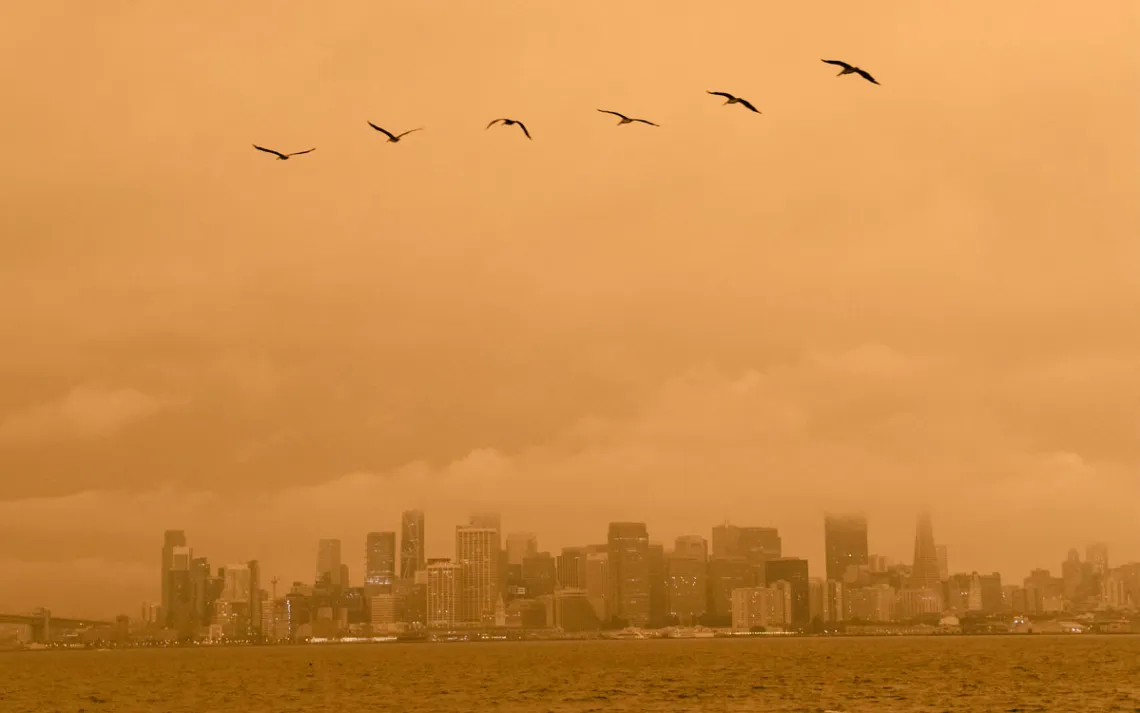
Wildfire smoke in San Francisco. | Photo by Michael Short/Bloomberg
A bird’s life is exhausting. Certain migratory species fly over 3,000 miles in one go, and the most active of avians can stay airborne for up to six months. To fuel such feats of endurance, birds have adapted with a unique way of breathing. Their respiratory system features a series of air sacs that constantly pump fresh air into their body cavity. This unidirectional airflow continues during both inhalations and exhalations, allowing birds to constantly take in oxygen. This works to their advantage on long-distance flights at high elevations—but it could pose a risk when the air around them is polluted.
When birds breathe air that is high in particulate matter and other toxins, it puts them at risk of respiratory distress, cardiovascular symptoms, and, in some cases, death. With wildfire seasons becoming longer and more intense, researchers are investigating what increasingly smoky skies could mean for birds now and in the future. A study published last month in Biodiversity and Conservation provides some clues.
Using data from New York state, researchers found that during the 2021–23 breeding season, certain woodland bird species, including warblers and thrushes, were less likely to be observed on days with high PM2.5 levels (a well-established marker of wildfire smoke). However, some water birds, such as osprey, were actually more likely to be observed—suggesting that they may have adapted ways to remain active during smoke events.
These findings—coincidentally, released right before New York faced a major smoke event from Canadian wildfires—resemble data previously collected from Washington state. There, smoky conditions were negatively associated with observing 16 bird species, but positively associated with 10 species including the spotted towhee, yellow-rumped warbler, and California quail.
“In general, we are seeing that birds are less active and they're less likely to be observed [in smoke], but there are some standouts where that's not true, and it's really interesting to think about why," said Olivia Sanderfoot, an ornithologist at the Center for Engagement in Science and Nature at the Cornell Lab of Ornithology and coauthor of both the Washington and New York studies.
To explain these outliers, Sanderfoot hypothesized that birds may follow a “Stay, Shift, Go” strategy following wildfire. While some species try to flee smoky conditions and relocate to places with cleaner air, others might stick around—potentially shifting their behavior to protect themselves from smoke’s worst impacts.
American robins, for example, seem to reduce the amount of flying they do to conserve energy on smoky days. If air pollution is particularly bad, they may even adjust the direction of their flight to orient themselves into the wind, potentially as a strategy to reduce smoke exposure. Oak-loving acorn woodpeckers seem to restrict flying time and stick near their home territory during smoke events too, while raptors like hawks and vultures may take an entirely different approach and actually fly toward the flames in search of vulnerable sources of prey. Another recent study found that certain grassland birds seem to reduce their vocal activity in smoke conditions, leading to soundscape shifts that can last for weeks at a time.
“We know that species, according to different groups, according to different habitats, respond differently,” lead author of the recent New York study Festus Adegbola, said. “What jumps out to me is the need to dig further, to do more research to understand some of the factors that might be causing such differences.”
The unpredictability of wildfire smoke makes this a challenging topic for field research. “We don't know when fires are going to start, and we don't know where smoke is going to blow. It always feels a bit like a surprise, particularly in the context of megafires—these big, catastrophic fires that we're seeing more and more often,” said Sanderfoot.
Since researchers can’t reliably monitor how a bird behaves in one place before, during, and after a wildfire event, they are turning to data that’s already been collected by people who are in the field day after day: hobby birders.
For the New York study, Adegbola and his team relied on nearly 100,000 observations on eBird—a platform where hobbyists log the bird species they see on outings. The database now holds more than 2 billion observations that are available to researchers and conservationists. “The more data you have, the more stable your models probably are,” Adegbola said of the decision to use eBird data in his research. “Being able to have such a huge volume of data is an advantage of community science projects.”
Adegbola pointed out that using data from these projects also tends to be less expensive than collecting it in the field, an important consideration during a time when federal science funding is threatened. “There's really no other way to study how birds are responding to wildfire smoke other than community science,” says Allison Shultz, an ornithologist and program director of Project Phoenix, a community science project within eBird specifically focused on birds’ reactions to wildfire smoke.
That said, data collected by nonscientists is not perfect. Novice birders may mistake which species they’re seeing or hearing, skewing their findings. Birders also tend to head out during certain times of year and congregate in areas with high avian activity, potentially leading to "data deserts" where reliable information is lacking. Not to mention, birding and volunteering are both activities that require a certain amount of disposable time, and they can be confined to wealthier areas that have more green space.
To account for some of these factors, initiatives like Project Phoenix set specific guidelines. Now in its fourth year, the project asks birders of all backgrounds and experience levels in California, Oregon, and Washington to head out during the typical fire season, July to November. Volunteers commit to visiting the same location for 10 minutes each week and logging all the birds they observe in that time, double-checking the ID of any rare species they see or hear.
“We really need consistent records of birds and other animals in order to better understand how climate change is impacting their populations and what we need to do to help,” said Sanderfoot, who is also the founder of Project Phoenix.
Project volunteer Carrie Brown-Kornarens hopes that the checklists she’s gathering from her backyard in the Los Feliz neighborhood of Los Angeles go on to help researchers learn more about how to protect birds in what will likely be a more fire-prone future. But science aside, she’s come to love the ritual of spending a few minutes a week tracking her yard’s visitors: song sparrows, spotted towhees, Allen's hummingbirds, and a pair of stately great horned owls.
“It's very peaceful and meditative because you're just looking into this little world.… It takes you away for 10 minutes where you're just watching and observing,” she said.
Project Phoenix isn’t the only community science tool fueling this research topic: Project FeederWatch, which collects winter bird sightings, is helping researchers study the avian response to fires that occur outside the typical fire season, like the Southern California blaze of January 2025. Meanwhile, NestWatch, which has volunteers monitor nest activity throughout the year, is being used to study how smoke impacts reproductive outcomes.
One day, organizers with these projects hope to provide volunteers and the general public with tips on how to support birds following wildfires. Until then, the best thing to do for our feathered friends on smoky days may simply be to count them.