Risky Mining Could Power the Switch to Renewable Energy
Conservation groups and island nations question the promise of deep-sea mining
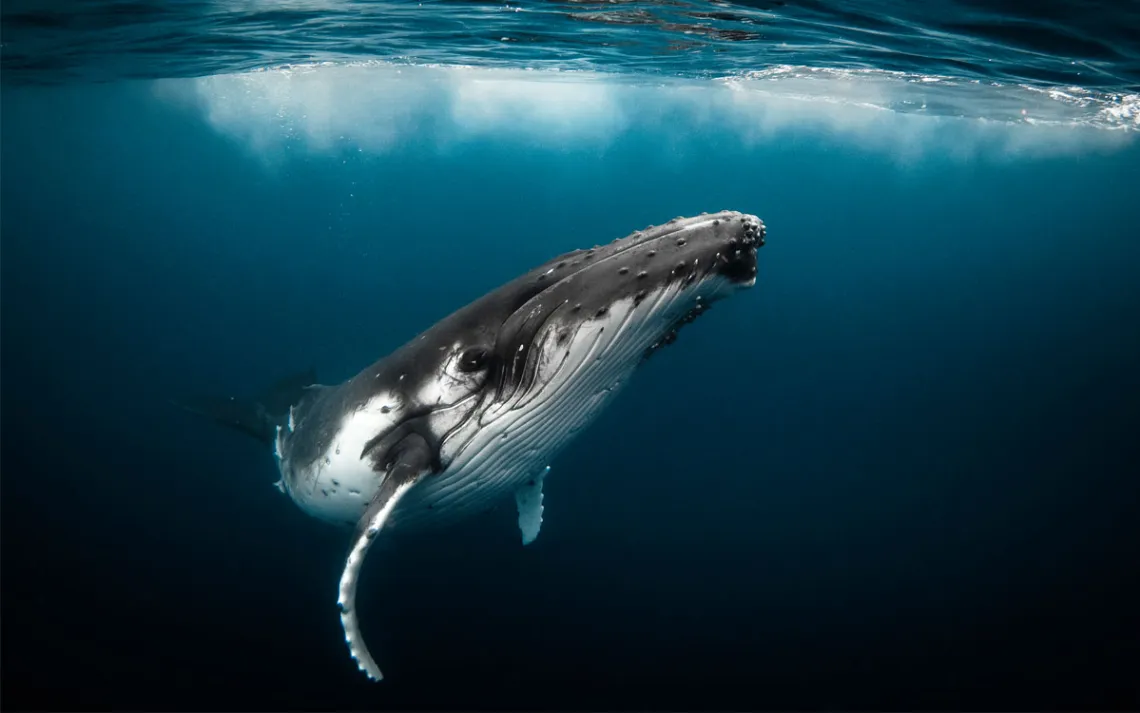
Humpback whale. | Photo courtesy of Philip Thurston/iStock
The ocean floor between Hawai'i and Mexico looks nothing like what most people see at the surface. Twelve thousand feet below this section of the Pacific Ocean is the Clarion-Clipperton Zone (CCZ), a deep-sea area spanning roughly 4,500 miles. Scattered across this vast, flat seabed, also called an abyssal plain, are minerals, in the form of polymetallic nodules. They’ve taken millions of years to form, are dark in color, resemble potato-size rocks, and are packed with nickel, cobalt, copper, and manganese.
These four metals are in high demand as nations attempt to shift from fossil fuels that emit greenhouse gases to renewable energy, including wind and solar. Without that new energy infrastructure, countries will struggle to achieve net-zero goals by 2050. And maintaining global commitments to keep temperature rise below the goal of 1.5°C above preindustrial temperatures will be well out of reach, warn climate experts. But is deep-sea mining worth the environmental and social costs?
The Trump administration certainly thinks so. In April, the White House released an executive order with the goal of fast-tracking deep-sea mining, seeking to offset China's dominant position in critical mineral supply chains. Then, in late October, the National Oceanic and Atmospheric Administration released a proposed rule to the White House’s Office of Information and Regulatory Affairs that would streamline seabed-mining permits, collapsing what is currently a two-step process (exploration and production) into a single review.
However, conservation groups and island nations have strongly opposed the practice. Much in the way that industrialists have pursued fossil fuels, the rush to mine a part of the earth less explored than the moon could have disastrous consequences, say critics of the practice. “The deep sea is the earth’s least understood ecosystem, and we already know mining would cause widespread, irreversible harm, from destroying seafloor habitats to releasing toxic sediment plumes that travel hundreds of miles,” stated a Natural Resources Defense Council press release, following the executive order. “This isn’t innovation. It’s reckless, unnecessary, and driven by short-term gain at the expense of long-term planetary health.”
New frontier
At the forefront of deep-sea mining are two companies, The Metals Company (TMC) and Impossible Metals. Both hold exploration rights in the CCZ and are set on mining manganese nodules, but their approaches are vastly different. TMC’s system uses water jets and a tracked collector to dislodge and vacuum up nodules. The device then releases most of the sediment back onto the seafloor while sending the remaining slurry up a riser pipe for processing. After the nodules are separated, the wastewater, fine sediment, and crushed fragments are discharged back into the ocean at about 6,000 feet, a depth the company claims minimizes harm to midwater ecosystems. Meanwhile, Impossible Metals uses battery-powered underwater robots that hover one meter above the seabed to collect nodules.
Despite these starkly different methods, both companies are pushing forward within a regulatory gray zone. The International Seabed Authority (ISA), which regulates deep-sea mining, has now issued more than 30 exploration contracts for the CCZ but has yet to adopt binding rules for commercial exploitation. So industrial activity could begin before scientists fully understand the consequences of mining a heavily under-studied area.
Erica Ocampo, the chief sustainability officer at TMC, believes that harvesting nodules in the abyssal plains would have a lighter environmental footprint than terrestrial mining. As she put it, the difference between biomass in a tropical rainforest and the deep seabed is 40 kilograms (nearly 90 pounds) versus 10 grams. In her view, that lower baseline means fewer species and less ecological complexity stand at risk.
But some scientists and environmental experts say the reality is far more complicated. While the CCZ is often described as low biomass, experts argue that this framing glosses over what’s actually at stake. Jon Copley, a professor of ocean exploration and science communication at the University of Southampton, told Sierra that to fully assess any potential risks of deep-sea mining, society should assume the worst-case scenario: that anything living on the mined seafloor could be potentially wiped out entirely. While the abyssal plain holds far less life per square meter than a coral reef or hydrothermal vent, low biomass doesn’t always mean low importance.
“There are an estimated 6,000 to 8,000 species of animals living on the seafloor in the Clarion-Clipperton Zone,” Copley said, noting that only a few hundred have been formally identified so far. Newly discovered creatures, such as gummy squirrels and “Barbie pigs,” simply remind us how unfamiliar deep-ocean life really is. And although life in the CCZ is sparse, the species that do exist are scattered across vast distances.
Take, for example, the tiny sponge Plenaster craigi. It is one of the most common species on nodules, yet its population stretches across at least 900 kilometers of seafloor. To safeguard such species, the ISA has designated 13 areas of particular environmental interest (APEIs), but whether these reserves are large enough or in the right places remain unclear.
Andrew Sweetman, a marine ecologist at the Scottish Association for Marine Science, compares these nodule fields to the Arctic sea-ice system or the Galápagos. Both ecosystems have relatively few organisms, but they nonetheless hold immense ecological value. Treating low biomass as low impact, he said, fundamentally misunderstands the deep sea.
When it comes to sediment plumes, Sweetman acknowledged that returning processed sediment deeper may reduce impacts, but "reduced" is not the same as zero. He also stressed the geological timescales at risk. A six-centimeter nodule can take 60 million years to form. Removing them is not like terrestrial mining. On the abyssal plain, the ecological footprint could last millennia or longer.
Perhaps most surprising is Sweetman’s recent finding that oxygen may be generated at the seafloor through electrochemical reactions involving manganese oxides. His team initially assumed their sensors were malfunctioning because deep-sea oxygen is normally consumed the deeper you get into the sea, never produced. Lab tests confirmed the effect, and physical oceanographers have now identified around 15 locations worldwide where oxygen mysteriously increases near the seabed. According to Sweetman, this hints at unknown biogeochemical processes that mining could disrupt before we even understand them.
Helen Rosenbaum, campaign coordinator of the Deep Sea Mining Campaign, shared these concerns. After reviewing plume modeling from Impossible Metals, she said its gentler method still produces sediment disturbance around 23,000 times the natural geological rate. “While they talk about plucking nodules, the impact is still orders of magnitude beyond what deep-sea species are adapted to.”
When asked about industry claims that releasing wastewater at 2,000 meters minimizes harm, Rosenbaum said that in both a recent lecture and in her own conversations with Jeffrey Drazen, an oceanography professor at the University of Hawai'i, he had made it clear there is no depth at which such discharge avoids ecological impact. Each layer of the ocean, she explained, is its own ecosystem with different chemistry, species, and vulnerabilities, meaning that shifting the discharge deeper doesn’t eliminate harm; it only moves it.
Pacific communities suffer
Even if future research shows that deep-sea mining is no more harmful than mining in places like the Atacama Desert, that doesn’t erase the very real consequences for Pacific communities. Fiji, Samoa, Vanuatu, and the Federated States of Micronesia have been among the strongest voices calling for a moratorium on deep-sea mining, warning that it threatens tuna fisheries that sustain millions as well as cultural and spiritual ties to the ocean that span generations. Advocacy groups, including the Alliance of Solwara Warriors, argue that disturbing the deep seabed could destabilize ecosystems crucial to coastal food security.
Others have since united behind a permanent ban on the practice, citing the potential collapse of tuna stocks and long-term cultural loss. The Federated States of Micronesia, for instance, has joined a regional moratorium alliance, while parliamentarians across the region warn that communities will bear the brunt of any miscalculation.
For now, the only certainty leaders and the public have is uncertainty. Scientists still don’t know enough to declare deep-sea nodule mining either essential or catastrophic, and that’s why the moratorium exists to allow rigorous research into the impacts of mining the seabed. The real question is whether both sides will accept whatever the science ultimately finds. Unfortunately, neither side has given reason to believe that they’re prepared to meet that evidence with real honesty—and ultimately, that might be the biggest challenge in this conversation moving forward.
“The best we can hope for is choosing the lowest-impact path, improving recycling, and confronting the political systems captured by powerful lobby groups that helped create this crisis,” Copley said. “Spatial management might avoid the worst risks, but whether deep-sea mining is necessary, or even wise, remains the question the world must answer before the machines hit the seabed.”