Five Bridges and a Hummingbird: Manhattan’s Ecological Oasis
Cities may not seem like places full of natural wonder, but if you know where to look, life indeed abounds
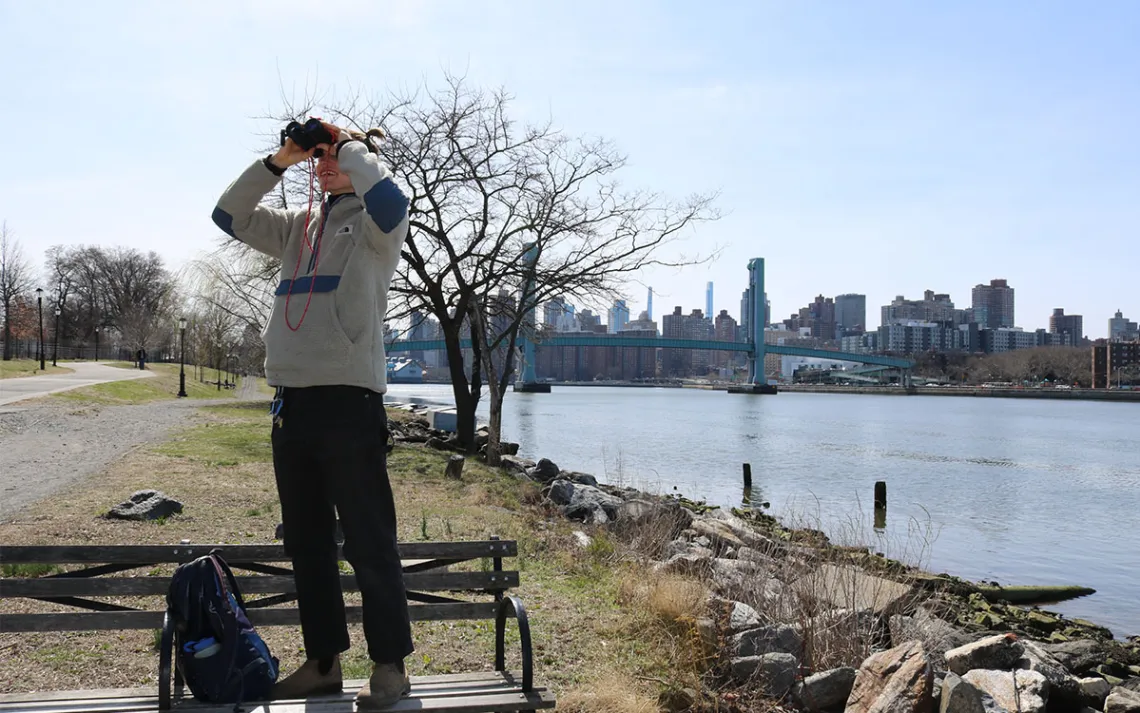
Laurie McDowell spots a red-tailed hawk through his binoculars against the Manhattan skyline. | Photo by Molly Herring
A chirp erupted from the brush, transforming into a shrill scold and then a soft squawk. I looked for three birds but spotted only one.
“It’s a mockingbird,” laughed Laurie McDowell, an ecological horticulturist on Randall’s Island in New York City. “Do you hear how it calls in threes?”
As we wandered from garden to meadow, McDowell’s pigtails seemed like birdsong antennae tuned to the native species of the Northeast. Amid the low drone of nearby highways and train tracks, McDowell pointed out his winged colleagues: a downy woodpecker and three starlings in a dramatic dispute.
He stopped short at the sight of a vibrant blue smudge against a background of wetland browns. It was a belted kingfisher—McDowell’s first sighting of the spring, although the birds call Randall’s home all year. It took me much longer to spot it.
While a classic New York City itinerary might not include bird watching, a short bus ride from Manhattan, Queens, or the Bronx can put you in easy earshot of the Carolina wrens, song sparrows, and tufted titmice on Randall’s Island. Nestled between the Harlem and East Rivers, the island is a hidden hub of recreation and a respite for New Yorkers winged and legged alike.
Over the past few hundred years, Randall’s has served as a Revolutionary War foothold and fertile farmland. It now holds a wastewater treatment facility, a psychiatric center, and recreation complexes. Perhaps most vital to New York’s nonhuman residents, the island hosts a smattering of natural ecosystems, gardens, meadows, and an urban farm. With the help of a team of earthly custodians, Randall’s provides a breath of fresh air and a life-saving foothold for over 200 varieties of native plants and 300 species of wildlife, especially birds, which have easy access to the island by air.
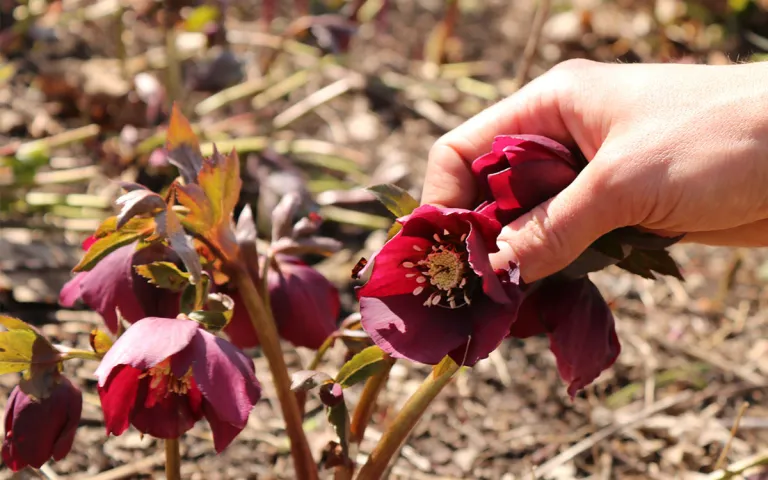
The ecological horticulture plants early blooming flowers like hellebores to color the spring. | Photo by Molly Herring
“Randall’s is a really good representation of the diversity of plants, birds, and insects of New York City,” said Barbara Davaros, Randall’s Island horticulture manager.
Plant care on Randall’s Island is divided: The natural areas team tends to the wetlands, the agriculture team maintains the urban farm, and the ecological horticulture team takes care of the woodland and half-dozen meadows and gardens.
While traditional horticulture prioritizes beautifying outdoor spaces, ecological horticulture goes beyond the ornamental, working to weave in functional plants that provide shelter and nutrients to bees, butterflies, birds, and everything living in the soil. “It’s looking at the whole ecosystem rather than just plants as furniture,” said McDowell.
McDowell has spent his whole career outside. He’s worked everywhere from an island in Virginia to a native plant nursery in the Blue Ridge Mountains, where he learned assistive maintenance practices that “scratch the back of the earth,” he said. When he moved to New York City to work on Randall’s Island, he recognized many native plants from southern Appalachia and greeted them like old friends.
He considers humans to be a custodial species, referencing Tyson Yunkaporta’s idea that our primary role is to look after beings on the earth, in the sky, and in between. “We have the ability to see, observe, listen, judge, and then act based on all of those things,” said McDowell. “If we actually took that seriously, it would change a lot of people's perspectives about what they do in their day-to-day lives.”
In the spring, Randall’s ecological horticulturists come out of hibernation. Seven seasonal workers join the year-round four, and the full team cuts back the winter growth that provides cold-weather shelter for bugs in the meadows. When the sun can reach the ground again, the spring blooms wake up. “Meadows need disturbance, especially on the East Coast, where there’s enough water and nature to turn them into forest,” said McDowell. “No fire can run through here. There aren't going to be landslides. So, we act as that disturbance. We remove the debris so everything can grow.”
Volunteers also arrive on the island in the spring to help manage invasive species, plant seedlings, collect trash, and weed right up until winter. Alongside them are students learning about ecology and recreators, including some of the employees. Davaros happily returns to her workplace on the weekend when friends visit the city from out of town. "Bring a sandwich and a blanket. Sit and hang out. You have a beautiful view of the water," she said.
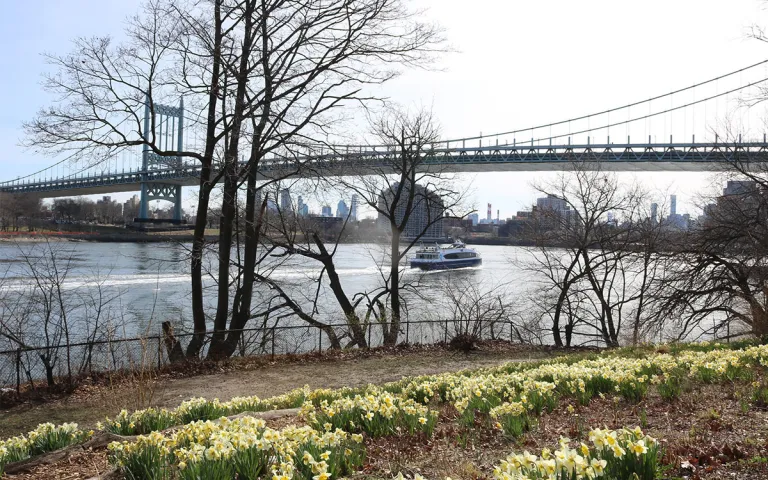
A ferry crosses under the Triborough (JFK) Bridge along the Harlem River. | Photo by Molly Herring
From the spring through the fall, the team dead-heads flowers, removing the spent seed pods to encourage another round of blooms. The bird and bug species will be out to play then, and the gardens in full glory. “It’s weeding every day, nonstop, all the time,” said Davaros.
Later in the spring, the team will start running pollinator surveys to figure out which bugs, birds, and butterflies are visiting Randall’s and what they might need. The species roll-call helps them understand what plants are growing on the island, and vice versa. Randall’s is an oasis for migrating bird species to rest and build strength for their journey along the East Coast’s Atlantic Flyway, a main migration route with fewer fueling stations in the uber-urban Northeast—a problem exacerbated by the fragmentation of natural areas.
During the fall and winter, the team shifts to planning and prepping, tending to the young sprouts in their greenhouse, a heated trailer in the center of the island. They map out bulbs and buds and dream up bigger projects. While McDowell learned a lot about plant care in school and in the field, every season brings new growth, which fuels fresh questions. “You learn the basics of nutrient movement through a plant, but you wonder why one plant's roots are yellow or why Ailanthus smells like peanut butter,” said McDowell. “The more you learn how to see, the more you see how much you don't know.”
Davaros grew up in nearby Queens but didn't realize the extent of New York City's wildlife diversity until she started working on Randall's. The first time she saw a hummingbird on the island was also the first time she saw a hummingbird in New York City.
"I was like, 'Oh my gosh, these really do exist here,' " said Davaros. "Now I'm gardening plants at my parents' to attract the hummingbirds, so I can bring them to Queens too. They're not far!"
In cities like New York, it’s easy to get lost between high-rises and concrete cracks, but every borough offers pockets of green space to help residents get grounded. The sense of separation from nature and native species is common among urban humans, but that dichotomy is totally fabricated, argues McDowell. We are just as much a part of the ecosystem as the red-tailed hawks that McDowell spots flying overhead almost every other day.
No matter where you live, planting native, pollinator-friendly plant species in your own backyard helps reconnect our fragmented natural ecosystems. If you’re tight on outdoor space, consider volunteering for other earth-forward organizations in your area. If all else seems out of reach, go on a slow walk and listen for a mockingbird. They live all over North America, and typically call in threes.