 The Magazine of The Sierra Club
This Is How Climate Change Transformed a Maryland Neighborhood
Extreme conditions are impacting Takoma Park's trees
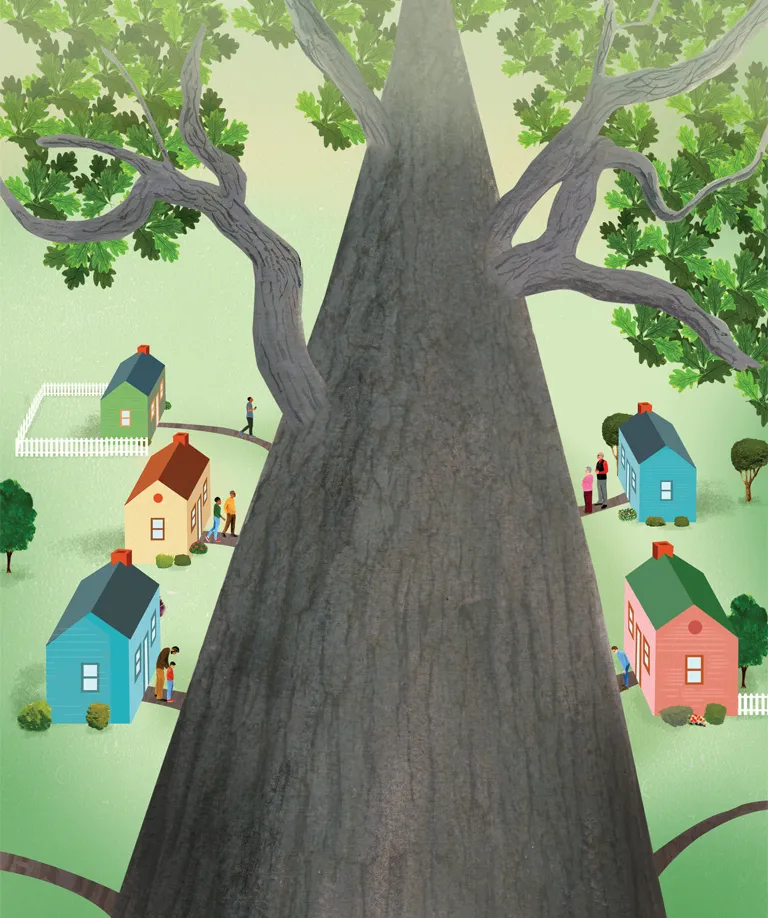
The biggest trees weren’t sick and dying when I moved to the 7100 block of Willow Avenue in Takoma Park, Maryland. There were true giants on my street back then, red and white oaks, tall and broad, offering a daydream greenery of good health. I was in good health too. I was 29 years old. I ran three miles a day. I grew native wildflowers in my garden just a few hundred feet from the Washington, DC, border.
But that was 1991, before the chaos of climate change really settled in over this narrow block of 14 houses.
Thirty years ago, scientists and journalists had to travel to the Arctic or to Australia’s Great Barrier Reef to see the early impacts of global warming up close. Now—after oil, coal, and gas combustion dumped 900 more gigatons of carbon dioxide into the atmosphere—the impacts can be witnessed everywhere. My neighborhood, a microdot on any Google map, has shifted to a whole new universe. Maybe you have seen this shift where you live too.
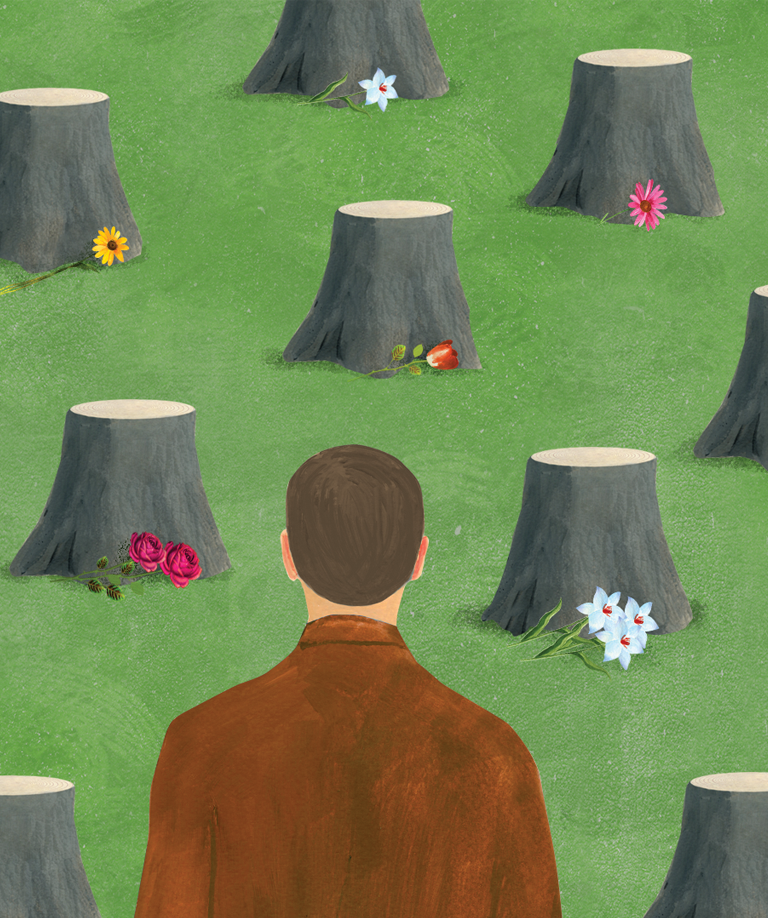
Those old oaks formed a durable ceiling of branches here in the 1990s and into the 2000s. Then came the years of heat, the weird rain, the beetles, and, in 2019, a sudden calamity. Today, tens of thousands of mature trees across Takoma Park and adjoining cities and counties survive as mute tombstones, chainsawed stumps in a region-wide graveyard of lost giants.
There were no deer three decades ago on my block; now they roam everywhere, spreading Lyme disease from ticks that survive our milder winters. At one point in my own 15-year battle with Lyme, I couldn’t read or write or understand someone speaking directly to me.
Neighbors show photos of the old winters, with bundled-up children atop sleds in the deep snow of lower Willow Avenue’s steep hill. And past summers? Old newspapers show fewer overheated people and faces, it seems, at the Fourth of July parade. Now umbrellas are a growing parade accessory as the natural parasols of trees disappear. And my church, a block from my house, never experienced urgent water problems until the altered weather patterns of the past few years. Now there’s an elevated flood berm on one side of the church—price tag $45,000—to keep water out of the basement preschool. The disappearing trees make the flooding even worse, with fewer roots absorbing and holding water.
There are still big trees on my block today—elder oaks, shrinking in number, nobly hanging on despite it all. But if they could, if those trees had legs, they would run away from this place, I think. They would head north, maybe 300 miles, to Western New York or southern Canada, to a latitude where the temperature is closer to what they were born into as acorns generations ago in my Maryland town. But that’s just temperature. They’d still be vulnerable to the more frequent storms, stronger winds, and altered insect patterns that are stressing out and killing trees. Even with legs, the old oaks on my block could not run away.
I did not become a climate activist years ago to save trees. I did it, first and foremost, to save the future of my son, Sasha, now 28. But the oaks on my street are a fair measurement of our collective progress on global warming. Mature oak trees, in urban forests and wilderness settings, are a keystone species, indicating ecological health. Beyond their bounty of acorns, oak trees sustain more life-forms than any other tree genus in North America. The loss of even one big oak can radically disrupt the ecosystem of an entire street. On my block, we’ve lost four towering oaks since 2019—and others will pass away soon.
Are we too late?
"Many of our native trees just aren’t native anymore,” said veteran tree expert Chris Larkin. “Our climate has changed. The trees are foreigners now. That’s why so many are dying.”
Larkin has worked in the DC region for Bartlett Tree Experts since the 1980s. He knows the trees of Takoma Park better than anyone. Every two weeks, he goes to a chiropractor to adjust his neck—strained from constantly looking up, scanning the canopies.
Larkin is in high demand in this town of 18,000 people—an old trolley suburb of DC that calls itself “Tree City USA.” So obsessed has this town been with planting and caring for trees during its century-plus history that a big share of its streets are named after them: Maple, Holly, Tulip, Cedar, Birch, Willow.
But oaks dominate here, highly valued for their ecosystem services and more. The emotional and physical benefits humans gain from being near trees are well documented. A person’s blood pressure typically drops while “forest bathing.” Just seeing a tree through a window can help patients recover faster from sickness.
“When a tree dies in a national forest, it’s one among thousands. When it dies in a backyard, it’s a friend.”
Also well documented is how much trees like to be around trees. Using radioactive isotopes pumped into the roots of trees, researchers have discovered that they talk to one another underground, learn from one another, store knowledge, and live as families whenever they can, children next to parents. Mothers “nurse” their young with supplemental food passed root to root. All the while, above ground, trees are talking too, using scent and color to warn of attacking insects or unfolding drought.
And trees almost certainly feel pain. During extreme droughts, the trunks can begin to vibrate softly in the plants’ version of vocal cords. Sonic tests have confirmed these vibrations inside distressed trees—what some believe are the arboreal equivalent of screams.
All of which makes the recent mass mortality of trees in Takoma Park even harder to bear.
It began, according to regional tree experts, with rainfall. Lots of it.
In 2018, in one of the stranger weather events of this overheating century, the jet stream dipped all the way south to the Gulf of Mexico, pulling tons of moisture up from the Gulf and hurling it toward the mid-Atlantic. Combined with other rainfall phenomena that year, nine mid-Atlantic states set annual rainfall records. Maryland got almost two more feet of rain than normal.
That rain did more than flood basements. It triggered a series of surreal and cascading events that ended with dead trees. First came an organism below the ground called Phytophthora. It’s a water mold of the class Oomycetes, always waiting for the right conditions to expand. In the summer and fall of 2018, nourished by the soaking deluge, it exploded in the soil and began feeding on the hairlike root tips of oak trees. Phytophthora means “plant destroyer” in Greek.
Countless trees in the mid-Atlantic woke up in spring 2019 to severely damaged root systems. To survive, to create the leaves needed for photosynthesis, they had to tap the large reserves of carbohydrates stored in their trunks. This process is extremely stressful for trees and creates the chemical ethanol as a byproduct. It permeates the air around the tree. And that’s when killer ambrosia beetles smell it like hound dogs. They attack the weakened trees in swarms.
The first tree to die on my block in summer 2019 was a 100-year-old white oak (Quercus alba) in Michele Kurtz and Scott Greenberger’s backyard. They had raised their kids, Sidney and Eli, under its protective canopy; it was so large, they were able to skip air-conditioning many days in the summer. And when the tree died, an arborist estimated that several hundred life-forms had inhabited its massive crown—from ravens and rat snakes to cicadas and tiny aphids, plus a patchwork of moss and lichen.
Long ago, white oaks were so abundant and healthy in this region that they were declared the official state tree of Maryland. Now they are falling like dominoes across Takoma Park. The city arborist and various plant scientists across the region agree: Extreme weather has been the trigger.
Official records show we lost nearly 1,200 trees in Takoma Park during the period from mid-2019 to mid-2021, the biggest share being oaks. That’s a lot for a small town. But in terms of canopy cover, it was much, much worse, given so many of these trees were spatial giants. Tree-removal permits granted by the city more than tripled during this period. A 2022 report showed that the city had lost 45 acres of canopy cover in roughly a decade, with weather a clear contributor.
The biggest blow on my block came when our oldest tree, a 150-year-old southern red oak (Quercus falcata), died on Dave and Lisa Miller’s property. One-third of its canopy had failed to leaf out in spring 2019, and the decline continued until the tree was finally cut down in April 2021. It probably weighed 20 tons when it died. It had outlived Teddy Roosevelt, World War I, the Great Depression, the 1960s, the Reagan administration, September 11, the dawn of smartphones.
The Millers didn’t want their 10-year-old son, Wesley, to see the tree come down. They sent him off to school as our street was shut down and a five-story crane was brought in and power lines were removed so that the massive limbs and trunk could be hauled away.
Four years later, the Millers are still grieving. Lisa grew up in a family of fishermen and hunters. She reveres the natural world. Dave too. Every day, the Millers wake up and their towering tree is not there. Every day, they don’t see its branches and its shade outside their kitchen window. Every day, they have proof that something has shifted on our block, that a threshold has been crossed in our city, and that the planet just doesn’t seem able to support big trees anymore. Those trees are now dying in sustained waves, reshaping landscapes, and not just here: The giant cedars of Lebanon are burning. The fabled stone pines of Rome are succumbing to invading insects. The bristlecone pines of Utah are dying of thirst.
Larkin, the expert on Takoma Park’s trees, told me, “When a tree dies in a national forest, it’s one among thousands. When it dies in a backyard, it’s a friend.”
Could we hear them while they were dying? Could we hear, at a subconscious level, the “screaming” vibrations of trunks over the years during increasingly strange stretches of drought? Could we hear the pain, too, as the big oaks died from the effects of extreme rain? We are grieving not just for the trees but for what they obviously represent: the passing of our entire planet. And does this cascading cacophony also affect us, weakening our immune systems, making us more vulnerable?
If studies show that just being under big trees makes us happier and improves our immune systems, what happens when those trees are gone?
My neighborhood, despite it all, fights on.
Dorothy Lee lives across the street from me. She’s a midwife and has delivered 800 babies in her career, mostly in the homes of mothers. Years ago, Dorothy and her husband, David, installed a geothermal energy system in their backyard to help heat and cool their home and do their part for the climate.
But they still worry. More every year.
“When I deliver a baby,” Dorothy told me, “it feels good. But then I come home and, you know, I see this tree is gone and that tree is gone. Some nights, I wake up thinking about my own kids and climate change and that’s it. I don’t sleep anymore that night.”
At least one global climate model shows we’ve already hit 1.5°C of planetary warming. It’s a level most scientists say we cannot permanently pass without disaster. No wonder the impacts are obvious now even at the street level.
When yet another big tree died on our block, in June 2023—an 80-year-old willow oak along Dorothy’s curb—she and I gathered for a moment of silence after it was cut down. Per a tradition I learned in Africa, we poured strong spirits—I brought some vodka—onto the ground, honoring all four realms of the afterworld: north, south, east, west.
Then, in an act of defiance and impulsive optimism, we planted a vegetable garden right there where the tree had been. For a decade, we figured, before the city’s replacement sapling gained dominance, we’d be able to harvest okra and squash and tomatoes in this suddenly sunny curbside spot.
It’s amazing how, in my neighborhood, when big trees come down, gardens go up. And solar panels happen. You’d be quite prosperous if you got a dollar each time a big tree disappeared here and solar panels went onto the pitched roof of a nearby household or the flat top of a commercial building. We’re adapting.
We’re proud, too, of local gas station owner Depeswar Doley. In 2019, he became the first station owner in the United States to switch from pumping gas to charging electric cars exclusively. His teen daughter, Teresa, named after Mother Teresa, was a driving force behind the move. The site still looks like a gas station, only with nine-foot-tall electrical charging “pumps” and handheld dispenser plugs under the service station canopy. The canopy itself is covered with solar panels.
Still, the transition to renewables here and nationwide is not enough. Clean energy alone can no longer arrest the trend of Arctic ice melting or the demise of urban trees. To do that, according to the United Nations Intergovernmental Panel on Climate Change (IPCC), we need to reach “negative emissions,” by removing carbon from the air and storing it in the ground with the help of crushed basalt rocks or by using giant carbon-filtering machines or through various agricultural practices.
My neighbor Ning Zeng, a climate scientist at the University of Maryland, has another idea. He wants to achieve negative emissions by burying billions of the world’s dying trees, including those on my street, in low-oxygen clay soil. This will slow their decay for a thousand years or more. “Reverse coal,” he calls it.
Zeng lives in Silver Spring, near the border with Takoma Park, a 25-minute walk from my house. In 2019, he lost a massive backyard white oak to the triple punch of rain, Phytophthora, and beetles. When the tree was cut down and hauled away, Zeng knew it would be sawed up further, be turned into landscaping mulch, or wind up in a landfill. Which meant most of the tree’s biomass would eventually break down and be converted to CO2 or methane within a few decades, adding to a warming climate.
As a society, Zeng believes, we should instead lock the carbon of “waste” wood underground. He began theorizing about this in 2006, and in 2013 buried several tons of tree trunks in the appropriate clay soil at a test site near Montreal. Eight years later, his research team dug up some of the trees, finding them virtually unchanged. More telling, the hired backhoe operator veered off course at one point and accidentally uncovered an even older cedar tree. It was so well preserved, it still had bark on it. Testing later revealed it was 3,775 years old.
In February 2023, I invited Zeng to my house to see firsthand the receding canopy on my block and the sad “headstones” of lost trees. Running his hand along the massive stump in the Millers’ backyard, he told me he wished he could have given this tree a “proper burial.”
Zeng then promptly invited me to Camp Small in Baltimore. It’s a surreal, sprawling boneyard for trees dying along that city’s streets and on public land. Environmental policies in Baltimore prevent such trees from going to landfills, so they pile up here with the goal of being repurposed as specialty lumber or playground climbing objects or just chopped into wood chips. But every year, supply outstrips demand, and the dead trees are turning into miniature mountain ranges of stacked wood stretching across this lot the size of two city blocks. Regional mortality records are spotty, but the anecdotal evidence and the perceptions of virtually every tree specialist here is clear: More trees are dying because of climate change—and wood lots like Camp Small are being overwhelmed across the region.
So when Zeng approached Camp Small officials and announced that he wanted to bury as many of the trees as he could, they were thrilled. In November 2023, he was given 100 tons of leafless trunks from the lot.
Of course, the act of planting trees, instead of burying them, is a form of negative emissions too. As they grow, hardwood trees can absorb and store as much as a ton of CO2 by age 40, and many nations worldwide have pledged to plant a combined 1 trillion new trees in coming years. The city of Takoma Park is planting more trees than ever, and in late 2023, two “climate smart” species went into my own yard: a swamp white oak in the front and a bald cypress in the back. Each is highly tolerant of both droughts and deluges.
Still, how long can the majority of the world’s trees last when, as Larkin says, they are becoming foreigners on a planet with constantly changing conditions. And when the trees die, the stored carbon in those trunks will return to the atmosphere.
Zeng estimates that if trees dying in urban forests or felled by hurricanes or mortally damaged by wildfires worldwide were buried, they could sequester 1 to 2 billion tons of carbon annually by 2060—up to a fifth of the negative emissions the IPCC says will be needed each year by that time.
He offered to let me witness the pioneering burial of the Camp Small trees in a prepared farmland plot outside Baltimore. The plot would contribute to further research and offer possible commercial value as a carbon offset. When Zeng said there would be a ceremony, I gathered seven fallen acorns from an old pin oak in my backyard.
At 11:30 a.m. on November 13, 2023, after the first 50 trunks had been mechanically lowered into a clay trench 14 feet deep, Zeng and I gathered with other guests at the edge of the gravesite. To honor the global scope of Zeng’s revolutionary idea, I dropped the acorns into the grave, one for each continent.
Each September, when the summer thunderstorms slow down and autumn has not yet fully arrived, a magical wind comes to my small block on Willow Avenue. It’s a steady wind, blowing all day, sometimes for two or three days, swishing through the trees. It makes the leaves speak.
So comforting is this wind, you can almost imagine you’re somewhere else, that the ocean is at the end of the block, its breeze flowing across the surf and into the trees. But it’s just the changing seasons. My former neighbor Jack calls it “September kite weather,” the early autumn companion of March weather, with leaves still on the trees to applaud another year.
For 30-plus years I’ve looked forward to these vivid, bright, windy days in mid-September. When I first moved here, the sound was different though. It was louder. The big trees were more numerous, the leaves everywhere, creating a pleasant roar. You had to politely yell to neighbors on the street, yell across backyard fences, raise your voice on sidewalks.
These days, if anything, the September wind is stronger. But with fewer big trees and fewer leaf collisions overhead, the sound has a softer quality. New pockets of sound have emerged. Deeper tones. Over gaps in the tree canopy, the wind passes like human breath over the tops of empty bottles.
Sixty years ago, writer Rachel Carson warned that human damage to the environment was changing the very sound of our seasons. Carson observed that fewer songbirds were arriving each spring across American farms and cities, killed off by DDT, which was later banned. Her book Silent Spring helped launch the modern American environmental movement.
In Takoma Park, autumn is not yet silent. There are still a lot of trees here. A visitor who doesn’t know our recent history will be impressed by our canopy. On my block, a scattering of old oaks inhabit the backyards to the east, and an impressive string of eight willow oaks (ages 40 to 80) line one sidewalk. But residents like me can walk you past all the stumps—or the sunken ground where stumps once were—strewn across our block and on streets citywide. My friend Daryl Braithwaite has lost five large trees in her yard on Hickory Avenue in recent years, including to swarming beetles in 2019. Walk our streets and you will see the gaps. You will see why September has a different sound today.
Braithwaite, ironically, oversees all things trees in Takoma Park as director of the city’s Public Works Department. She is significantly expanding tree-planting efforts in the wake of recent losses. Pained residents want their trees back. Death is spurring demand for new life.
Meanwhile, two trends may be helping our city’s canopy recover. More people are planting swamp oaks and bald cypresses and other species tolerant of wild weather swings. And data suggests that trees are growing faster now. The increased CO2 in the air—from centuries of fossil fuel combustion—acts as a fertilizer for most of the world’s trees and other plants. It speeds up photosynthesis. One study found that certain tree species in the Chesapeake Bay region are growing as much as two to four times faster now than in the 1980s.
But again, it’s unclear how big these trees will ever get or how long the mature trees we have will continue to live.
I root for the day when our trees can finally slow down again and traditional native species like white oaks and southern red oaks can grow old once more in my neighborhood. That will mean we did it. We stabilized the climate. We completed the clean energy revolution in time—with help from tree burials and other negative-emissions techniques.
And then when my son and his future kids visit Takoma Park, they will have to speak loudly outside to be heard on those special days in September. The trees and the people and the climate will be native again.
This story was adapted from The Lost Trees of Willow Avenue: A Story of Climate and Hope on One American Street, by Mike Tidwell (St. Martin’s Press, 2025).