Why Trees Often Signify Wealth
Federal funding cuts threaten to widen the gap in who gets to plant trees
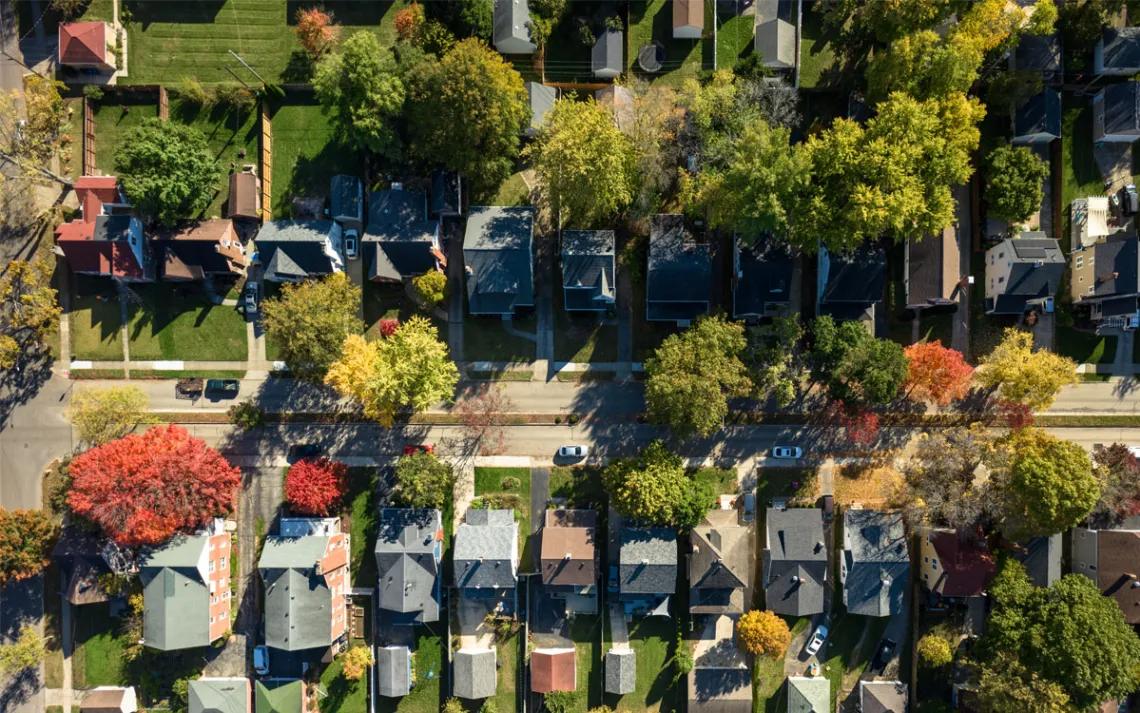
Photo courtesy of halbergman/iStock
This summer, people living in cities across the northeastern United States experienced record-high temperatures as a heat wave swept across the area. Cities including Washington, DC, and Boston recorded all-time highs in June, reaching more than 100°F in some places, according to the National Weather Service. To help urban communities cope with soaring summer temperatures, the US Forest Service and nonprofits like the Arbor Day Foundation have planted trees in cities for decades.
Trees help cool urban areas by shading impervious surfaces like pavement and asphalt that heat up when they absorb the sun’s energy. Trees also chill air temperatures when water evaporates from their leaves—a process that uses heat energy drawn from the surrounding air. But new research shows that urban forests are not planted equitably—more affluent neighborhoods with a majority-white population have gained most of the trees and reap most of the health benefits.
Meanwhile, efforts to shrink this inequity are now under threat as the Trump administration has cut $75 million in funding for a nationwide tree-planting initiative run by the Arbor Day Foundation.
The path of least resistance leads to inequity in urban forests
Researchers from the University of California, Davis, studied changes in tree cover over a 20-year period beginning in 2000. Overall, they saw that tree cover grew as city planners, decision-makers, and communities realized the benefits that trees provide to urban communities. But the researchers found that the growth was mostly centered in affluent, majority-white neighborhoods.
From the start, trees were more abundant in well-off communities. But the disparity between neighborhoods of color and those that are mostly white grew 5.4-fold as tree cover rose over the study period, the researchers found.
“It's alarming and it's disheartening to hear that we're actually going backward,” said Dan Lambe, the chief executive of the Arbor Day Foundation, referring to the growing gap between communities. (Lambe was not involved in the study.)
Looking across neighborhoods, the researchers found that for every $50,000 difference in average household income, tree cover grew by 1.3 percent. And on average, neighborhoods with 25 percent more white people had 0.6 percent more tree cover.
Income has a stronger effect on where trees are planted. But the effect that race has on communities’ access to trees is growing more quickly, said Cody Pham, a lead author of the study and PhD student at UC Davis.
Pham said he doesn’t think that tree-planting programs are deliberately inequitable. The differences are more likely because it’s easier to plant trees in areas that have better resources and more space, which are more often affluent and majority-white neighborhoods.
“The inequity we're seeing persists largely because we've been taking the path of least resistance in our efforts to green our cities,” said Pham.
Pham presented the results at the Ecological Society of America conference in August. The research is expected to be published in a peer-reviewed journal in the coming months.
Trees boost health and well-being
Pham’s research also showed that the preferential spread of tree cover led to worse welfare outcomes in marginalized, tree-poor communities.
Since 2000, summertime land surface temperatures fell on average in neighborhoods with the most tree cover, the research found. In contrast, temperatures increased 1.5-fold in communities with low amounts of tree cover.
Heat is the leading weather-related cause of death in the United States, according to the National Oceanic and Atmospheric Administration. The number of heat-related deaths in the US has more than doubled in the past 25 or so years, increasing from roughly 1,100 in 1999 to more than 2,300 in 2023, research finds. At high temperatures, people can suffer from exposure and dehydration. Also, pre-existing conditions, such as renal and cardiovascular disease, become worse, said Robert McDonald, a lead scientist for nature-based solutions at The Nature Conservancy.
Green spaces are also linked to better mental health, studies show. Pham and his team’s research found that a 50 percent increase in tree cover was associated with a 1 percent decrease in frequent mental distress reported by individuals.
Previous studies have shown that in many US cities, lower-income and minority populations live in neighborhoods with fewer trees, higher summer surface temperatures, and worse health outcomes.
But Pham’s research is the first nationwide study to examine changes in tree cover over time and how that differs between neighborhoods with different socioeconomic statuses.
He said the “substantial” increase disparity that his research found “is something that we as a society need to acknowledge and then rectify.”
Fewer trees, fewer benefits
Urban forests mostly provide neighborhoods with benefits, but there are some downsides to trees, which can turn communities off, said McDonald, who has analyzed the distribution of urban forests in some US cities. Some communities are concerned that trees will fall and damage houses or power lines. Others are concerned about the financial costs of caring for trees. Communities also worry that natural spaces can become hotspots for crime. He said that allergies to tree pollen are also a concern.
Communities must be on board with tree-planting initiatives to ensure the trees flourish, said Lambe. Building relationships with local communities enables organizations to hear which trees residents want and are more likely to care for. For example, some residents want trees for shade, but others prefer fruit trees that they can harvest or to provide habitat for wildlife, said Lambe.
Omar Leon, an arborist in Cape Coral, Florida, said his team uses several tools to help determine where planting new trees will have the biggest impact and help reverse trends in inequity. These tools include the Environmental Protection Agency’s environmental-justice screening software that maps green and demographic indicators, software that maps urban canopy using satellite imagery, and a tree-equity scoring system developed by the nonprofit American Forests.
Cape Coral has an annual budget of around $2.6 million for planting and maintaining trees and other green spaces, said Leon. It wants to reach around 600,000 trees to catch up with the tree cover of its neighboring cities. To help achieve this goal, they received a grant to plant 11,000 trees through the Arbor Day Foundation that was financed with cash from the 2022 Inflation Reduction Act.
But the city’s efforts, along with those of many other tree-planting organizations, were hindered when the Trump administration canceled the $75 million in funding that the Arbor Day Foundation distributes.
“It is stopping a lot of these communities in their tracks,” Lambe said.
The foundation has made up some of the shortfall from donations from private companies and other donors, but many projects that were meant to bring shade to schools and streets, for example, are left unfinished, he said.
“Unfortunately, what it’s going to mean for communities is less shade, less trees, less canopy, less benefits,” he said.
The foundation is appealing the grant termination, said Lambe. Tree planting in Cape Coral slowed down when it lost its grant, but the city cobbled together funds from other sources to see the project through, said Leon.
The benefits of tree planting don’t just boost the environment and public health. They translate into huge economic gains too, said Leon. The city’s existing canopy cover is worth around $54.5 million from services such as filtering air pollution, capturing carbon, and managing 310,000 gallons of stormwater.
Leon’s summation? “The benefit is pretty astonishing.”